Rabbi Refael Aharon ben Shimon (1847-1928)


 Rabbi Refael Aharon ben Shimon was born in Rabat, Morocco in 1847. In 1854 he came to Israel with his father, Rabbi David ben Shimon, who was also his main teacher. The family established themselves in Jerusalem.  Besides his Rabbinical studies, especially in the field of  Jewish law, Rabbi ben Shimon learned European languages. He was fluent in Italian, French and Spanish.   In 1890 he visited Morocco and once there, he searched writings that were unpublished and he recommended the establishment of a institution mekiṣe nirdamim to publish old books and manuscripts of Moroccan Rabbis which were not accessible to the general people.  On his way back from Morocco he was invited to visit the important Jewish community of Egypt. Once there, he was offered to serve as the Chief rabbi of Cairo, instead of the previous rabbi Yom-Tob Israel, who retired from the rabbinate.   He served the Egyptian jewish community from 1891 until 1921.
Rabbi Ben Shimon had to face new challenges. The modern world brought about many innovations in technology and social values which needed to be reassessed from an Halakhic perspective.  In the introduction of his most famous book, umiṣur debash, he mentions a few subjects that he had analyzed in research-like responsas. Among them: the use of electricity and matches on Yom Tob. The use of chariots driven by gentiles for the sake of burying a death during Yom Tob. The assessment of the Cairo water supply system in order to be considered as mayim lo she-ubim (non-transported waters), and therefore be suitable for a Mikve. The status of the children of mixed marriages, converts, etc. And the status of a wedding which took place in a private ceremony.
Let me refer briefly to this last issue.  Rabbi ben Simon witnessed a new trend. Men coming from Europe would marry a Jewish girl in a private ceremony and then, after a few years of staying in Egypt, these gentlemen would come back to Europe abandoning their wives. These poor women would be considered now‘agunot, i.e, not formally divorced from their husbands and therefore unable to marry again. Together with rabbi Elyahu Ḥazan from  Alexandria and Rabbi Mendel haCohen, the rabbi of the Ashkenazi community of Cairo (sic.) they forbade the celebration of secret marriage ceremonies, annulling those weddings retroactively (hafqa’at qiddushin) and thus, releasing these women from their status of ‘aguna.
(To be continued…)


Rabbi Hayim Palachi (1788-1869)

Rabbi Ḥayim Palachi (also Palaggi or Palacci) was born in Smyrna, Turkey in 1788.  He was the grandson of Rabbi Yosef Ḥazan, the author of Ḥiqre Leb, and the disciple of Joseph Gatenio, author of Bet Yiṣḥaq.
In 1847 he became the ab bet din of Smyrna and of another six neighboring communities. In 1855 he was appointed Ḥakham Bashi of Izmir by the Ottoman authorities .
During his Rabbinate period he gave importance to social welfare; and as an important mission he thought of founding a Jewish hospital. He requested assistance from the wealthy Jews in town. With the help of respected Senior Leon Adut they contacted Baron Rothschild in Vienna and received the necessary support. He was also able to receive the support from Sir Moses Montefiore. The Jewish hospital was established. At the time, the population of Izmir was 220,000, with the Jewish population consisting of about 16,000 souls.
Rabbi Palachi’s set a goal to maintain mandatory education to all Jewish children. He adopted a community law which required every Jewish father to give Talmud Tora education to his children. Children would continue their education until they were able to read and write properly, and could grasp the fundamentals of Tefila. Only the instructor was allowed to decide when the students had achieved the required educational goals. Rabbi Palachi made sure that all the poor children also received education.
Rabbi Ḥayim Palachi was very sensitive to events that affected Jews outside Izmir as well. During the blood libel in Damascus in 1840, he called for the support of his Egyptian Jewish friend Don Abraham Kamando, Baron de Rothschild and Sir Moses Montefiore. Through their intercession, the innocent Jewish victims in Damascus were exonerated.
(Adapted from Rabbi Naftali Haleva, present day Rabbi in Istanbul, Turkey)
This is a picture of the Izmir community in 1896. In the center, one can see rabbi Abraham Palachi (rabbi Ḥayim Palachi’s son)
Rabbi Ḥayim Palachi was an extraordinarily  prolific writer. He  authored more than 70 works, most of them have been published. Many of his manuscripts were burned and a great number were not published. Most of his books contain in their titles his name, “Ḥayim”  or “Ḥay”
*Darke Ḥayim  on Pirqe Abot.
*Leb Ḥayim a, responsa, interpretations, and comments on the Shulḥan ‘arukh.
*Nishmat Kol Ḥai , rabbinical responsa.
*Ḥiqeqe Leb , homilies and eulogies.
Other books: Nefesh ḤayimTora ve-ḤayimKaf ha-ḤayimMo’ed le-Khol ḤaiḤayim ve-ShalomSefer ḤayimGinze Ḥayim, etc. 


Rabbi Hayim Nahum (1872-1960)

Rabbi Ḥayim Naum was born in 1872 in Izmir, Turkey. He was an extraordinarily intelligent person with an exceptionally diverse education. He received his formal Jewish education in Tiberias and his secondary education at a French Lycee. He held a degree in Islamic Law from Constantinople. He attended the Sorbonne’s School of Oriental Languages in France while at the same time attending the Rabbinical Academy of Paris. He then returned to Constantinople and taught at the Turkish Military Academy.
Rabbi Naum’s unusual background and eclectic interests earned him great respect. From 1909 until 1923, he served as akham Bashi (Chief Rabbi) of the Ottoman Empire and was granted the title of “Effendi” (Lord) by the Turkish government. Rabbi Naum successfully intervened in favor of Jews in various localities of the Empire, especially in assuring government protection for them during World War I (it seems that it was due to him that the project of expelling the Jews from Jerusalem was averted).
In 1923, Rabbi Naum agreed to become the head of the Jewish community in Cairo, and thus the Chief Rabbi of Egypt. Here, too, Rabbi Naum became a man of noted success within the greater gentile society. From 1930 to 1934 he was a member of the Egyptian Parliament. He helped found the Royal Academy of the Arabic Language, and was instrumental in making possible the reconvening the Society for the Historical Study of the Jews of Egypt.
With the rise in Arab nationalism in the late 1940s, life for Egyptian Jews became increasingly difficult. There was an abundance of political intimidation and economic oppression. Although he gave into government pressure to denounce Zionism (using vague, meaningless phrases), he held firm in his refusal to have synagogues recite prayers for an Egyptian victory in the 1948 war. Ignoring his own failing health (and blindness), Rabbi Naum spent his final years in service to the greatly diminished Egyptian Jewish community. He was 88 years old when he died.


Rabbi Yishaq ben Walid (1777-1870)


“The western luminary” (Ner haMa’arabi). That was the title given by Morrocan rabbis to one of its most illustrious: Rabbi Yiṣḥaq ben Walid (or Bengualid) from the city of Tetuán, in the north (Spanish) of Morocco. 

Rabbi ben Walid belonged to a family of Rabbis, who left Spain after the expulsion in 1492. Since childhood, and despite the loss of his father at a very early age, he dedicated himself completely to study Tora.  After the death of his father, the financial situation of the family was so desperate that the mother had to sell her husband’s books, a set of the Talmud, to maintain themselves.  Rabbi ben Walid worked for years saving penny after penny to buy back what he considered to be his most important patrimony: The Talmud.
He was known for his brilliant mind, his piety and above anything else for his humbleness.  In 1830, after the head of the Rabbinical court, rabbi Moshe haLevy,  passed away, and knowing that the community leaders will consider him as a candidate, rabbi Ben Walid  fled to Gibraltar and hid for a while, running away from honors, as Pirque Abot indicates.  Only at the insistence of the community leaders who presented him a petition with the signatures of sixty of the most prominent rabbis of the time, Rabbi ben Walid accepted the new position. His condition, however, was that he will make his Halakhic decisions always with at least two other rabbis, and never by himself.
He had a special inclination for ḥesed and charity. He would provide food to the needy, especially before Shabbat and Holidays. One time he gathered the leaders of the community and told them: “My family is starving. I need a raise.” And he proposed to create a tax on kosher meat, the “gabela” (Spanish for community tax) , to generate the extra money. After the community leaders accepted the rabbi’s request he explained that the “starving family” he was referring to, were the needy people of the city, his brothers and sisters. And for many years all the money from the gabela was given to the most needy of the city.
√ Rabbi Ben Walid  refused to publish his book in order to avoid a financial burden on the impoverished Jewish community of Tetuán.  In 1855, his oldest son Shemtob, published his book vayomer Yiṣḥaq in the city of Livorno, Italy.  This book is a collection of rabbinical responsa which includes the Minhaguim and traditions of Spanish Moroccan Jews.  We present  HERE one of the first edtitions of vayomer Yiṣḥaq  from www.hebrewbooks.org


√ Those who read Hebrew and are interested in knowing more about the life of rabbi ben Walid should read the introductions/dedications written by his two sons, Shemtob Ben Walid and Vidal ben Walid, at the beginning of the book.  
  
√ Click here to see the unmarked grave of rabbi  ben Walid in the Jewish cemetery of Tetuán.


Rabbi Shemtob Gaguin (1884-1953)

Rabbi Shemtob Gaguin(e) was born in Jerusalem in 1884.  Rabbi Gaguin was a British Sephardic Rabbi and a descendent of a famous Moroccan Rabbinical dynasty which emigrated to Israel from Spain at the time of the Inquisition. He was the great-grandson of R. Hayim Gaguin, the first Chief rabbi (Chakham Bashi) of the Israel during the Ottoman Empire.
He studied at the “Doresh Zion” school in Jerusalem and was a pupil of the celebrated Rabbi Jacob Alfiye. At an early age, he contributed articles to the Palestinian Hebrew Press (“HaChabbazelet”) on aspects of Jewish traditional observances, as well as on biblical and philological matters. He was awarded rabbinical diplomas by numerous authorities, including Rabbi Chayim Berlin (the son of the Natzi”b) and Chief Rabbis of Israel Ya’aqob Meir and Abraham Kook
In 1920 he accepted a position of Rabbi of the Sephardic community of Manchester and at the same time he was a Dayan (Rabbinical Judge) in the Manchester Rabbinical court (Bet Din).
From 1921 he was the head of the Sephardic communities of London. Rabbi Gaguin died in Manchester, 1953.

Rabbi Shemtob Gaguin

Among his works we find:
√ A study on origin and history of the Jews of Cochin (India)
√ Shulchan Arukh, a critical study of the Jewish Codex based on several old editions and unpublished manuscripts.
√ Commentaries on Midrash Rabba and Midrash Tanchuma
His most famous book is  Keter Shem Tob, an encyclopedic treatise which examines and compares the Tefilot and traditions of the Eastern (Turkey, Israel, Egypt Syria) and the Western (Amsterdam, London, NY ) Sephardim, paying particular attention to the customs of Spanish and Portuguese Jews. The first two volumes were published in 1934. The final work comprised a total of 7 volumes, the last 3 of which were published posthumously with the help of his son, Rabbi Dr. Maurice Gaguine.
Click HERE to download  Keter Shem Tob


Rabbi Moshe Chefetz (or Hefes) 1663-1711

Rabbi Moshe ben Gershom (1663-1711) known as Rabbi Moshe Chefetz (of Hefes)  was a rabbinic scholar from Italy. Born in Trieste, raised in Venice, he lived as a private tutor teaching Talmud and Midrash. He wrote poetry, and dealt with philosophy, math, and natural sciences.
A member of the prominent Chefetz family (or Gentili, in Italian) of Northern Italy, he was considered a child prodigy and studied under the renowned R. Solomon Nizza. One of his poetic works written at age 13, appeared in the famous Venice edition of the Bible (1675-78).
Among the writings of Rabbi Chefetz we could mention:
  • Chanukkat HaBayit (lit. Dedication of the Temple), a book that details the construction of the Second Temple and all of his vessels and utensils (Venice, 1696). The book includes illustrations and tables by the hand of the author.
  • Melekhet Machasebet (Intentful Work), a superb commentary on the Torah (Venice, 1710) based on traditional interpretations but also upon the principles of secular science. The book includes a portrait of the author.  His portrait  in Melekhet Machashebet (see below) was the first ever published in a Hebrew book (first edition, 1710). The name of the book, Melekhet Machashebet was also a sophisticated way to seal the name of the author, common practice among Sephardic Rabbis of the time: the word machasehbet in Hebrew is the acronym of: Moshe Chefetz shokhen be’ir Trieste, Moshe Chefetz, who lives in the city of Trieste.
At the bottom of the portrait it says: “ben me-a shana… anokhi hayom”, which literally means: “I’m one today hundred years old”. When you see the portrait you notice that rabbi Chefetz was obviously younger. The numerical value of the Hebrew wordme-a (=40, 1, 5)) is 46, i.e., the real age of rabbi Moshe Cheftez in this portrait.
A philosophical study on the five books of the Torah, by Rabbi Moshe Chefetz. Impressive complete copy containing a detailed copper engraving frontispiece, a leaf with the portrait of the author, clean-shaven and ministerial, and a leaf with geometric sketches. Another sketch on leaf 57.
Moses b. Chefetz (1663-1711) was born in Trieste and raised in Venice. Considered to be a child prodigy, he studied under the renowned R. Solomon Nizza, and developed into a fine rabbinic decisor as well as a scholar familiar with the disciplines of mathematics and the sciences. His best-known for this philosophical commentary.
His age at the time of printing is written in a colophon under his portrait, “ben me’ah shana” (literally 100 years old) the gematriya value of me’ah being 46. Many misunderstood that this was a gematriya and thought that he was 100 years old at the time he wrote the book. Unfortnaltelly, rabbi Mishe passed away when he was just 48 years old
In 1550 Alvise Bragadin established a Hebrew press in Venice, thus ending a brief monopoly in Hebrew printing in Venice enjoyed by Guistiani (after the closing of the Bomberg press). This press continued as one of Venice’s leading Hebrew print-shops, issuing Hebrew titles in the 18th C under several generations of Bragadins (the last of whom was Alvise III). Throughout the years, the output of the Bragadini press was considerable, and covered the gamut of Hebrew works. The press was somewhat unusual, however, in that the Bragadins themselves did not always take an active role in their printing-house, leaving its operation to other printers, and lending their name to other presses.
[8], 98 leaves three illustration plates.
Melechet Machshevet, on the Five Books of the Torah, based upon natural sciences and philosophy, by R. Moshe Chefetz. Venice: Bragadin, [1710]. First edition. Complete wide-margined copy on high-quality paper. Includes an engraved frontispiece, a leaf with an engraved portrait of the author, and a leaf with geometric diagrams. Another diagram on leaf 57. The following caption appears beneath the portrait, alluding to the age of the author at the time of the printing: “Moshe Chefetz here in the picture, in 1710, at the age of me’ah” – at the age of 46 (numeric value of me’ah), though some misunderstood it to mean one hundred years of age (see below). R. Moshe Chefetz (1664-1711, Otzar HaRabbanim 14709), Italian rabbi, researcher and philosopher. Born in Trieste, he was raised in Venice, where he later disseminated Torah. He possessed wide ranging knowledge of Torah, G-d and nature, as is portrayed in this book – Melechet Machshevet. He composed this book to find solace for the untimely passing of his son R. Gershom, author of Yad Charuzim. R. Moshe died at the young age of 48 on 30th Cheshvan 1711 (R. Chananel Nepi in his book, printed as part of Toldot Gedolei Yisrael of R. M.Sh. Ghirondi, Trieste 1853, p. 239). Samuel David Luzzatto (Shadal) quotes a tradition transmitted by Italian Torah scholars, which maintains that the sages of his generation, upon hearing of the text of the caption R. Moshe intended to place beneath his portrait in his book, tried to dissuade him from doing so, warning him that it is not something one can make jest of. He did not heed their warning, and passed away within that year (Igrot Shadal, VII, p. 1013).
With numerous illustrations of the Temple’s structure and its vessels and a large folding map of the Temple’s structure. Chacham Moshe Chefetz was born in 1663 in Trieste, Italy. He studied under the sages of Venice, including Chacham Shlomo ben Yeshaya Nitza. Was a Talmid Chacham who was proficient in philosophy and nature as well as music. In 1678, the Bible was printed in Venice. Printed on its first page was a poem by Chacham Moshe Chefetz. The book Machbarot Emanuel by Chacham Emanuel ben Shlomo of Rome, which was hand-copied in the same time in Venice, included a short commentary by Chacham Moshe Chefetz on the poem ‘לשוד ולרש ילעג ישחק’. In (1699) he published his book Chanukat HaBayit – the form of the Temple, in Venice. In (1699) his son, Gershom, passed away during a plague. In that year, Chacham Moshe Chefetz published his son’s book Yad Charuzim which inlcuded a eulogy by his Rav, Chacham Shlomo NItza, for his son, Gershom Chefetz. In (1710) he published in Venice his book Melechet Machshevet – on the Torah, which had many following editions. Chacham Moshe Chefetz passed away in 1711, when he was only 48 years old. The book was printed in two stages. Initially, the text of the book was printed with blank pages left for the illustrations. These were later added by embossing.

el rabino Moshé Jefetz sobre la creación del “segundo día”

En su comprensión de la creación, el rabino Moshé Jefetz ofrece una de las explicaciones más lúcidas y cercanas a lo que hoy denominamos ciclo del agua. Basado en el Midrash, en la Guía de Perplejos de Maimónides y en los Sabios del Talmud, Jefetz afirma que la separación entre “aguas superiores” y “aguas inferiores” no describe una división mística en planos cósmicos, sino la diferenciación entre el agua en estado líquido y el agua en estado gaseoso. Esa separación —dice— es la creación del ciclo natural del agua.

Maimónides ya había señalado que, en el segundo día, Dios estableció las leyes físicas que gobiernan el comportamiento del agua. En Guía de Perplejos 2:30 explica que el rakia fue creado a partir del agua, y que parte de esa agua “se separó, de algún modo, y quedó sobre el aire” (חלקם הובדל בצורה כלשהי מעל האויר). De acuerdo con esto, los “cielos” del segundo día no son los shamaim de Génesis 1:1 —que alude al universo entero— sino el cielo visible, la zona atmosférica donde se forman nubes y vapores.

El rabino Jefetz desarrolla este concepto en su obra Melejet Majashebet (Venecia, 1710; Varsovia, 1914, pp. 10-11). Identifica las “aguas superiores” con vapores y nubes, surgidos por la evaporación del agua terrestre. Siguiendo la etimología talmúdica, señala que la palabra shamaim es la unión de esh (fuego o calor) y maim (agua). Para Jefetz, el cielo es literalmente el producto del calor que actúa sobre el agua.

Explica así el versículo “Que haya un rakia en medio de las aguas” (Gn 1:6). Según su lectura, la orden divina puede parafrasearse como: “Que haya dentro del agua (betoj hamaim) un cuerpo sutil, móvil y expansivo, que ascienda por su liviandad” —es decir, vapor. Este es su texto original:
“…יהי בתוך המים אויר וגוף מתנועע דק ומתפשט”.

Para Jefetz, rakia no significa la expansión del espacio, sino la expansión del agua convertida en vapor. “Así como el agua puesta sobre fuego se transforma fácilmente en vapor —escribe— ese vapor, al encontrar frío, vuelve a convertirse en agua”:
“כאשר יעשו המים על האש בנקל יתהפכו לאויר והאויר ההוא הנהפך אם ימצא קור בנקל ישוב למים כבראשונה”.

De este modo, Jefetz interpreta que en el segundo día fueron puestas en funcionamiento las leyes físicas que permiten que el agua exista simultáneamente como líquido y como gas. La “separación entre las aguas” es, para él, la primera descripción bíblica de la evaporación y la condensación. Allí comienza el ciclo del agua: las aguas inferiores (océanos) liberan vapor; ese vapor asciende y forma las aguas superiores (nubes); luego, al enfriarse, retorna a la tierra en forma de lluvia.

Esta identificación fue compartida por otros sabios. Ribbí Itzjak Samuel Reggio escribió: “Parte de las aguas se congregó arriba y se convirtieron en nubes” (Torat haElohim, Viena, 1821, p. 4). Ribbí Menashé ben Israel explicó que la división del segundo día condujo directamente a la formación de la lluvia (El Conciliador, p. 3).

La ciencia moderna confirma esta lectura: las nubes son “masas visibles de gotas de agua o cristales de hielo suspendidos en el aire”. El geógrafo John Lynch lo expresó de manera sorprendentemente acorde con la Torá: “Vivimos en un planeta de agua… existe un océano alrededor nuestro y otro sobre nosotros”. Difícil encontrar una formulación más precisa de las “aguas inferiores” y “aguas superiores”.

Así, según Jefetz, el segundo día no describe solamente una división metafísica, sino la creación del mecanismo esencial que hace posible la vida en la tierra: el ciclo del agua.

https://works.hcommons.org/records/z7w6w-09k12?utm_source=chatgpt.com#description-heading
See  HERE  the book Chanukkat haBayit
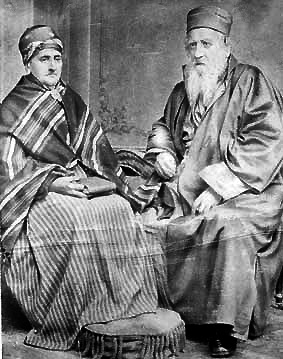


Rabbi Yehuda Alqalai (1798-1878)

Rabbi Yehuda Chai Alqalai (or Alkalai) was born in Sarajevo, Bosnia. He came to Israel with his parents at the age of 11.  At a very young age he was ordained as a rabbi by Rabbi Eliezer Pappo, the author of Pele Yo’etz.  He was sent from Israel to serve as the Rabbi of the important Sephardic community of Zemun (present day Serbia).

In 1839 rabbi Alqalai met with rabbi Yehuda Bibas (see this), who inspired him and shared with him his enthusiastic ideas about the return of the Jews to the land of Israel.
In 1840 the Jewish world was  shocked by the Damascus blood libel. Not only because of the ridicule accusations that “Jews killed gentiles to consume their blood”, but especially because the French authorities in Damascus and the modern “media” of that time, accepted those absurd accusations. “The Jews thought that the world had outgrown, especially in the West, where Jews were convinced that Western culture would not accommodate such terrible lies.”
The Damascus libel affair represented a turning point in the life of Rabbi Alqalai. His ideals would now become part of a practical plan to restore the Jews to the land of Israel and obtain their political independence, as Rabbi Yehuda Bibas had envisioned and preached.
Rabbi Alqalai published in 1840 his first book, Minchat Yehuda, where he called the Jews to reunite in the land of Israel.
Rabbi Alqalai had practical plans for the establishment of the Jews in israel. He wrote and spoke about the need of teaching the Hebrew language to the Jews. He saw that the revival of Hebrew will represent a unifying factor between the Jewish communities worldwide. He also wrote about the need of having a Jewish Bank which, through individuals’ funds, will buy lands in Israel. He insisted in the urgency to address the Sultan of the Ottoman Empire. He suggested the formation of joint-stock company between the Jewish Bank and the Ottoman Empire, such as a steamship or railroad trust, with the purpose of inducing the  Sultan to cede Palestine to the Jews as a tributary country, on a plan similar to that on which the Danube Principalities were governed.
To be continued….
 
Rabbi Yehuda Alqalai with his wife Esther (Viena, 1874).
Read here about the Damascus Blood Libel of 1840


Rabbi Ytzhaq Nissim (1895-1981)


 √  A picture of Rabbi Yitzchaq Nissim z’l.
Rabbi Yitzchaq Nissim was the Sephardic chief Rabbi of the State of Israel from 1955 to 1972. He was born in Baghdad, Iraq, in 1895.
In 1925 he came to Jerusalem where he studied with the greatest rabbis of the time: Rabbi Chizqiya Shabetay, Rabbi Ben-Zion Abraham Cuenca and Rabbi Ben-Zion Uziel among others.
Rabbi Nissim established one of the first rabbinical academies in Jerusalem, among his students were Rabbi Mordechai Elyahu , who was also a chief rabbi of Israel from 1983-1993.
Rabbi Nissim struggled to unify the Jews that lived in Israel. He thought that after centuries of being separated, Sephardic and Ashkenazi Jews and very especially religious and non-religious Jews should leave the differences aside and find the common grounds between them. He endeavored to create and build bridges of communication in which all Jews would work together to build a unified “Israel”.
Rabbi Nissim became world famous for his refusal to meet with the pope Paulus the Sixth in 1964. When the pope came to visit Israel, he made sure to visit East Jerusalem (in those days in the hands of the Jordanians), but he deliberately avoided Israeli-controlled West Jerusalem, forcing Israeli President Zalman Shazar and Prime Minister Levi Eshkol to travel to the northern town of Meggido to greet him in a 20-minute ceremony.  Rabbi Nissim was invited as part of the delegation that would meet the Pope in Megiddo, but he refused to go.  Reasoning that if he would attend that ceremony he would legitimize the Vatican’s delegitimization of Israel.  (The Vatican did not recognize Israel as a state. In a thank-you letter sent to Israeli president Zalman Shazar, for example, the pope deliberately left out the title “President”, and erroneously but pointedly addressed it to Tel Aviv rather than Jerusalem). Rabbi Nissim was known as “the Rabbi that dared said “no” to the Pope”. The Israeli newspaper haAretz declared that the refusal of the Rabbi was an historical event, because it was a strong symbol of the independence of the State of Israel.
Rabbi Nissim died in Jerusalem in 1981.

Professor Meir Benayahu, one of the most important scholars of Jewish studies in modern times,  and former Kenesset member and Israeli Minister  Moshe Nissim were his sons.

√ Read more here about the controversial visit of pope Paulus the sixth to Israel in 1964.


SEPHARDIC RABBIS: Rabbi Ben-Zion Meir Hai Uziel (1880-1953)


Rabbi Uziel was the Sephardic Cheif rabbi of the British Mandate of Palestine, succeeding rabbi Ya’aqob Meir (see here) from 1939 to 1948, and the first Sephardic Chief Rabbi of the State of Israel from 1948 to 1954.
Rabbi Uziel was born in Jerusalem. His father, Rabbi Joseph Raphael, was the ab bet din of the Sephardic community of Jerusalem. At the age of twenty he founded a Yeshiba called Machaziqe Tora for Sephardi young men. In 1911, he was appointed Yafo and the district. In spirit and ideas he was close to the Ashkenazi rabbi Abraham Ytzchak Kook and their affinity helped to bring about more harmonious relations between the two communities.
In 1921 he was appointed chief rabbi of Salonika (Greece) for a period of three years. He returned to become chief rabbi of Tel Aviv in 1923, and in 1939 was appointed Chief rabbi of the British Mandate of Palestine.  He contributed extensively to newspapers and periodicals on religious, communal, and national topics.
He was the author of  Mishpete Uziel, a very important collection of rabbinical Responsa on Halakhic general topics, and a selection of his addresses, letters and other writings.
Two days before his death he dictated his testament. It said, among other things,  “I have kept in the forefront of my thoughts the following aims: to disseminate Tora among students, to love the Tora and its precepts, Israel and its sanctity; I have emphasized love for every man and woman of Israel and for the Jewish people as a whole, love for the Lord God of Israel, the bringing of peace between every man and woman of Israel, to bring genuine peace into the home of the Jew, into the whole assembly of Israel in all its classes and divisions, and between Israel and its Father in Heaven.”
 
√ The full text of Rabbi Uziel’s testament was printed by the Israel Ministry of Religion in 1953, to commemorate his Sheloshim. This short but meaningful  text (printed in vocalized Hebrew) could be found today in Hebrewbooks. Click here to read it.
√ Rabbi Uziel wrote many books, among them Hegyione Uziel, a work on the basic philosophical aspects and creeds of Judaism.
To read this fascinating book (Hebrew) click here .


Emmanuel Hai Ricci (1688-1743)

Rabbi Ricci (or Riqi) was born in Ferrara, Italy. When he was six his father died and his mother’s brother, Jedidia Rabbino, undertook to provide for the family and the education of the children. On Rabbino’s death his son took charge of the family and married Ricci’s sister. At the age of 20 Rabbi Ricci began to travel around various Italian cities, making his living as a teacher.  In 1717 he was ordained rabbi in Trieste by R. Hillel Ashkenazi.
He then settled in Israel but because of a plague that ravaged the country, in which his daughter died, Rabbi Ricci left Eretz Israel. On his way back to Italy, his ship was captured and taken to Tripoli, but he was released after 40 days. He settled in Leghorn, but later journeyed to Smyrna, Salonika, Constantinople, and London. He spent two years in Aleppo and in 1737 he arrived in Jerusalem, where he stayed for three years. In 1741 he returned to Leghorn to settle business matters connected with his books. While on one of his trips he was murdered by robbers.
His books, in the order in which they were written, are
(1) Ma’ase Chosheb (Venice, 1716), a commentary on the building of the Mishkan, the tabernacle built in the desert
(2) Chosheb Machashabot (Amsterdam, 1727), on the technical Halakhic issues which bear no Biblical textual source,  known as Halakha leMoshe miSinai, like the size of a mikveh or some specifics of the Tefilin, etc. The book also analyzes homiletic commentaries on the Bible and Talmud;
(3) Hon ‘Ashir (Amsterdam, 1731), this is probably his main work, a commentary on the six orders of the Mishna, written in Gorizia and completed and expanded in Safed.
Click here Download Rabbi Ricci’s main work, HON ASHIR, on the Mishna, from Hebrewbooks.org 
See a new edition here
Rabbi Ricci also composed a famous Kabbalistic work: Mishnat Chasidim (Amsterdam, 1727), a book modeled on the six orders of the Mishnah, with each order divided into tractates. Rabbi Ricci considered that the act of Creation lies beyond the power of human understanding and arrived at the conclusion that the Kabbalistic idea of tzimtzum (withdrawal) is essentially metaphorical, based on the pasuq: melo kol ha-aretz kebodo as referring to the providence of God, which is found everywhere.