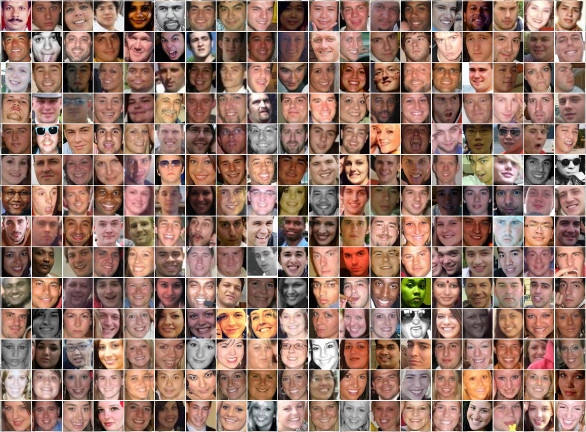
EMUNA: Can you design 7,275,650,514 different faces?

אין צור כאלקינו

Last week we explained what the Hebrew word Tsur (צור) means when used referring to HaShem. We said that Tsur means “rock”, and it is sometimes used to refer to God as our Protector, like the rock that protects the soldier from the arrows of his enemies. But in its original metaphorical sense, Maimonides said, Tsur alludes to the rocky mountain, or the Mother-Rock from which all stones originate. Thus, when we refer to HaShem as Tsur, we mean to say that He is our Origin, our Creator. For example, in the Amida, we used this beautiful expression: TSURENU, TSUR HAYENU to say that “HaShem is our Creator, the Source/Creator/Origin of our lives. ”

Let us see now a third explanation of the word Tsur. This explanation is based on the fact that the word TSUR is grammatically associated with the word TSURA, form o design, and TSAYAR, designer, artist.

The Gemara in Berakhot analyzes the verse in Shemuel (I 2: 2) in which Hanna praises HaShem saying אין צור כאלקינו “There is no Tsur like our God.” Here, again, one could understand Tsur as Source or Origin.  Hanna used this word in gratitude to God Who gave her a son, Shemuel. However our Rabbis made a derasha, a non-literal (or a literary) interpretation of the word Tsur. They said: Here we should understand Tsur (=creator) as Tsayar (=Artist or Designer). “There is no craftsman like our God.” The Gemara elaborates and says that while a human being can design nice figures or sculptures, only HaShem can design something as perfect as a human being, who breathes and thinks (like baby Shemuel, that HaShem just gave to Hanna!). The Sages particularly praised the wisdom (or art) of our Creator referring to the phenomenon of pregnancy: HaShem can create a human being who breathes (Shemuel), inside another human being (Hanna).

In Masekhet Sanhedrin (38a) the Hakhamim formulated a similar idea, inspired by the same pasuq. They said: “when a person wedges coins, using the same mold, all are identical, but when HaShem designs people with the same mold, they all look different. ”  HaShem uses the same exact mold: a nose, two eyes and a mouth, and with these few elements he designs over 7 billion different faces!

אין צור כאלקינו – אין צייר כאלקינו

When we say Tsur referring to HaShem, we need to remember that He is the Supreme Creator, the incomparable Designer of the world and its unique creatures.


Clint Eastwood, Shlomi and the Jewish people

November 21st, 2014

Two days ago, as Coty and I were leaving ‘Mamila’, near the Old City we met Shlomi, a young ‘cool’ Israeli taxi driver, probably 30 years old, didn’t look very religious. He had a sign in his windshield with his phone number (xxx 827 8120) and a smaller sign saying ‘Lo beShabbat’ which means, ‘this Taxi does not work on Shabbat…’

Knowing that Israeli taxi drivers are talkative, very friendly, and always updated about Israeli politics, I asked him about the military situation in the North: Hizbullah claims to have 20,000 missiles ready to attack; Syria is deploying its forces and of course, Iran is threatening Israel as a response to the US sanctions…

Very relaxed and with a big smile Shlomi said: “Don’t worry, my friend, nothing bad is going to happen..…”. And I said: “Why? Do you know anything about the Israeli army that the press doesn’t know or is not telling us?”

Surprisingly, he asked me: “Do you know who Clint Eastwood is?” I said: “Yes!”

He said: “Have you ever watched a Clint Eastwood movie”. Thinking about a ‘cowboys’ movie, I said: “Yes”.

And then Shlomi said:  “Have you ever seen Clint Eastwood dying in the movie? No. Right?. He can’t die because he is the main actor. The whole movie revolves around Clint Eastwood’s character. Without Clint Eastwood, the movie wouldn’t make any sense…. and we, AM ISRAEL -my friend- we are the ‘Clint Eastwood’ of the world’s movie. God, our Almighty movie Director, will never let Clint Eastwood disappear”. 

Shlomi, the taxi driver, calmed me down and strengthened my EMUNA, articulating the most amazing philosophical and uplifting argument about the role of the Jewish people I’ve ever heard in my life.


EMUNA: Where do stones come from?

One of the names by which we call HaShem is TSUR (צור). This name or attribute of God appears many times in the Tora and in the Tanakh, especially in the book of Psalms. The word TSUR referring to God is also used very often in our Tefila, for example at the end of the Amida (ה ‘צורי וגואלי).

In Hebrew, the word TSUR means “rock.” When God commanded Moshe to extract water from the rock, the Tora used two words interchangeably: one is sela ‘(סלע, or “stone” BeMidbar 20: 8) and the other is TSUR (or rock, Shemot 17: 6).

But why would the Tora call HaShem “rock”?

Three explanations. Not possible but complementary.

The first explanation, which seems to be the peshat (=the literal meaning) is brought by Maimonides in his More Nebukhim (1:16).  HaRambam explains that the word TSUR is used metaphorically to refer to God as “our source”. As we all know, the Jews in the time of the Tanakh were experts in extracting, transporting and working the stone. The land of Israel is arid and mountainous, and stone extraction was one of the most common industries then. Until today there is a unique stone, famous in the world, called in Hebrew EBEN YERUSHALMI, the typical stone of Yerushalayim, the stones of the Kotel and the only stone that is permitted to be used when building in the Old city of Jerusalem.
People were very familiar with the origin of stones. All stones have ONE origin. The Rock (=rocky-mountain) or “quarry”. According to this beautiful Biblical metaphor, we are to HaShem what the stones are to the “rocky mountain”. This is what Yesha’ayahu (51:1) told explicitly the people of Israel, urging them to return to God: “Hear, you, who pursue righteousness and who seek HaShem; watch The Rock (צור חוצבתם) from which you were cut… . “.

According to this explanation, when we say TSUR in reference to HaShem we should think that He is The Source of all that exists. The Tora uses the word TSUR to refer to God as YOTSER, the Creator of everything and everyone (the beautiful word TSURI means:  “My Creator”).

The second explanation (or application) of the word TSUR referring to Hashem can be learned from David HaMelekh. In Tehilim 144, for example, the Psalm in which David prays (or talks) to HaShem in the battlefield. In the first pasuq David calls HaShem TSURI. There, David is not referring  to HaShem (only?) as his Creator but as his Protector. On the battlefield, the rock helps the soldier to hide and to protect himself from the arrows of the enemy. David HaMelekh understood that what protected him from the enemy’s weapons, and what made him invisible to the eyes of the enemy, was not a stone but HaShem, “his Rock”, his Protector.

Here TSUR is used to say that HaShem, beyond being our Creator, is also our Protector.

(to be continued …).


EMUNA: Thinking about HaShem’s names

Last week we explained that the Shem haMeforash, the main name of HaShem, is written in one way and it is pronounced in a different way. The meaning of the name of HaShem as it is written means “The Eternal”, the One that was, is and will be. As such, when we read this name we remember that it is beyond our limited capacity to know Him or understand Him. We should be humble and in a sate of awe and submission (yr-at HaShem) when we realize that God is transcendent and beyond our comprehension.

But although written in a way that expresses the unbridgeable distance between Him and us,  we  pronounce His name in a way more accessible to us. We read His name A-M-O-N-A-Y (reading D for the M) which comes from the word ADON (Lord), He is our Master. We see HaShem as the Creator of the world, its Owner, its Master. The Eternal is recondite but the Master is accessible. He listens to our prayers. He loves us and cares about us. We can easily relate to our Master (ahabat Hashem).

According to the Shulhan ‘arukh (OH, 5:1), every time we pronounce this name of God we have to keep in mind these two meanings:  ADON haKol, He is our Master, and He is Eternal ( He is, was and will be).

These two meanings of the name of HaShem, obviously, complement each other.

In the same halakha the Shulhan ‘arukh explains the second most common name by which we refer to God: Eloqim. This name of HaShem means that He is all-powerful and Omnipotent.  When we pronounce Eloqim we have to think and remember that nothing is beyond HaShem’s possibilities or His knowledge. He knows what we do, even in our intimate life, and he knows what we think and what we feel. “Eloqim” remind us that we live (or we should live…) permanently under His sight. Keeping this in mind, should inspire us to do always what is correct in His eyes, and especially,  avoid  what is wrong in His eyes.

The Shulhan ‘arukh stresses the importance of thinking about these ideas when we say the names of HaShem.

The Midrash says that HaShem told Yesha’ayahu haNabi that some of His children praid to Him with their lips but not with their hearts (מצות אנשים מלומדה ).  In other words, they were reciting the prayers, but were not thinking about the meaning of those prayers. In this way, they did not allow the prayers to inspire them and realize, for example, that HaShem, although Infinite and Recondite, is close to us, He knows what we do, what we say, what we think.

HaShem, in Ladino

In Spanish, the name of God is “Dios”. But Sephardic Jews who spoke Ladino did not call HaSjem “Dios” but “Dio” (Buena semana mos de el Dió…etc.). Why? Because in Spanish, like English, the ending letter “s” signifies the plural, especially when the word ends with a vowel (casa/casas, hombre/hombres, sombrero/sombreros). They were therefore very careful to call HaShem “Dió” without the final “s”, to stress the singularity of God,  stressing in this particular way their Emuna in HaShem Ehad (HaShem is One).  


 Snapshot of Israel

http://www.sheppardsoftware.com/Middleeastweb/snapshot/Israel.htm

I took this picture 3 days ago. Anything special? Just children playing, right? Not so fast…

I’m in the Old City of Jerusalem on a street/square called Batei Machase. I see to my left elders sitting in a bench, looking at those children play. Then, there is also a scripture craved on a stone, just behind me. It’s a quote from the prophet Zekharia. 8: 4-5

Zekharia lived at the time (540 BCE) when the Jews were exiled to Babel and their future looked very grim. Following the course of history, the Jews should have naturally integrated/assimilated to the Babylonian Empire, and disappear….

Yerushalaim was totally destroyed, completely in ruins; everything was ashes, death and desolation….

But from the mist of the ruins, Zekharia had an incredible courageous vision: Chapter 8 4 – 5

“And now haShem says: I will return to Mount Zion, and I will live in Yerushalaim”

“…. And once again old men and women will walk Jerusalem’s streets with their canes and will sit together in the city squares. And the streets of the city will be filled with boys and girls at play”.

Now, the whole picture: I’m reading this very verse, engraved on the stone next to me. I see the elders, sitting in a bench. I see the children playing on the street. And I realize, I have the incredible –an undeserved- merit of being a witness to Zekharia’s words.

In MY days, in YOUR days, in OUR incredible days his words were finally fulfilled. Zekharia was talking about US! We are living a prophecy…

Sent on the Sprint® Now Network from my BlackBerry®


AHABAT ISRAEL: When it gets to Israel, facts don’t matter…..

Today is the 9th of Tamuz, 5770

We must know the painful truth about Israel’s situation and make it known to as many people as we can. We can’t defeat some of the NY Times’ cynical columnists in their relentless criticism against Israel. We should, however, first know the facts ourselves and then make every effort to spread the truth over the Web.
Take for example Hamas and the Gaza strip. Israel has been criticized and portrayed as the ‘bad guy’ for not lifting the blockade, which is so unfair for the ‘innocent’ Gazans. Hamas is portrayed as the victim. As if it was just another separatist political movement, like the Spanish ETA or the Kurdish PKK. Now, what does ETA want? ETA, as most nationalistic groups, declare that their goal is to gain political independence from Spain and create an independent Basque state. In a sense, they are advocating for a Basque state that will leave peacefully alongside the Spanish state…
But what does Hamas want? One good thing about Hamas is that they NEVER tried to hide their true intentions and they even wrote a ‘Charter’ where they explicitly manifest their goals.

Article Thirteen: Peaceful Solutions, [Peace] Initiatives and International Conferences

…the so-called peaceful solutions, and the international conferences to resolve the Palestinian problem, are all contrary to the beliefs of the Islamic Resistance Movement. For renouncing any part of Palestine means renouncing part of the religion; the nationalism of the Islamic Resistance Movement is part of its faith, the movement educates its members to adhere to its principles and to raise the banner of Allah over their homeland as they fight their Jihad: “Allah is the all-powerful, but most people are not aware”. *

What do all Israel critics mean when they demand Israel to lift the blockade or to engage in ‘conversations’ with Hamas? Hamas is an Islamic organization, and I know as a Rabbi, that unlike nationalistic expectations, religious principles are NOT negotiable….

Hamas seeks only the destruction of Israel. And Israel must do whatever it sees fit to prevail.

DO SOMETHING FOR ISRAEL

* http://middleeast.about.com/od/palestinepalestinians/a/me080106b.htm

Read Pilar Rahola, a voice of reason in EU: http://www.aish.com/jw/s/96560674.html

Read the column of one of Israel’s unconditional critics, advocating ‘dialogue’ with Hamas.
http://www.nytimes.com/2010/06/11/opinion/11iht-edcohen.html?scp=2&sq=roger%20cohen&st=cse


The power is at the tip of your fingers. Ask Uri Lander!

Today is the 2nd day of Tamuz 5770

Uri Lander is 21 or 22 years old. He was born in Uruguay but now lives in Israel. A few weeks ago he checked his Facebook account before going to sleep. Uri found a new group “Yo Tambien Odio Los Judios” (“I also hate the Jews”).

Unfortunately, anti-Semitism – or the more politically correct anti- Israel movement- is so tolerated by us today that we got tragically ‘used’ to see this kind of expressions and we do nothing about it. But Uri -as his father, Dr Eduardo Lander proudly described to me- decided to take “immediate action”. Uri understood that if the Web is such a powerful tool to spread hatred it must work both ways. We should be able to use Internet also to demand justice!

Uri created a new Facebook group:

24 HORAS para que Facebook borre el grupo “YO TAMBIÉN ODIO A LOS JUDÍOS” (we give 24 hours for Facebook to delete the group “I also hate the Jews”) threatening Facebook that otherwise all of Uri’s new group members will close their Facebook accounts. Uri went to sleep. In the morning Uri checked his Facebook group and to his surprise he found out that the group had already 800 members…!!! In two days Uri’s group had 4,000 members and then it grew to 20,000. At that point Facebook finally closed the anti-Semitic group. Two weeks later, Uri’s group had 200,000 members. Most of them non Jews showing their sympathy for the Jewish people.

Uri made a change. And inspired a lot of people (including me) to use the Web as a vehicle for Israel advocacy.

Uri put together two important things: the power of the web and the ‘passion’ for Am Israel (Ahabat Israel) which today demands from all of us immediate action.

See the story of Uri’s Facebook group here:

http://2lifemagazine.blogspot.com/2010/05/i-also-hate-jews-on-facebook.html