SHABBAT CHAZON: Does God Reside Only in His Temple?

THE PROBLEM

On the Shabbat before Tisha Be’av we read a special Haftara from the book of Yeshayahu (1:1–27). It is known as “Hazon,” from its first word, and it gives this Shabbat its name: Shabbat Hazon. In this prophetic vision, Yeshayahu rebukes the inhabitants of Yerushalayim and describes the sins that would eventually lead to the destruction of the first Bet HaMikdash.

But what exactly was their sin? At first glance, it seems strange. These were not people who had abandoned the Temple. On the contrary: they came to the Bet HaMikdash constantly. They offered sacrifices. They celebrated the festivals. They prayed. And yet God, through His prophet, tells them something devastating (1:15): “When you stretch out your hands in prayer, I will turn My eyes away from you. Even if you multiply your prayers, I will not listen. Your hands are full of blood.”

How can we understand this? These people practiced every ritual in the Temple — but outside the Temple they stole, exploited the weak, bribed judges, and corrupted justice. And they saw no contradiction between these behaviors. In their minds, everything was in order. They fulfilled their obligations toward God in God’s house, and what they did in their businesses, in their courts, in the marketplace, was not something that should concern God.

THE SOURCE OF THE PROBLEM

To understand this mentality, we have to remember the world they lived in. In the ancient pagan world, every god had an address. Ba’al had his temple, Kemosh had his, Marduk had his sanctuary. Each god “lived” in his sanctuary — exclusively. There the gods received their offerings, and there — and only there — they had power and jurisdiction. Outside his temple, the god had no eyes, no presence. What his worshipers did in their homes or their business dealings was of no interest to the gods — and perhaps even beyond their reach. Religion was a transaction conducted at the god’s residence: you brought gifts, and if the god was satisfied, he would spare you from his wrath.

The Jews of Yeshayahu’s generation had absorbed this mentality from the pagans around them — and applied it to the God of Israel. They treated the Bet HaMikdash as if it were a pagan temple: the place where HaShem lives. Inside, they were scrupulously religious. Outside, they acted as if God could not see them — as if His presence ended at the Temple gates.

MELO KOL HAARETZ KEBODO

Jewish monotheism is not reduced to believing in ONE God. First of all, it is the belief that this God is the only power — to the exclusion of every other god. Second, the God of Israel is invisible: He has no body. He is pure “existence” (or “consciousness,” if you want to use a modern word). And third, the God of Israel is omnipresent. He is everywhere. He sees what we do and knows what we think (consciousness is indeed a good word).

This was the great mistake of that generation, and it is the mistake Yeshayahu came to denounce: they ignored the omnipresence of God. HaShem is not a local deity who resides in a building in Yerushalayim. He is the Creator of heaven and earth. The Bet HaMikdash was never His exclusive residence, but our meeting point with Him — the place where we come to His presence, not the place where His presence is confined. As Shelomo HaMelekh said when he inaugurated that very Temple, recognizing God’s omnipresence: “The heavens and the heavens of the heavens cannot contain You — how much less this house that I have built” (Melakhim I, 8:27).

GOD’S EYES

A God who is everywhere sees everything. He is present in the courtroom when the judge takes a bribe. He is present in the marketplace when the scale is rigged. He is present when the widow and the orphan are turned away. And therefore, for the God of Israel, there is no such thing as religion inside the Temple and “private life” outside it. A person who is pious in the sanctuary and corrupt in his business has not understood who God is. He is worshiping HaShem as if He were Ba’al.

This is why God rejects their sacrifices and their prayers. Not because He does not want them — but because they are addressed, so to speak, to the wrong god: to a small, local, bribable deity who does not exist.

And this is also why the door remains open. Yeshayahu tells them that they are not condemned. Since their sin was moral, the remedy is moral (1:16–17): “Wash yourselves, purify yourselves. Remove your evil deeds from before My eyes. Stop doing evil. Learn to do good. Seek justice, defend the oppressed, take up the cause of the orphan, plead for the widow.” Not one word about more sacrifices. The way back to the Temple runs through everything we do outside it.

The first Bet HaMikdash was destroyed, our Sages say, when it had already been emptied of its meaning — when it had been turned into the private residence of a local god, by people who forgot that the God of Israel fills all the earth. Remembering their mistake is our task on this Tisha Be’av: to live, inside and outside, before the same God.


The Week of Tisha BeAv: Laws and Customs

From the 17th of Tammuz until the end of the 9th of Av we observe certain restrictions as an expression of mourning for the destruction of the Bet HaMikdash.

Weddings: No weddings are celebrated during these three weeks.

Shehecheyanu: We avoid eating a new fruit or wearing a new garment, which would require the beracha of Shehecheyanu.

Music: We refrain from listening to instrumental music or attending events with music.

From Rosh Hodesh Av

From the beginning of the month of Av we do not eat meat or drink wine, with the exception of Shabbat.

The Week of Tisha Be’av (שבוע שחל בו)

Our mourning reaches a higher level during the “week of Tisha Be’av,” which extends from the end of Shabbat Hazon — the Shabbat before Tisha Be’av — until the fast. This year, that week began on Saturday night, July 18, and extends until the fast ends.

In addition to the practices already mentioned, during this week we refrain from:

Laundry and Freshly Laundered Clothes: Doing laundry or taking clothes to the dry cleaners during this week is prohibited until after the fast. We also refrain from wearing freshly laundered clothing (except undergarments) until after the fast.

Haircuts and Shaving: It is prohibited to get a haircut or shave during this week until after the fast.

Bathing: We do not bathe or shower with hot water until after the fast. One may, however, wash for hygiene, washing the body in parts with a hand-held shower and warm water.

The Fast

Tisha Be’av begins Wednesday night, July 22 (8:20 pm in NY) and ends Thursday night, July 23 (8:49 pm).


I ❤️ ISRAEL: The Challenge of Fasting in Israel

Yesterday we commemorated the 17th of Tamuz, a fast day that opens a period of mourning that grows in intensity until the 9th of Ab. We remember the five tragedies that struck the Jewish people on this date: the breaking of the Tablets of the Law, the betrayal of Menashe, the cancellation of the daily sacrifices, and the breach of the walls of Yerushalayim (see here all the details of what happened on this day: https://halaja.org/2026/07/todo-lo-que-debes-saber-sobre-el-17-de-tamuz/).

In the Diaspora, even in the most comfortable corners of the Jewish world, it is becoming less and less difficult to feel this sense of mourning. To experience these fasts properly, one must feel “exiled”: away from home, demonized and hated by one’s hosts.

But here in Israel, how do you summon that kind of grief? And not because Israel lacks external threats or internal problems. It’s that here it is hard to be sad, while enjoying the extraordinary opportunity HaShem has given our generation: to live in His country and to serve Him in His own place of residence.

NUMBERS

This “contagious” feeling of happiness you sense here is not just theory or a subjective impression.

In the 2026 international happiness index, the World Happiness Report, which measures 147 countries, Israel ranks 8th in the world. For the second year in a row. In the middle of a war with Iran and company!

And the most remarkable detail: it is Israelis under 25, the generation of the future, who rank third in the world. The young people who serve in the army, who run to shelters, who lived through the trauma of the hostages, who buried friends. Third in happiness, far ahead of their peers in the West. In the United States, for example, young people rank around 60th. And Israel’s neighbors? Egypt: 139. Lebanon: 144.

And this is not just statistics: you see it in the street! In the malls. Full restaurants, families with many children, people enjoying the present and planning the future.

It is the greatest miracle: the most threatened country in the world is the happiest country in the West.

MEANING AND HAPPINESS

How do you explain it? Researchers point to family bonds, to social cohesion. All true. But I believe there is something more: here there is a sense of purpose.

The ordinary Israeli, the soldier, the farmer, the mother raising five children, knows that his daily life is part of something bigger than himself. He is not simply “living his life”: he is keeping the house. The house of the entire Jewish people. Every Jew on the planet, whether he knows it or not, has a home here. And if he ever needs it, if one day his country of residence stops being 100% safe, his refuge, his security, and his future are waiting for him here. Israelis are the guardians of that house. And whoever keeps the house of an entire people has no time for an existential void.

Modern psychology confirms it: happiness does not come from comfort; it comes from purpose. That is why young Israelis, who know what they are doing, why they are doing it, and for whom they are doing it, with everything they carry on their shoulders, are happier than young people who have every comfort and no mission in life, no way to shape the destiny of a nation through their own actions.

That is why the 17th of Tamuz tastes different in Israel. In Israel we fast for the walls of Jerusalem that were broken, while we are surrounded by the walls rising all over the Holy City.

The Mishna (Taanit 4:8) clearly reminds us that one day these fasts will become days of joy. Here in Israel, that day does not seem very far away.


I ❤️ ISRAEL: The Farm on the Hill


From the summit of Har Ebal, looking toward Shechem and the surrounding Arab towns, our guide, Israel, pointed just in front of us to the hill of Tammun. “Do you see that little house on the top? It’s a chava, a Jewish farm.” To see it clearly, we needed binoculars: a little house, a corral, and an improvised dirt road. Nothing more.

1 FAMILY + 50 SHEEP

The chavot (farms) project is brilliantly simple, and of strategic, even messianic, importance. A young family with small children settles, with great sacrifice, on an empty hill, and raises 20 to 50 animals: goats, sheep or cows. The animals go out to graze every morning, and the vast territory they cover is now assigned to that Jewish family. One family with a flock covers more territory than any new community could.

THE NUMBERS

Let’s look at the numbers.

In Yehuda and Shomron (Judea and Samaria) about half a million Jews live today, in more than a hundred communities. The entire built area of those communities, all the houses, streets and schools built from 1967 until today, extends over some 8,000 hectares.

There are now about 150 new farms in these territories, inhabited by a few hundred people. How much land do they cover with their grazing animals? About 78,600 hectares. That is 14% of all Yehuda and Shomron.

Read that again: half a million people, building for sixty years, occupy 8,000 hectares. A few dozen brave Jewish families with their flocks cover ten times more! Seventy percent of the land that returned to Jewish hands in these decades returned through grazing, not through construction.

And the pace is accelerating: since October 2023 alone, some 50 new farms have been established.

THE SECRET

Then Israel, our guide, said something I had never heard before.

The Arabs of these territories receive enormous amounts of money. Billions of dollars from Europe, from the United Nations, and even from the US. Why don’t they build? Why don’t they govern more territory, why don’t they have better infrastructure, why don’t they fill these hills with houses and cities with all those fortunes?

The answer, he said, is one word: “corruption.”

The corruption of the Palestinian leadership is legendary. And until this past Wednesday, it truly bothered me. Arafat’s family accumulated a fortune of billions of dollars (see here: https://www.cbsnews.com/news/arafats-billions/). The same goes for the families of the leaders of the Palestinian Authority and Hamas.

The international money that was supposed to build cities ended up in personal accounts. But now I understand that while the leaders were filling their pockets, the hills of the Shomron remained empty, waiting for the Jews!

Sometimes Bore Olam intervenes in the minds of the Goyim: He hardens their hearts, as He did with Pharaoh, and perhaps He also inflates their egos and their material ambitions, as with these greedy political leaders. Thanks to their corruption, we can repopulate our land!

MIRACLE

From Har Ebal you can see the past: the altar of Yehoshua’s sacrifices. And you can also see, on the mountains of the Shomron, the little Jewish farms that, with enormous sacrifice, are going up and reclaiming the land of our ancestors.

May HaShem bless and protect all the pioneers who do so much for Am Israel, the Torah of Israel, and the Land of Israel.

PS: If you believe in becoming partners in this remarkable sacrifice, reclaiming the land of Yehoshua bin Nun, Shemuel, and his mother Chana, consider getting in contact with one of the organizations that help these farms and settlements in Judea and Samaria.

I found this website that helps the pioneers of these farms obtain security equipment to defend themselves from the constant attacks by the Arabs around them:

https://israel365charity.com/our-projects/protect-farms-in-judea-and-samaria/


I ❤️ ISRAEL: Back to the Shomron

My wife Coty and I are here in Israel with our family, celebrating the Bar Mitzva of our grandson Yosef. This past Wednesday, the 16th of Tamuz, we left Yerushalayim in the morning and headed north. In less than an hour the landscape changes: the buildings end and the hills of the Shomron (Samaria) begin, olive terraces and villages on the hilltops. It is a biblical landscape. You don’t have to imagine it. It’s right there, on the other side of the window.

SHILO

Our first stop was Shilo.

“The whole assembly of the people of Israel gathered at Shilo” (Yehoshua 18:1).

In this city, Yehoshua bin Nun gathered all the tribes of Israel to decide by goral (lottery) how the land would be divided: which tribe would settle in the north, the south, the center, the coast, etc.

Shilo is also where the Mishkan was established: the Tabernacle, the precursor of the great Temple of Yerushalayim. It stood there for 369 years. We visited the site of the Mishkan, which can still be identified, a plot of about 50 meters long by 25 meters wide.

It was there, at the Tabernacle of Shilo, that Chana, the mother of Shemuel, the first prophet of Israel, asked HaShem for a son. She later composed her famous prayer of gratitude, Tefilat Chana. It is written there, and we read it aloud with great emotion.

WINE IN SHOMRON

From Shilo we went to the Tura winery, where we had lunch. They gave us three wines to taste: white, rose, and red. First we recited Hagefen, and then, twice, Hatov veHametiv. The wines of the Shomron are famous all over the world. They have won international awards (https://www.jpost.com/israel-news/article-745547) in blind tastings, where the judges taste the wines without knowing where they come from (otherwise, I doubt we would have won).

There we had lunch with the most famous and active man in the region these days: Yosi Dagan, the head of the Shomron Regional Council and the man responsible, together with the extraordinary minister Betzalel Smotrich, for the incredible, miraculous reconstruction and reestablishment of 22 new communities in the Shomron, what the Goyim call the West Bank.

For dessert, my son, Rabbi David, gave a beautiful Debar Torah. He began by saying: אנחנו שותים נבואה, “We are drinking a prophecy.” He was referring to the words of the prophet Yirmiyahu, who, looking at this territory of Israel completely depopulated and destroyed, dared to say:

ע֚וֹד תִּטְּעִ֣י כְרָמִ֔ים בְּהָרֵ֖י שֹׁמְר֑וֹן נָטְע֥וּ נֹטְעִ֖ים וְחִלֵּֽלוּ׃

In the future, the Jews “will plant vineyards again on the mountains of the Shomron… and they will enjoy their fruit” (Yirmiyahu 31:4).

Notice the detail: the pasuk does not say “in Israel” in general but specifically on the mountains of the Shomron, the exact place where the Tura winery stands, along with other famous wineries, like “Shiloh.” And the final word, vechilelu, is a halakhic term that applies only to Jews: it refers to redeeming the fruit of the fourth year (neta revai) so it can be consumed with a great celebration. In other words, the prophecy does not announce only planted vineyards but Jews drinking with joy from the fruit of the vine of those mountains. Exactly what we were doing at that very moment!

After the wine, I needed a strong Elite Turkish coffee to stay awake and arrive sober at our main destination: Mount Ebal (הר עיבל).

HAR EBAL

It was an hour’s drive to reach the past: some 3,500 years back. Our destination?

The altar built by Yehoshua bin Nun:

אָ֣ז יִבְנֶ֤ה יְהוֹשֻׁ֙עַ֙ מִזְבֵּ֔חַ לַֽה׳ אֱלֹ-הֵ֣י יִשְׂרָאֵ֑ל בְּהַ֖ר עֵיבָֽל

“Then Yehoshua built an altar to ה׳, the God of Israel, on Har Ebal” (Yehoshua 8:30).

Moshe had instructed Yehoshua that, upon entering the land of Israel, he should perform a ceremony confirming the covenant between God and Israel: he was to write the Torah on stones coated with plaster, read the terms of the Covenant before the entire people, and there, in that very place, offer sacrifices and offerings of gratitude to God.

In the 1980s, the archaeologist Adam Zertal identified this altar. Thousands of burned bones were discovered there, all from animals the Torah considers pure, that is, fit to be sacrificed. The altar is built exactly as the Torah prescribes: with a ramp instead of the stairs used by pagan peoples and made of whole stones, untouched by metal tools. It is the oldest identifiable archaeological site in the history of Israel in its land!

It was deeply moving to stand there and picture, from that spot, our ancestors between the two mountains, the Kohanim and Leviim facing us in the valley, listening to Yehoshua bin Nun reading the Torah.

THE RESET

But we did not only see the past. We also saw the future. Standing at the summit of Har Ebal, with our backs to the altar, the view commands the northern Shomron: Mount Gerizim in front, the valley below, and hills dotted with Arab towns and villages: Shechem, I believe Jenin as well, and others.

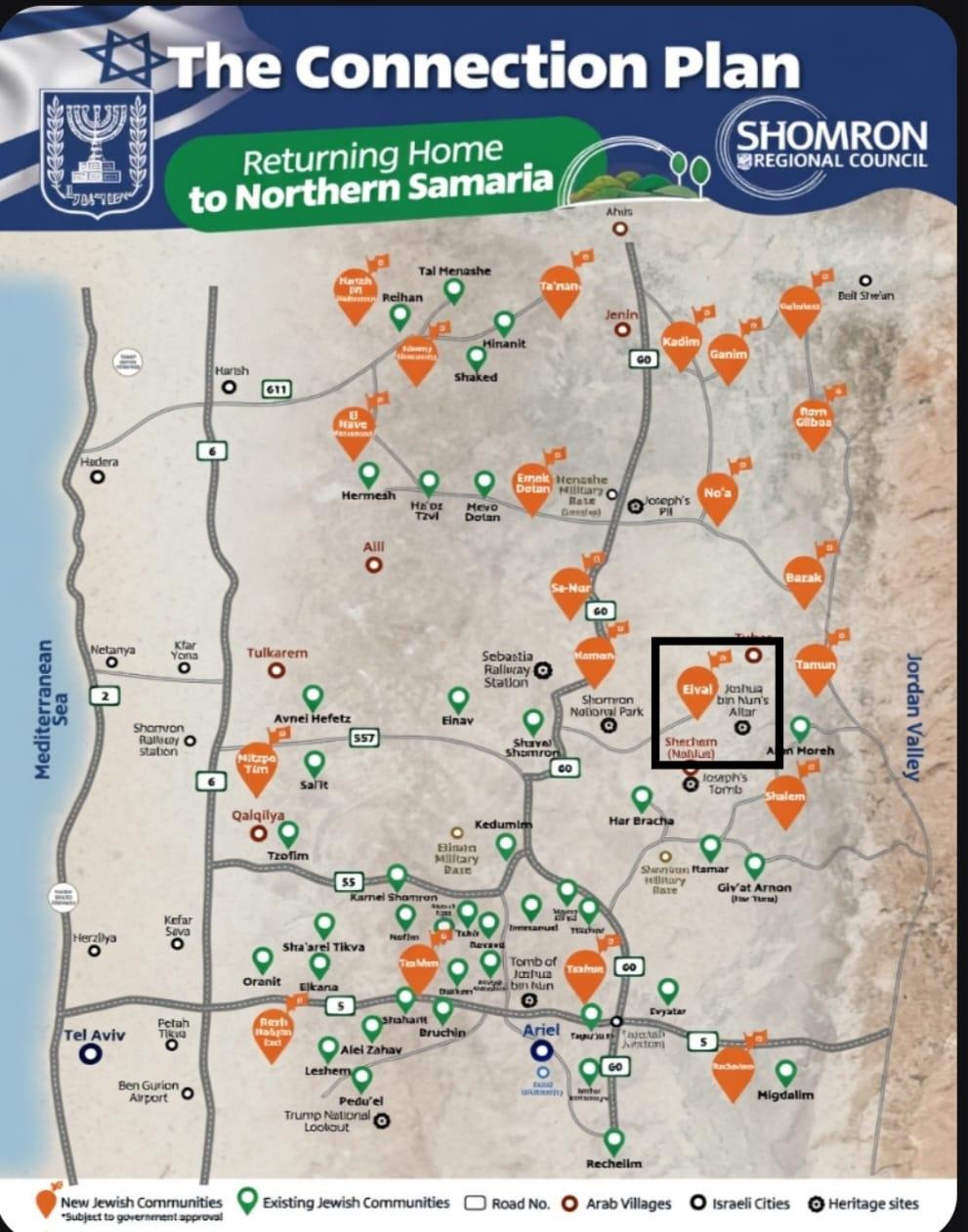
But from that same spot we could also see the new Jewish communities: Har Berakha, on Mount Gerizim itself. Elon More, very close, to the east. Itamar.

And now look at the map.

In the black square you can see the site of Yehoshua’s Mizbeach (altar), on the northeastern summit of the mountain. And a short distance away, on the same mountain, there is a new dot that did not exist a year ago: a new community bearing the name of this mountain: Ebal (spelled: Eival).

And Eival is not an isolated case. In May 2025 the government of Israel, B”H, approved the creation of 22 new communities in Yehuda and Shomron, something that had not happened in decades. The names are a map of the Tanakh coming back to life, as you can see in the orange marks on this map. It is part of Yosi Dagan’s “One Million in the Shomron” plan: to reach one million Jewish residents in the Shomron by 2050.

The community of Eival was founded in March 2026, in the middle of the war with Iran. While missiles were falling on Israel, trucks were climbing the mountain of Yehoshua at night, carrying the first homes. Half a year of preparations, and the Mount of the Covenant has a Jewish population again, after thousands of years.

Without knowing it, we were standing on a time-tunnel, or a time-bridge. Behind us, the ancient stones of the altar that Yehoshua built 3500 years ago. And in front of us, the land to which the people of Israel are returning, in our privileged days.


 I ❤️ ISRAEL: The Shadow of Peace — and the News

THE AIR OF ISRAEL

I’m in Yerushalayim, in Emek Refaim. Outside there’s movement everywhere: cranes and construction all over, streets closed off, traffic squeezed down to a single lane, fences and worksites the length of the whole block. Yerushalayim never stops rebuilding itself. But the noise doesn’t reach inside. I’m at Café Kafit, a beautiful place, full of people, with air conditioning and good wifi. I’m alone, with my computer, trying to finish writing my book —Dinosaurs in the Torah— where I analyze in depth how Chazal, the Rishonim, and the Sephardic Acharonim understood pesukim 20, 21, and 22 of the first chapter of Bereshit. I don’t quite know why, but the coming and going of people doesn’t distract me: it keeps me company. I concentrate better here than in a library. I’m moving forward with my book the way I never could in New York. Could this be what our Sages taught, that avira de’Eretz Israel machkim—that the air of the land of Israel makes you wiser? It helps you think better. The mind feels lighter.

CONNECTION VIA NEGATIVA

I ordered shakshuka and a carrot juice.

The phone rings. It’s a member of my community in Great Neck. I answer. With a worried voice, he asks how I am, how I’m feeling, and what it’s like to be in Israel with the terrible situation with Iran, the confusing messages from Trump and Vance, and the threats from Turkey. He knows Israel matters deeply to me and that I live these news stories with intensity. And he takes for granted that I must be suffering, glued to the latest updates on Telegram.

And I don’t know how to explain to him that here everything is calm. That people are content, that the restaurants are full, and that the biggest problem of the morning is finding a free table to sit down for a coffee.

The truth is there are two countries called “Israel.” There’s the Israel of the international headlines—the one that shows up every day in every newspaper in the world, always on the edge of something, surrounded, threatened, and demonized—and there’s the other Israel, the one where you go to sleep with the windows open, enjoying the breeze of Yerushalayim, and wake up happy to be in the best country in the world.

NEWS DETOX

I told him I had no idea what was going on. And I said, almost without thinking: I’m not following the news! I surprised myself hearing it. And I realized something. In New York my head is more here than there; I can’t help it. A psychologist would tell me it’s a mix of guilt for not being in the land of my fathers and a need to stay connected to Israel all the time. Without meaning to, I had turned worry into a form of connection with Medinat Israel. But here I don’t need that: I’m inside, and the connection no longer runs through the news.

Here I’m in the company of my people, wherever I go. At Kafit I don’t know anyone, yet I know them all. I know exactly where they come from, they and their ancestors, and what future they want for their children.

And the connection with Boreh Olam is felt in the soul. In my Amida it takes far less mental effort to address God in the second person. The relationship with Boreh Olam happens far more naturally. I think that’s what gives a person so much peace. That Presence, immanent in the air of Israel, makes you more aware that there is Someone in charge of this place and this people. Yesh Ribon laBira —there is a Master to this palace. And it isn’t Trump, or Vance, or even Netanyahu.

SHADOWS

Our Chachamim teach that in the desert the people were wrapped in the Anane Kavod, the clouds of glory that surrounded them on every side. They were the sign that HaShem was with them, protecting them “from above.” And so they could go to sleep at ease, without standing guard, in the middle of the desert, even knowing they were surrounded by dangers. They also knew under whose shadow they stood. It’s the same shadow you feel here. It’s the one we’ll mention this Friday night in the Arbit prayer: ufros alenu sukkat shelomecha —spread over us the “shadow,” the sukka of Your peace. And we add a special mention: that this shadow of peace extend over all the people of Israel, and very particularly over Yerushalayim, His city. Our greatest wish as a nation is to dwell beneath the Divine Shadow. And that is what makes Israel special. It’s not that there’s no danger outside. It’s that here you give yourself over to Divine protection, and everything else stays outside: the news, the threats, the headlines. The world keeps turning, but the noise stays on the other side of the Shadow.


BEHALOTEKHA: More therapy or more responsibilities?

American Jewish journalist Abigail Shrier, in her 2024 book Bad Therapy, does not deny that therapy can help, or even save lives. Her warning is that in certain circles it has become automatic, used even when it is not needed. Her target is a culture that, in the name of catharsis, pushes children, and especially teenagers, to ruminate on their own distress again and again. And chewing on it does not help. It locks them in a loop of anxiety that only drags them down further. Asking “how are you feeling” on repeat, validating every fear, tracking every emotion: all of it, Shrier says, manufactures the very problem it claims to cure.

For the kind of anxiety that comes from abundance and from having nothing meaningful to do, her prescription is not the couch. It is real life. And she gets specific. Give the teenager chores at home, jobs that actually matter and have to get done. Push him to get a job, part-time or summer, and earn something with his own effort. Let him move around and figure things out alone: run an errand, settle his or her own fights. Set clear rules at home and hold the line, instead of negotiating every point with your child like she is another adult. And on the other side, let go. Stop padding every fall. Stop treating every normal stumble of growing up like a wound that needs treatment.

Strong character is not built by picking at small problems until they grow. It is built through competence: the feeling that you can stand on your own, that you are useful, that you are worthy. The teenager carrying a real responsibility is too busy to spend his days ruminating over his feelings.


BEHAALOTEKHA: The anxiety of having it all

Clinical anxiety, and the other kind

There are two kinds of anxiety, and they should not be confused. One is clinical. It has a real cause: a concrete threat, the panic attack, the racing heart. That kind is medical. It belongs to doctors, and nothing here is about it.

The other kind is cultural, even spiritual. It grows out of materialism and abundance. It is not the anxiety of the man with nothing to eat. It is the opposite. It is the anxiety of the man who has everything. That was roughly the situation of the children of Israel in the desert. God gave them everything they needed. No generation since has known that kind of material ease. The man or manna fell from the sky each morning. Nobody had to plant it, harvest it, store it, or worry about tomorrow’s supply. It was a complete food: tasty, filling, and nutritious. And it solved the problem that had haunted humanity since Adam: Where will my next meal come from? In Egypt they had worked like animals to answer that one question. Now it was answered. And right then, in the middle of all that comfort, the crisis hit.

Anxiety and emptiness

The mechanics are simple. The human mind runs on a kind of energy built to solve problems: find bread, protect your family, and put a roof up. That mental energy does not switch off when the problems go away. It stays on. It looks for something to do. And when it finds no real goal to attach to, it curdles into anxiety. How?

The small stuff floats up. The Hebrew word for trivial, superficial stuff is “shtuyot”: nonsense. It rushes in to fill the empty space at the center of the mind. The question is no longer “what will I eat.” It is “Do I want the steak medium or medium well?” It is no longer “what will keep me warm.” It is “which of my fifteen pairs of shoes goes with this dress.”

The same Jews who spent centuries as slaves, working for a piece of Matzah, now complain about the manna and demand meat. And fish. And melon for dessert. In the desert!

The first to complain were the asafsuf: the ones with the least spiritual inclination, the ones who never embraced the new national project, which was to learn the Torah they had just received and become God’s people. Freedom plus abundance minus purpose left a void they were not built for. They had nowhere to channel the extra mental energy. Slavery had been easier. At least slavery came with a job.

The wrong diagnosis

What happened in the desert is one of our problems too. We are the best-supplied generation in history. We wiped out hunger across whole continents. We have heat, air conditioning, medicine, too much food, and entertainment without end. We are also the most anxious people who have ever lived. But the curve runs backward from what we expected. More abundance, more anxiety. Fewer real needs, more shtuyot becoming needs.

It is easy to misread this. Many treat this particular anxiety, not the clinical kind, which is real and needs care, like a broken part to be repaired. But read through this week’s Parasha; it is not a psychological issue but a spiritual one. The fix is not chemical. It is a question of direction.

Testing or coaching?

The Torah frames the desert paradise as a nisayon: a test, or better, a training exercise. Take away the daily fight for survival, and one question is left standing. What will you do with your mind when you no longer need it to keep yourself alive?

The answer is not to go back to scarcity. Hardships do not make us better. They distract us. The answer is to give that mental energy a target worth the effort. Build a family. Raise children. Build a home with values. Study Torah. Get closer to God. Improve your Amida. Volunteer at a hospital, at Bikkur Holim, or at a home for the elderly. Any real work for someone else.

A mind that isn’t occupied gets preoccupied. And preoccupation is where this type of anxiety comes from. The surest way to stop chewing on your own small troubles is to go do something that really matters for someone else.


NASO: Sotah and the Art of Marital Fidelity

The trust between husband and wife is one of the foundations on which a family stands—and infidelity is one of the few things powerful enough to bring it down.

One of the topics mentioned in this week’s Parashah is Sotah, a case related to infidelity.

The Torah and the Sages discuss this topic in depth and describe not only the obvious consequences of adultery but also the factors that contribute to this deviation or to a suspicion of infidelity, and the behaviors that prevent it and strengthen fidelity.

In the following lines, I will briefly refer to a few topics directly or indirectly related to preserving sexual exclusivity in a Jewish marriage.

Sanctifying Sexual Intimacy

Unlike other religions, Judaism perceives sexuality as something positive and even sacred. Our Sages explained that our behavior should aspire to emulate God. He is compassionate, equitable, and magnanimous. Likewise, we must incorporate these characteristics into our own conduct. This “imitation of God” reaches its highest point when husband and wife become the “creators” of a new life. Procreation offers us an opportunity—unparalleled in any other act in life—to imitate the Almighty Creator of the world.

Sexuality also completes us: it leads us to physical and emotional plenitude as individuals. The first biblical reference to sexuality states: “Therefore a man shall leave his father and his mother and cling to his wife, and they shall become one flesh” (Genesis 2:24). From this verse, the Sages deduced that a man or a woman should consider themselves as half a person (pelag gufa), and that human fulfillment can only be achieved through marital intimacy.

Sexuality is certainly sacred, but it is also vulnerable to corruption. The Torah recounts the generation of the Flood, where sexual corruption and rape were the first symptoms of the moral decay of that corrupt generation. For those people, sex ceased to be an act that brought humans closer to the Divine. They treated sex as if it had no relation to love and holiness, considering it simply casual and unbound—a means to satisfy primal instincts.

Because of its importance and its creative (and destructive) power, sexuality needs to be “sanctified” (qiddushin). The sanctification of sexuality takes place when it is expressed exclusively within the context of marriage. This allows us to imitate the Creator and helps us intimately know the person we love the most, transforming us into something more significant than just the “I”: a “WE” (husband, wife, children).

Sex outside of marriage is destructive. Infidelity often plays a decisive role in most divorce cases; adultery is usually the final red line that has been crossed. Infidelity distances a person from God and from those one loves the most: the wife or husband and the children.

Preserving Passion

But Judaism goes beyond limiting sexuality to the context of marriage. It is also crucial to preserve the sexual attraction between husband and wife and to avoid anything that can harm or destroy it. The Mitzvah of Niddah strengthens fidelity. A Jewish married couple abstains from sexual activity for approximately two weeks each month, corresponding to the woman’s menstrual cycle plus seven more days. When the Sages of the Talmud, specifically Rabbi Meir, explained the reason behind this regulation, they said that thanks to this period of physical separation, husband and wife are able to rekindle their desire for each other. In other words, far from negatively affecting sexual desire, this period of separation intensifies it, preventing one of the greatest challenges that marriages face: boredom and sexual monotony. This problem, well known and analyzed by psychologists and sexologists, arises from the theoretically unlimited opportunities for intimacy in a marital relationship, which can drive a person to look outside for sexual novelty, leading to infidelity.

Rabbi Meir explained that during the days of physical separation, a Jewish husband desires his wife, and his physical attraction to her intensifies as the night of the Mikveh (the ritual immersion that concludes the period of abstinence) approaches. And when the wife returns from the Mikveh—even in the case of a couple who have been married for many years—the desire between them is regenerated “with the passion they felt on their wedding night.” It is as if the Niddah period creates a new honeymoon every month. (Someone said that if this extraordinary Mitzvah didn’t exist, it would have to be invented!)

This period of separation also promotes a deeper level of interaction between husband and wife. The couple learns to communicate affectionately on the level of friendship. Every couple should aspire to achieve this level of non-physical relationship that will strengthen the marriage for the rest of their lives. Especially as the years go by and sexual desire naturally diminishes, the friendship between husband and wife will flourish, based on that “platonic relationship” built over the years during the Niddah periods.

Preserving Fidelity

In Jewish tradition, laws and codes of conduct are specifically designed to prevent infidelity, or anything that leads to it. One of these rules is known as “Yichud”: when a man and a woman who are not married to each other isolate themselves in a secluded place. The Sages mention it as one of the mistakes made by the Sotah, raising well-founded suspicions of adultery. The story of Amnon and Tamar in the book of Samuel illustrates the importance of Yichud. Amnon, one of King David’s sons, had a sexual obsession with Tamar, his half-sister. In order to be alone with her, he pretended to be sick and asked for her help. He requested that everyone leave his room, and once alone with his half-sister, Amnon abused her. This devastating event deeply impacted King David, who felt guilty for not realizing what was happening in his own family. To prevent similar cases from recurring in the future, King David, together with his Court of Justice, instituted the law of Yichud, which prohibits a Jewish man from being alone in a locked room with a woman who is not his wife.

The prohibition of Yichud falls into the category of “gedarim” or “siyagim,” which translates as “security measures” or halakhic fences intended to prevent people from succumbing to more significant transgressions. An equivalent of a “siyag” would be a ranger erecting a fence a few steps away from a cliff, to protect visitors from getting too close and accidentally falling into the void.

Similar preventive mechanisms exist, for example, in the field of addictions. A person struggling with alcohol addiction is advised to avoid bars and gatherings where alcohol is served, and to refrain from socializing with friends who drink. These “social fences” protect people from their own impulses and prevent the possibility of facing temptations they cannot control. It is easier to avoid entering a bar than to resist drinking once the drink is within reach.

Similarly, the rabbis recognized the power of the sexual instinct and emphasized that relying solely on common sense and personal morality is insufficient (אֵין אַפּוֹטְרוֹפּוֹס לַעֲרָיוֹת). Additional rules and fences are required to prevent potentially catastrophic situations. By avoiding Yichud—private seclusion between a man and a woman—the natural scenario in which infidelity or inappropriate sexual behavior develops is prevented.

The concept of Yichud is recognized and increasingly practiced in our day, even in non-Jewish society. It is very common for legal advisors to recommend that therapists, doctors, lawyers, and other professionals avoid staying alone in a closed room with a patient or client of the opposite sex, in order to prevent inappropriate situations or allegations of misconduct. This demonstrates the advanced wisdom of the Torah and our Sages, who established these laws thousands of years ago—laws that are now widely recognized, valued, and adopted throughout the civilized world.

Communication and Fidelity

In Judaism, sexuality is reserved exclusively for the intimate relationship between husband and wife. This simple but crucial idea also implies that certain types of interaction between married men and women should be avoided—beyond seclusion or Yichud—even in the field of communication.

Affectionate or sexual language and comments, or sensual behavior from a man toward a woman who is not his wife, are considered inappropriate. Similarly, a Jewish wife should reserve her physical charm for her husband, ensuring that her behavior and appearance in public are not provocative and that they reflect this exclusivity.

These principles of moral conduct are not very popular in contemporary society, where sexuality has been objectified through advertising, pornography, and the media. The widespread exploitation of sex—and modern permissive culture—has normalized inappropriate sexual behavior, and intimacy is no longer widely perceived as something exclusive between spouses and bound to marriage.

And this is precisely why preserving our Jewish codes of conduct while living in a society that promotes contrary values represents one of the most formidable challenges that we Jews face today. But it is imperative to do so if we seek harmony in our marriage and the happiness of our family. And to do that, we must recognize the behaviors that enable infidelity, or that provoke justifiable jealousy from a spouse.

Let us consider one last example.

The Torah teaches us that infidelity can sometimes develop unintentionally, through the exchange of emotional communication between a married man and a woman. The first time the Torah describes sexual relations, it uses the verb “to know”: “And Adam knew Eve, his wife.” This “knowing” refers to the emotional connection that precedes—and leads to!—physical intimacy. When a couple goes on their first date, they treat each other respectfully and cordially. Then comes friendship, which slowly develops into an emotional relationship, recognized when communication between man and woman includes the subject of feelings. When this level is reached, the couple is ready for intimacy—that is, for marriage.

If we observe this progression from respect to intimacy, we can understand why the Sages warned that, beyond preventing physical contact or seclusion with someone of the opposite sex, a married person should avoid repeating a similar progression—which might develop unintentionally and unconsciously—with a person of the opposite sex in their professional or social life.

The Sages describe this emotional closeness as “qiruv da’at”: when a woman and a man share and communicate to one another their private feelings and intimate information. Although initially the content of that information may not be related to the sexual sphere, this level of emotional communication enables feelings of closeness that might lead to intimacy.

A married man should avoid this type of communication, especially with a person of the opposite sex with whom he routinely interacts, such as an employee or a colleague in the workplace. Likewise, a married woman should avoid emotional dialogues with a coach, a therapist, or a teacher. These emotional interactions, qiruv da’at, do not turn into intimacy overnight, but they develop gradually.

Preserving fidelity is the cornerstone of the Jewish family and of the emotional well-being of our loved ones. This requires remaining vigilant and respecting the boundaries that prevent situations which can progressively become more difficult to control. The laws of Niddah, Yichud, and qiruv da’at—each from a different perspective—contribute to safeguarding fidelity, the most sacred and essential aspect of our family life.


NASO: The blessing of the Kohanim

Birkat Kohanim is the blessing that HaShem bestows upon us through the Kohanim. This blessing appears in our Perasha, NASO and consists of three biblical verses (pesuqim), organized in a very precise mathematical progression: the first pasuq has 3 words and 15 letters, the second 5 words and 20 letters, and the third 7 words and 25 letters.

Each pasuq consists of two blessings for the recipient of the blessing.

Verse 1: Material blessing and good health.

Verse 2. Wisdom and Grace

Verse 3. HaShem’s attention and peace.

יברכך ה The first pasuq says: “May HaShem (= God) bless you and protect you.”

Which means: May HaShem grant you all the material blessings you need (yebarekhekha), a house, food, clothing, etc. In the second blessing (veishmerekha) we ask that HaShem protect us from diseases or accidents. These blessings complement each other: we need money to buy food, clothing, etc. But we also need the blessing of good health,  one of the few things that cannot be acquired with money. Obviously, a blessing is not a magic formula. To receive this and the other blessings we need to become an appropriate recipient of that blessing. We have to merit it and we have to make our effort and stay healthy, drive our cars with care, and do everything possible to avoid any kind of accidents, etc.

יאר ה The second pasuq says: “May HaShem enlighten you with His presence and favor you.”

The subject of this Pasuq is not material but rather intelctual blessings. “May HaShem enlighten you” means that we expect HaShem to help us and inspire us to obtain a very special type of wisdom, the wisdom to understand the Tora. The biblical words “May HaShem enlighten you” יאר allude to that spiritual and intellectual enlightenment. The second blessing of this verse is חן, grace or favor: HaShem to bless us with a good character, to inspire us to be loved by people, to find grace in the eyes of others. The first blessing refers to our spiritual and intellectual talents. The second to what is called today “emotional intelligence,” the blessing of being accepted and loved by the people around us.

ישא ה  The third pasuq says:” May HaShem direct His Presence toward you and grant you peace. ”

Our rabbis explained that there is no greater blessing for the Jewish people than peace שלום. We Jews do not aspire to destroy our enemies  and control the world. Our aspirations are noble and very simple. We only ask to live in peace. In order to serve our God, fulfilling His Tora in our own land, Israel. These are ALL our national aspirations.

Returning to the first part of this berakha, it literally says: “May HaShem direct His “Face” towards you.” Obviously God has no “face”. Our rabbis explain that this expression means: “May HaShem pay attention to you.” This is probably the most important blessing. Let’s explain it with a simple example. What must I do to deserve this extraordinary privilege? What do I have to do to make God direct His face / His attention to me? Imagine a class in a huge auditorium with hundreds of students. Everyone came to listen to a lecture that will be given by a very famous teacher. Upon entering the auditorium the teacher looks at the audience and welcomes everyone. But suddenly he stops and looks at one of the students, someone sitting in the fifth row. The teacher fixes his eyes on him for a few seconds, smiles at him, and greets him with his hand. At the end of the lecture the other students approach the privileged student and ask: Why did the teacher turn his face towards you, why did he pay a special attention to you? The student responds: “It is because during last year I have read his books, I exchanged some emails with him, asked him some questions and tried to contact him by phone” .

If we want to be the recipients of this blessing, if we want to be identified by HaShem and deserve His special attention, “We must be known by Him”, by studying His works and connecting with Him as often as we can. Thus, we will become an appropriate recipient all His blessings.