Rabbi Yehuda Alqalai (1798-1878) and Modern Zionism
Rabbi Yehuda Alqalai was one of the first rabbis (or Jews) in modern times to formulate the idea of a return to Zion. Following the footsteps of Rabbi Yehuda Bibas, he did not envision the return to Zion just as a solution for the eternal problem of anti-Semitism but essentially as a way to fulfill the Jewish aspiration of political normalization: i.e., Jews living in their Jewish homeland. He understood that the nation of Israel needs not wait passively until the Mashiach comes to realize this aspiration. Rather, it should actively seek the reestablishment of an independent Jewish state in the forefather’s land as a way to advance the coming of the Messiah.
Rabbi Alqalai formulated his plan and ideas for the restoration of the Jews in Israel in his book Goral lahaShem, published in Viena in 1857. In this book, rabbi Alqalai designed a comprehensive plan with the religious foundations and the practical steps to be taken in order to reestablish the Jewish nation in Israel. The book was published in three different editions and translated into many languages, including English. The correspondence between the practical ideas of this book and Theodore Herzl’s: “The State for the Jew” (Medinat haYehudim) is so similar that it is not improbable that Herzl was familiar with his book and had internalized its concepts which were later on formulated in his famous book. Simon Loeb Herzl, Theodore Herzl’s paternal grandfather, attended the Alqalai’s synagogue in Semlin (Serbia) and the two frequently visited each other. Grandfather Simon Loeb Herzl “had his hands on” one of the first copies of Alqalai’s work Goral lahaShem prescribing the “return of the Jews to the Holy Land and renewed glory of Jerusalem.” Many contemporary scholars conclude that Herzl’s own implementation of modem Zionism was undoubtedly influenced by that relationship.
Rabbi Alqalai made Aliya to Israel in 1874. He established himself in Yafo and together with other Jews from the Ottoman empire and North Africa founded the community Mikve Israel of the Old Yeshub of the city. He died four years later and he is buried in the Har Hazetim (Jerusalem).
I present to the readers the book GORAL LAHASHEM by Rabbi Yehuda Alqalai. It is very interesting to see the haskamot (Letters of support) he had from many prominent rabbis. to me, the most interesting haskama was the first one, which seems to have been written originally in Hebrew, by Sir Moses Montefiore (1784-1885) a contemporary of rabbi Alqalai.
Three Miracles of the Independence War
ON VICTORY AND DEFEAT On the day that the Jewish leaders declared the establishment of the new State of Israel, on May 14, 1948 (5 Iyar 5718), the neighboring Arab countries declared war on the Jewish State and began an invasion on all fronts, confident of their victory. Israel had many disadvantages, but the most notable was the lack of weapons. Let us remember that the five Arab countries that launched an attack against Israel – Egypt, Iraq, Syria, Lebanon, and Jordan – had become independent a few years earlier. Both England and France equipped them with weapons and trained their armies. The Arab countries had, for example, 50 tanks, while Israel only had one tank. The Arabs had 200 artillery vehicles, and Israel had just two. The Arabs had 140 guns, and Israel only had five. The most significant disadvantage was that the Arabs had more than 70 warplanes. At the start of hostilities, Israel had none. The Arab countries had warned that if Israel declared its independence, they would attack. They were waiting for this to happen since the chances of winning the war and having everything in their favor were 100%. So confident were in their triumph that they called on the Arab radio for all Palestinians living in Israel to leave for a while the country, assuring them that they would return very soon when the short battle would be over, and all the Jews would be thrown into the sea (a euphemism for: “being brutally murdered”). Hundreds of thousands of Palestinians left the territory of Israel. In this way, the Arab countries created the “Palestinian refugee problem,” for which they never took charge, and instead, to this day, they continue to blame Israel.
OBJECTIVE: TEL-AVIV Immediately after the declaration of independence, Egyptian warplanes appeared in the skies over Tel Aviv, began to bombard the city, and met no resistance. These nonstop attacks from the air left hundreds dead — including women and children — and thousands wounded. The Egyptians advanced significantly and reached Ashdod, remaining only 30 kilometers from Tel Aviv. The powerful Jordanian legion, trained by the British and commanded by British generals (sic.), managed to besiege Jerusalem, and the invasion of the Holy City was imminent. The Jordanians also captured the city of Lod and what is now Ben Gurion International Airport and approached Tel Aviv from the east. Iraqi forces that came from the northeast were also closing in on Petah Tikva and Hadera on their way to Tel Aviv. The Syrians were surrounding the city of Tiberia and, together with the Lebanese military forces, had isolated the Galil, the north of the country, from the rest of Israel. The final destination of the Arab armies was Tel-Aviv, which at that time was the seat of Israel’s Government and the military High Command.
UNITED AGAINST ISRAEL Israel had no way to defend herself and could not get weapons. Why? Because the United States was leading an international embargo that prohibited any country from selling weapons to Israel, with full awareness and knowledge that Israel could not possibly survive the attack of the Arab armies on her own. It was only a matter of time before a new Shoah was repeated, and the world, for the second time, acted as a silent accomplice. All efforts by Israel’s newly created Israeli Army to defend itself failed. The forecasts that predicted the brutal defeat of Israel were coming true. The military superiority of the Arab armies was insurmountable. There was no way the Israelis could withstand the attacks even for a few more days…. the end was imminent. The Arabs, very confident in their victory, announced that “what Hitler had done was nothing in the second war, compared to what they would do with the Jews” once they conquered Tel Aviv. The world, as in a horrible dejavú of the Holocaust, watched and remained silent. And then a great miracle happened. It was June 11, Sivan 4, 1948.
THE CEASEFIRE The Swedish Count Folke Bernadotte, appointed by the United Nations as a mediator between Israelis and Arabs, proposed a ceasefire, that is, an interruption of the military activity of the armies for four weeks, offering that each one remains in control of the positions they had conquered up to that moment. Israel, which was losing on all fronts, obviously agreed. The inexplicable thing—the miraculous thing!—was that the Arab countries also accepted this ceasefire, even though they were one day away from conquering Tel Aviv! I quote Professor Ben Artzi, a historian at Bar Ilan University. He writes this in his (Hebrew) book Megillat Hatequma VehaAtzmaut: “But why did the Arabs accept the ceasefire…? In reality, all their military objectives had already been achieved: Jerusalem was surrounded and besieged; Tel Aviv, a very short distance [from falling into their power]; the south of Israel [the Negeb] disconnected from the rest of the country, and the Galil, the north, had already been conquered. A little more effort on the part of the Arabs, and they were already in the heart of Jerusalem, Petah Tikva, Netania, Hadera, Afula, and Tel-Aviv”. Ben Artzi does not try to hide his conviction that this ceasefire was a miracle of Biblical proportions.
CELEBRATING AHEAD OF TIME The truce began on June 11. The five Arab armies, who considered that they had already won the war, started negotiations among themselves about how Israel’s territory and the spoils of war were going to be divided once the Jews had formally surrendered, something they hoped to happen in the next few days. But Israel took advantage of the ceasefire and, with the support and generous donations of Jews in the United States and the diaspora, bought from Czechoslovakia, the only country that dared to break the international embargo, all the weapons they could, including 15 military planes. It also changed its strategy: even though the military balance was still in favor of the Arabs—at least 10 to 1— Israel decided that now it was not only going to defend itself but would start attacking the Arabs! Once the war resumed, the Arab armies were so confident in their victory that they practically stopped fighting. According to Igal Alon, the famous Palmach commander, when the ceasefire expired: “The Arab armies that had a great advantage stopped advancing, something that is inexplicable.”
BIBLICAL FEAR And then the third miracle happened. Israel’s courageous and unexpected decision to go on the offensive caught the Arabs entirely by surprise. They went from passivity to panic, imagining that Israel had more power than it did. At the end of May, four unassembled “Messerschmidt” military planes secretly arrived in Israel from Czechoslovakia inside a commercial aircraft. The planes were assembled in record time, and on May 30, before they could test them, they went out on their first mission: trying to stop the Egyptian forces who were only 30 kilometers from Tel Aviv. The planes made a surprise attack on the Egyptians. Still, they did not cause severe damage since the attacking equipment did not work well. However, the Egyptian commander in charge of that force sent an urgent message to his superiors, telling them that “his army could advance no further because they were being bombarded by a force far superior to them.” All this panic was more imaginary than real. The Tora first mentions the “fear” that Israel’s enemies felt in the Yaaqob Abinu story. When the inhabitants of Canaan, obviously stronger and more numerous than Jacob and his sons, “wanted but did not dare” to attack Jacob. The Torah says (Genesis 35:5) that the inhabitants of those cities “were taken by a Divine fear, which dissuaded them from persecuting the children of Israel. ויהי חתת אלקים על־הערים אשר סביבתיהם.” This is the way HaShem intervened to save our ancestors from their numerous enemies. The Tora tells the same thing in the famous song that the children of Israel recited when crossing the sea. תפל עליהם אימתה ופחד בגדל זרועך ידמו כאבן עה. In the book of Shemot, it appears to be an explicit promise from God to Israel. Our Torah says (Exodus 23: 27) that when Israel prepares to conquer the peoples of Canaan, God will intervene. How? “And I will strike fear and terror into your enemies, and confuse them…and cause all your enemies to turn their backs on you and flee.” We see this “Divine Modus Operandi” dozens of times in the Tanakh: Hashem defends His people, infusing an irrational psychological fear in the hearts of Israel’s enemies.
BIBLICAL AUDACITY Israel took an Egyptian officer who had participated in the War of Independence prisoner in the 1956 war. He was asked why the Egyptians accepted the ceasefire and did not continue to advance toward Tel Aviv in 1948 when the road was completely open to them. The officer said: “When we attacked the Israelis, we saw something that scared us: even after taking direct fire and heavy casualties, the Israeli soldiers kept advancing as if they were “crazy” (mej’nunin). And then we said to ourselves: “These crazy people cannot be beaten. It is better to [accept the ceasefire] and settle for what we have already achieved.HaShem did not just infuse fear in the enemy; He also inspired extraordinary courage in the hearts of His people.
MY INTERPRETATION I want to end this incomplete history of the most crucial war in the history of the State of Israel with a final reflection. The most inconceivable fact of this story is that knowing about their incomparable military inferiority, the leaders of Israel have decided to declare the Independence of Medinat Israel, knowing that the Arab’s attack would be imminent. This decision did not make any sense, neither from a military point of view nor from a logical point of view. Looking at the numbers, one can only think that it was an act of madness. However, there is another possibility. David Ben Gurion and the Israeli leaders of that time were not just acting on their own. A kind of Divine audacity moved them: God intervened in their minds and hearts in a way opposite to the way He intervenes when He spreads irrational fear into the hearts of our enemies. The Almighty inspired their souls with incredible irrational courage and bravery, which led them to act like Nachshon Ben Aminadab, going into the water until literally it covered their nose, knowing that HaShem would eventually intervene by opening the sea. This was the first miracle of Yom HaAtzmaut. Perhaps the greatest of them all
YOM HAATZMAUT: From Tikvatenu to Hatikva
A young man from Galitzia (hoy en Ucrania), named Naphtali Herz Imber, inspired by the founding of Petah Tikvah in 1878, wrote a poem expressing his hopes for the Jewish people’s return to their land.
The song, originally called “Tikvatenu” (Our Hope), later became “Hatikvah,” the national anthem of the State of Israel. One of the central themes of the poem/song “Hatikva” draws from the words of the prophet Ezekiel. In the renowned chapter 37, where Ezekiel describes the prophetic vision of the valley of the dry bones, he prophesies that the people of Israel, in their despair, will proclaim: “We are doomed to disappear, we are dead, buried, ‘our hope is lost'” (in Hebrew: abda tikvatenu). In response, “Hatikva” asserts, now with the establishment of Medinat Israel, “‘od lo abda tikvatenu”—our hope is definitely NOT lost.
Imber was born in 1856 into a Hasidic family. He received a traditional education and left home early to wander the world. He arrived in Palestine in 1882 and spent six years there, writing essays, poetry, and articles for Hebrew periodicals.
“Tikvatenu” was first published in 1886, though it had already been publicly read as early as 1882 to a group of farmers in Rishon LeZion, who received it enthusiastically.
Among them was Samuel Cohen, who so enjoyed the poem that he immediately set it to music.
“Hatikvah” was sung after the Sixth Zionist Congress in Basle in 1903, the last congress presided over by Theodor Herzl, who died tragically the following year. The anthem was performed at all subsequent Zionist Congresses, and at the 18th Congress, held in Prague in 1933, it was officially confirmed as the Zionist anthem.
“Tikvatenu” became the unofficial anthem of Jewish Palestine under the British mandate. At the Declaration of the State of Israel on May 14, 1948, the assembly performed “Hatikvah” at its opening ceremony.
The original text of haTikva, pre-Medinat Israel, differed from the one we have today. It was five times longer and included the Jewish aspiration of “coming back to the land of our forefathers, and to the city founded by King David (=Jerusalem)” od lo and tikvatenu, hatikva hanoshana, lashub leEretz Abotenu, leir bah David chana.”
Once the State of Israel was established and the People of Israel were settled in the land of our forefathers, the last eight words were changed and adapted to the new reality.
This is a very symbolic week, a week that represents the transition between two completely opposite historical milestones that affected the Jewish people more than any other historical event. On the one hand, this past Tuesday we cried and mourned on Yom HaShoah, the Holocaust Remembrance Day. On the other hand, this coming Tuesday night, we will celebrate Yom ha’Atzmaut, the day of Independence of the State of Israel. Jews have suffered countless persecutions, massacres, and pogroms everywhere and at all times. However, we have never suffered as in the Shoah. Both in absolute and relative terms, there has never been such a devastating massacre as the Shoah. The Jewish people were never so close to being exterminated. At one point in 1944 or 1945, when the Nazis murdered half a million Hungarian Jews in just six months, when no one dared to oppose the Third Reich, or when Rommel was preparing the gas chambers in Tunisia to transport and gas there, the Jews of North Africa, Palestine, Syria, Iran, and Iraq. At such times we lost all our hopes. We felt we were doomed to die or we were already dead. We were buried. It was the end.
But then the greatest miracle, promised so long ago by our prophets, happened. In a span of just three years, which in the context of the history of our people is less than the blink of an eye, the Kibbuts Galuyot, the return to our land, began. HaShem took us out of our graves, lifted us, and brought us back to Israel. And from the ashes, we, the Jewish people, began to revive. More than 2500 years ago, Ezekiel (Yehezqel) had a very special prophetic vision (nebua). In this vision (Chapter 37), HaShem transported him to a valley. In that valley, there were bones. Many bones. Human bones. Probably millions of bones. Dry bones. There is nothing more dead than a dry bone. Ezekiel saw it and said nothing. And then HaShem told Ezekiel: “Son of man: Do you believe that these bones will ever come alive? And Ezekiel, in a combination of humility and surprise, replied: “HaShem, God, You would know that.”
And then, there was a deafening noise. The bones began to move, came together and formed skeletons. Veins and nerves covered the skeletons and, finally, flesh and skin. Now, they were no longer bones but bodies; dead human bodies, corpses. Then, HaShem said to Ezekiel, “Prophesy to these bodies to insufflate into them a breath of life, and let the spirit of life enter into these bodies and let them live again.” And so it was. A breath of life entered the bodies, and they stood up. It was a great army, very large. HaShem told the prophet Ezekiel, “Son of man, these bones are the house of Israel. They say, ‘Our bones dried up, we lost our hope, we have been sentenced to disappear.’ So, I prophesy and say to them [Israel]: Thus said HaShem, God: behold, I will open your graves, and I will raise up from your graves, and I will bring you to the land of Israel. And it will be known that I am HaShem when I open your graves and bring you from them, My people. I will grant you a spirit of life, and you will live again. And I will lead you into your land. And you will know that I am HaShem. I have promised, and I delivered.”
It is impossible not to connect this prophecy with 1945 and 1948. In 1945, we were doomed to disappear. We were dry bones or, perhaps worse: ashes. And then, when so many Goyim thought that we had disappeared, that we would never again become a people, that all those promising prophecies would never be fulfilled, the greatest miracle occurred, just like Ezekiel saw in the valley of the dry bones. HaShem opened our graves, lifted us, and brought us back to Israel. HaShem promised, and He delivered.
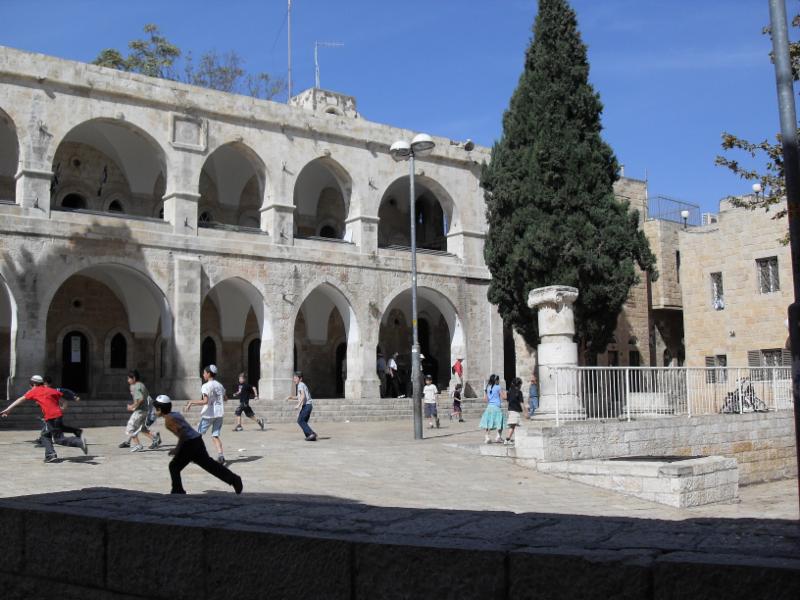
Look closely at this picture. Do you see anything special? Just children playing in a square. Right? Well, not so fast…
This is the Old City of Jerusalem. Some children are playing in a square (and a street) called Bate-Mahase. This is a very important place in the Old city. The two-story building with arches that you see was built in 1871 with funds provided by Baron Wolf Rothschild of Frankfurt to house poor families. The Rothschild family coat of arms is still at the top of the building. Today, it houses the offices of the Jewish Quarter Municipality. In this courtyard, you see a very familiar scene: children running and playing. This happens every day because there are two schools close to this courtyard: The No’am Talmud Tora and the Sylberstein Yeshiva.
What you don’t see in the picture is another familiar view: elders, old men, and women sitting on the benches of the square. Elders love the sight of children, and many times after school hours, grandparents would come to this square to play with their grandchildren.
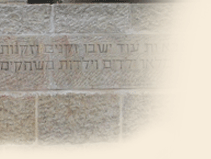
There is something else in this place. Look at the following picture.
There is a scripture carved in stone. It’s a quote from the prophet Zekhariah, 8:4-5. Zekhariah was a child when the Jews lived in the Babylonian exile 2500 years ago. Without their own land and without the Bet HaMiqdash, the future of the Jewish people looked very grim. They were hopeless. In normal circumstances, Jews would have naturally integrated (assimilated) into the Babylonian population and disappeared. But a miracle happened. Cyrus, the Persian emperor, was moved by HaShem (as he explicitly declared) and encouraged the Jews to come back to Israel and rebuild Jerusalem. Although the majority of the Jews chose to remain in Babel (the first but not last “voluntary exile”), thousands came back.
Zekhariah was among them. They found a completely destroyed city. Everything was ruins, ashes, and desolation. There was not even a wall to protect the city, which made living in the city a mission impossible (imagine living in a house without one of its outside walls).
But from the midst of this desolation, Zekhariah had a prophetic vision, a very unlikely scenario to happen, given the terrible conditions of Yerushalayim in his days.
This prophecy, engraved on that stone, is in Chapter 8, verses 4-5:
“And now, HaShem says: I will return to Mount Zion, and I will dwell in Yerushalayim…. And once again, old men and women will walk Jerusalem’s streets with their canes and will sit together in the city squares. And the streets of the city will be filled with boys and girls playing in it.”
Let us now see the whole picture: you are in Bate Mahase, reading this extraordinary verse engraved on the stone in front of you. On any given day, elders sit on a bench and children play in the street. Then you realize that you have the incredible merit of being a living witness to the fulfillment of Zekhariah’s prophetic words. You also understand that you are not just a witness of Zekhariah’s prophecy but rather the embodiment of that prophecy. You get the feeling that 2500 years ago, in his incredible vision, Zekhariah saw you.
The Inexplicable Ceasefire of (June 11th, 1948).
(This article is the continuation of the article found at this link).
Israel’s War of Independence was the most critical battle for the survival of the Jewish State. It began on the evening of May 15th, 1948, when the British army withdrew from their region. Throughout the first few weeks of the war, the United Arab armies were defeating the newborn State of Israel, despite a heroic resistance. But Israel was not able to stop the advance of five strong armies with planes, ammunition, and counting with the implicit support of the rest of the world. Before beginning their attack, the Arabs, confident in their impending victory had said that “what Hitler did was nothing compared to what they would do with the Jews living in Israel.” It was a horrible dejavu of the Shoa, to see that the world remained silent. But HaShem was with us. And the unimaginable occurred. Israel not only survived the invasion of five Arab armies but against all odds, won the war in a way no one could have anticipated.
THE MIRACULOUS CEASE-FIRE
According to Dr. Hagai Ben Artzi- professor of history at Bar Ilan University (and brother-in-law of former Israeli Prime Minister, Benjamin Netanyahu) the greatest miracle of this war was that the Arab armies accepted a ceasefire. The proposal came from the Swedish Folke Bernadotte, who had been designated as a mediator between the Arabs and Israelis by the United Nations. The ceasefire proposed to stop all military activity for four weeks and stated that the armies would remain in control of the positions they had conquered. Israel, which conquered nothing and was cornered everywhere, immediately accepted the proposal. The unexplainable, however, is that the Arab armies also accepted the proposal. I quote Ben Artzi from his (Hebrew) book- Megillat Hatequma VeHaAtzmaut: “…but why did the Arabs accept the ceasefire …? …they had almost reached all of their military objectives: Jerusalem was surrounded and besieged; Tel Aviv, a very short distance [from falling]; southern Israel [the Negeb] disconnected from the rest of the country, and the Galil, the North, was already conquered. A little more effort on the part of the Arabs and they were already in the heart of Jerusalem, Tel-Aviv, Petah Tikva, Netania, Hadera, and Afula. … ” Ben Artzi does not hide his conviction that this ceasefire was indeed a miracle of Biblical proportions. The enemies of Israel retreated as if possessed by an imaginary panic.
A BIBLICAL FEAR
Among other examples of this sort of Providential intervention, Ben Artzi mentions what happened on May 30th, 1948. Israel went to war without a single military plane. While the Arabs had over 75 active warplanes. The only country which dared to break the embargo and sold weapons to Israel was Czechoslovakia. By the end of May, four unarmed German “Messerschmidt” military planes arrived in Israel inside a transport plane. The planes were quickly assembled and on May 30th, and without even a test run, were sent on their first operation: trying to stop the Egyptian forces that were only 30 Kilometers away from Tel Aviv. These new Israeli planes took the Egyptians by surprise but did not cause severe damage, because the weapons did not function very well. Nevertheless, the Egyptian commander sent an urgent message to his headquarters saying that they could go no further because they were heavily bombarded “by a force far superior to them”. This “military assessment” was based more on imagination than reality. Ben Artzi also cites the reports of an Egyptian officer who fought in that battle and was taken prisoner by the Israelis in the 1956 war. When asked why the Egyptians did not continue their advancement towards Tel Aviv in ’48, when they had the whole area open to them, he said, “In the two Israeli attacks … we saw something that shook us: even after being hit by direct fire and suffering large losses, the Israeli soldiers continued to advance as if they were “crazy” (mej’nunin). And we said to ourselves: it is impossible to defeat these madmen. Better [accept the ceasefire and] settle for what we have conquered. ”
ALL ROADS LEAD TO JERUSALEM
Another providential event that occurred was that a young soldier, Moshe Eshed, discovered, “by coincidence” an alternative path to Jerusalem through the mountains, which was named “Derekh Burma.” Through this path, the Israeli fighters were able to send food, medicine, weapons, and reinforcements to the city. There were about 100,000 Jews in Jerusalem at the time, especially concentrated in the Western area, the “Jewish Jerusalem.” They were completely isolated and trapped by the Jordanians, who had blocked all entrances to Jerusalem to avoid any supplies sent in. If this mysterious path- which shockingly neither the Arabs nor the United Nations discovered for six months- had not been found, Jerusalem would’ve collapsed and the war would have had a very different ending.
WHEN WHAT DOES NOT HAPPEN IS A GOOD THING
Despite all efforts, the Old City of Jerusalem (where the Kotel and the Temple mountain are) could not be conquered. By the end of the 1948 war, the Old City still remained in the power of the Jordanians. Until the Six Days War in 1967. Even in this failure, we can see the Divine Hand because if Israel had conquered Jerusalem in 1948, the United Nations would have demanded the internationalization of Jerusalem, a holy city “for the three Biblical religions”. International pressure would have been unsustainable and Israel, which was not strong at that time, would have surely relented. Jerusalem, with international status, would have been impossible to recover. And the long-term consequences for Israel would have been terrible. In the end, the Old City was not conquered by the Jews in 1948 and came under Jordan’s sovereignty. And as expected, no one imposed an “International status” on the city, and there were no complaints to the Jordanians for not allowing the Jews to visit the Western Wall.
Therefore, when in 1967 Israel conquered the Old City, the U.N. could no longer demand from Israel what they did not demand from Jordan for 19 years…
Israel’s Miraculous Independence War (May 15, 1948)
Israel’s victory in the War of Independence, which began on May 15, 1948 and lasted for 10 months, is unprecedented in the annals of military history. This is due, on the one hand, to the incredible courage, ingenuity, and sacrifice of our leaders and fighters, who gave it all to succeed, and mainly to Divine intervention that, battle after battle, miracle after miracle, made it possible.
To understand it better, it is important to remember the following.
ISRAELI ARMY vs ARAB ARMIES
On the day that Israel declared its independence, British troops who had been there since 1922, left Israel. Immediately afterward, that same night of May 15, the Arab armies launched an attack to destroy the newborn state of Israel. The Arabs had absolutely everything in their favor, politically and militarily. Syria, Egypt, Lebanon, Iraq, and Jordan had become independent states a few years earlier, and both England and France had sold weapons to them so that they could have an organized army. Israel, on the other hand, was on its way to becoming an independent State. And no country was supporting the Jewish state. Moreover: England, France, and the United States had declared a strict weapon embargo that prohibited the entire world from selling weapons of any kind to Israel.
At the beginning of the armed conflict, the difference between the military power of Israel and that of the unified Arab armies could not be more unequal.
For example.
The Arabs had 50 tanks. Israel had 1.
The Arabs had 200 artillery vehicles. Israel had 2.
The Arabs had 140 cannons. Israel had 5.
But the most important difference was in the air force. The Arab armies had 60 attack aircraft and 14 transport aircraft. Israel, at the start of the battle, did not have one single plane.
THE LOGIC OF WAR
Before continuing, I would like to stop here and reflect for a few seconds. First of all, it is completely understandable that the Arabs launched a full-force attack against Israel because the chances of destroying Israel, with their absolute military advantage, were 100%. It is also understandable that the Arabs themselves broadcasted by radio to all Palestinians living in Israel –who were not taking an active part in the war– to leave Israel. Assuring them that they would return very soon when the short war was over, and the Jews were “thrown into the sea” (a euphemism for: “murdered”). Hundreds of thousands of Palestinians left Israel. In this way, the Arab countries created the “Palestinian refugee problem” for which they never took charge, and to this day, they continue to blame Israel.
WHO IS NOT RELIGIOUS?
What is indeed inconceivable is that being aware of Israel’s military inferiority, the Jewish leaders made the decision to declare the Independence of Medinat Israel, having been warned of the imminent Arab attack. This decision made absolutely no sense, either from a military point of view or from a logical point of view. Looking at the numbers, it was a suicidal act! Although there is another possibility. An idea that might be viewed as mystical… Every Jew, even a secular Jew, has a “nitzotz”, a “hidden” spark of Emuna. A Divine connection, perhaps, an unconscious one, that is always there, latent, dormant, but lit, like a boiler’s pilot. And at critical moments, perhaps in matters of life and death, this spark ignites the Jewish soul and . I believe that David Ben Gurion and all the “seemingly secular” Israeli leaders of that time, had an epiphany, or a moment of Divine Inspiration when they decided to declare the establishment of the State of Israel. A spark that ignited their Jewish faith and led them to act like Nachshon Ben Aminadab, the man enter into the sea, and when the water reached his nostrils, he continued “knowing” that the sea was going to open up for him. Israel’s leaders (miraculously, if you will) relied on a miracle that “had to happen”. And in the end, it happened.
I can’t find a better explanation.
THE DARKEST HOUR The entire world was certain that Israel’s defeat was a matter of days, or perhaps a few weeks. And they were not very wrong. During the first four weeks, the Arab armies advanced significantly and reached Ashdod, 30 kilometers south of Tel-Aviv. From Ashdod, they reached Hebron and thus they divided the Negev from the rest of the country.
The powerful Jordanian legion, which had been trained by the British, managed to besiege Jerusalem from all sides. A frontal attack was imminent. Jordanians also captured Lod and the airport (today, Ben Gurion International) and were approaching Tel-Aviv from the east.
Iraqi forces had attacked the Shomron and were approaching the cities of Petach Tikva and Hadera, en route to Tel-Aviv.
The Syrians came from the north and were encircling the city of Tiberia. Together with Lebanon’s military forces, they were isolating the northern Galil from the rest of Israel. Their final destination was Tel-Aviv.
All efforts by the newly created Israeli Army to defend Jerusalem from Jordanians or to repel Egyptian, Syrian, or Iraqi forces failed.
During the first weeks of the war since May 15, 1948, all predictions about Israel’s brutal defeat were fulfilled. Despite the sacrifice and bravery of our soldiers, the military superiority of the Arab armies was insuperable. There was no way for the Israeli forces to withstand the enemy’s attacks for even a few more days…. it seemed that the end was imminent.
And then, the first great miracle of this war occurred. It was June 11, Sivan 4, 1948.
The Balfour Declaration And A Home For The Jews (1914-1917)
אמר לו ר ‘חייא: כך היא גאולתן של ישראל, בתחילה קמעא קמעא, כל מה שהיא הולכת, היא רבה והולכת
In 1914 it seemed that the project to obtain a Jewish State of its own had failed (see here). The land of Israel was in the hands of the Ottoman Empire, which did not view with good eyes the increase of the Jewish population in “Palestine”. Nor did we have the minimal international political support needed to create a home for Jews. Immigration stopped and o make it worse: many immigrants who had arrived in Israel in the past decades returned to Europe or emigrated to the United States since the living conditions in old Israel were very precarious. It seemed that the Zionist dream was over.
Then, on July 28, 1914, the First World War broke out. It was a terrible war that claimed the lives of some 40 million people, military and civilians. The war also brought unexpected changes in England and the Middle East. The most important of these changes from Israel’s point of view was that the Ottoman Empire, which had ruled the Middle East for more than 500 years, was now defeated. At the end of the war, in 1918, England was in control of what is today Iraq, Syria, Lebanon, Jordan, Saudi Arabia, Egypt, and of course, Israel.
THE CHURCH AND THE JEWS
In 1916 Herbert Henry Asquith resigned his post as Prime Minister of Great Britain and in his place came David Lloyd George. The attitude of these two leaders towards the Jews was completely opposite. Asquith, a catholic, opposed a Jewish State. Lloyd George, on the other hand, had a different religious upbringing. To understand his beliefs, I must briefly explain the main differences between the Catholics and Protestants, as to how each one perceived the Jews and their role for centuries. The Catholic Church was founded on the essential premise that the Church (Latin for “congregation”) is the “New Israel”. This New Israel REPLACES / DISPLACES ancient Israel – that is, the Jewish people – as the people of God. This New Israel also has a New Testament, that is, a new Covenant (as in Hebrew ברית החדשה) that replaces the Old Testament, which “expired with the imminent extinction of the ancient Israelites.” The main problem that this foundational dogma always faced was that “the stubborn Jewish people, in spite of being permanently in the verge of extinction, persisted in continuing to exist!”. The Church then changed its narrative and argued that the capricious existence of the Jewish people was a Divine Punishment for deicide (i.e., the killing of a god). And the evidence is that the Jews were now condemned to permanent exile (“The Wandering Jew”) and as a consequence, they will NEVER return to their homeland! Therefore, the return of the Jewish people to the land of Israel was (and it largely remains) for the Catholic Church a huge fundamental theological challenge for their faith and religious principles. A good example is the Vatican’s hostile attitude towards acknowledging the right of the Jewish People to the Land of Israel, or the refusal of the Pope to recognize a Jewish Jerusalem (see this ).
EVANGELICAL CHRISTIANS AND THE JEWS
The attitude of many Protestants towards the Jewish people is very different. There is a very big support for a Jewish Israel, and it is not something new. This historical attitude might have begun with Oliver Cromwell (1599 -1658), who supported the return of Jews to Israel, albeit, for their own religious views. Many Protestants today maintain that it is great merit in itself to support the Jewish people and their State since they believe in the blessing that HaShem granted to Abraham Abinu when He said “Those who curse you will be cursed and those who will bless they will be blessed. ” Many Christian Englishmen held this religious belief as well. Among them, were David Lloyd George and his Foreign Minister Arthur Balfour, who were enthusiastic supporters of the Jewish people and understood their aspirations to return home.
ACETONE, AND THE STATE OF ISRAEL
An important factor that enhanced the British predisposition to grant a national home to the Jewish people in the land of Israel was the contributions of the famous Jewish scientist Chaim Weizmann (1874-1952) to the Commonwealth. Weizmann, born in Russia but nationalized British, was a chemist who discovered the formula to produce acetone from grain starch. Until then, acetone used to detonate dynamite was difficult to produce, increasingly expensive, and critical to winning the war. Dr. Weizmann was in charge of producing 30,000 tons of the critical chemical element through the process known as “ABE fermentation”. For this and for other discoveries Dr. Weizmann is known in the scientific world as the “father of industrial fermentation”. At the end of the war, the British were very grateful to Dr. Weizmann for his invaluable services and asked him how could they repay him for his contributions. It is said that Doctor Weizmann answered: “I do not want anything for me, but I want a home for my people.” And so it was that in 1917 the Balfour Declaration emerged, and the British officially approved the creation of a national home for the Jewish people in the land of Israel. This was the beginning of what eventually culminated with the miracle of the birth of Medinat Israel in 1948.
Chaim Weizmann And A Sefer Tora In The White House
THE JEWISH STATE OF UGANDA
Weizmann was born into an Orthodox family in Belarus, Russia, in 1874. He was one of 15 siblings. He studied chemistry in Germany and stood out as a gifted student. Aside from his great intelligence, Weizmann also had great charisma and a charming personality, something not very common among intellectuals and scientists. From his youth, Weizmann was interested in the Zionist movement and participated in the congresses led by Theodore Herzl. At the 1903 congress, Herzl made a very controversial statement, thinking that he had already exhausted all other options, he accepted the British offer to establish “a national home for the Jewish people … in Uganda, Africa; a territory that belonged to the British Crown”. When Herzl announced his acceptance of this plan, Weizmann left the congress in protest along with the entire Russian delegation.
BECOMING BRITISH
In 1904 Weizmann was invited to teach at the University of Manchester, in England. Later, and after obtaining British citizenship, he met Lord Arthur Balfour, a very influential English politician. Balfour tried to persuade Weizmann to support Uganda’s offer. But far from changing his opinion, Balfour was persuaded by Weizmann that Israel (then called “Palestine”) was the only national and spiritual home of the Jewish people: “If I offered you to go to Paris, you would not go there, because London is your home, “ Weizmann told Balfour, ” Jerusalem has been our home when London was still a swamp. ” So passionate and contagious was Weizmann’s conviction that from that moment Lord Balfour became a great ally of the Zionist movement and supported for the rest of his life the return of the Jews to Jerusalem.
WAR AND ACETONE
In 1914 England declared war on the German Empire and its allies. This was the First World War. England had a very serious technical problem: did not have acetone, an essential solvent to activate artillery fire and dynamite. For many years England imported acetone from Germany, something that was not possible now. Winston Churchill came to Weizmann urgently and asked him to work on a formula to produce acetone locally, fast, and in large quantities. Acetone was normally made from wood, and it took hundreds of tons of wood and a very difficult process to distill it. Weizmann, who was already known in scientific circles as “the father of industrial fermentation” began working day and night on his mission until he finally developed the formula to produce the precious solvent from corn and potatoes, materials that were much easier to obtain. If Chaim Weizmann had not discovered the formula for producing acetone, England would not have won the First World War. This was well known to Lloyd George, who was the Minister of Defense during the First War and later became Prime Minister of Great Britain.
WHAT CAN THE CROWN DO FOR YOU?
Towards the end of the war, and when England had already displaced the Ottomans from the Middle East, Lloyd George thanked Chaim Weizmann for his services and asked him: “What can England do for you?” Chaim Weizmann replied: “I don’t want anything for myself, but my people need their own land.” And that is how in 1917 Lloyd George and Arthur Balfour drew up the document known as the Balfour Declaration, granting the Jewish people “the first national home”, neither in Uganda nor in Entre Ríos, but in the Holy Land of Israel! This was the beginning of what eventually culminated in the miracle of the birth of Medinat Israel in 1948, where, as we will see now, Chaim Weizmann also played a decisive role.
THE AMERICAN VOTE
On November 29, 1947, the United Nations voted to divide Palestine and create two states, one Arab and one Jewish. But neighboring Arab states warned that they would not accept a Jewish State and they will declare war on Israel. They also did everything possible in the political arena to prevent the nations from accepting a Jewish State. The British chose to remain neutral. And the US government, which had voted in favor of a partition, began to have its doubts and was planning to vote for delying a final resolution. This meant that if the Jewish State declared its independence, the United States, its most important ally, would oppose or at best abstain from voting, and thus the creation of a Jewish State could be suspended or canceled. The US vote was in the hands of President Harry Truman. In the first months of 1948, Truman refused to meet with any American Zionist leaders because he wanted to maintain America’s neutrality in light of the tremendous pressure he had from the oil-rich Arab countries. May 15th, the date on which the British were to leave the territory of Israel, was approaching, and Truman’s support for the future declaration of independence was absolutely necessary. Chaim Weizmann was in the United States to guarantee the US’s support, but Truman refused to receive him.
MILLIONAIRES LOOKING FOR COINS
On March 12, 1948, Dewey D. Stone of Brockton spent the day in New York City with his friend Chaim Weizmann, who expressed concern about Truman’s refusal to meet with him. Stone was a passionate American Jew and that night, he returned to Boston and met with Frank Goldman, president of B’nai B’rith. Stone shared with him his concern that there was no way that President Truman would agree to meet with Weizmann. Goldman said that by coincidence, he recently saw Eddie Jacobson in Kansas, who received an award from the B’nai B’rith, and that Jacobson shared with him that he was a personal friend of President Truman and his partner in some businesses. Goldman offered to call Jacobson right then and there and ask him to see Truman as soon as possible. But they ran into a problem: they didn’t have enough coins to make a long-distance call. It is told that the two millionaires, Stone and Goldman, went table by table asking for quarters until they had enough coins to call Jacobson. Jacobson was not very enthusiastic. He said that convincing the President was going to be impossible. Stone then invited Jacobson to New York and took him to see Chaim Weizmann. Like Balfour and so many other people before him, Jacobson was absolutely captivated by Weizmann’s personality and passionate arguments, and at the end of the meeting, he accepted to talk to Truman. Stone told him “all you have to ask President Truman is that he would agree to meet with Weizmann. Weizmann will take care of the rest.”
CAN YOU SAY NO TO A FRIEND?
When Jacobson arrived at the White House, “unannounced”, President Truman was very happy to see him but warned him that he would not agree to talk about Palestine or the partition plan. Jacobson nodded and said to Truman, pointing to a bust of Andrew Jackson: “I’m not going to talk about Palestine. I just want to ask you to meet Chaim Weizmann, a national leader with the same values and temperament as Jackson”, whom Truman revered. Truman laughed because he fell into the trap of his friend and had no choice but to give in. Truman and Weizmann finally met in Washington and by the end of the meeting, Truman was so convinced of the Jewish cause presented by Weizmann that he promised to recognize the State of Israel when the British would leave.
A SEFER TORA IN THE WHITE HOUSE
On May 14th, 1948, when the British were about to leave, Ben-Gurion declared the creation of the State of Israel. President Harry Truman, keeping his promise to Chaim Weizmann, recognized the newly created Jewish State just 11 minutes after its founding. Chaim Weizmann was appointed as the first President of the State of Israel, a position he held until his death in November 1952. One of the first things Weizmann did after being elected President was to visit Washington DC. On May 25, 1948, Chaim Weizmann visited the White House, he thanked president Truman for recognizing the Jewish State and presented to him a Sefer Tora (see picture above) for his friendship and support for the People of Israel.
Once the First World War was over, the League of Nations was created. It was the first international organization in history, created to maintain world peace and prevent the emergence of other armed conflicts.
This League was headed by the nations that triumphed in the First World War: Great Britain, France, Italy, etc.
On April 23, 1920, almost 100 years ago, the League of Nations met in the Italian city of San Remo to reorganize the “world order” and promote peace. One of the issues they discussed was the division and administration of Middle East lands. Until 1918 the Middle East was part of the Ottoman Empire, which gave the local mandate to different heads of ethic grupos, clans or Arab tribes. There were no states like Syria, Iraq, Jordan or Saudi Arabia. The League of Nations sought to establish a political order to replace the governing structure of the Ottoman Empire. The Middle East was divided into a few areas, like Syria and Lebanon, were under the french mandate; Mesopotamia (Iraq) and Palestine, what today is Israel and Jordan, were under the British mandate.
Why were the great superpowers interested in investing their efforts in the Middle East? Before the end of the First World War, no one had much interest in these deserted lands, with little water, and useless for agriculture.
However, towards the end of the War it was discovered that these lands were rich in oil reserves, and thus interest in the Middle East increased.
SAN REMO AND THE TWO SIDES OF JORDAN RIVER
In the Balfour Declaration, 1917, England committed to the creation of a National Home for Jews in the Land of Israel, which back then was known as “Palestine”. The Balfour declaration was also legally validated by France (February 14, 1918), Italy (May 9, 1918), and the United States (August 31, 1918).
Now in San Remo the Balfour declaration was given its definitive international recognition.
I think the most remarkable thing of the San Remo resolution is that the Jewish Home in Palestine included what is now the state of Israel, with Gaza, Jerusalem, Judea, Samaria, etc. and it also included the entire territory of what is today Jordan (officially: The Hashemite Kingdom of Jordan).
As you can see in the map above, that was the territory conceived by the League of Nations in San Remo, 1921, to establish the Jewish State.
In San Remo, the nations also assigned to Great Britain the mandate to implementing the establishment of a Jewish Homeland. For this, England assigned a Jewish British High Commissioner for Palestine: Sir Herbert Samuel (1870-1963), who was also the first observant Jew to become a member of the British cabinet (see this)
CHURCHILL and THE WHITE PAPER
But the Arab leaders were not happy. They did not accept the decision of the League of Nations and began to attack and kill Jewish civilians in Tel Hai, Yerushalayim and Yafo, etc. This terrorist tactic unfortunately worked out for them: on June 3, 1922, Britain wrote the White Paper.
This document was signed by Winston Churchill, who visited Jerusalem in 1921 and met with Arab and Jewish representatives (see video below). Churchill decided that “Palestine” was going to be divided into two states: one, on the Eastern side of the Jordan River, which would be ceded to the Hashemite Arab clan to establish its kingdom there, and rule over the Arabs of the region. And the other state, on the Western margin of the Jordan River, would be the territory destined for all the Jews of the world.
The Zionist Organization complained to the English authorities who had yielded to Arab violence, establishing a dangerous precedent (whose echoes continue to this day). One of the voices that denounced this betrayal was that of the famous Jewish leader Zeev Jabotisnky. In those days they sang the famous BETAR movement song : שתי גדות לירדן, זו שלנו זו גם כן “The Jordan River has two banks (the eastern and western territories), one is ours and the other one too. “
This division that ceded to the Arabs two thirds of the territory promised to the Jews, was finally ratified by the League of Nations, as a way to reach a “peaceful compromise”, which would allow the two peoples, the Arab and the Jews, to live peacefully next to each other.
The Jews had no choice but to accept “the two states solution”, with the (naive!) hope that we would finally live in peace and harmony with our Arab neighbors ….
I hope we have learned the lesson!
To be continued…
[To clarify, “Palestine” is the name given at that time to the land of Israel and to the Jewish National Home under the British mandate. There never existed an Arab Palestinian State, a Palestinian nation or a Palestinian people, or anything like it. In any case, according to what we wrote today, “the designated land for Arabs in Palestine is ‘Jordan'”].
In this video you can see the Great Rabbis of Israel coming out of a conference with Winston Churchill. Rabbi Abraham Isaac Kook, Chief Rabbi of the Ashkenazi community in Israel (with a fur hat); Rabbi Yosef Chaim Zonnenfeld, Rabbi of the Eidah Haridit (with long white beard); Rabbi Yaacob Meir, Chief Rabbi of the Sephardic community (with a traditional turban).