12th PRINCIPLE: Was Yeshu the Messiah?

Today we’ll talk a little more about the Messiah, and next week, BH, I will write on what Mishne Tora says about the “Messianic times”.
We explained earlier that the Messiah or Mashiah will be a monarch, a ruler of Israel, a descendant of the dynasty of David, with a position close to that of King David and Bar Kokhba.
His mission: to bring all the Jews back to Israel and rebuild the third and final Bet haMiqdash.
Maimonides also insists again and again that the Messiah will not come to change the laws of the Tora. On the contrary, he will come to teach, implement them and defend them.
This is what Maimonides says when he talks about the ways to identify who is NOT the Messiah (Hilkhot Melakhim 11: 3):..
“Our Torah, its precepts and laws, will never be changed. Nothing will be added to its precepts and none will be void or removed. If anyone suggests [on behalf of God] to add or to remove a commandment, or to interpret it out of what our tradition explains [גילה פנים בתורה והוציא הדברים שלמצוות מפשוטן], we know that he is an impostor or a heretic “.
In other words, if a candidate to be the Mashiah proposes to change even one single law of the Tora, we know that this is a false Messiah. Here Maimonides refers to the two great biblical religions, who accepted the Hebrew Bible, but tried to change, add or remove from its precepts, and more specifically Maimonides refers here to Yeshu (Jesus), because he was a self-proclaimed Messiah of the Jewish people.
Not everyone knows that there are several rabbinical sources that mention explicitly “Yeshu” and how he tried to change the Tora. The Talmud mentions him for example in Masekhet Sanhedrin. Of course, the comments of the rabbis, many of them were contemporaries of Yeshu, were not received with much enthusiasm by the Church. And numberless times the Talmud was burned publicly, with this pretext. In some exceptional cases the Church allowed to reprint the Talmud,  but the paragraphs talking about Yeshu had to be omitted.
With the book of Maimonides something similar happened. Particularly with a paragraph in Chapter 11 of Hilkhot Melachim where Maimonides speaks of the Messiah, and mentions Yeshu. This paragraph was also censured for centuries, but survived in many manuscript editions of the Mishne Tora produced in Arab countries. And only 15 or 20 years ago this paragraph was again reprinted in the new editions of the Mishne Tora.
What does Maimonides say about Yeshu? I quote:
Hilchot Melachim 11: 4a.
“Also Yeshua of Nazaret imagined that he was the Messiah, and he was executed by the order of the court. This had been prophesied by Daniel, who said.” And the children of those indecent among your own people, will rebel in fulfillment of their [own] vision, but they will fail “(Daniel 11:14). And, is there any bigger failure than this? All prophets said that the Messiah will redeem the people of Israel and will save them [from their enemies], and that the Messiah will bring them back to their homeland, and strengthen the observance of the Torah…  and this [man, Yeshu] caused [the opposite]: the death of the Jews by the sword, the exile of the Jews and their dispersion [around the world]; Yeshu tried to replace the Tora, and he deceived most of the world into serving a god who is not HaShem “.
Maimonides explains very clearly why Yeshu represents the opposite of what the Messiah will be for the people of Israel. He attempted to change the Tora, and we were exiled, persecuted and killed, ironically “in the name of Yeshu”… Is this “our” Messiah?.
The true Messiah will lead, and defend the people of Israel from its  enemies. With the help of HaShem, he will fight to protect us and he will bring us all back to the land of Israel, where we will live in peace with our neighbors, free to serve HaShem in the Bet haMiqdash, study His Tora and observe HaShem’s eternal commandments.


12th PRINCIPLE: Who qualifies to be considered the Jewish Messiah?

The 12th principle of the Jewish faith declares our belief in the coming of the Messiah (in Hebrew “Mashiah”).

When we speak of the Messiah, there are two issues that must be treated independently. One is “the person of the Messiah” and the other is the “Messianic Times”. Today we will talk about the person of the Messiah, that is, who can be considered as a candidate to be the Messiah.
Maimonides says that an individual can be considered as the Messiah if he meets three requirements a priori and two posteriori. And only when all these five conditions are met we can say that this person is the true Messiah:
Maimonides says in chapter 11 of Hilkhot Melakhim, Halakha 4 (numbers and parentheses are added by me for better understanding):
“If a king will arise (1) from the House of David (2) who diligently studies the Tora and observe its mitsvot, as set out in the Written Tora and in the Oral Tora, as David, his ancestor, and he would urge all the people of Israel to walk in the (way of the Tora) and he would correct the breaches in the observance of the Torah [i.e., he would rectify what the Jews are doing wrong in terms of religious observance], (3) and he would fight the wars of God, he could be considered the Messiah. If he is successful in the foregoing, and (4) he builds the Bet haMiqdash [= Temple] in its place [= har Habayit, Jerusalem], and (5) he gathers the exiles of Israel, one can then say without a doubt that this person is the Messiah. “
Let us analyze this text step by step text.
Yesterday we explained the first pre-requisite
(1) To be a descendant of King David. This would exclude automatically, for example, anyone who is Kohen or Levi, because David belonged to the tribe of Yehuda. For more detail on this point, see what I wrote yesterday.
There are two other requirements to be met.
(2) To qualify as a candidate for the Messiah, this person must be a studious and observant of Tora, both the written and the oral Tora law, as was King David. He must be a leader who cares and does everything possible for the Jewish people to behave according to the Tora, both individually and collectively.
(3) The Messiah must fight the “wars of God” (לוחם מלחמות ה ‘). What does “Wars of God” mean? It does not refer here to “wars” in a metaphorical sense, as if the Messiah ought to be the commander of a “Salvation Army” or fight “spiritual battles” (that is actually part of the second condition) or command an army of children. “HaShem wars” are the real wars and real military battles that we Jews fight against our enemies, as we fight today in Israel (see Hilkhot Melakhim 4:10, 7:15).
The models taking into account by Maimonides, and which he explicitly mentions in his description of the Messiah, are two historical characters: one is King David, who obviously met the three requirements (the other two were not applicable in his kingdom). And the other one is Bar Kokhba (ca. 90 -135 CE).
Maimonides cites Bar Kokhba in a different context: to explain that doing miracles is not a prerequisite for being considered the Messiah:
Hilkhot Melakhim, Halacha 3
“Do not assume that the Messiah must perform miracles and wonders … or perform other similar actions [to qualify as a candidate to be the Messiah] as the ignorant say. This is definitely not true. The evidence we have is the case of Rabbi Aqiba, one of the greatest sages of the Mishna, who supported the king Bar Kozibah [Bar Kokhba] and considered him [a priori] as the Messiah. He, and all the Sages of his generation regarded him as the anointed King [= Messiah] until he was killed [in battle] because of the sins. Once he died, [the Sages] realized that he was not the Messiah. Still, the Sages never asked him to do miracles or wonders [to be considered as the Messiah].”
Bar Kokhba met indeed all the requirements of the Messiah: (1) He was a descendant of David (2) he was a very observant Jew, who imposed the law of the Tora (see this) and (3) he fought against the enemies of Israel, then the Romans, in order to establish a Jewish state, independent of Rome, where the Tora would be the law of the land. In this independent state the other two conditions should have been met (4) rebuilding the Bet haMiqdash (the Temple destroyed by the Romans in the year 68 of the Common Era) and (5)  repatriating to Israel all the Jews who were exiled when the Romans destroyed the Bet haMiqdash.
When Bar Kokhba died in battle, the sages realized that, while Bar Kokhba had all the attributes for being Israel’s leader, he was not the Messiah they were waiting for.
To be continued…


11th PRINCIPLE: Divine Justice: who, when, where and how?

The eleventh principle of Judaism says that God is just. He rewards those who keep His commandments and punishes those who transgress them.

Where do we learn this principle from?

Maimonides explains: When Bene Israel made the golden calf in the wilderness, and HaShem told Moses that the Jewish people deserved to be eliminated for this great sin, Moses interceded and begged God to forgive His people, and he said: If You do not forgive them, “erase me from Your book that You wrote” [= kill me]. God replied to Moses: “[Only] those who sinned against Me, those individuals will be erased from my book.

From here we see that HaShem does not act arbitrarily but with a justice that is comprehensible to us, in that every human being, based on their free will, is responsible for his or her own actions.

Beyond this basic notion,  we cannot understand most details of God’s execution of justice, because as it is well explained in the book of Job, this understanding is beyond our mental capacities.

Some examples.

1. We do not know, for example, WHO deserves to be punished or rewarded and who does not. Since we ignore how HaShem exactly measures our merits and mistakes. Let me explain: Only God knows the true potential of a man, “our denominator.” A math teacher would assess two students by the same yardstick: If student “A” answers correctly 8 questions in a test, his score will be 8. If student B answers correctly only 5 questions, his score is 5. Hashem in virtue of His omniscience (= He knows absolutely everything) knows, for example, that the student who answered 8 questions had the ability to respond well 10 questions, but he did not do his best effort.   While the student who answered 5 questions has the intellectual potential to respond well 5 questions, he made every effort to achieve his full potential, and he did it. Now, while for the math teacher, 8 is greater than 5, and “A” will be rewarded and “B” will be punished, for HaShem, 5 will be greater than 8. Because although 8 is greater than 5, the truth is that 5/5 is greater than 8/10. God’s “privilege” is that He (and only He) knows the denominator of each individual, and therefore He alone can determine whether A or B deserves to be punished or rewarded.

2. We also ignore WHEN and WHERE  Divine justice will be served. We Jews believe in life after life, in the immortality of the soul. And that there is not necessarily an immediate reward for an act of kindness, and no automatic punishment for a transgression. We do not always see with our own eyes the punishment of the wicked and the reward the righteous. The execution of God’s justice, both punishment and reward, is not limited to this earthly life. And it is possible that a bad deed will be punished in the next world, after this life, and not in this world. Or viceversa.

3. We do not know HOW would God punish or reward us.

We know that HaShem never punishes in the sense of revenge, and we also know that not all suffering is a punishment. Sometimes we have to suffer in this life to correct ourselves, to leave our bad actions, or to educate ourselves on the highest ideals. Perhaps to understand the suffering of others,  to become more sensitive and get closer to God, etc.

Our sages also explained that there are feelings and emotions that are part, or and atonement, of our punishment, like remorse and guilt. Or the loss of our own self-esteem, provoked by our bad actions.Or the loss of our respect; or the shame that our sin causes to our families; or the awareness that we have offended God, Who gives us so much. These are all forms of “punishments” or “expiations” for the sins committed.

In sum: HaShem is righteous. And although we do not know precisely who, when, where and how, good deeds are, or will be rewarded, and evil will be punished.


10th PRINCIPLE: Living under His sight

The Creator, blessed be His name, knows all of man’s deeds and thoughts.”He who molded every heart together, He understands what each one does.” (Psalm 33:15.)


The Tenth principle asserts our belief that the Creator knows all the thoughts and actions of man. HaShem is all-knowing, or omniscient i.e., He knows everything.


His knowledge, obviously, is completely unlike our knowledge. We ‘acquire’ knowledge (now I don’t know, now I do ) while His knowledge is not something that can be separated from His essence  (there is not such a thing as ‘God knows now something He ignored before’)…He and His knowledge … are One… This concept is beyond the power of speech to express, and beyond the power of the ear to hear. There is no way the human mind can comprehend it” (Maimonides  MT, Yesode haTora 2:10).


Man cannot understand the nature of God’s knowledge, i.e., how God knows what we are thinking or feeling, or how His knowledge of the future does not compromise our freedom of choice, etc. As the prophet Yesha’ayahu said (55:8): “My thoughts [=God’s thoughts] are not your thoughts, My ways are not your ways”.


What we do understand about God’s knowledge, and which concerns us the most, is that God knows us intimately.


In the words of Rabbi Hayim Pereira-Mendes : “Whatever we do or say or think, God knows it.   It is useless for us to try and deceive God by false excuses. God knows our thoughts. God knows what conduct should be expected of us by reason of our intelligence or education or environment. The greater our intelligence, the better our education, the more enlightened our environment, the higher are the ideals of conduct expected from us by God…. God has given us the power of discerning between right and wrong. He knows that we possess that power. Therefore we must use it rightly and wisely.”


Beyond its philosophical value, this principle signals primarily our ethical responsibility: we must live a life with the consciousness that God knows our thoughts, actions and intentions. We might easily deceive other human beings.  Hide our negative intentions or secrets plans behind eloquent words, rhetoric or gestures.   But when it comes to God,  there are no lies, excuses or pretensions.  The more we become alert of God’s omniscience, the easiest to live a life of righteousness. And vice-versa.


The Shulhan ‘Arukh (or more precisely, the glosses of Rabbi Moshe Isserles, 1520-1572, or MURAM) in the first article of the first chapter, explains this idea deeper. He implies that having HaShem present and realizing that nothing is hidden from His sight, protects us from ourselves, “As it is said in Tehillim: “I’m aware of [lit. I put] HaShem’s [Presence] always in front of me. ” This is a greatly important concept in the Tora, and it is the fundamental quality of the tsadiqim (righteous people) who conduct themselves on the paths of HaShem. Since the way a person conducts himslef … and performs his daily activities while alone at home is not the same as when he is in front of  a sovereign. In addition, the way a person talks or expresses himself, while in the privacy of his home …is not the same as when he would address a mortal king. Then, when one sets in his mind that the Almighty King, the Holy One, blessed He is, is in front of him…  then, if a person is about to do something wrong, even privately, the thought of knowing that Hashem is seeing us… will make a person feel ashamed before God, and he will not do any wrong… “


9th PRINCIPLE: Can the Tora be changed or replaced?

We are exploring the 13 principles of Jewish faith. These were first formulated by Maimonides, Rabbi Moshe ben Maimon, or Maimonides (1135-1204) in his Pirush haMishanyot, Sanhedrin Chapter 10.


The 9th principle says that “the Tora will never be changed or replaced. God will never give another Tora or a new religion to the people of Israel or to any other people.”


In Mishne Tora Yesode haTora 9:1, Maimonides also says: “If a prophet comes to change any law of the Tora of Moshe, we would immediately know that he is a false prophet. Whether this prophet is or is not Jewish, and regardless of whether he offers evidence of his divine mission through miracles he can perform… if the prophet says that God sent him to add or subtract a Tora commandment … we know that he is a false prophet. The mission of the true prophets is to inspire the people of Israel to fulfill the Tora and warn the people when they are transgressing it. “


The 9th principle aims primarily to warn us about “Biblical religions”, particularly Christianity and Islam. Both religions are based on a replacement theology which states that the commandments of the Torah must be replaced by a New Testament (Christianity) or a new revelation (Islam).


In last week’s Parasha we read about the most important event in Jewish history, in Hebrew Ma’amad Har Sinai, the event at Mount Sinai. What happened at Mount Sinai? The usual answer is: we received the Tora. But the broader response should be: on Mount Sinai, God chose us and offered us to make a covenant with Him, which we accepted. This covenant or “berit” is known in Judaism as “berit ‘olam”, an everlasting covenant that will last כימי השמים על הארץ “while the heavens are above earth.” And the main part of that “covenant” or “berit” is that we received the Tora. Without going into the details of that covenant, it is interesting to know that in the Christian jargon the covenant is called “testament” (as “testimony”). And the basis of Christian theology is that God replaced ח”ו the Old covenant/Testament for a new one (the intent of this replacement becomes clear when we explore this concept in Hebrew, where the the New Testament it is called “Berit Hadasha ” the new pact). The first reason why Jews reject Christianity is precisely the idea that, contrary to this principle,  the Tora can be modified or replaced.


Probably alluding to another dogma of the Christian religion, Maimonides explains that in messianic times, no commandment of the Tora will be modified. Unlike Yeshu, the true Messiah will come to ensure compliance with all the laws of the Tora, not their abolition or replacement.


The 9th principle also implies that no commandments may be added to, or removed from the Tora, as it is said in Debarim 13: 1 “These words that I command you, you shall keep and observe them, you shall not add to them, nor subtract from them.”


Certainly, there are many commandments of the Tora that we do not fulfill today. But that is because today we do not have the right conditions for doing so. For example, there are dozens of commandments which deal with the religious services at the Bet-haMiqdash, the Temple of Jerusalem, which we have not rebuilt yet.


Are there commandments that are out of fashion? Back in the days of the Greeks many commandments of the Tora were criticized for being “outdated”. For example, The Greeks believed that the weekly Sabbath rest was only relevant to the ancient Judeo-Egyptian slaves, but in the era of “modernity” (250-300 years before Common Era) the Shabbat was outdated, not relevant any more ….  this past Shabbat my son David Bitton, visiting New York, addressed the issue of Shabbat in our days. He said that it looks like Shabbat has never been so necessary as today, in the history of humankind. Because today Shabbat is not just about resting or refraining from work. In our days, Shabbat also helps us to disconnect from the electronic world, from the media-addiction, from cell phones, electronic games, gadgets, etc. All this digital universe around us that, which not only does not allow us to think, but also prevents communication between us and our loved ones. Today, the only people in the world who possess the formula to make their children leaving the phone in order to communicate with their parents around a table, is the Jewish people. And that Divine formula is the “old” Shabbat.


The 9th principle declares that the Tora is not modern. Is eternal.


8th PRINCIPLE: Understanding Rabbinical Laws

Today we will finish our brief explanation about the Oral Tora, and in doing so we will end our presentation of the Eighth Principle, which states that the Written Tora and the Oral Tora are of divine origin.
We mentioned so far three categories of laws, or explanations of Biblical laws: 1. The Perush. 2. Halakha leMoshe MiSinai and 3. Dinim Muflaim (see below).
There are 2 more categories which we will explore today:
4. Gezerot (prohibitions). and 5. Taqanot uMinhaguim (decrees).
These are two rabbinical categories, that is, laws that were enacted by rabbinical courts in the times of Talmud. The main rabbinical court, or Bet Din HaGadol, had the authority to enact new laws, when they saw fit. This Bet Din was like the Supreme Court of the Jewish People. Once the Talmud was closed in the year 500 of the Common Era, this “national” rabbinical court disappeared. Since then and until today, there is no central Court that can legislate new decrees for “all” Am Israel, or revoke decrees issued by those Talmudic courts.
Since the Talmud was closed, the lawmakers Rabbis (or posqim) might rule new cases by deriving or comparing them with Talmudic legal precedents, as it was shown yesterday with the case of hatsitsa. However, in the absence of the “Supreme Court of Am Israel”, the authority of Rabbis is limited to the confines of their own communities, which is why there are numerous differences in some details of the commandments between the different communities.
Some examples of these two categories:
4. Gezerot: the rabbis of the time of the Mishna (10-200 of the Common Era), experienced the exile of the Jews, which began with the destruction of the Bet haMiqdash (68 CE). One of the dangers of this new situation was the risk of assimilation with other nations. The rabbis then decided to limit the interaction with the gentile society in social contexts. And they enacted some restrictions, or “barriers to limit socialization” (in rabbinic Hebrew משום חתנות או משום בנותיהם). They banned for example, the consumption of wine produced by non-Jews (סתם יינם), homemade bread, and cooking some meals (עולה על שולחן מלכים), even when all elements were Kosher, etc. All these laws, as we explained, were established to limit socializing with gentile society and remind the Jews in exile that they must make every possible effort to live in peace and behave with great respect with their gentile neighbors, but they must avoid socializing, which could lead to intermarriage.
5. Taqanot and Hanhagot (decrees and customs). These are, for example, the Rabbinical “mitsvot” , like lighting candles before Shabbat, reading Megillat Esther on Purim, lighting the Hanuka candles etc. “Customs” means rabbinical decrees which began from the people’s practice, and later on were enacted into law by the rabbinical courts. For example, celebrating two days of Yom Tob outside Israel.
A very important point: in Parashat Shofetim the Tora says that when any doubts arise about a Biblical law of any kind, the case must be referred to a Bet Din or rabbinical court. Thus, the Supreme rabbinical court was actually acting as an extension of the Biblical authority, and as such had the authority to interpret the law (Dinim Muflaim) and enact new restrictions (gezerot) and decrees (taqanot). That’s why, for example when lighting the Shabbat candles, which is a mitsva established by the Rabbinical Courts, we say the Berakha: “Blessed are  You HaShem … that You have commanded us to kindle the Sabbath candles” as if HaShem had commanded us this commandment directly in His Tora. Maimonides explains that the words of this Berakha must be understood in this way: “Blessed are You Hashem … that You have commanded us to ‘obey the rabbinical courts which ordered us to’ light the Shabbat candles.
We conclude now this brief overview of what is and what covers the Oral Tora,inviting again the avid reader who wishes to know this issue in more detail to study the book MATE DAN, by Rabbi David Nieto
IMPORTANT CLARIFICATION 
 
My son, Rabbi Yaaqob Bitton, wrote yesterday a comment to my brief, and perhaps imprecise, explanation of DINIM MUFLAIM, which I am sure will serve to clarify some doubts that the reader advanced reader might have. See here


8th PRINCIPLE: The journey from the Written Tora to the halakhic practice

Last week we explained that the first category of laws of the Oral Tora is the PERUSH, that is the basic definition of each Biblical precepts and its extension (see this).
The second category is called Halakha leMoshi MiSinai. Briefly, this category also defines the details of the mitsvot, perhaps more specific details than the first category, such as: the color of Tefillin, the size of a mikveh, the amount of matsa  to be eaten on Pesah, etc. What is the difference between these two categories?
While for the category PERUSH there is always some biblical allusion or source, the specifications classified as Halakha is leMoshe miSinai do not have a Biblical source.
What do they have in common, these two categories? The details of the mitsvot included in both categories (1) were received by Moshe Rabbenu and (2) there is no disagreement on them.
Let’s clarify this last point: Many times there is no consensus among the rabbis about certain laws. This rabbinical dissent  is known as “mahloqet” (lit. debate, discussion, disagreement).
Let’s continue with the example of Tefilin:
The WRITTEN TORA says: “You shall bind them as a sign on your arm.” No further specification in the text about how to “binding words to the arm”.
The PERUSH, says: this is the arm’s Tefilin, which should have four biblical texts, inside a leather box, which should be placed in the weakest (usually the left) arm, etc.
HALAKHA LEMOSHE MISINAI: The box of Tefilin must be square, the leather straps: black, the knot should be done a certain way, etc.
On all these and many other details there is a complete consensus among the Rabbis. Which, according to Maimonides, “It is evidence that these details and explanations were received by Moses at Sinai.”
For Maimonides, every detail of the Oral Law upon which there is disagreement, was not received by Moses at Sinai.
This brings us to the third category. DINIM MUFLAIM These are the details of the laws, the largest of the five categories in terms of the items it covers, that although they define a biblical commandment, are not considered of biblical but rabbinical origin and status. As Maimonides says, they were not received “directly” by Moses at Sinai. Rather, they were defined by the rabbinical courts or by the rabbis of each generation.
A modern example of a “DIN MUFLA”
Can I put the Tefilin strips over my watch? Or should I remove my watch first and placed the leather straps directly on my skin?
The answer to this Halakhic question was not transmitted “directly” to Moshe at Sinai. But there is indeed an ancient Halakhic concept that encompasses this and other similar cases: to concept of “hatsitsa”, that is, when something interrupts between the body and the element with which we perform a mitsva.
There cannot be a hatsitsa, for example, when we wash our hands ritually, netilat yadayim. That is, I cannot have traces of clay, ceramic or any other physical element in my hands when I do netilat Yadayim. I must wash my hands first, remove the hatsitsa, and then proceed to do netilat yadayim. Something similar happens in the case of the mikve: a woman must wash her body first, and verify that no foreign element is on her skin when immersing in the mikve.
Now a watch, evidently, is a “hatsitsa”, an element that stands between the Tefilin and my skin. The question is whether the law of hatsitsa for Tefilin applies to the  arm, forearm and hand or applies only to the arm, where the straps are holding the actual Tefilin.
Rabbi Obadia Yosef explains that the prohibition of having hatsitsa in Tefilin is learn from a pasuq (על ידך). That is, this law is not Halakha leMoshe MiSinai  but rather  a law of the highest category, that is: PERUSH.
Then Rabbi Yosef brings a short discussion on the reach of hatsitsa. According to most Rabbinical opinions hatsitsa only applies where the Tefilin box is placed, in the arm, (מקום הקשירה). According to other opinions, it would also apply thru the forearm until the wrist. Rabbi Yosef concludes that technically hatsitsa law does not apply to the wrist, where the watch is worn, and therefore there is no problem in wearing the tefilin’s straps over the watch (but he also clarifies that conceptually, it is best to remove the watch when using the Tefilin, והמחמיר תבוא עליו ברכה).
We can see in this typical case how the different categories of laws included in the Oral Tora work in the development of an halakhic conclusion.
Rabbi Yosef Bittón
Ohel David UShlomo Congregation
710 Shore Blvd, Manhattan Beach
SURPRISE!!!
My dear friend, Dr Daniel Banilevy from Great Neck, N.Y., found and sent me a translation of the Mate Dan in English,”THE ROD of JUDGEMENT”, the first dialogue, by Dr Loewe, London, 1842.   Kindly uploaded by Google books.
Download here .
Thanks so much Dr Dani


8th PRINCIPLE: Presentation of the book Mate Dan, by rabbi David Nieto

The subject of the Oral Tora was explained by many of our sages. One of them was Maimonides, who expanded on this theme in his Mishne Tora and in his commentary on the Mishna. It is this last text which we are using to analyze the different categories of laws including in the Oral Tora.

However, even if we would write for two or three weeks on this issue, I believe that it will not be enough for the reader who really wants to learn about the Oral Tora. That’s why today I’m presenting a book, which unfortunately is little known, called MATE DAN,  written by Rabbi David Nieto (Venice, 1654 – London, 1728). MATE DAN was written in a bilingual edition Hebrew and Spanish. What is the book MATE DAN about? This is a book about the nature of the Oral Tora, which Rabbi Nieto, following the Sephardic custom, called in Spanish “Mental Law”. The book MATE DAN was virtually impossible to get, even in special libraries, up to 3 or 4 years ago. Nowadays, we have the great merit of having access to this book online public. And this is the link to find and download Mate Dan in the original bilingual edition, London, 1714.
Mate Dan was recently reprinted by “The Spanish and Portuguese Congregation of London” and “Mechon Haktav”. I have the book, which has an impecable English translation done by Louis and Raphael Loewe, Jerusalem, 5768.  (I have the English edition “The Rod of Judgement” which was given to me as a gift by my friend Rabbi Abraham Levy, when visiting London. I don’t really know if and where this English edition can be purchased…)
Rabbi Nieto wrote this book for the BENE ANUSIM of his time, that is, for those Jews that after the Inquisition and the Expulsion from Spain (1492) and Portugal (1496), lived as Christians for generations, and now they were looking into their roots to start again living as Jews in Amsterdam, London and the Americas. These descendants of ANUSIM knew the Bible  because of their Christian past, but almost completely ignored the Oral Tora and its principles.
Mate Dan is divided into five chapters, which the author calls “dialogues”, because Mate Dan was deliberately written as imaginary dialogues between a rabbi, the Hakham, and a Gentile king whom the author calls “the Cuzari” the king of the Khazars,  who converted to Judaism in the 8th century.  Rabbi Nieto took the model of the famous book “The Cuzari” by Rabbi Yehuda Halevi (1075-1141). Because, as he himself explained, “In the Cuzari the author demonstrated the truth of the Written Tora, and in this book, which will be also called ‘the second Cuzari’  I will prove the truth of the Oral Tora.”
Let us review this book, chapter by chapter.
1. In the first dialogue Rabbi Nieto shows that the Oral Tora existed even before the written Tora. And that an oral tradition is always necessary to understand a written law.
2. In the second dialogue, in my opinion the most original of all, Rabbi Nieto demonstrates with logical arguments and using principles of psychology, that the Oral Tora could not be “fabricated” by the Rabbis, it was transmitted to them by previous generations.
3. The third chapter talks about the different categories of laws including in the Oral Tora, which is the subject we started to analyze last week. It also explains on what kind of laws exists consensus between the rabbis and in what not.
4. The fourth chapter demonstrates that our Sages of the Mishna and the Gemara (חז”ל) had very deep knowledge of sciences, like medicine, physics, biology, etc.
5. The fifth chapter deals almost exclusively with the Hebrew calendar. Knowledge of the Jewish calendar involves a very profound knowledge of sciences related to astronomy, physics, mathematics, etc. This issue is very complex because in the Hebrew calendar combines the lunar calendar with the solar, and for this combination to be possible, one must know very very precisely  (a number followed by 4 or 5 decimals) the exact duration of the moon and sun cycles. To demonstrate that this data is not easy to get, Rabbi Nieto brings the example of Pope Gregory XIII, who in 1582 had to adjust the Christian calendar: that year the calendar jumped from October 4th to October 15th in 24 hours, because they did not have an accurate information about the solar cycle.    This is perhaps the most technical chapter of the book, and I think that is a must reading for those who want to know about the details of our lunar-solar calendar, and to understand the role that the Oral Tora plays in this and in many other cases.
Maté Dan should be a required reading for any student who wants to study Mishna and Gemara, or for any Yehudi who wants to know the basic principles of orthodox rabbinical Judaism.
FOR THOSE of YOU WHO WOULD DARE TO READ MATE DAN IN SPANISH
I think the modern Spanish reader will not have major problems in understanding the content of this book, as the vocabulary, although with a style that today is outdated, it is very similar to ours.
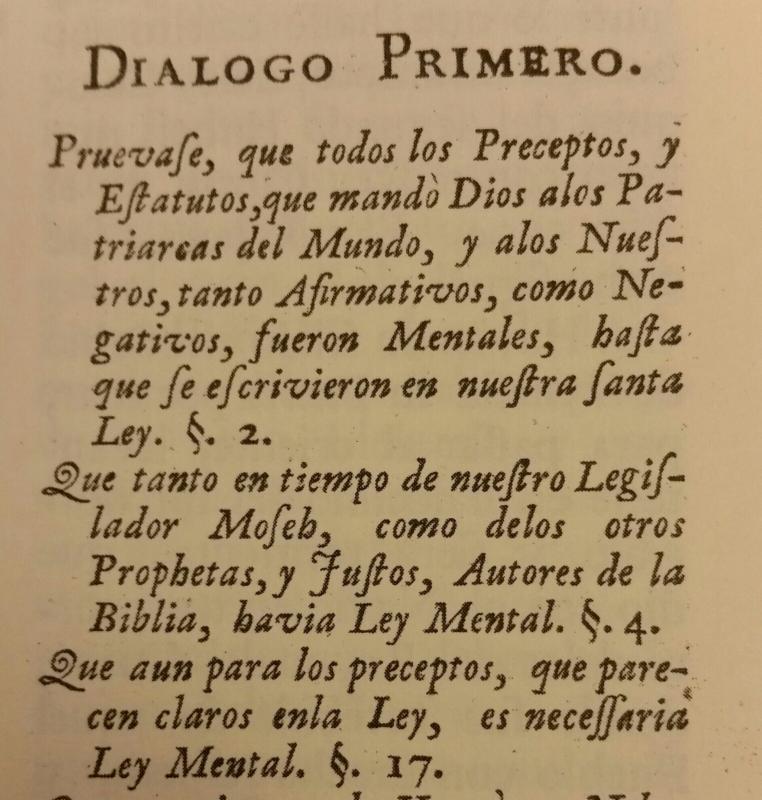
From my own experience I think the only difficulty a beginner reader will have is to identify the letter “S” when it is written at the beginning or in the middle of the word. In old Spanish (or English) the “S” in this position was “taller” than today, and the modern reader often confuses between the “S” and the “F”.  Beyond that, I think, it is very easy to read this book, and the advantages of studying a book of this category and this authority in the original are, I think, priceless.
To further facilitate the reading in Spanish, I will copy a short paragraph of the book and re-write it in a more modern version.
mate dan
Pruebase que todos los preceptos y  estatutos que mando Dios a los patriarcas del Mundo y a los Nuestros, tanto afirmativos como negativos fueron mentales, hasta que se escribieron en nuestra santa ley. Página 2
Que tanto en tiempo de nuestro legislador Moshe, como de los otros Profetas y Justos, autores de la Biblia, había Ley mental. Página  4
Que aun para los preceptos que parecen claros en la ley, es necesaria Ley mental. Página 17 
לע”נ שלומית קריגמן, ,23 הי”ד 


8th PRINCIPLE: The Divine origin of the Oral Tradition

We are analyzing the eighth principle of the Jewish faith (see previous halakhot here). The eighth principle includes another key element. As we all know, apart from the written Tora, we also received the Oral Tora, that is, the oral tradition that explains the written Tora.
The eighth principle assets that the Oral Tora is also of divine origin, and was transmitted by God to Moshe rabbenu.
I think Jewish Oral Tora or Oral Tradition is a fundamental issue and I believe we should spend a few days to explain it in detail. There are at least three subjects that we need to know in greater depth
1. The elements included in the Oral Tora.
2. The history of the transmission of the Oral Tora.
3. The methodology of the halakhic process. That is, how do we get from the Biblical precepts of the written Tora to the daily halakhic practice?
Let’s start with what constitutes the Oral Tora.
According to Maimonides, in his introduction to the Mishna, the Oral Tora is divided into five categories.
1. Perush (the ancient sephardic pronunciation was “pirush”). This category is also called by Maimonides “qabbala”, which does not refer to the mystical aspects of the Tora.
2. Halakha leMoshe MiSinai.
3 Dinim Muflaim.
4. Gezerot
5. Taqanot and Minhagim.
We will explain today the first category.
1. PERUSH: In the introduction to Mishne Tora Maimonides says: “Every commandment given to Moses on Mount Sinai was given together with its explanation (perush)”, this is,  the basic instructions –the definition of each commandment– which were not written by Moshe but were received and transmitted orally for generations.
Illustration: The written Tora mentions the precept of Tefilin. But the written Tora only says: “And these words which I entrust you today … you shall bind them upon your arm (or hand) … and they should be place on your forehead.”   Now, out of this short text, how would we be able to know what the Tora is referring to by commanding us to “bind words upon the hand”? How do we suppose to “bind”  words? Should we write them first? And once written, where exactly do we have to bind them?, and how? These are some of the many questions we might ask ourselves, and not be able to answer, if we would only had before us the written Tora. And we will have the same problem with absolutely all the mitsvot. Even with those commandments that seem easy to understand and fulfill.    For example, if I only had before me the words “You shall not kill”, how would I know the definition and especially the scope of this commandment? What is included and is not included in it? Does the prohibition to kill includes the killing of animals or just people? What about killing in self-defense, to stop someone from killing me? And what about euthanasia (killing a dying person who is suffering) or  abortion (is abortion considered killing?) What about “suicide” (perhaps “You shall not kill” would not include “You shall not kill yourself”), or killing in war or applying the death penalty? etc.
There is no way to know only from the text what includes and what does not include “YOU SHALL NOT KILL” .
This is why, as we explained, every biblical precept was given with its PERUSH. That is, the basic definition and description of each of the 613 commandments of the written Tora.
For instance:
The Oral Tora, the PERUSH indicates the basic way to fulfill the commandment of Tefillin:
1. Writing in small scrolls the words of the four biblical texts in which the mitsva of Tefilin is mentioned.
2. Placing these scrolls in leather boxes.
3. Performing a small hole at the end of the boxes, and introducing there leather strips.
4. Placing one of those boxes in the arm and the other box on the forehead,  adjusting the boxes with leather strips. Etcetera.
Now that we understand what the Oral Tora is,  we shall return to the eighth principle of Judaism.  The eighth principle asserts that these oral instructions were not invented by Moses or by the rabbis. Their origin is divine. They are an integral part of what we call “TORA”, and were received by Moses on Mount Sinai.


8th PRINCIPLE: Is our Sefer Tora reliable?

The eighth of the thirteen principles of the Jewish faith says that the Tora we have today is the same as the one given to Moshe Rabbenu (Moses) in Sinai.
Today we will explore the meticulous method used by the Sages of Israel to transmit the text of the Tora in a way that unintentional errors would be avoided.
We know that mistakes in the transmission of texts was something quite common, especially before the invention of printing.  We believe that the Sefer Tora (a Tora scroll), as we have it today, contains exactly the same words that God transmitted to Moses. The biblical text has been preserved for centuries with great care. Our sages were well aware they were transmitting a unique text: the word of God. Therefore they did not allow the possibility of having inadvertent errors in the transmission or in the process of copying from one text to another.
What did the Sages do to avoid copyists’ mistakes?


Our Scribes were called in Hebrew “Soferim”. They were the Sages responsible for copying the Biblical text from one Tora scroll to another, keeping intact the text. To understand the transmission system that our sages have used to preserve the integrity of the text, we need to learn first why were they called “Soferim”. The word “Sofer” or plural “Soferim” is a term used in reference to the individual who writes Tefillin, Mezuzot and scrolls of the Tora. But it is curious that the word “sofer” literally means “counter” (=accountant) not “writer” or “scribe” … So, why would the rabbis who copied the Sefer Tora be called Soferim? Our sages explain that they were called Soferim because “they counted all the letters of the Tora”, that is, they knew exactly how many letters the Tora has, how many letters had each Parasha has, and even how many times each of the 22 letters of the hebrew Alphabet appears in each Parasha or in the Sefer Tora. And every time they copied the text, they did not just wrote and read the words: they also counted the words and the letters they wrote, to verify the accuracy of the text and ensured that there were no more or less letters.


For example: It was known from time immemorial that the Sefer Tora, the five books of Moses, contains exactly 79,847 words and a total of 304,805 letters. The Soferim also knew, for example, how many letters each of the five books of the Tora contains: Bereishit: 78,064, Shemot: 63,529, Vayqra: 44,790, Bamidbar: 63,530, Debarim: 54,892. Thus, when a Sofer wrote a new Sefer Tora he counted the letters to make sure that nothing was missing.


A simple personal example to demonstrate how knowledge of the number of letters ensures the accuracy of the transmission of a word. My personal email is “rabbibitton@yahoo.com”. When I dictate someone the first part of my email address I always clarify that  “rabbibitton” is one word, with 11 letters. Many times people tell me that they were able to realize my last name is spelled with double “T” because I told them “11 letters”. If I had not given them the number 11, many would have written “biton”, or “rabi” if they don’t know English.
The number of letters guarantees an accurate transmission > copying of a word or a text.


The eighth principle of our faith says that the Torah we have today is the same exact Tora we received at Sinai. This principle of faith is essentially about the faith we have in our ancestors. We are completely confident that they copied and transmitted us each letter of our holy Tora with absolute fidelity and accuracy. They developed a method, counting letters, which ensures that the “chain of custody” of the world’s most important text was and is absolutely reliable.


B’H Tomorrow we will see that this eighth principle also includes our belief that the oral Tora we have today is the one transmitted by HaShem to Moshe Rabbenu.

.