“You shall dwell in sukkot for seven days. Every native in Israel shall dwell in sukkot, so that your generations may know that I made the people of Israel dwell in sukkot when I brought them out of the land of Egypt. I am HaShem, your God” (Leviticus 23:42-43).
This Friday night, September 25, we begin the celebration of Sukkot. This year the first day falls on Shabbat. Sukkot, followed by Shemini Atseret and Simchat Torah, runs until Sunday night, October 4.
For seven days we leave our homes and settle in the Sukka. We eat there, we study there, and if the weather and our health allow it, we sleep there. Sukkot commemorates the forty-year journey from Egypt to the Promised Land, when God provided everything we needed and protected us from the dangers of the desert. By dwelling in the Sukka we relive that gratitude and that trust in Divine Protection, which has not stopped since.
The Sages explained that to fulfill this Mitsva we have to turn the Sukka into our main residence for the seven days of Sukkot, and our house into the temporary one. That means doing in the Sukka the ordinary things we normally do at home. Some examples:
MEALS: Except when it rains, we eat in the Sukka, above all the formal meals that include bread (hamotsi and birkat hamazon), reciting the blessing: “…asher kiddeshanu bemitsvotav vetsivanu liysheb basukka.”
MEZONOT: Cakes, cookies and other mezonot foods are also eaten in the Sukka. If they are eaten as a snack between meals, the blessing for the Sukka is not recited. Some families in our community follow the old Sephardic custom, based on Maimonides, of reciting liysheb basukka every time they enter the Sukka to eat or drink something.
SNACKS: Light foods such as fruit or coffee may be taken outside the Sukka, although it is praiseworthy to eat and drink nothing outside it during Sukkot.
SLEEPING: Sleeping in the Sukka is part of the Mitsva, but it depends on the weather, on one’s health, and on other factors such as safety or the presence of animals.
Seven days in a house without a roof teach something unexpected: almost nothing we thought we could not live without at home turned out to be necessary. That is exactly what the Sukka came to teach.
Sukkot In A Mexican Prison
Throughout history, Jews have overcome every obstacle to observe the Mitsva of Sukkot. One of the most striking examples of this love and determination is a Sukka built in 1603 in the courtyard of the Inquisition prison in Mexico City by a crypto-Jew (“converso”) named Sebastian Rodriguez.
Sebastian was born in 1573 in São Vicente da Beira, Portugal. At age seven, he left home and moved to Seville, Spain, where he worked in the shop of his uncle, Antonio Rodriguez, who taught him to read and write.
In 1587, at fourteen, he moved to New Spain (Nueva España, the colonial name of Mexico). He settled in the city of Puebla, in the house of a distant relative, also Portuguese, named Guillermo Rodriguez. Guillermo sent Sebastian to nearby villages to sell the clothes he produced. At sixteen, Sebastian became independent and began working on his own.
At eighteen, he married his cousin, Constanza Rodriguez. Before the wedding, his brother-in-law, Domingo Rodriguez, and a friend, Manuel de Lucena, secretly revealed to Sebastian that he was Jewish. They would take him out to the fields, away from the eyes of the inquisitors, and teach him the laws and traditions of the Torah.
Sebastian began to learn more about his heritage. His main teachers were Luis de Carvajal (El Mozo) and Sebastian de la Peña, Jews who lived outwardly as Catholics. They took long walks together, reviewing passages and precepts of the Torah. Luis de Carvajal kept written quotes from the Torah hidden between the lining and the felt of his hat, and used them to teach Torah and Mitsvot to his many students.
In 1596, when Sebastian was twenty-three, a man named Pedro de Reparo denounced him to the Inquisition. His crime was “judaizar,” judaizing, that is, practicing Judaism in secret. Sebastian was arrested in Mexico City along with his wife, Constanza, and taken to the Inquisition prison on Plaza Santo Domingo, a few blocks from today’s famous Zocalo in the historic center of Mexico City. His punishment was life imprisonment and, of course, the confiscation of all his property.
During the first three months of interrogation, Sebastian kept absolute silence to avoid revealing the names of his teachers and his converso friends. After those months of torture, chained hand and foot, he confessed to practicing the Law of Moses. The chains were removed, and he was placed in a cell next to Luis Diaz, a supposed converso who was in fact a spy for the Inquisition. Diaz, later nicknamed “El Malshin” (the informer), reported to the inquisitors that his cellmate was still “judaizing” in prison. He gave examples: Sebastian did not eat the meat or chicken he was served; he did not sweep his cell on Saturdays; he washed his hands before eating bread; and every day he stood still (that is, prayed) facing east, with his head covered.
As a result, Sebastian was brought before the inquisitors to confess. He denied the accusations, so they tortured him again, this time on “el potro,” the rack, which stretched the limbs with ropes. After the fifth round, Sebastian declared that he had indeed practiced some Jewish rituals but that he now “repented.”
The holiday of Sukkot was approaching. Sebastian, his wife Constanza, and their little son Domingo had been in prison for seven years, in a place called “La Casa Chata.” Sebastian’s greatest wish was to celebrate Sukkot, but it looked like an impossible dream. Then a risky plan came to his mind: to build a Sukka in the prison courtyard itself, in the presence of the inquisitors Alonso de Peralta and Gutierre Bernardo de Quiros.
In early September 1603, the Count of Monterrey, the viceroy, granted an important award to Captain Esteban Lemos, a notary of the Inquisition. Sebastian proposed holding a party in Captain Lemos’s honor at “La Casa Chata.” The warden was enthusiastic and gave permission. The date chosen was the day of Sukkot. The warden also approved Sebastian’s guest list, made up mostly of hidden conversos.
Sebastian asked for branches to “decorate” the courtyard. The inquisitors sent four Indians to bring them, and Sebastian began building his Sukka. He prepared the open courtyard, known to this day as the “Patio de los Naranjos” (Courtyard of the Orange Trees), and laid the branches across the top of its four walls.
For this “special occasion,” they prepared a fine meal. The main dish was chicken slaughtered by Shechita (kosher slaughter), which Sebastian arranged with help from outside the prison.
On September 21, 1603, Sebastian, his wife Constanza, and several other conversos, guests, and Jewish prisoners celebrated Sukkot. They ate and sang in front of the Inquisition officials, who had no idea that the conversos were celebrating a Jewish holiday.
On June 2, 1606, Sebastian, Constanza, and their son Domingo were released. The Inquisition believed that Sebastian had finally become a rehabilitated Christian.
The Inquisition, one of the most horrific forms of religious persecution, pursued our brothers and sisters even in the New World. Sebastian Rodriguez’s decision to build a Sukka inside an Inquisition prison is an inspiring example of the Jewish people’s determination to keep the Torah, no matter the circumstances.
The original article was written in Spanish by Mr. Eli Suli (México) an expert in Sephardic Jewish history and a personal friend. The translation is mine.
SUKKOT: The Bet haMiqdash and Hosha’na Rabba
The days of Sukkot were celebrated with extraordinary joy in the Bet haMiqdash. Beyond the biblical commandment of taking the four species (ארבעת המינים), two other Mitsvot were kept in the Temple. One was nisukh hamayim, the water libation, the ceremony of pouring water on the altar. The other was mitsvat ‘araba, the commandment of the willow branches. Both were about water.
NISUKH HAMAYIM
The rabbis describe the joy of the water libation:
“He who has not seen the celebration of the water libation has never experienced true joy. Big golden lamps were hoisted, with four cups of gold on top of each lamp. Four young apprentice priests rose to the top, carrying large oil jugs to fill the lamps. Once lit, there was no courtyard in Jerusalem that did not shine with the light coming from the Temple. Special balconies were built so the women of Israel could see the Sages of the Sanhedrin as they danced. People sang, and the righteous and pious men danced before them while juggling lighted torches. The Levites stood on the fifteen steps leading down from the court of Israel to the court of the women, playing lyres, harps, trumpets and many other instruments. Two priests stood at the top of the stairs, on each side of the entrance to the great door of the court, and sounded the silver trumpets. They did all this to honor the commandment of the water libation. At dawn, the people came down singing to the spring of Shiloach, at the foot of the walls of Jerusalem. One of the Cohanim carried a special jug of gold and filled it with water from the spring. Then the congregation walked back up to the Temple, led by the Cohen bearing the water. At the Temple, the Cohen brought the vessel to the altar and poured the water into a silver basin at one of its corners” (Mishna Sukka, chapter 5).
The ceremony was known as Simchat Bet haSho’eba. It opened the prayers for rain, and it was accompanied by Tefilot and psalms of praise, trusting that HaShem would bless the land and its produce with rain in the season ahead.
MITSVAT ‘ARABA
The second ceremony was separate from the two willow branches tied to the lulab. Outside Jerusalem there was a place called Motsa, which still exists under the same name, on the banks of the Soreq river. Every day of Sukkot people went down to Motsa and cut large willow branches, about twenty feet high. They stood the branches around the foot of the altar with their tops bent over it. The altar was sixteen feet high, so the branches rose a few feet above it on all four sides.
Every day of Sukkot the Cohanim, and according to other opinions the elders of the city, circled the altar once with their lulabim in hand, praying “Anna HaShem hoshi’a na, Anna HaShem hatslicha na.” Please, God, save us. Please, God, grant us success. On the seventh and last day, Hosha’na Rabba, they circled the altar seven times.
Today we circle the bima, the platform where the Sefer Torah is placed, with our lulabim and etrogim, in memory of the mitsvat ‘araba of the Bet haMiqdash. We do it every day of Sukkot except Shabbat. This year the first day of Sukkot falls on Shabbat, September 26, so the hakafot begin on Sunday the 27th. Hosha’na Rabba falls on Friday, October 2, and that morning we circle the bima seven times.
CHABATAT ‘ARABA
One more ritual belongs to the mitsva of the ‘araba, a tradition established by the last prophets of Israel, Chaggai, Malakhi and Zekharia, after the destruction of the first Temple. At the end of the Tefila of Hosha’na Rabba we take a few willow branches, the custom is five, and they cannot be the ones used with the lulab, and without any blessing we strike them against the ground. The practice is called chabatat (or chibut) ‘araba.
WHY THE ‘ARABA
Why this much attention to the willow?
Our rabbis explain that by the end of Sukkot the Heavenly Court issues the verdict on the rain that will fall in the coming year (bachag niddonim al hamayim). That is why, following a custom of the Kabbala, many stay awake through the night of Hosha’na Rabba studying Torah. This year that is Thursday night, October 1. Anyone planning to stay up should have everything ready for Shabbat beforehand, since Shemini Atseret begins the next evening.
Rain is the one element our sustenance cannot do without. The ‘araba is the plant that needs the most water and the first of the four species to dry out. It stands for our vulnerability. And striking the branches against the ground, watching them lose their leaves with every stroke, is a way of absorbing how fragile we are, and how completely we depend on God, not only for prosperity but for survival.
The next morning is Shemini Atseret, Shabbat, October 3. In the Musaf Amida we stop saying morid hatal and begin saying mashib haruach umorid hageshem. Everything the Temple did with water for seven days, the golden jug, the spring, the dancing, the willow branches around the altar, we now carry in a single sentence of the Amida.
SUKKOT and the Alliance of the Four Plants
FOUR JEWS, FOUR IDEAS
Our Sages said that the four plants we take on Sukkot stand for the Jewish community: four kinds of people, differing from one another in how much Torah they know and how much of it they keep.
The etrog, which has a good smell and a pleasant taste, stands for the Jew who knows the Torah and keeps it. The Sages read the metaphor this way. Taste stands for the study of Torah, since learning should be pleasant and sweet. Smell stands for keeping the Mitsvot, whose intention should always be selfless. The lulab, a branch of the date palm, comes from a tree whose fruit is very sweet but has no fragrance at all. The lulab stands for the one who studies Torah but does not fully keep it. The myrtle, hadas in Hebrew, has a pleasant smell but no taste (you cannot make tea from its leaves). The myrtle stands for the one who keeps the Torah but does not study it, and never reaches its depth. And then the willow, the ‘araba, with neither taste nor smell, standing for the Jew who is not observant and never had the chance to learn Torah.
The Jewish community, the Sages said two thousand years ago, is these four people. On Sukkot, carefully and with devotion, we put every member of the Jewish community together in our hands. If one of them is missing, we have not fulfilled this beautiful commandment.
What is the message in having every member of this varied community present?
THE CHALLENGE OF THE ETROG
First, the metaphor teaches that the etrog, already held apart from the other three plants, must not stay apart from the community. It has to join those who are less than it is, to stand next to those who do not keep or do not know the Torah. And by doing that, by staying joined instead of separating, it perfumes the others with its fragrance. Once the etrog joins the rest, we say the blessing and lift all four plants at once.
What turns the etrog into a good influence? The etrog has to be strict above all about everything that has to do with derekh erets: manners, honesty, humility and respect for other people. And if on top of that the etrog lives his observance with joy, he becomes impossible to resist.
Why did the Sages have to insist that the etrog not separate? In my opinion, because the opposite happens often enough. Many religious Jews choose to withdraw from the community and keep company only with other etrogim “like me.” The temptation is understandable. Will I be able to influence the rest of the community, or will I end up influenced by those who know and keep less than I do? According to this and other teachings of our Sages (see for example כל תענית שאין בה מפושעי ישראל אינה תענית שהרי חלבנה ריחה רע ומנאה הכתוב עם סממני הקטורת), pulling away from the rest of the community would be like trying to fulfill the Mitsva of lulab with four etrogim.
Sometimes this polarization is not deliberate but careless. If the etrog does not hold to the values of derekh erets with the same rigor he applies to ritual. If his observance is not matched by honesty, humility and unconditional respect for other people, his bad example can swing all the other plants to the edge. Or past it. As we read this past Shabbat in Haazinu, when the Torah comes across badly to someone watching or listening, it is because those of us who are supposed to represent it are representing it badly.
THE PROBLEM OF THE ‘ARABA
On the other side, the ‘araba, the Jew who knows less or does not keep the Mitsvot, has to keep an open mind and be willing to learn. To allow that his negative opinions about the Torah may be nothing more than prejudice. That he may have judged the whole tree of Judaism by a few rotten apples. That it is never too late to learn or to change your mind.
Do you know who taught me this? My father, z”l. Like a great many other Jews, my father grew up in a family that kept nothing. He never went to a Jewish school and never had the chance to learn to read Hebrew. My father was perhaps an ‘araba, but a beautiful ‘araba. Because although he was not religious, he was never antireligious. He never objected to his son learning more about Judaism or wanting to keep more. He was glad when I started studying Torah as a teenager. That attitude kept him inside the virtual community of the four plants his whole life.
Many non observant Jews, unfortunately, and for a long list of reasons I cannot go into here, cross to the other side. They cross the line of the ‘araba, the red line that separates them from tolerance, and their lack of religion turns into a toxic antireligious activism. When that happens, the sacred pact of the community of the four plants breaks, and the separation is unavoidable. The consequences of antireligion have always been catastrophic for the Jewish people.
All of us, the members of this brotherhood of four plants, have to do everything we can to practice respect and tolerance toward every single person in Am Israel. Our highest goal is to stay together. To grow and rise together. Understanding that what unites us counts for far more than what sets us apart.
SUKKOT 5785 SPEECH: Shemuel Yosef and Shimon Bar Kochba
Two Documents, 1,900 Years Apart
This is the story of two historical documents: a letter written 1,900 years ago, and a video of a phone conversation I received a week ago in my family chat. The young man speaking in the video had never heard of the ancient letter. Still, remarkably, both documents carry the same message: the unwavering will of the Jewish people to fight for their land, and their dedication to the precepts of the Torah in the most critical moments.
Let’s start with the video. One of my wife’s younger sisters lost her husband to cancer about 20 years ago, when their youngest son was only three years old.
She lives in Ashdod and has four sons and a daughter. The oldest served in the army and now handles security (Bitachon) in his settlement, very close to Sderot. The second served in an intelligence unit of the Israel Defense Forces. The third, 30 years old, is currently serving as a reservist (Miluim) at Zikim, a military base near Gaza. It is a warehouse (machsan) that runs the army’s supply chain of ammunition, food, clothing, and other necessities.
The youngest son is fighting in Gaza alongside the troops in Jabalia, a Palestinian city in the north of the Strip. Israel plans to evacuate civilians from northern Gaza, about one-third of the Strip, and turn it into a closed military zone under Israeli control. About 200,000 Palestinians remain in that area, and terrorists hide among the civilians and prepare ambushes against Israeli soldiers from there. Israel is making significant efforts to clear the area of terrorists. Unfortunately, several Israeli soldiers have been killed in Jabalia, including the Druze colonel Ahsan Daqsa, commander of the 401st Brigade, the highest-ranking officer to fall since the beginning of the war, who died today, October 20, in a tragic explosion.
My nephew is a very young soldier. His face still has the innocence and purity of a child, which even the harsh army life has not managed to change. He wears a large white knitted kippah, and long pe’ot peek out from under his green helmet.
A few days ago, I received a video in the family chat. In it, his older brother, the reservist, is talking on the phone with him. I cannot share the video for security reasons, but I will share part of the conversation.
First, the older brother identifies himself by his combat name. Then he says something like: “Right now I’m taking care of getting lulavim and etrogim for you and your battalion. I want to make sure you subdue the enemy, so shake them in all directions, but especially toward the heavens (kivune shamayim).” Then, more casually, he asks, “How are you?”
“Barukh HaShem,” the young soldier replies. “Today I spoke with our oldest brother. He said he would bring some lulavim to Mom in Ashdod.”
“Yes, I know. He was here in Zikim, and we brought some sets here too.”
When I saw this video, it gave me chills. Why? Because my mind traveled 1,900 years into the past.
The last time the people of Israel had an army, before the establishment of the State of Israel, was around the year 130 of the common era, in the days of Bar Kochba. Since the destruction of the Bet HaMikdash in 68, the Romans had ruled the land of Israel, and Jerusalem was in ruins. In 117, Emperor Hadrian came to power, obsessed with ending the Jewish people, and he gradually restricted religious practice. He first banned Berit Milah (circumcision) under penalty of death, then outlawed the observance of Shabbat, and later the study of the Torah. Around the year 129, unhappy that Jews kept observing the Torah in secret at the risk of their lives, he planned his greatest provocation: an idolatrous temple in Jerusalem dedicated to the Roman god Jupiter.
At that moment, a brave Jewish leader named Shimon Bar Kochba decided they could not stand idly by. He organized a revolt against the powerful Roman Tenth Legion to regain their national and religious freedom. Miraculously, Bar Kochba’s makeshift army succeeded and destroyed the mighty Roman legion. They recaptured Jerusalem and even minted coins that read, “Year One of the Liberation of Jerusalem.” These coins were minted for three years, which means that during that time the Jews regained their religious independence.
Then the unexpected happened. Hadrian’s hatred of the Jews was so great that he brought his entire army, the most powerful in the world, to fight them. His troops came from Britain, Gaul (France), and Germania (Germany). This reminds me of what Hitler did in 1944: while losing to Russia, he diverted resources to deport 500,000 Jews from Hungary to Auschwitz, at the expense of the Russian front.
After a heroic struggle that lasted years, Bar Kochba’s army was defeated. Many historians believe that despite the military defeat, Bar Kochba triumphed. Thanks to his struggle, a pagan temple was never built in the holy city, which would have been the greatest possible affront and humiliation to the ruins of the Bet HaMikdash.
Bar Kochba was not only a military leader who fought Israel’s enemies. He also guided the people of Israel to fulfill the mitzvot and embrace the Torah.
A few decades ago, the famous Israeli archaeologist Yigael Yadin discovered, in the caves of the Judean desert, a letter written on behalf of Shimon Bar Kochba himself. In it, the Jewish leader writes to one of his fighters to request some essential supplies:
“From Shimon to Yehuda: … I am sending you two donkeys and two men. Take them to Yehonatan bar Masabla … and have him load the donkeys with palm branches [lulavim] and etrogim and send them back. He should also send other men to bring myrtle branches [hadasim] and willow branches [aravot] to our camp. Make sure the tithe (ma’aser) has been separated. Send everything to the camp, [because we need a large number of lulavim, as] our army is very large. Shalom.”
In the video and in Bar Kochba’s letter, we see the same pattern. In the middle of a war, a general or a soldier of the Jewish army steps away for a moment from critical military matters to attend to something more urgent: making sure the fighters have lulavim and etrogim to celebrate Sukkot.
Because both in the days of Bar Kochba and today in Gaza or Lebanon, what is at stake is not just a military operation to reclaim territory or defeat the enemy. It is the unwavering will to remain Jewish, to observe our Torah, and to keep our connection to God and to the land He gave us.
Chag Sameach.
First, Rafael identifies himself by his combat name and then says something like: “Right now, I’m taking care of getting the lulavim and etrogim for you and your battalion. I want to make sure you subdue the enemy, so aim (your prayers or the lulav movements) in all directions, but especially towards the heavens (kivune shamayim).” Then, more informally, Rafael asks, “How are you?”,” Baruch Hashem,“ replies Shmuel Yosef, “Today I spoke with Shimon. He said he would bring some lulavim to [mom in ] Ashdod.“. ” Yes, I know, Shimon was in Zikim, and we brought some sets [of lulavim] here too,“ replies Rafael.
When I saw this video, it gave me chills. Why? Because my mind traveled 1,900 years into the past.
The last time the people of Israel had an army, before the establishment of the State of Israel, was in the year 130 of the common era, in the days of Bar Kochba. Since the destruction of the Bet HaMiqdash in 68, the Romans had ruled the land of Israel, and Jerusalem was in ruins. In 117, Emperor Hadrian came to power, obsessed with ending the Jewish people and gradually restricting religious practice. He first banned the Berit Milah (circumcision) under penalty of death, then outlawed the observance of Shabbat, and later the study of the Tora. Around the year 129 CE, dissatisfied that Jews continued to observe the Tora in secret and risking their lives, he planned his greatest provocation: to build an idolatrous temple in Jerusalem dedicated to the Roman pagan god, Jupiter.
At that moment, a brave Jewish leader named Shimon Bar Kochba decided they could not stand idly by and organized a revolution against the powerful Roman Tenth Legion to regain their national and religious freedom. Miraculously, Bar Kochba’s makeshift army was entirelysuccessful and destroyed the mighty Roman legion. They recaptured Jerusalem and even minted coins that said, “In the first year of the Liberation of Jerusalem.“ These coins were minted for three years, meaning that during this time, the Jews regained their religious independence.
But then the unexpected happened: Hadrian’s hatred of the Jews was so great that he decided to bring his entire army, the most powerful in the world, to fight against the Jews. His troops came from England, Gaul (France), and Germania (Germany). This event reminded me of what Hitler did in 1944, when, losing against Russia, he decided to allocate his military reinforcements to deport 500,000 Jews from Hungary to Auschwitz and abandon the Russian front.
After a heroic struggle that lasted years, Bar Kochba’s army was defeated. Many historians consider that despite the military defeat, Bar Kochba triumphed because, thanks to his struggle, a pagan temple was never built in the holy city, which would have been the greatest affront and humiliation possible to the ruins of the Bet HaMikdash.
In addition to being a military leader who fought against Israel’s enemies, Bar Kochba guided the people of Israel to fulfill the mitzvot and embrace the Tora.
A few decades ago, the famous Israeli archaeologist Yigal Yadin discovered a letter written in the handwriting of Shimon Bar Kochba himself, found in the caves of the Judean desert. In that letter, the Jewish leader addresses one of his combatants to request some essential supplies.
The letter reads: “From Shimon [Bar Kochba] to Yehuda: … I am sending two donkeys and two men. Take them to see Yehonatan bar Masabla… and they should ask him to load the donkeys and bring them back with palm branches [lulavim] and etrogim. He should also send other men to bring myrtle branches [hadasim] and willow branches [aravot] to our camp. Make sure the tithe (ma’aser) is already separated. Send everything to my camp. [Remember that we need a large number of lulavim, as] our army is very large. Shalom.”
In Rafael’s video and in Bar Kochba’s letter, we see the same pattern of behavior. In the midst of war, a general or a soldier of the Jewish army distracts himself momentarily from critical military matters to attend to something more urgent: ensuring that their fighters can have lulavim and etrogim to celebrate the festival of Sukkot.
Because both in the days of Bar Kochba and now in Gaza or Lebanon, what is at stake is not just a military operation to reclaim territory or defeat the enemy, but the unwavering will to remain Jewish, to observe our Tora, our connection to God, and to the land He granted us.
CHAG SAMEACH.
AWESOME CREATION, A Study Of The First Three Verses Of The Tora
The first three verses of the Torah are perhaps the best-known sentences of the Hebrew Bible. They may also very well be the least understood. In Awesome Creation, Rabbi Yosef Bitton delves into these verses with an open mind and an open heart. Drawing on classical Jewish sources as well as current scientific data, Rabbi Bitton offers a fresh reading of the initial words of Scripture. Among the subjects covered are the coincidences and differences between the Big Bang theory and the Biblical Creation story, the unexplored consequences of Creation ex nihilo, the controversies surrounding the age of the universe, the state of our planet upon its creation, the natural forces used by the Creator to reshape His world, and the enigma of the nature of primeval light. Throughout his book, Rabbi Bitton emphasizes the importance of an accurate comprehension of Biblical Hebrew, as explained by the Rabbis of the Talmud and the classical Torah commentators. Through a precise understanding of each word of these verses and thanks to today s modern scientific knowledge we are able to appreciate, as never before, the beauty and sophistication of the Biblical story of Creation.
2 REVIEWS OF “AWESOME CREATION”
IN AMAZON
THE TORAH PERSPECTIVE
By Ruth Sher
For as long as I can remember, I have always been fascinated by the mystery of creation. I used the creation story as the topic for my Bat Mitzvah speech, and I took a course in astrophysics at university. As a religious Jew, I believe in the Torah’s creation narrative, but as a scientist, I believe in the Big Bang. According to Rabbi Yosef Bitton, that is no contradiction.
In Awesome Creation, Rabbi Bitton presents my favourite consolidation of the creation narrative with Big Bang theory. Rather than trying to find Torah sources to support modern scientific thinking, Rabbi Bitton focuses on trying to understand the simple meaning of the Torah words. Only once he has established clearly what the Torah is saying does he present modern scientific theories for support. Rabbi Bitton is coming from the perspective of a ‘grammarian’, not a scientist, so he does not accept any scientific explanations (compelling though they might be) that break the precise rules of Hebrew grammar.
The backbone of Rabbi Bitton’s approach is the idea that creation was a gradual, yet accelerated, process. He derives the concept of gradual, accelerated creation from a midrash explaining the events of the sixth day of creation, and uses an analogy to explain it: If someone showed you two pictures of a watch, one in which the hands were pointing to 12 o’clock, and the other in which the hands were pointing to 2 o’clock, and asked you how much time had passed between the two pictures, the simplest answer would be that two hours had passed. That is based on our knowledge of how watches work under normal circumstances, without external influences. However, it is possible that someone manually wound the watch forward by two hours, in which case the two pictures could really have been taken seconds apart. The external influence caused the process to be accelerated, but it is still gradual in that the hands of the watch passed through every position between 12 o’clock and 2 o’clock.
In the creation story, science can describe the gradual process that had to take place, as well as the time that would have had to pass for that process to be completed naturally. But the Torah assumes the presence of an outside influence, namely G-d, which could cause the acceleration described in the Biblical narrative. This accounts for the difference in timing for creation, according to the two views. However the acceleration would only speed up the process, not change it. Rabbi Bitton explains the gradual process of creation as described by the Torah as follows:
• In the beginning, all the building blocks of matter were created (in a Big Bang event).
• The young Earth was formed with a toxic atmosphere, but it was equipped with wind and water.
• Intense sunlight penetrated the atmosphere and began to heat the water. (Day 1)
• The water evaporated, and the wind helped to begin the water cycle. (Day 2)
• The wind and rain together shaped the land into its current structure, and plants were able to emerge. (Day 3)
• Plants produced oxygen which cleared the toxic atmosphere and formed into an ozone layer, blocking out the intense sunlight so that the sun could become life-sustaining. (Day 4)
With the presence of a life-friendly environment, the creation of animals and humans (in days 5 and 6) would be possible. Although Rabbi Bitton does not discuss the emergence of life in any detail, he does mention in a footnote that it would be interesting to explore that in a separate book.
The book is laid out as an analysis of first three verses of the Torah. As each verse, and each word, is explored in detail, a view of the creation process emerges that is uncannily in line with current scientific thought.
HIGHLY RECOMMENDED
By Michelle Cohen
Awesome Creation is really a fantastic work. Highly recommend it to anyone interested in delving into the biblical story of creation. The work is divided into three parts, each analyzing a different verse from the beginning of Genesis. The verses are analyzed using Hebrew grammar, clsssical commentaries, modern Jewish thinkers, scientific findings, relevant biblical parallelisms and philosophical ideas.
I would say that there are three aspects which make this work stand out.
First, the attention given to Hebrew grammar. Often, modern Biblical commentaries are not versed enough in Dikduk to be able to give over a sophisticated and traditionally accurate reading of the Hebrew text. This is something which was always indicative of classical Sepharadic biblical scholarship and which Rabbi Bitton does a fantastic job of integrating in his work.
Second, the way the book integrates science and scientific findings to explicate the words of Bereshit. This is not a book which directly deals with the science vs. religion question. It does not seek to solve that dilemma. What Rabbi Bitton does instead is to highlight how modern science sheds new understanding on some biblical/talmudic ideas and concepts.
Third, this book brings to life many, many Rabbis which are to often absent from normative Jewish literature in America. He features writers like R Moshe Chefetz, R’ Menashe Ben Israel, R’ Morris Raphall and many others. These voices add nuances and new understandings which are currently not being heard in the scholarly and religious discourse around Biblical exegesis.
Overall, I found the book great. It presents very complex subjects in an accessible manner (especially since it has a summary to every chapter) and is also filled with inspiration of the divine genesis. I very much recommend Awesome Creation.
Definition of true Happiness
ושמחת בחגך אתה ובנך ובתך ועבדך ואמתך והגר והיתום והאלמנה אשר בשעריך
דב’ 16:13-15
“Be joyful at your festival. You, your children, your servants, the Levites, the strangers, the orphans, and the widows who live in your towns.”
Besides living in the Sukka and taking the four species of plants, in Sukkot we have another Mitsva: “simcha”, happiness. The Tora instructs us to be and behave happily every Yom Tob, particularly in Sukkot, Shemini Atzeret, and Simchat Tora.
DEFINING HAPPINESS
First, we should realize how privileged we are to belong to Am Israel, knowing that HaShem protected us in the desert and that we are still under His permanent care: this thought should bring us happiness. Second, although we are used to the idea that happiness results from success and that success consists of having more, gaining more, showing more, etc., the Jewish vision of happiness is slightly different. It is not having what I want but wanting what I have and especially enjoying sharing what I have.
MEALS and GIFTS
The essence of the Mitsva of being happy consists of enjoying festive meals with our family, friends, and guests. Meat and wine are a must on Yom Tob’s menu. We eat, drink and sing in gratitude to HaShem. We honor the day and make it pleasurable as we do during Shabbat (Shulhan ‘arukh OH 529:1). In honor of Yom Tob, we should dress well, and according to the Shulchan ‘arukh we should dress in Yom Tob better than in Shabbat. (idem.) Our Sages also mentioned that each family member enjoys material happiness differently. Before Yom Tob begins, the parents should get for their children “…roasted nuts and walnuts (=the equivalent today of candies and small toys); the husband should buy clothing and jewelry for his wife, whatever he can afford. And the husband is happy with a good meal. And his happiness increases –I would add –when seeing his wife and children happy!.
MODERATION:
The “Simcha”, the joy of Yom Tob, also requires moderation. “During Yom Tob [and this includes the celebrations of Simchat Tora] a person should not drink too much alcohol … because drunkenness and frivolity are NOT part of the Mitsva of behaving with joy: excessive consumption of alcohol brings to lightheadedness and frivolity. Our goal as Jews is to reach a level of happiness conducive to serving God. No one can serve the Almighty through frivolity and drunkenness “(Idem., 6:19)”. The best way to serve God is to feel happy that we are fulfilling God’s commandments and that we love and we are grateful to Him. “(MT H. Sukka veLulab, 8:15).
SHARING
In the pasuq me mentioned above, the Tora specifically commanded us to share our happiness with those who have less. In a sense, the Tora is explaining to us that being happy consists of making other people happy: providing means or food to orphans, widows, and poor people (SH ‘A 529: 2). Maimonides elaborates on this last point: “If someone closes the doors of his house [to the needy] and he eats and drinks alone with his children and his wife, and does not feed and give to drink to the poor and needy, he is not feeling the joy of a mitsva, but the joy of his stomach. . “(MT Yom Tob 6:18)
Shemini Atseret & Simchat Tora
ושמחת בחגך אתה ובנך ובתך ועבדך ואמתך
והגר והיתום והאלמנה אשר בשעריך
דב’ 16:13-15
“And you shall rejoice in your celebration, you, and your sons, and your servants, and the stranger, and the orphan, and the widow that dwell in your people”
During the festival of Sukkot, we reside in the Sukka for seven days and we take the four species of plants (etrog, lulab, hadas, ‘araba). Also during Sukkot, we have another Mitsva called “simcha”, which means “to celebrate” or to be happy. This is the only one of the three Mitsvot of Sukkot that also continues for the next festival: Shemini Atseret, this coming Shabbat Oct 6th and 7th and Simchat Tora, Sat night Oct 7th and Sunday, Oct 8th.
What is Simchat Tora?
Outside Erets Israel, as on any other festival (= Yom Tob), the holiday is celebrated for two days in a row. In this case, the second day of Shemini Atseret is also known as Simchat Tora, in which we celebrate the completion of the annual cycle of Tora reading and the uninterrupted beginning of the new cycle of reading from Bereshit.
The Tora tells us to be happy and to manifest our joy during these holidays. We sing and dance around the Tora, expressing our joy at being a part of the people chosen by God to study and observe His Law.
Material joy is also part of the celebration. During Yom Tob we share several festive meals with our loved ones. We eat, drink, honor the day of Yom Tob, and make it as pleasurable as the Shabbat (Shulhan ‘Arukh OH 529: 1).
In honor of Yom Tob we also dress well, as we do when we go to a wedding. According to the Shulhan ‘Arukh we must dress in Yom Tob “better” than in Shabbat. (Idem).
The Rabbis also explained that each individual enjoys material happiness in a different way. They said that before Yom Tob begins, the parents will give their children “… nuts [to eat] and nuts [to play]. The equivalent today would be “candies and small toys [not electronics!]”. The husband must give his wife clothes and/or jewelry, always according to his possibilities (and the husband is happy seeing his wife happy).. On the other hand, the woman of the house prepares a good meal for her husband and her family. Wine and meat are “mandatory” on the menu of Yom Tob. Meals are prepared with care and in abundance, but still within each person’s budget.
Although we are accustomed to the idea that happiness is the result of success and that success consists of having more, gaining more, showing more, etc., the Jewish view of happiness is a little different. In Yom Tob, we learn to rejoice with what we have, regardless of “how much” we have. In our materialistic society, it is considered that success is having what one wants; we must learn that happiness consists in wanting what one has and sharing with others what one has.
By offering others–those who do not have enough to eat, or those who do not have a family, especially orphans and widows– to participate of our family meals (SH ‘A 529: 2).
Maimonides said about this last point: “The person who closes the doors of his house [to the needy], eats and drinks [by himself] together with his wife and children and does not feed and drink the poor, is not practicing the joy of this Mitsva, but the joy of his own stomach … “(MT Yom Tob 6:18)
Finally, material joy also requires moderation:
“During Yom Tob [and this includes Simhat Torah, YB] a person should not drink too much [alcohol] … because drunkenness and frivolity are not part of the Mitsva to be happy. [drunkenness is rather] part of vulgarity and ignorance … and [the Tora commanded us] to attain a level of happiness that is compatible with our service to HaShem … a person can not serve HaShem from frivolity, lightheadedness or drunkenness “(6:19). “The highest way to serve HaShem is to feel happy that we are able to fulfill [His will by observing] His commandments …” (Maimonides, MT H. Sukka veLulab, 8:15).
Where is the Etrog Originally From?
Although it is not mentioned in the Tora as one of the seven typical fruits of Israel (wheat, barley, grapes, figs, pomegranates, olives, and dates), the etrog is a fruit indigenous to the land of Israel. Maimonides has already suggested this fact in his “Guide for the Perplexed,” where he explained that the Tora instructed us to use four specific plants, etrog, palm branches, myrtle, and willows, which were easily obtainable in the land of Israel.
The etrog was such a predominant Jewish symbol that it could be found in many mosaics and coins of ancient Israel. For example, in the coins of the year 66 CE, before the destruction of our Second Temple, and especially in coins minted in the years of the of Bar Kokhba revolt, 130- 135 of the Common Era.
Back then, supported by Rabbi Aqiba, Bar Kokhba led an army that tried to rebel against the Roman empire and rebuild an independent Jewish state, but the rebellion failed.
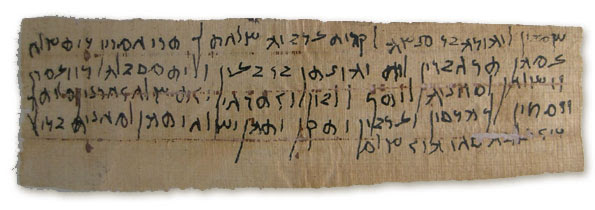
The use of etrogim in the coins of the Bar Kokhba rebellion is even more meaningful when we remember the great discovery of the Israeli archaeologist Yigal Yadin, who found a perfectly preserved letter in the caves of the Yehuda Desert, written by Bar Kokhba himself, in which he describes the difficulties of his troops with some unique supplies.
This is the text of the letter.
“Shimon [bar Kokhba] to Yehudah: …. I’m sending two donkeys and two men. I sent them to Yehonatan bar Masabla … you must ask them to carry donkeys and bring them back loaded with palm branches [lulabim] and etrogim. And also send other [men] to bring to our camp branches of myrtle [hadasim] and willow branches [‘arabot]. Make sure tithing (ma’aser) is already separated. Send all to my camp. Our army is very large. Shalom“.
And this is the original letter of Bar Kokhba in ancient Hebrew
While originally from Israel, the etrog is also found on the coasts of the Mediterranean. Some areas are famous for the extraordinary quality of their etrogim. Calabria (Italy), the island of Corsica (France) or the island of Corfu (Greece). One can find etrogim also in Lebanon, Libya, Morocco, etc.
But, how did the etrog come to those parts of the world?
The most accepted hypothesis today is that the etrog was brought from Israel to other areas of the Mediterranean with the dispersion of the Jews throughout the world, with a very specific mission in mind: to be used during the holiday of Sukkot.
Why do researchers believe that?
Because unlike the lemon or other citric fruits, the etrog tree is relatively fragile, very sensitive to diseases that can affect its root, and lives for relatively few years (12-15, unlike the lemon, which can live 25 to 30 years). In addition, the etrog demands much more water than other citric trees; and the fruit has almost no pulp. For what other reasons have etrogim been planted in orchards along the Mediterranean Sea?
For a long time, etrogim were not grown in the land of Israel, and these “foreign” etrogim supplanted the etrogim from Israel. Only in the mid-19th century, on the initiative of Sir Moses Montefiore z”l, that etrogim were grown again in Israel.
Many Jews in the diaspora use etrogim from Morocco, Italy, Yemen, etc. But it is good to remember that those etrogim also have solid Jewish roots…
See this interesting article about Calabria and the Etrogim https://www.calabriatheotheritaly.com/santa-maria-del-cedro-diamante-citron/
What is the Secret of the Four Plants?
“And, you shall take on the first day [of Sukkot] a fruit of a citric tree (etrog), branches of palm-trees (lulab), a branch of myrtle (hadas) and willows of the brook (‘araba), and you shall rejoice before HaShem, your God, for seven days”. (Lev. 23). What is special about these plants that we take in Sukkot?The Tora does not explain why we should take specifically these four species during Sukkot. One possible explanation for this omission, in line with the thinking of Maimonides, is that at the time the Tora was given the reason for this commandment was so obvious that it needed no further explanation.The Hakhamim (the Rabbis of the Talmud) offered some interpretations, focusing on what these plants visually represent (four organs of the body -spine, heart, eyes, mouth- all united to serve HaShem); or their perfume and taste ( four individuals of the Jewish people, their study and their virtuous deeds).
PERENNIAL PLANTS My teacher, Rabbi Sa’adia Benzaquén, z “l, used to say that what these four plants represent the “vegetable kingdom” because all of them are perennial plants, i.e., they do not die or lose their leaves in the winter. This is particularly characteristic of the etrog, a fruit, that as the Gemara explains “remains in its tree throughout the whole year (haddar beilano mishana leshana). These four plants also grow in four completely different habitats. The etrog grows in the valleys, the lulab in the desert, the myrtle (hadas) in the mountains, and the ‘araba (willows) on the shores of lakes and rivers.
Their need for water is very different.
THE LIFESPAN OF A PLANT I also noticed a few years ago that these plants get dry at a completely different pace. The plant that dries faster than all other plants is the ‘araba. Willow branches, once cut from their tree, would dry up within a few days. Sometimes, the branches of ‘araba might not survive even the seven days of Sukkot. Then we have the myrtle leaves, hadasim, which would dry up completely in a few weeks. The lulab, the palm branch, dries very slowly, it takes months not weeks to dry up. And finally, we have the etrog. There are several elements that make the etrog a special fruit. But perhaps the most characteristic aspect of the etrog is that it does not decompose, and might last for years. If one leaves, for example, a lemon or any other citric fruit for a few days outdoors, or even in a refrigerator, it will inevitably turn white or green and moldy . The etrog, however, never decays. The etrog will shrink and dries up and it would loss its color, but it would not decompose, and it would preserve its aroma, not for months but for years!
BY DESIGN? Are these characteristics by chance? Although I’m not quite sure how to interpret the meaning or symbolism of these features –and perhaps at the time the Tora was given the reason was absolutely obvious — I do not think that it is just a coincidence that the Tora mentions these specific plants. Why? First, because a fundamental element of the festival of Sukkot is water / rain. During Sukkot we start thanking HaShem for rain (mashib haruah, morid hageshem) , and we also pray and ask HaShem to have a year of generous rainfall, at its due time, knowing that at this time God decides the fate of our crops and produces (בחג נדונים על המים). And these plants seem to represent four different levels of “dependence” on water, and the humidity they contain and preserve. The etrog and the ‘araba seem to be at opposite ends in terms of how long the moisture they keep inside lasts. The main reason why I do not think this interpretation is a coincidence is the order in which these four plants are presented in the Tora. The Tora mentions these four species in a specific order: first, the Tora mentions the fruit that lasts the longer, the etrog. Then, the lulab (palm branch), then the hadasim (myrtle), and at the end the ‘araba (willow): the longer the plant last, the earlier it is mentioned in the pasuq.
MY GARDEN OF EMUNA
This year I planted in my backyard a few tomatoes plants. And I noticed that the tomatoes don’t grow all at the same time: they produce their fruits, one or two at a time, thus, allowing us to have tomatoes for the entire season. I was so amazed and grateful to HASHEM when I noticed that! Then, this year as I was reviewing what I wrote about the reason for these plants I thought of a similar idea: the main reason why the Tora tells us to take these plants and being grateful and “rejoice before HaShem, your God” is because Sukkot happens at the end of the harvest. It should be noted that in ancient times there were no refrigerators or food preservation methods like we have today. And of course it was always necessary for farmers to have food reserves that could last until the next harvest. There are perishable foods that, just like the “‘araba”, won’t last for a long time once they are harvested and they must be eaten while they are fresh. There are also foods that like “hadasim” and “lulab” can last for a few weeks. And there are other foods that can be left to dry like the “etrog”, like figs, dates, and most grains. In His infinite wisdom and goodness the Creator designed perishable foods that need to be eaten fresh, and foods with no expiration date. Perhaps the arba’at haminim, four plants with very different expiration date, represent these characteristics and they give us one additional reason to thank HaShem for his Awesome Creation.