SHABBAT: Carrying an object outdoors

 Last Friday we began our overview of the melakha (=an activity which is forbidden to perform on Shabbat) named “hotza-a”, i.e., carrying, transferring an object from one domain to another domain.   The Rabbis distinguished between four different domains. 1. reshut ha-yahid a private domain , 2. reshut ha-rabbim, a public domain, 3. karmelit , the semipublic domain, and  4. meqom petor,  the exempted domain They specified case by case, in detail and at length all the different situations and laws pertaining to each category.
There is one particular case on which we will focus our attention first, because in our days and our urban reality, this is probably the most practical case: carrying an object within a public domain, which is also considered part of this melakha (MT Shabbat,  12:8).
But why would carrying an object in the public domain be considered as transferring it from one domain to another domain? Although this is classified as a legal axiom (Halakha leMoshe miSinai), the reasoning behind it is the following:  according to Jewish law a person standing in the public domain is deemed to create around himself a sort of a personal private domain in the area around his body. It is an abstract  perimeter of authority and liability. Jewish Law defines the area of this domain as a square of approximately six feet by six feet, each side (visually, and to be more precise,  it is the length of the person when he lays down on the floor with his arms extended. Thus, this square is slightly different in size from person to person).  Now, if for example two people, Mr A and Mr B, see a lost object in the street and both claim possession on that object, if the object happens to be within six feet of Mr A, he has the legal right to keep this object.
So, the six feet perimeter around me is an abstract reshut hayahid, i.e., my private domain within the public domain.  Now, this area is re-created anew every time the person rests on another spot of the public domain.  Therefore, if I carry an object from my present perimeter (Area 1) into an area more than  six feet away (Area 2) it is like transferring an object from one domain to another domain.  Consequently, for example, I am permitted to transport an object in the street within my own six feet: if I take my glasses off, I can carry them within my six feet but not beyond six feet.
(to be continued…)
Shabbat Shalom. 
Candle lighting in NYC:  7.19 pm
Shabbat Ends in NYC:  8.20 pm


SHABBAT: “hotza-a”, introduction to the melakha of carrying.

 There are 39 activities that are forbidden in Shabbat (melakhot , see here). One of them is called in Hebrew hotza-a, i.e., carrying, transporting or transferring an object from one domain to another.
Although this melakha is not explicitly mentioned in the Tora (same as most of the 39  melakhot) there are a few places where this activity is seen as a melakha.  For example, when haShem sent the manna (heavenly bread, Ex. 16 ) which the people of Israel would gather everyday as their only source of sustenance, haShem forbade the people to gather, carrying and bringing home the manna on Shabbat. They had to relay on the manna of Friday, which consisted of a double portion.
A second source where carrying objects is called as melakha is found in Exodus 36:6. The people of Israel donated precious metals, fabrics, leathers, stones, etc. At one point, they realized that they had a surplus  of materials and Moshe ordered them to stop all melakha (as we know melakha defines the activities done for the building of the mishkan), the pasuq then says “vaikale ha’am mehabi” and the people, following the instructions of Moshe “refrained from bringing” any more things to the mishkan.
This melakha is so important (and its details so intricate) that the Mishna of Shabbat devotes to this subject five of its 24 chapters, and of course most of the tractate ‘erubin, ten chapters, are related to this melakha. Maimonides, in his Mishne Tora devotes to hotza-a eight out of 30 chapters and most of the eight chapters of hlkhot ‘erubin.
B’H in the following HOTD we will explain some of the details of this  melakha.
Le’ilui nishmat haRab haGa-on R’ Ya’aqob ben haRab Obadia Yosef, z’l.  
 
Shabbat Shalom!
Candle lighting in NYC:   7:12 pm
Shabbat ends in NYC:     8:13 pm
 
 
WATCH here Hilkhot Shabbat from rabbi Ya’qob Yosef z”l (Hebrew).


The Habdala Ceremony

   Previously, we saw the different opinions regarding the time Shabbat ends ( see here). We also began to explain the Habdala ceremony, which is the official way we depart from Shabbat, and the fulfillment of a biblical commandment ( see this  ).
Before we do the Habdala ceremony we pray Tefilat ‘arbit, as we do every night, including a special text: “Ata honantanu”, which means”You, haShem, granted us wisdom and understanding… enabling us to distinguish between light and darkness, between the holy and mundane and between the Seventh day and the rest of the week…. “. By reciting this text we acknowledge the distinction between Shabbat, ending as we speak, and the rest of the week, that is beginning right now.   In ancient times, when the Jewish people were such a difficult financial situation that they were not able to afford wine for the hadbala, the Rabbis (anshe keneset hagedola) did not require to perform the Habdala ceremony, but just the recitation of Ata honantanu.
Because we love Shabbat and we have a particular instruction to add some time from the weekdays (Friday and Sunday) to Shabbat we do not rush to pray ‘arbit. On the contrary, we actually recite some Psalms from Tehilim (leDavid… laMnatzeah) and the Hazan sings the qaddish and other prayers with a slow melodie, to delay the end of Shabbat.
After the ‘arbit prayer, the custom is that the Hazan recites the Habdala for all the congregants in the Synagogue.  Particularly for those who for any reason will not recite the Habdala at home.
Therefore, all those who listen to this Habdala with the intention of being included in it, fulfill the Mitzva of Habdala (even if they did not drink from the wine).
Now, those who already participated in this public Habdala, can still do Habdala at home for their family members.
The correct custom, following the shulhan ‘arukh, is to say or listen to the Habdala while seated.
Shabbat Shalom!
Candle lighting in NYC:   7.05 pm
Shabbat ends in NYC:      8.06 pm
For Minhaguim of Sefirat ha’Omer see  THIS
For Sefirat ha’Omer app for your Iphone, Ipad click here
For Sefirat ha’Omer reminder app for your android see this


SHABBAT: Understanding the Habdala ceremony

The fourth of the Ten commandments states: “Remember the  day of Shabbat to sanctify it”. This means that we should sanctify the Shabbat with words, by beginning and ending Shabbat with a ceremony in which we declare the holiness of Shabbat and its distinction from all other days of the week.
The opening ceremony we make at the initiation of Shabbat is called qiddush (=consecration). And the closing ceremony we do at the end of Shabbat is called habdala (=distinction).
The Rabbis, in this case the anshe keneset hagedola ( Men of the Great Assembly, ca. 450 BCE) instructed us to perform  these two ceremonies over a cup of wine.
The Habdala ceremony includes four blessings:  1. A blessing over the wine. 2. A blessing over aromatic spices 3. A blessing over the light of a fire.  4. A blessing in which we state the distinction between holiness (Shabbat) and the ordinary (= ḥol, i.e., weekdays).
Smelling an aromatic spices, according to the some opinions, is a symbolic compensation for the loss of the “additional soul” (neshama yetera) which accompanied us throughout the Shabbat.
The purpose of the blessing over the light “Blessed are You, haShem…the Creator of the light of the fire” – is to show thatmelakha (=an activity forbidden on Shabbat) is now permitted. It also remind us that a new week begins, and the first thing God created in the Creation-week was light (Gen.1:3).  When saying the blessing over the light one should actually benefit from the light. The Rabbis said that the light should be intense enough to distinguish, for example, between two similar coins, one from your country and one from another country. The custom is to bring our hand –semi closed– near the candle, distinguishing between the shadowed area and the lighted area of the hand (light vs. darkness).  Some have the custom to look at their fingernails, benefiting from the light which helps to recognize the nails from the fingers.
Shabbat Shalom 
Candle lighting in NYC:  5:05 pm
Shabbat ends in NYC:      6:03 pm  
WATCH
Yoram Gaon,
hamabdil ben qodesh lehol
a Ladino presentation (with Hebrew subtitles). 


SHABBAT: At what time does Shabbat end?

We have explained that Shabbat begins at sunset and that we are instructed to add some additional time at the beginning of Shabbat. Thus, we always receive Shabbat before sunset (see this).
Now, at what time does Shabbat end?
We must bear in mind three time-references: sunset (sheqi’a); nightfall (ṣet hakokhabim) or “dusk”, which Halakhically is determined by the visibility of three medium-size stars, and twilight (ben hashemashot) which is the lapse between sunset and nightfall.
Technically speaking, Shabbat concludes at nightfall. And similar to what we do when Shabbat begins, we extend Shabbat, adding a few minutes after nightfall before we actually end Shabbat.
Now, let me explain briefly why we cannot set a universal time for the end of Shabbat. The conclusion of Shabbat depends on the length of the twilight time-zone. And twilight varies depending on the year’s season and especially on the latitude of the observer. In the Ecuador, for example, twilight would last approximately 10 -15 minutes, while in some cities of England, a couple of hours. Another point to bear in mind is that there are different criteria to establish what twilight is (for Rabenu Tam, for example, “sunset” takes place at a later, time!) even in the non Halakhic world. We find that there is “civil twilight”, “naval twilight” and “astronomical twilight” (see this), depending on the angle of the sun below the horizon, which obviously affects the darkness of the sky and the visibility of the stars.
In Israel twilight is calculated at 13 and a half minutes. In New York, for example, it is estimated by most Rabbis that twilight lasts for approximately 30 minutes (this is close to the “civil twilight” or “civil dusk”). Therefore, what is beyond debate is that in New York you cannot end Shabbat less than 30 minutes after sunset.  As a result, in some communities they would end Shabbat 35 minutes after sunset, extending Shabbat for just 5 additional minutes. In most communities they would end Shabbat 40 or 50 minutes after sunset, i.e., 10 or 20 minutes extension (tosefet).  The truth is that, since there is no minimum mandatory length of time that it should be added to Shabbat, the amount of time you add to Shabbat once twilight is over is a matter of conventionalism or Minhag (tradition, custom).
Shabbat Shalom  
Candle lighting in NYC:   4:56 pm  (sunset is today 5:14 pm)
Shabbat ends in NYC:      5:54 pm  (30 minutes twilight + 10 minutes additional time, tosefet)
Interesting MIX Jewish voices of Lekha Dodi


SHABBAT: At what time does Shabbat begin?

The new day, in the Hebrew calendar, begins at some point between sunset and nightfall. Nightfall is defined as the time when is so dark that three medium size stars are visible in a clear sky. The length between sunset and nightfall is relative to the geographical location and the season of the year (for a great technical discussion about this issue see minhat cohen, by Rabbi Abraham haCohen Pimentel, Amsterdam 1668). In Israel, for example, this time is calculated at approximately 15 minutes. In New York, approximately 30 minutes. The window between sunset and nightfall is known as twilight or ben haShemashot.
Again, the new Hebrew day, any day, begins at some point between sunset and nightfall. This exact point cannot be established Halakhically. But we know that (i) the previous day does not end before nightfall and (ii) the next day does not begin before sunset.
The rabbis, therefore, established that Shabbat begins at sunset and ends at nightfall, i.e., the strictest possible consideration.
There is another element to bear in mind in order to understand the standard time Shabbat begins and Shabbat ends: our tradition (based on TB, Yoma 81b) is to add time to Shabbat, at the beginning and at the end of it. In other words, although Shabbat officially begins at sunset, we receive Shabbat before sunset. And although Shabbat ends at nightfall, we delay the end of Shabbat for a few minutes after nightfall.
In New York, for example, sunset is today at 4:57p.m.. The “conventional” custom is to receive Shabbat 18 minutes before sunset, i.e., 4:39 p.m. However, if we did not receive Shabbat at 4:39 p.m. we can still receive Shabbat a few minutes later (if, for instance we need to drive, cook, etc)  as long as (i) we add a few minutes to Shabbat and (ii) we don’t cross the sunset line.
(To be continued…)
Shabbat Shalom 
Candle lighting in NYC:    4:39 p.m.
Shabbat ends in NYC:        5:37 p.m. *
* Calculating the end of Shabbat at 40 minutes after sunset. In many communities the end of Shabbat is determined at 50 minutes or more after sunset. 
LEKHA DODI
by Itzik Eshel


SHABBAT: Lighting Shabbat candles in a Hotel.

Lighting Shabbat candles is a rabbinical decree. The candles should be lit mainly to have light in the room where the family will have dinner.   The Shulḥan Arukh, however, says (OH, 263:6) that a single young student who lives outside home should light a candle in his bedroom [the same applies for a girl] saying the blessing for it.  In other words, if dinner takes place in a different place, then both places should have their candles lit.
The same principle applies in a case of an Hotel, when we eat in the Hotel’s dinning room and we sleep in our own room, we need to have a candle in both.  Rabbi Obadia Yosef (yalqut yosef, Shabbat 1, p.148) clarifies that if the Hotel does not allow to have a candle lit in the room, for safety reasons, one should leave an electrical light lit, and before turning it on, the correspondent blessing should be said.
Now, as to the Hotel’s dinning room, while there is an obligation to have candles lit there, there is no “personal” obligation to light a candle in the dinning room. In other words, if someone else already lit a candle in the dinning room, there is not need for me or my wife to light another candle.
However, if someone still wants to light an additional candle in the dining room, then, there is a difference of opinion between the Sephardic and Ashkenazi tradition.  Sephardim do not say a berakha for lighting an additional candle (OH 263:8) because it is considered an unnecessary berakha [berakha lebatala]. While the Ashkenazi tradition (Rama, idem) holds that one should recite the berakha on an additional candle [tosefet ora], because it adds to the splendor and enjoyment of Shabbat.


SHABBAT: Understanding Shabbat Candle lighting


Lighting candles before Shabbat begins is a Rabbinical, not a Biblical commandment. The Rabbis saw that many times, people would forget to leave the lights (=in those days, candles) on before Shabbat began  and when they would come home from the Synagogue they were forced to have Shabbat dinner in total darkness, which (i) generated tensions between husband and wife and (ii) it diminished the honor and enjoyment of Shabbat.
They established then, that it should be mandatory to light the candles before Shabbat begins. In this way, this candle-lighting would avoid a disruption of the peace and harmony between husband and wife or other members of the family (Shalom Bayit) and it created an environment with more light, thus increasing the honor and enjoyment (‘oneg) of Shabbat.
Shabbat candle-lighting is not a personal or individual Miṣva , but a family (or a household) Miṣva. Quoting Maimonides (MT, Shabbat 5:1) “Men and women, they have to have in their homes a candle lit on Shabbat”.
Normally it is the woman who is primarily in charge of lighting the candles (the tradition is that men also should be part of this Miṣva by preparing the candles, placing them in the candle- holders, pamotim, etc.)  If the woman of the house is not home, or if she is not able to light the candles, then the husband or any adult member of the family should light the candles, and recite the corresponding blessing.
According to Sephardic tradition there is no obligation for the single daughters to light additional candles. However, if they still want to light candles (to be trained or educated in this Miṣva) they could do so, provided they do not recite the blessing for those candles, because, as we explained, Shabbat candle lighting is not a personal obligation, but an obligation for each house.
Shabbat Shalom!
Candle lighting in NYC:  4:23 p.m.
Shabbat Ends in NYC:     5:21 p.m.


SHABBAT: Modifying a Shabbat timer

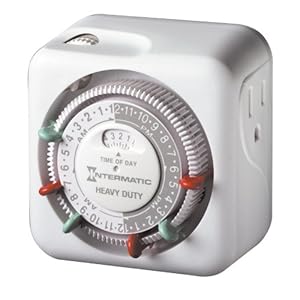
As we have explained before (see here) during Shabbat we can’t turn on or off any electrical appliance or lights. However, it is permitted to program a timer (sha’on Shabbat) from Friday, before Shabbat begins, to turn on and off lights or some other electrical appliances.
Modern Rabbis discussed the issue of modifying the time of the timer during Shabbat. For example, if I programmed the timer to turn off the lights at 10.30 p.m., and then I realize that I will need the lights for one more hour, can I reprogram the timer to turn off the lights at 11.30 p.m.?
Many Rabbis would forbid to do this, but Rabbi Obadia Yosef, Rabbi Auerbach and many other Rabbis authorize to reprogram the timer in the following circumstances:
1. First, it should be a manual timer (see for example this) , not a digital timer (see this ).  A digital timer cannot be modified during Shabbat.
2. When dealing with a manual timer we would be allowed to move the knobs forward, but not back to turn the lights off or even on. We could move the knobs, for example, from 1.30 p.m. to 2.30 p.m.,  but not from  2.30 p.m. to 1.30 p.m..
3. Rabbi Melamed says (Penine Halakha, Shabbat B, p.24) that in exceptional circumstances (sha’at hadaḥaq) most Rabbis would also authorize to reprogram the timer to turn off the lights at an earlier time.  Rabbi Yosef mentions the case of a sick person (even in a non-life threatening situation) for example, if the lights don’t allow him or her to rest.  Similarly, in certain cases (leṣorekh Miṣva)  we would be allowed to reprogram the timer to turn the lights on at an earlier time. Rabbi Yosef mentions as an example,  Limud Tora.
Shabbat Shalom!
Candle lighting in NYC:     4:31 p.m.
Shabbat ends in NYC:         5:38 p.m. 


SHABBAT: Using an elevator on Shabbat

Using a common elevator in Shabbat is not permitted, because the activation of any electrical device is considered a melakha (a Biblical Shabbat prohibition) or at least a rabbinical prohibition (see this).
But what about taking an elevator that has been programmed to stop in every floor and it automatically opens and closes its doors? They are known in Hebrew as ma’alit Shabbat and in Israel, New York and other areas with a significant Jewish population, one can find these elevators in hotels, Hospitals or big apartment buildings.  Are those elevators permitted on Shabbat?
Modern rabbis have analyzed and discussed this issue.
Some rabbis (Rabbi Vozner and others) have forbidden to use it because when a person takes the elevator it forces its  engine to use more electricity causing thereby a (slight) increase in the  consumption of energy.
Rabbi Halperin from Israel, a specialist in Halakha and modern world, holds that it is permitted to go up with an automatic elevator but not down. When going down, the elevator uses also the person’s weight (slightly) as a source of energy.
Most contemporary Rabbis (Rabbi Auerbach, Rabbi Obadia Yosef and others) authorize using an automatic elevator on Shabbat, particularly for a Mitzva, like going or coming from Synagogue, attending Seudot Shabbat, etc.   They considered that the arguments regarding the interaction between the person’s weight and the elevator, in terms of the modification of energy consumption are indirect, incidental and non-deliberate side effects (pesiq resheh, see here) and therefore they do not need to be taken into account. They indicate, however, that when the doors of the elevator are closing, a person should not try to enter into the elevator, because that would cause the doors to be open as a direct result of the person’s  action.
Shabbat Shalom and Chodesh Tob!
Candle lighting in NYC:     7:32 p.m.
Shabbat ends in NYC:         8:38 p.m.
Priceless!
A New York Times article on Shabbat Elevators
Another Landlord Worry: Is the Elevator Kosher?