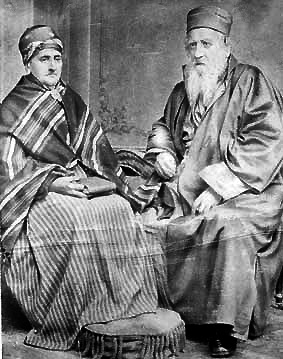
Rabbi Eliyahu Hazan: The first Sephardic Bat-Mitzva

After being in Tripoli for a few years (see this), rabbi Eliyahu Hazan was invited to serve the Jewish community of Alexandria, Egypt, replacing rabbi Moshe Pardo, who passed away in 1888.
At the beginning of the 20th century, Alexandria was a cosmopolitan city, with a strong European influence.  The Jewish community was at the vanguard of the socio-economic progress. Those were times of reform and secularization. Jewish education was not popular at all. Many parents were sending their children to the “prestigious”  Christian (some of them missionary!) schools of the city.  As they struggled to find the delicate balance between Jewish education and the increasing demands of the parents for dedicating more time to secular studies (including: art, tennis and dance) the few Jewish schools of Alexandria did not achieve the desired goals in terms of basic Jewish scholarship, particularly with the Jewish girls.   The schools (or the parents) would provide special tutoring in preparation for the boy’s Bar Mitzva. The girls, however, were largely ignorant of Judaism and “could not utter a single word in Hebrew”.
Attentive to this issue Rabbi Eliyahu Hazan introduced a new ceremony, not practiced until then among Sephardic Jews: The communal celebration of the Bat Mitzva. Unlike the boys’ Bar Mitzva, which was centered on the reading of a portion of the Tora from the pulpit, the girls’ new ceremony consisted in the recitation of some prayers and answering questions dealing with the basic principles of Judaism.
For Rabbi Hazan the Bat Mitzva ceremony served a higher purpose: it allowed Rabbi Hazan to develop an innovative educational curriculum. The new program of Religious studies for girls was a prerequisite for participating in the Bat Mitzva ceremony. Now the girls and their parents, eager to participate of the popular celebration,  were provided with a great stimulus to read fluently Hebrew; to learn the basic prayers, and to master the foundations of Judaism.
Rabbi Hazan served the Jewish community of Alexandria for 20 years, until his sudden death in 1908.
He was succeeded by Rabbi Raffaello Della Pergola (from 1910 to 1923) and Rabbi David Prato (from 1927 to 1936). Both from Italy.


Rabbi Eliyahu Hazan (1846-1908) and the Role of Secular Studies

Rabbi Eliyahu Bekhor Hazan
Rabbi Eliyahu Hazan  (1846-1908) , son of Yosef Rafael Hazan, was born in Izmir, Turkey . His grandfather was Rabbi Hayim David Hazan, the author of nedib leb and the Chief Rabbi of Israel (Hakham Bashi and Rishon LeZion) in 1861. In 1856, when he was 10 years old and with the blessing of his parents, he was taken by his grandfather to Yerushalayim. There, he studied day and night for many years. At a very young age he was part of the Bet Din (rabbinical court) of Rabbi Abraham Ashkenazi. In 1866 his grandfather granted him his Rabbinical ordination.
In 1872 when visiting Tripoli (Libya), he was offered to serve as the Chief Rabbi of Libya, a very important and numerous Jewish community on those days.
The first task he took upon himself was to make some improvements in the area of education. In his most famous book,ta’alumot leb Rabbi Hazan describes the situation of the Libyan community in this area: “And I saw that the cause of their insufficient education in Tora and general studies (derekh ereṣ) is the lack of a proper Talmud Tora (a Jewish school), because the children attend some informal classes in the Synagogues… where there is only one teacher for 60 or 70 students at a time… and those parents who want to give a better education to their children are forced to send their children away to Europe or to the [private] Catholic schools in the area”
Despite some opposition, Rabbi Hazan founded a Jewish day school in Tripoli, in which Jewish children were given instruction in religious topics, as well as in other subjects, like mathematics and the Italian language, which was the most essential tool to guarantee that the students will have a melakha (profession or commerce). He also required that all school instructors would be certified teachers.
(To be continued…)
געגועי ירושלים
Upon leaving Yerushalayim to establish himself in Libya he writes: “My family and I left with a broken spirit the Holy city, the city of my ancestors’ graves… “. In honor of Yerushalayim Rabbi Hazan wrote this beautiful poem “ochil yom“, where he expressed his deep longing for the Holiest city.  This piyut is very popular among Jews from North Africa.


Rabbi Refael Aharon ben Shimon: Sephardim and Ashkenazim

Cairo was also home to an Ashkenazi community, which was founded in the aftermath of the progroms that hit Europe in the latter part of the 19th century.  The Ashkenazi community had its own Synagogue where they would hold services according to their customs and traditions.  Still the basic community services (cemetery, sheḥita, education) were provided by the  Sephardic community for both. In 1893 the lay leaders of the Ashkenazi community decided to have their own services. Rabbi ben Shimon (1847-1928) did not refuse and the Sephardic community gave the Ashkenazi community a parcel in the cemetery for free.  They also appointed their own Rabbi, Rabbi Rafael Ginzburg, who passed away three years after his appointment. At the end of the 19th century he was succeeded by Rabbi Aharon Mendel haCohen, a great rabbinical scholar from Tiberia. Rabbi ben Shimon and rabbi Mendel worked together for the benefit of the Jewish community. Rabbi Ben Shimon brought Rabbi Mendel as part of his Bet Din (rabbinical court). Even though Rabbi Ben Shimon in his position as the Chief rabbi of Egypt, appointed in 1893 by the Turkish Sultan, was technically the single authority of the entire Jewish community, before he issued a new rule, he would consult with rabbi Mendel and seek his approval.  The relationship and camaraderie between the two Rabbis was known as an example of team-work and mutual respect between a Sephardic and an Ashkenazi rabbi.
Even when they would disagree on certain issues, they would still respect each other greatly. In 1903, rabbi Mendel together with rabbi Zvi Makowsky (va-ashiba shofetaikh) planned to reestablish the Sanhedrin (ḥiddush hasemikha), i.e., a universal Rabbinical Supreme Court that, among other things, would (i) resolve all the disagreements between Rabbis and arrive at one final Halakhic decision, mandatory for all (ii) appoint community rabbis who will act on behalf of this Sanhedrin. Rabbi Ben Shimon was very enthusiastic about the idea in general, but he was skeptic about its realization.  In a  beautiful letter addressed to rabbi Mendel (which could be found in nehar miṣrayim B, pp. 583-587) he tried to dissuade him. Rabbi ben Shimon’s opposition to this idea was based purely on pragmatic grounds: In present times –he said– with so many divisions among the Jews, it will be impossible to persuade all the Rabbinical and lay leaders to surrender their local authority and empower one single entity above them.   Unfortunately, Rabbi ben Shimon was right and the project never came to fruition.
 Read more  HERE about past and present attempts to renew the Sanhedrin


Refael Aharon ben Shimon response on suicide

As we saw last week, Rabbi Refael Aharon ben Shimon (1847-1928) is a good example of a rabbi that confronted the challenges of modernity.
We described how and why he, for instance, forbade the celebrations of private weddings (see here) and issued a decree making mandatory to celebrate weddings only in a Synagogue.
Today, I would like to address a completely different and very delicate issue, which Rabbi ben Shimon had to deal with too. As he himself writes (see nehar misrayim 2, page 584) in Cairo (Egypt) suicide became epidemic in his time (ca.1910-1920). “We see with a broken heart… how young people take their own lives because of small problems, illusory matters of honor or frustrated romantic expectations.. and I saw that this terrible outbreak came from European influence [=Western culture] because there they do not believe in an afterlife, and have nor fear of [=belief in] God, so when they are confronted with any crisis –instead of accepting it as a Divine decree– in a brief moment of impulsivity, they would take their own lives…”.
Rabbi ben Shimon spoke publicly several times about these issues, encouraging the people to believe that going through difficult times is part of what makes us grow, and that we should see these challenges as God-sent opportunities to elevate ourselves emotionally and spiritually.
Besides his teachings, rabbi ben Shimon also made the following ruling: When someone commits suicide (has veshalom) the honors due in normal circumstances to someone that passes away are suspended. The body is buried outside the common area of the graves, etc. But in order to alleviate the families the rabbis usually consider that the person who committed suicide was not completely mindful of his actions, and/or in the last seconds, he might have repented from his intention. Thus, his death is not categorized as suicide and honors would be given to his body.
Rabbi ben Shimon cancelled this leniency. He saw that the last resource to stop the potential suicide might be knowing the pain and shame that will be inflicted to his family, since his body will not even be buried in a normal grave, etc.
As Rabbi ben Shimon  himself testified, this preventive ruling was effective and the rates of suicide in Cairo diminished dramatically.


Rabbi Refael Aharon ben Shimon (1847-1928)

As we said last week (see here) Rabbi Ben Shimon wrote many responsas about the new inventions of his time. As the highest authority in his community he had to pronounce a ruling on those issues.
In a rare and exquisite passage in one of his responsa (oraḥ ḥayim , 8, p.23) of his book umiṣur debash, he was asked about the usage of matches (a new popular invention in those days) in Yom Tob. Before he build the case against or in favor of using matches in Yom Tob, he writes the following [my own, free translation]:
“What a difficult task is for a Rabbi today to answer this kind of questions. New inventions in all areas of life are so many in our generation… Human knowledge has increased through the investigation and the new discoveries of the principles of Creation, and with it, man’s industrial and technical capabilities. Every day there are innovations which were inconceivable for our ancestors or even for our own elders. It is a very difficult task for a Rabbi to find the proper answers to questions about these new technological inventions. To determine, for example, if they could be used on Shabbat or Yom Tob.  Because it is very laborious to compare these new inventions with the elements mentioned in our holy Talmud [1500 years ago], which is the guide of our lives and the source for establishing what is permitted and what is forbidden. Only through a great patient effort, and with a clear and calm mind, and with enough available time–free from all other troubles–it will be viable to analyze these innovations and compare the classic principles with the new discoveries. Searching with candles every comparable detail which could be found in the Talmud –which is like a deep ocean– to arrive, perhaps, to a practical conclusion and final ruling. And in addition to all this, once a conclusion is reached, one has to have a special merit to be spared from the critics, those whose expertise is to condemn, because they were trained to criticize arguments, and not to build them… “


AN EXCEPTIONAL MOMENT OF TRUTH 
AT THE U.N. DISCUSSING ISRAEL .
(Do not expect to see  THIS VIDEO in mainstream media…)


Rabbi Refael Aharon ben Shimon (1847-1928)


 Rabbi Refael Aharon ben Shimon was born in Rabat, Morocco in 1847. In 1854 he came to Israel with his father, Rabbi David ben Shimon, who was also his main teacher. The family established themselves in Jerusalem.  Besides his Rabbinical studies, especially in the field of  Jewish law, Rabbi ben Shimon learned European languages. He was fluent in Italian, French and Spanish.   In 1890 he visited Morocco and once there, he searched writings that were unpublished and he recommended the establishment of a institution mekiṣe nirdamim to publish old books and manuscripts of Moroccan Rabbis which were not accessible to the general people.  On his way back from Morocco he was invited to visit the important Jewish community of Egypt. Once there, he was offered to serve as the Chief rabbi of Cairo, instead of the previous rabbi Yom-Tob Israel, who retired from the rabbinate.   He served the Egyptian jewish community from 1891 until 1921.
Rabbi Ben Shimon had to face new challenges. The modern world brought about many innovations in technology and social values which needed to be reassessed from an Halakhic perspective.  In the introduction of his most famous book, umiṣur debash, he mentions a few subjects that he had analyzed in research-like responsas. Among them: the use of electricity and matches on Yom Tob. The use of chariots driven by gentiles for the sake of burying a death during Yom Tob. The assessment of the Cairo water supply system in order to be considered as mayim lo she-ubim (non-transported waters), and therefore be suitable for a Mikve. The status of the children of mixed marriages, converts, etc. And the status of a wedding which took place in a private ceremony.
Let me refer briefly to this last issue.  Rabbi ben Simon witnessed a new trend. Men coming from Europe would marry a Jewish girl in a private ceremony and then, after a few years of staying in Egypt, these gentlemen would come back to Europe abandoning their wives. These poor women would be considered now‘agunot, i.e, not formally divorced from their husbands and therefore unable to marry again. Together with rabbi Elyahu Ḥazan from  Alexandria and Rabbi Mendel haCohen, the rabbi of the Ashkenazi community of Cairo (sic.) they forbade the celebration of secret marriage ceremonies, annulling those weddings retroactively (hafqa’at qiddushin) and thus, releasing these women from their status of ‘aguna.
(To be continued…)


Rabbi Hayim Palachi (1788-1869)

Rabbi Ḥayim Palachi (also Palaggi or Palacci) was born in Smyrna, Turkey in 1788.  He was the grandson of Rabbi Yosef Ḥazan, the author of Ḥiqre Leb, and the disciple of Joseph Gatenio, author of Bet Yiṣḥaq.
In 1847 he became the ab bet din of Smyrna and of another six neighboring communities. In 1855 he was appointed Ḥakham Bashi of Izmir by the Ottoman authorities .
During his Rabbinate period he gave importance to social welfare; and as an important mission he thought of founding a Jewish hospital. He requested assistance from the wealthy Jews in town. With the help of respected Senior Leon Adut they contacted Baron Rothschild in Vienna and received the necessary support. He was also able to receive the support from Sir Moses Montefiore. The Jewish hospital was established. At the time, the population of Izmir was 220,000, with the Jewish population consisting of about 16,000 souls.
Rabbi Palachi’s set a goal to maintain mandatory education to all Jewish children. He adopted a community law which required every Jewish father to give Talmud Tora education to his children. Children would continue their education until they were able to read and write properly, and could grasp the fundamentals of Tefila. Only the instructor was allowed to decide when the students had achieved the required educational goals. Rabbi Palachi made sure that all the poor children also received education.
Rabbi Ḥayim Palachi was very sensitive to events that affected Jews outside Izmir as well. During the blood libel in Damascus in 1840, he called for the support of his Egyptian Jewish friend Don Abraham Kamando, Baron de Rothschild and Sir Moses Montefiore. Through their intercession, the innocent Jewish victims in Damascus were exonerated.
(Adapted from Rabbi Naftali Haleva, present day Rabbi in Istanbul, Turkey)
This is a picture of the Izmir community in 1896. In the center, one can see rabbi Abraham Palachi (rabbi Ḥayim Palachi’s son)
Rabbi Ḥayim Palachi was an extraordinarily  prolific writer. He  authored more than 70 works, most of them have been published. Many of his manuscripts were burned and a great number were not published. Most of his books contain in their titles his name, “Ḥayim”  or “Ḥay”
*Darke Ḥayim  on Pirqe Abot.
*Leb Ḥayim a, responsa, interpretations, and comments on the Shulḥan ‘arukh.
*Nishmat Kol Ḥai , rabbinical responsa.
*Ḥiqeqe Leb , homilies and eulogies.
Other books: Nefesh ḤayimTora ve-ḤayimKaf ha-ḤayimMo’ed le-Khol ḤaiḤayim ve-ShalomSefer ḤayimGinze Ḥayim, etc. 


Rabbi Hayim Nahum (1872-1960)

Rabbi Ḥayim Naum was born in 1872 in Izmir, Turkey. He was an extraordinarily intelligent person with an exceptionally diverse education. He received his formal Jewish education in Tiberias and his secondary education at a French Lycee. He held a degree in Islamic Law from Constantinople. He attended the Sorbonne’s School of Oriental Languages in France while at the same time attending the Rabbinical Academy of Paris. He then returned to Constantinople and taught at the Turkish Military Academy.
Rabbi Naum’s unusual background and eclectic interests earned him great respect. From 1909 until 1923, he served as akham Bashi (Chief Rabbi) of the Ottoman Empire and was granted the title of “Effendi” (Lord) by the Turkish government. Rabbi Naum successfully intervened in favor of Jews in various localities of the Empire, especially in assuring government protection for them during World War I (it seems that it was due to him that the project of expelling the Jews from Jerusalem was averted).
In 1923, Rabbi Naum agreed to become the head of the Jewish community in Cairo, and thus the Chief Rabbi of Egypt. Here, too, Rabbi Naum became a man of noted success within the greater gentile society. From 1930 to 1934 he was a member of the Egyptian Parliament. He helped found the Royal Academy of the Arabic Language, and was instrumental in making possible the reconvening the Society for the Historical Study of the Jews of Egypt.
With the rise in Arab nationalism in the late 1940s, life for Egyptian Jews became increasingly difficult. There was an abundance of political intimidation and economic oppression. Although he gave into government pressure to denounce Zionism (using vague, meaningless phrases), he held firm in his refusal to have synagogues recite prayers for an Egyptian victory in the 1948 war. Ignoring his own failing health (and blindness), Rabbi Naum spent his final years in service to the greatly diminished Egyptian Jewish community. He was 88 years old when he died.


Rabbi Yishaq ben Walid (1777-1870)


“The western luminary” (Ner haMa’arabi). That was the title given by Morrocan rabbis to one of its most illustrious: Rabbi Yiṣḥaq ben Walid (or Bengualid) from the city of Tetuán, in the north (Spanish) of Morocco. 

Rabbi ben Walid belonged to a family of Rabbis, who left Spain after the expulsion in 1492. Since childhood, and despite the loss of his father at a very early age, he dedicated himself completely to study Tora.  After the death of his father, the financial situation of the family was so desperate that the mother had to sell her husband’s books, a set of the Talmud, to maintain themselves.  Rabbi ben Walid worked for years saving penny after penny to buy back what he considered to be his most important patrimony: The Talmud.
He was known for his brilliant mind, his piety and above anything else for his humbleness.  In 1830, after the head of the Rabbinical court, rabbi Moshe haLevy,  passed away, and knowing that the community leaders will consider him as a candidate, rabbi Ben Walid  fled to Gibraltar and hid for a while, running away from honors, as Pirque Abot indicates.  Only at the insistence of the community leaders who presented him a petition with the signatures of sixty of the most prominent rabbis of the time, Rabbi ben Walid accepted the new position. His condition, however, was that he will make his Halakhic decisions always with at least two other rabbis, and never by himself.
He had a special inclination for ḥesed and charity. He would provide food to the needy, especially before Shabbat and Holidays. One time he gathered the leaders of the community and told them: “My family is starving. I need a raise.” And he proposed to create a tax on kosher meat, the “gabela” (Spanish for community tax) , to generate the extra money. After the community leaders accepted the rabbi’s request he explained that the “starving family” he was referring to, were the needy people of the city, his brothers and sisters. And for many years all the money from the gabela was given to the most needy of the city.
√ Rabbi Ben Walid  refused to publish his book in order to avoid a financial burden on the impoverished Jewish community of Tetuán.  In 1855, his oldest son Shemtob, published his book vayomer Yiṣḥaq in the city of Livorno, Italy.  This book is a collection of rabbinical responsa which includes the Minhaguim and traditions of Spanish Moroccan Jews.  We present  HERE one of the first edtitions of vayomer Yiṣḥaq  from www.hebrewbooks.org


√ Those who read Hebrew and are interested in knowing more about the life of rabbi ben Walid should read the introductions/dedications written by his two sons, Shemtob Ben Walid and Vidal ben Walid, at the beginning of the book.  
  
√ Click here to see the unmarked grave of rabbi  ben Walid in the Jewish cemetery of Tetuán.


Rabbi Shemtob Gaguin (1884-1953)

Rabbi Shemtob Gaguin(e) was born in Jerusalem in 1884.  Rabbi Gaguin was a British Sephardic Rabbi and a descendent of a famous Moroccan Rabbinical dynasty which emigrated to Israel from Spain at the time of the Inquisition. He was the great-grandson of R. Hayim Gaguin, the first Chief rabbi (Chakham Bashi) of the Israel during the Ottoman Empire.
He studied at the “Doresh Zion” school in Jerusalem and was a pupil of the celebrated Rabbi Jacob Alfiye. At an early age, he contributed articles to the Palestinian Hebrew Press (“HaChabbazelet”) on aspects of Jewish traditional observances, as well as on biblical and philological matters. He was awarded rabbinical diplomas by numerous authorities, including Rabbi Chayim Berlin (the son of the Natzi”b) and Chief Rabbis of Israel Ya’aqob Meir and Abraham Kook
In 1920 he accepted a position of Rabbi of the Sephardic community of Manchester and at the same time he was a Dayan (Rabbinical Judge) in the Manchester Rabbinical court (Bet Din).
From 1921 he was the head of the Sephardic communities of London. Rabbi Gaguin died in Manchester, 1953.

Rabbi Shemtob Gaguin

Among his works we find:
√ A study on origin and history of the Jews of Cochin (India)
√ Shulchan Arukh, a critical study of the Jewish Codex based on several old editions and unpublished manuscripts.
√ Commentaries on Midrash Rabba and Midrash Tanchuma
His most famous book is  Keter Shem Tob, an encyclopedic treatise which examines and compares the Tefilot and traditions of the Eastern (Turkey, Israel, Egypt Syria) and the Western (Amsterdam, London, NY ) Sephardim, paying particular attention to the customs of Spanish and Portuguese Jews. The first two volumes were published in 1934. The final work comprised a total of 7 volumes, the last 3 of which were published posthumously with the help of his son, Rabbi Dr. Maurice Gaguine.
Click HERE to download  Keter Shem Tob