Rabbi Ya’aqob Meir (1856-1939) First Sephardic Chief Rabbi Of Israel

Rabbi Ya’aqob Meir (his original last name was “Mercado”) was born in Jerusalem in 1856. He was the son of a very successful and generous merchant, Caleb Mercado. He studied with Rabbis Menachem Bekhor Isaac and Aharon Azriel. He was an accomplished Talmudic scholar who was fluent in Hebrew and five other languages. At the age of 16 he married Rachel Yitzhaki. While studying, he devoted himself to activism for the benefit of the incipient Jewish community in Palestine (Israel). In 1879, he was one of the founders of Bikur Cholim, which established the Misgab Ladach Hospital in Jerusalem.
KIBUTZ GALUYOT
In 1882, he was sent as an emissary to Bukhara (Uzbekistan). The Jews of Bukhara, who rarely had such prestigious visitors, received him with great respect. And in his honor they called all his children born during his stay with his name. The Rabbi helped them with the formulation of religious and community regulations and encouraged them to emigrate to Israel. Thanks to his encouragement, from 1889 the Jews of Bukhara began to emigrate en masse to Israel. From 1888 to 1899 he was a member of the Rabbinical court of Ya’aqob Shaul Elyashar, Chief Rabbi of Jerusalem. In this capacity he helped establish new neighborhoods, such as Ezrat Yisrael, Yemin Moshe, and the Bukhara neighborhood in Jerusalem (shechunat habujarim).
ACHDUT ISRAEL
At that time the differences between Sephardic and Ashkenazi Jews were very significant, culturally and even religiously. Both communities wanted their own Rabbis and did not agree. Rav Meir, aware of the importance of us Yehudim sticking together, worked tirelessly to bridge the gap between the two communities. One of his projects was the establishment of the HITACHDUT, an organization of Sephardic “and” Ashkenazi rabbis, something unprecedented until then. One of the first things this organization did was to appoint Naftalí Hertz HaLevi, an Ashkenazi rabbi born in Białystok, Poland, to serve as the sole rabbi of the city of Jaffa, and to be accepted by Ashkenazim and Sefaradim. HEBREW LANGUAGE Rabbi Meir was also noted for his effort to revive the Hebrew language. Hebrew had ceased to be a spoken language by 2,000 years. Rabbi Meir founded the organization “Safa Berura” together with Rabbi Chaim Hirchenson. Later the famous Eliezer Ben-Yehuda joined this organization. These tireless volunteers roamed the schools and Yeshivot of the Yishub teaching Hebrew and encouraging its daily use.
ISRAELI POLITICS
After Rabbi Elyashar’s passing in 1906, Rabbi Yaakov Meir was the natural candidate to be the new Rishon LeZion. But many leaders opposed him and accused him of being “too Zionist” (an accusation that certainly made him proud) and the Rabbi was frowned upon by the Turkish-Ottoman authorities, who ruled Palestine until 1917, and they were not in favor. agreement on the immigration of so many Jews to Israel.
THESSALONIKI
In the summer of 1907, Rabbi Meir was invited to serve as Chief Rabbi in Thessaloniki, Greece. At that time this was one of the largest Sephardic communities in the world with about 100,000 members. Thessaloniki also stood out as the only city with a Jewish majority. The Rabbi stayed in Salonika for 10 years. When the First World War began he did something extraordinary: he organized a group of young Greek Jews, “The Hebrew Legion”, to fight for the liberation of Palestine. He also encouraged many Jews from Thessaloniki to settle in the land of Israel.
GONE WTH THE FIRE 
In 1917 there was a tragic fire in Thessaloniki that irreversibly devastated the community. More than 50,000 Jews lost their homes in this fire. 16 of the 33 synagogues and the Rabbinate with all its archives were destroyed. Rabbi Meir’s home was also affected, and his entire library was destroyed. The worst and most tragic thing for Rabbi Meir was that the fire also consumed his manuscripts: all the explanations, the comments and the rabbinical responsa that he had strict for 20 or 30 years… he could never find consolation for this loss. Since there were no books written by him then, his words and opinions were recorded in the books of other rabbis, such as Rabbi Ben-Zion Cuenca and Rabbi Isaac Abulafia.

RISHON LEZION
In 1919, Rabbi Jacob Meir returned to Erets Israel where he was honored and decorated with the Commander of the Order of the British Empire award for his service in war. In 1921 with the help of Rabbi Abraham Kook, he was chosen as Israel’s chief Sephardic Rabbi aka, Rishon leZion. He held this position until his death. The 1920s and 1930s were very critical times for the “Jewish settlement” that was not yet independent. And there was much to do. One of Rabbi Meir’s main contributions was the establishment of a Rabbinical Court of Appeal: although the law of Palestine was established by the British authorities, if a legal ruling opposed Jewish law, a Jew residing in Israel had the right to appeal and ask to be tried by Jewish law in this court of appeals that was founded and headed by Rabbi Meir.
PEACE WITH THE ARABS
In 1924, he participated with Colonel Frederic Kish and David Yellin in meetings in Amman, Jordan, with Hussein bin Ali and his son Abdullah, in an attempt to establish good relations between Arabs and Israeli Jews, which at that time was not inconceivable.  The Sephardic rabbis and leaders (such as Abraham Shalom Yahuda and others) had a great advantage over other rabbis and politicians in this area: they spoke the language of the Arabs, they were part of a similar eastern culture and shared a similar mindset, and this allowed them a more fluid and diplomatic dialogue with the Arabs. Rabbi Meir passed away in May 1939 and Rabbi Ben-Zion Meir Hai Uziel took his place.

WATCH this rare historic footage from 1918. The 3rd rabbi to appear is Rabbi Ya’aqob Meir.

The sad words of rabbi Jacob Meir about the consequences of the fire in Salonika

היות כי לדאבוני פרצה תבערה גדולה בשאלוניקי בשנת תעז”ר ונשרפו כל בתי עיר הפנימית ובכללם גם משרד הרבנות והמעון שאני דרתי בו, נשרפו גם שני הקונטרסים אשר טיפחתי וריביתי בימי בחרות, הראשון על שו”ע אבן העזר והשני על חושן משפט, ולא נשארה לי העתקה מהם… חוץ מזה לא נשאר בידי כלום. עתה אין בכוחי לכתוב חידושי תורה מחמת כמה סיבות. ראשית, אין לי כל הספרים הדרושים לתכלית זו, ספרייתי העשירה שהייתה לי לפני נוסעי לסאלוניקי התפוררה והתפזרה… שני טרדות הציבור מונעות עתה ממני להפנות לזה ושלישית הנה באתי בימים וזקנה קפצה עלי. אני מוסר מודעה כי כל מה שאנוכי רושם וכותב בפנקסי אינו לשם חיבור כדי להדפיסו היות שידעתי שאין בו דיבור של ממש…”


Rabbi Menashe ben Israel (1604-1657) the most famous Jew in the world

Portrait of Menasseh ben Israel  by Rembrandt

Ribbi Menashe was born in Portugal in 1604, under the name Manoel Dias Soeiro. His family moved to the Netherlands in 1610, when Amsterdam was an important center of Jewish life in Europe. Like many other Jews arriving from Portugal, Ribbi Menashe’s family openly returned to Judaism.

Young Menashe received the best possible education within the Sephardic tradition, which maintains that secular studies should complement religious studies. He excelled in his Talmudic studies and deeply knew the Tanakh. He mastered the entire spectrum of Jewish thought, from the school of Maimonides to the writings of the most famous Kabbalists.

He had an extensive knowledge of medicine, mathematics, and astronomy in secular matters. He stood out in languages: he spoke ten languages. He was also well-versed in classical literature and the writings of non-Jewish philosophers and theologians. This knowledge enabled him to debate with non-Jewish intellectuals and refute their ideas when they contradicted Judaism.

At the surprisingly young age of 18, in 1620, he was appointed as the rabbi of the Sephardic community and soon became one of the most famous preachers in that prestigious community. Shortly after assuming this position, he married Raquel Soeiro, a direct descendant of Rabbi Don Yitzchak Abarbanel, with whom he had three children.

In 1626, he established the first Hebrew press in Amsterdam, and indeed in all of the Netherlands, called “Emet MeErets Titsmaj.” In his printing press, he used a new typeface that would later be copied by many European presses.

During those years, the Dutch colonized Brazil, and many Jews from the Amsterdam community, and prominent international traders, moved to the city of Recife in the region of Pernambuco. In 1638, Ribbi Menashe decided to visit Recife and was probably the first rabbi to set foot on American soil, but he returned to Amsterdam shortly after arriving because two important Portuguese Jewish entrepreneurs, the brothers Abraham, and Isaac Pereyra, had settled in the city and offered to hire Rabbi Menashe to lead a Talmud Torah, a Jewish school they had founded.

One of Ribbi Menashe’s early books was “El Conciliador,” written in Spanish and later translated into English by Elias Hayim Lindo (see here). This extraordinary book (which I mention several times in my book “Awesome Creation”) aims to reconcile all the texts of the Tanakh that seem to contradict each other. For example, one of the first points he analyzes is the apparent contradiction between what the Torah describes during the first three days of Creation, “and there was evening, and there was morning,” and what seems to be the creation of the sun on the fourth day. Rabbi Menashe presents eight possible answers to resolve this issue (the Jewish sages, by the way, explain that the sun and moon were created on the first day, in the first act of Creation). In this book, the Portuguese rabbi refutes the arguments of self-proclaimed Bible critics. It was one of the first works written by a Jew in a modern language that aroused great interest among Christian readers. This earned the rabbi a great reputation in the non-Jewish academic world. Over time, his fame as a scholar and expert in all matters of learning and science spread beyond the Netherlands. Some of the most prominent figures in the world sought his friendship and advice. His non-Jewish correspondents and friends included Queen Christina of Sweden, the famous artist Rembrandt who painted his portrait, and the statesman and philosopher Hugo Grotius.

In 1644, Ribbí Menashe met Antonio de Montezinos, a Portuguese Jewish converso who had traveled to the New World and had encountered the then-exotic lands and cultures of the Americas. Montezinos told him that the indigenous peoples of the South American Andes practiced certain rituals and symbols similar to those of the Jews and that, in his opinion, they were descendants of the Ten Tribes of Israel. The colorful accounts of Montezinos and Ribbi Menashe’s theory regarding the significance of this discovery in relation to the arrival of the Messiah were recorded in one of his most famous books, which he wrote in Spanish: “MIKVE ISRAEL: La esperanza de Israel o el origen de los americanos.”

A few years later, he wrote an extraordinary historical and philosophical treatise addressed to the authorities of England, presenting arguments in favor of the readmission of Jews to England, from where they had been expelled in 1290. His letter to Cromwell, written in perfect English, can be found here in this link from Hebrewbooks (https://hebrewbooks.org/52715). In 1653, Ribbi Menashe traveled to England to formally request the readmission of Jews. He was received by none other than Oliver Cromwell. However, he faced many difficulties, including the demand that for readmission, Jews had to convert en masse to Christianity. He left England and returned to the Netherlands in 1655, frustrated for not achieving his objective and materially impoverished for not having worked for such a long time. He never knew that it was thanks to his efforts that Oliver Cromwell finally readmitted Jews to England and allowed them to freely practice their religion, as he passed away in Amsterdam that same year, 1657.

In his time, Rabbi Menashe ben Israel was the most famous Jew in the world.

For a complete biography, see “Cecil Roth: Life of Menasseh Ben Israel (The Modern Jewish Experience).”



Rabbi Yom Tob Tsahalon, Purim and the First Book Ever Printed In Israel

EARLY LIFE

Rabbi Yom Tob ben Moshe Tsahalon (1559-1619), also known by his acronym מהריט” ץ, was a student of Rabbi Moshe of Tirani (the Mabbit) and Rabbi Moshe Alshekh haQadosh. He may have also occasionally studied under Rabbi Yosef Caro, author of the Shulchan’ Arukh. Rabbi Tsahalon was a child prodigy. From an early age, he combined advanced intelligence and a passion for studying Tora. Referring to his learning as a teenager with the Mabbit and Rabbi Alshekh, he writes: “I devoted myself to studying day, evening and night, without interruption … clinging to the dust of the feet of the two great luminaries [his two teachers] and drinking with thirst their words and teachings … [During all this time] I did not rest or pause, and I only dedicated myself to learning the Divine Judgments [the Laws of the Tora] …. I suffered the mockery of my friends when they saw that I was walking so strictly on these good paths; they despised me because I did not do what the youth of my age used to do … but I did not distract myself… since my greatest delight was always to learn Divine Laws … “The effort paid off. When he was 20 years old, the young Rab Tsahalon began to write his Pesaqim, his Rabbinic Responsa, something reserved for very experienced Rabbis. We have evidence that at the age of 25, some of the most important rabbis of that time, such as Rabbi Shemuel Yafe of Constantinople (1525-1595) consulted with the young rabbi Tsahalon, to know his opinion in all kinds of rabbinical jurisprudence cases. Some of those responses were published in the most famous book of Rabbi Tsahalon “She-elot Utshubot Maharitats”. The book was printed in Venice, Italy, in 1694  (see link here). It is a collection of Rabbinical questions and answers on Jewish rituals and legal issues.

THE BEST GIFT FOR PURIM

One of Rabbi Tsahalon’s lesser-known books, but perhaps the most fascinating, is a commentary on Megillat Esther, the Book of Esther. The name of the book is “Leqach Tob”. And I found three reasons to assert that this is an amazing book. 1. Rabbi Tsahalon published this book in the year 1577. Considering that he was born in 1559, he then published his book he was 18! Which means that he wrote this book in his early teens! 2. Like every good book, its content makes this work fascinating: Rabbi Tsahalon bases his commentary on two fundamental elements: 1. The Talmud, and the ideas of the Midrash. 2. a critical and meticulous analysis of the Biblical language, where many times a new meaning can be discovered by rereading the same text with a “mental microscope,” analyzing the almost imperceptible details of the Hebrew words. 3. Finally, what makes this book truly unique is that it was the first book ever printed in the land of Israel! Until the year 1577, there were no printing presses in Israel. Jewish books were printed mainly in Italy (Rome, Ferrara, Venice) or Turkey. The first printing press in the history of Israel was established in Tsefat by Rabbi Eliezer ben Ytshaq Ashkenazi, who had his printing in Lublin (Poland) and Constantinople (Turkey). Anyway, this printing press did not last long, only ten years, in which only the book of Rab Tsahalón and five other books were printed (for the fascinating story of the first printing press in Israel, see the article: “Early Hebrew Printing from Lublin to Safed: The Journeys of Eliezer ben Isaac Ashkenazi” by Marvin Heller). Rabbi Tsahalon dedicated this book to his father as a mishloach manot, a gift, for the festival of Purim.

We will now see a couple of examples of his commentary.

1. RELIGIOUS EXCEPTION One of the most famous questions of the Megilla is why Mordekhai refused to bow to Haman. The Midrash explains that Haman had an idol around his neck, which made him a representative (virtually: a human incarnation) of that god. Therefore, kneeling before Haman would amount to idolatry. The question then is: Why did Mordechai stay at the King’s court? If he could not kneel before Haman, he should have quit his position in the court and not endangered the lives of the Jews of the Persian empire! Rab Tsahalon (page 34) observed that the last words describing what Mordekhai did are written in the future tense, and although in many cases like this, this type of continuous tense can be understood as a past tense, in this particular case, we must preserve the original conjugation. Thus, this Pasuq would say, “All the officers at the King’s court knelt and prostrated before Haman because the King had so ordered … but Mordekhai should not kneel, and should not prostrate [before Haman]. “Thus, Rabbi Tsahalon explains that the King actually granted Mordekhai special permission, a religious exemption, so that Mordekhai, a known Jew, would not have to kneel before Haman. Obviously, Haman was not happy with seeing Mordekhay standing. Despite the King’s exception, Haman felt humiliated and plotted to kill the entire Jewish people in response. When he presents his case to the King, he never mentions anything about Mordekhay’s refusal to bow down. As far as I know, this explanation is unique and original to Rabbi Tsahalon.

2. 70 DAYS OF HORROR When you read the Meguilla, you must make a huge effort to visualize what the Yehudim must have suffered once the edict reached their residence. In that edict, there were explicit instructions that at a certain date, the 13th of Adar, all Jews would be killed. No appeals. No exceptions. This terrible letter from Shushan the 13 of Nisan (11 months before the “execution day”) and it must have arrived after a few days or weeks to all the corners of the empire. Now, what happened once the letter arrived? Were the Jews able to be free and continue with their lives? Were they allowed to escape? Part of the sinister plan of Haman was that the volunteer executors could keep the assets of the victims, so all the prospective volunteers wanted to make sure that no Jew escaped with anything of value until the day of the genocide. The Midrashim tell us that many times after the letter got there, many non-Jewish neighbors showed their sharp knives to the horrified Jewish mothers, mocking them and showing that they would kill their little children with those weapons. The Midrash also explains that the perpetrators celebrated in advance of the massacre and planned how to distribute the Jews’ assets and property possessions. In his book Leqach Tob, Rabbi Tsahalon explains that once the edict was publicly read, the Jews were “detained” or “imprisoned” (משועבדים), probably with the collaboration of the imperial army to prevent them from escaping with their possessions or from saving their lives. Thinking of 1940-1945 Europe, it is not difficult to imagine the “labor camps” where thousands of Jews must have been imprisoned and awaiting the day of their execution. The Jews were not able to do anything to defend themselves. They prayed, fasted, and hoped for a miracle. Which ultimately happened. It took 70 days until the second letter was sent from Shushan reversing the mandate and “condemning to execution all those who planned to execute the Jews”.

You can find this and other original insights of Rabbi Tsahalon in his book Leqach Tob  (hebrewbooks.org).


Rabbi Abraham de Sola (1825-1882), a Forgotten Sephardic Giant

EARLY LIFE

Rabbi Abraham de Sola (1825-1882) was a Canadian Rabbi, an orientalist and a prominent scientist. Rabbi De Sola was recognized as one of the most influential leaders of Sephardic and Orthodox Judaism in America during the second half of the nineteenth century, at a time when the struggle between the Orthodox and Reform wings of the community was at an acute stage.

His father was rabbi David Aaron de Sola, a famous Rabbi from the Sephardic Community of London, and his mother was the daughter of rabbi Raphael Meldola (see this).

In 1847, at the age of 21, Rabbi de Sola arrived to Montreal, Canada from London and there he served as the rabbi of Shearit Israel, the Spanish and Portuguese community.   In 1852 he married Esther Joseph, whose father was one of the earliest Jewish settlers in Montreal.

SEPHARDIC TORA UMADA

Rabbi de Sola soon established himself at the center of Montreal’s English-speaking intellectual community. An eloquent and esteemed lecturer, and a man of broad interests, he frequently addressed the Montreal Mercantile Library Association, the Montreal Literary Club, the Numismatic and Antiquarian Society of Montreal, of which he was elected as an honorary member , the Montreal Mechanics’ Institute, and the Natural History Society, which he served as president in 1867-68, as well as several organizations associated with McGill University.

In 1848, Rabbi de Sola was appointed lecturer, and in 1853 professor, of Hebrew and Oriental literature at McGill University in Montreal –the most prestigious university in Canada– and he eventually became the senior professor of its Faculty of Arts.  1858, in recognition of his extraordinary scholastic accomplishments, McGill conferred upon him the degree of LL.D. (legum doctor, an honorary doctorate degree)

In 1873, by invitation of President Ulysses S. Grant,  Rabbi De Sola opened the United States Congress with a prayer. He became the first British subject to open the US House of Representatives with a prayer.

Rabbi Abraham de Sola was the pioneer in what is known today as Tora uMada’, the way of looking harmoniously at Science and Judaism.


HIS WORKS

He was a very prolific writer and the author of dozens of books, articles and papers.

Among them:

“Behemoth haTemeoth: the identification and classification  of the prohibited animals of Leviticus, Montreal, 1853.

“Biography of David Aaron de Sola”, the late senior Rabbi of the Portuguese Jewish community in London, Philadelphia, 1864.

“Critical examination of Genesis III”. 16; having reference to the employment of anæsthetics in cases of labour,” published in the British American Journal of Medical and Physical Science,  Montreal 1849.

Canada’s first Rabbi, Abraham de Sola, supported obstetric anesthesia in defiance of diehard traditionalists. Like Professor James Simpson, de Sola reinterpreted the key passage of Genesis 3:16. In three articles for a Canadian medical journal, Rabbi de Sola explains how God had ordained that woman should bring forth children with “toil” or “labour”, not pain. See here 

“The Day of Atonement: a sermon delivered in the synagogue Shearith Yisrael, Montreal,” published in Occident, and American Jewish Advocate Philadelphia, 1848.

“A few points of interest in the study of natural history,” Canadian Naturalist and Geologist, .1868.

“God’s judgments on earth: a sermon delivered in the synagogue ‘Shearith Yisrael’ Montreal, during the Asiatic cholera pandemic.

“Hebrew authors and their opponents,” Jewish Chronicle London, 1849.

“History of the Jews of Poland,” Jewish Messenger, New York, 1870..

“History of the Jews of France, after Bégin and Carmoly,” Jewish Messenger New York, 1871.

“An inquiry into the first settlement of Jews in England”

“Life and writings of Saadia Gaon,” Cincinnati, Ohio, 1881

“The Mosaic cosmogony,” (creation of the universe) Jewish Messenger,  March 1870.

“Notes on the Jews of Persia under Mohammed Shah” Occident, and American Jewish Advocate,  1850.

“Observations on the sanatory institutions of the Hebrews as bearing upon modern sanatory regulations,” Canada Medical Journal and Monthly Record of Medical and Surgical Science, Montreal,  1852.

“The revelation at Sinai; its possibility and necessity: a sermon delivered in the synagogue, Shearith Yisrael,  Montreal,

“The righteous man: a sermon commemorating the bestowal of public honors on Sir Moses Montefiore, by the city of London; preached in Montreal, on Shabbat Noah 5625 , Montreal, 1865.

“Life of Shabethai Tsevi, the pseudo-Messiah . . . ,” Jewish Messenger,  March. 1869.

“Yehuda Alcharizi and the book Tachkemoni,” Jewish Record Philadelphia,  1879.


A FORGOTTEN GIANT

Rabbi de Sola died in New York, in 1882 and was buried in Montreal.

There is a street bearing his name: Rue Abraham-De Sola , in Côte-Saint-Luc, Montreal.

For a more detailed biography of this exceptional Rabbi and for an impressive list of his articles and publications, see  this.


Rabbi David Nieto (1654-1720) and the Sephardic community of London

Portrait of Rabbi David ben Pinehas Nieto
 

FROM VENICE TO LONDON
Rabbi David Nieto was born in Venice, Italy, in 1654. At an early age he moved to Livorno, a very important Jewish community at the time, and devoted himself to Tora study. In Livorno, he acted as a rabbi, Dayan and also as a physician , since like many other rabbis in Italy at that time, he studied medicine at the University of Padua. Rabbi Nieto was also a Renascence man: a distinguished scientist, philosopher, physician, poet, mathematician, and astronomer. In 1702 at the age of 48 he was appointed Hacham of the Sephardic Community of London “Sha’ar HaShamayim”. Let us remember that the Jews were expelled from England in 1290, during the reign of Edward I, and did not return for centuries. In 1655, following the intervention of the famous Rabbi Manasseh ben Israel, Oliver Cromwell readmitted Jews to England and thus began what is to this day called the  Spanish and Portuguese Sephardic community and its splendid building, Bevis Marks, the oldest synagogue in England (see here). The first members of this Spanish-Portuguese community in London were mainly Jews from Amsterdam, including some highly successful businessmen. All members of the community spoke and wrote in Spanish or Portuguese, since they or their parents were originally from Spain or Portugal. Rabbi Nieto served the London community until his death in 1728. His son, Rabbi Isaac Nieto, was appointed in his place as rabbi of this community.

HIS FIRST BOOKS
Rabbi Nieto wrote his first book on one of his favorite subjects: the calendar. “Pascologia”, was written in Italian and explains the differences between the Gentile calendars—the Greek Orthodox calendar, the Roman calendars—and the Jewish calendar, showing the miscalculations in the gentile calendar since the first Council of Nicaea. (325) until 1692. Two years later, he published his book “De la Divina Providencia” which explains, among other things, that the concept of “nature”, as opposed to “Creation”, is a secular idea. The way Judaism explains the dynamic between God and Creation is by using the verbal construction “hif’il” which in Hebrew defines when: “A” causes “B” to produce “C”. Thus, for example, when the Sages describe that the Creator produces rain, they formulate the idea using this conjugation. For example: mashib haruach morid hageshem, which means: God (A) produces natural phenomena (“B”) —temperature changes, air pressure air, etc.— that produce wind and rain (“C”). What  Gentiles call “nature” is, so to speak, God’s modus operandi. But nature cannot be confused with God, as Spinoza, a contemporary of Rabbi Nieto, affirmed. This book was highly praised by the famous Hacham Zevi Ashkenazi and by Rabbi Hayim Yosef David Azulai (the “Jidah”).

THE SECOND CUZARI
Rabbi David Nieto’s most famous book is undoubtedly “Matteh Dan” (this is how the author writes these two words in Hebrew). It was written in a bilingual edition: Hebrew and Spanish, and published in London in 1714. In this book, Rabbi Nieto shows the authenticity of the rabbinical tradition (Tora SheBealpe) demonstrating the intellectual integrity of the rabbis of the Talmud. He explains that the disagreements among the Sages—supposed evidence of a faulty tradition—never focus on the essential laws of the Torah (shorashim or roots) but only on the details (anafim or branches) of the commandments, or the new halakhic cases that had no legal precedent. “Matteh Dan” is also called the Second Cuzari, and is divided into five chapters, which the author calls “dialogues”, because it was written in the style of imaginary conversations between a rabbi and a gentile king, “the Cuzari”, the king of the Khazars. Rabbi Nieto explains that the reason he modeled his book after the famous book by Rabbi Yehuda haLevi (1075-1141) is that “…the Cuzari demonstrates the truth of the Written Torah, and this book, which will be called the second Cuzari will prove the truth of the Oral Torah.”

MATTEH DAN, CHAPTER BY CHAPTER
1. In the first dialogue Rabbi Nieto demonstrates that the Oral Torah existed even before the written Torah, and that an oral tradition is always necessary to understand any written law.

2. In the second dialogue, in my opinion the most original of all chapters, Rabbi Nieto proves —using arguments and principles of history, psychology, logic, and even economics— that the Oral Tora could not have been made up by the rabbis, because it benefits no one, particularly the rabbis who transmitted and sanctioned it. Rabbinic Judaism, he says, was received and passed down from generation to generation with extreme care and devotion.

3. The third chapter talks about the different categories of laws included in the Oral Torah. He also explains what kind of laws there is consensus among the rabbis and what laws do not.

4. The fourth chapter shows that the Sages of the Mishnah and the Gemara (חז”ל) had a very deep knowledge of the sciences, such as medicine, physics, biology, etc.

5. The fifth chapter deals with the Hebrew calendar. Knowledge of the calendar demands a very deep expertise on astronomy, physics, mathematics, etc. Because it is the only calendar that combines the lunar year —354 days— with the solar year —365 days— and for this combination to be calculated accurately, it is necessary to know very precisely the exact duration of the moon’s cycle and the exact duration of earth orbit. Rabbi Nieto mentions that the Christian calendar, which is only based on the orbit of the earth around the sun, had to be modified by Pope Gregory XIII in 1582: that year the calendar jumped from October 4 to 15 in 24 hours, and all this was because gentile scientists did not have the exact information of the solar cycle. The Elders of Israel knew the lunar cicle with an accuracy of 5 decimal places, something that was recently confirmed by NASA (see Video below). This is perhaps the most technical chapter in the book, and one that can be difficult for the beginner, but it is a must-read for those who want to know more about the details of our Hebrew calendar, and understand the role that rabbinic tradition plays in it and in many other cases.

WHAT AUDIENCE IS THIS BOOK ADDRESSED TO?
Rabbi Nieto wrote this book for the bene anusim of his time, that is, for the descendants of those Jews who, due to the Inquisition in Spain and Portugal, lived as Christians for generations, and now returned to Judaism and wanted to know more about it. Many Bene Anusim were university students, professionals, doctors, and knew the Bible very well —because of their Christian background— but they were completely ignorant of the Jewish Oral Tora and its principles. Matteh Dan was also written with religious dissidents in mind, such as the disciples of Spinoza and Uriel de Acosta, who criticized Rabbinic Judaism.
Matteh Dan should be required reading for anyone beginning to study the Mishnah and Gemara, or for anyone wishing to understand the most basic principles of normative Rabbinic Judaism.


Rabbi Ben-Zion Cuenca (1867-1937) And The Hebron Massacre Of 1929

HIS CHILDHOOD AND EDUCATION

Rabbi Ben-Zion Cuenca was born in the old city of Jerusalem in 1867. His surname, Cuenca, corresponds to a province of Spain in the area of ​​Castilla-La Mancha. The family was part of the Jews expelled from Castile and Aragon in 1492. The family settled in Thessaloniki (Greece) and lived there for 3 centuries. His father, Abraham Cuenca, emigrated to Erets Israel around 1850. Before he was ten years old, the rabbis and teachers considered the young Ben-Zion as an ‘iluy (a child prodigy) and allowed him to wear the Tefillin at that age given his extraordinary knowledge and maturity. Aware of his son’s ability, his father devoted his resources to hiring the best teachers and mentors who also provided his son with a vast secular education, especially in the fields of Jewish history and languages.

RABBI OF RABBIS

Rabbi Cuenca got married at 15, something that was not uncommon in those days, to Esther, a second cousin, and they lived in the old city of Jerusalem. Then they moved to Yemin Moshe, the first Jewish neighborhood built outside the walled city sponsored by the famous philanthropist Sir Moshe Montefiore. At the age of 30, Rabbi Cuenca established a Yeshiba “Tiferet Yerushalaim”. In this Yeshiba, which also included general studies,  were educated among others Israel’s chief rabbi Ben-Zion Meir Hay Uziel, the famous Sephardic Hebrew writer Yehuda Bourla, and Rabbi Moshe Nissim, the father of another Chief Rabbi of Israel, Rabbi Isaac Nissim. Rabbi Cuenca was also very active in the religious Zionist Mizrahi movement. He was the Head of the Rabbinical Court of Jerusalem and excelled also as a community leader. He founded, raised the funds for and directed the first Sephardic Nursing Home in modern Jerusalem.

THE MASSACRE OF 1929

The second holiest city in Israel is Hebron –acquired by Abraham Abinu 4,000 years ago–  which is the burial place of our patriarchs and matriarchs. In the 1920s, about 800 Jews and about 20,000 Arabs lived in Hebron. In August 1929 the Arabs spread false rumors in their communities saying that the Jews were carrying out “mass killings of Arabs.” Until that moment Jews and Arabs had lived in relative peace.  Sepharadim lived in Hebron for centuries (see below the testimony of a survivor). And the Ashkenazi Jews had recently arrived and established the famous Slabodka Yeshiva, also known as Yeshivat Hebron. On August 23, 1929, a Friday night, a massacre against the Jews began that lasted for three days. Shouting “Death to the Jews” thousands of Arabs armed with knives and axes looted Jewish houses, destroyed the Synagogues; tortured and murdered 67 Jews in cold blood: men, women and children, including rabbis of the two communities. The survivors moved to Jerusalem, and Hebron was left without Jews for the first time in hundreds of years.

STARTING OVER

Nine months after the massacre, Ashkenazi Chief Rabbi Abraham Kook and Sephardic Chief Rabbi Yaakov Meir signed a statement calling for volunteers to return to Hebron: We call on “… all the people of Israel to support our request and rebuild the great Jewish community Hebron … For the holiness of our nation and for our establishment on this land, we are required not to let the blood of our brothers be spilled in vain: we have a duty as the people of Israel to respond to this call by rebuilding and reestablishing the city of the patriarchs”. In 1931 the Jewish settlement of Hebron was resumed and the rabbi who bravely lead that community was Rabbi Ben-Zion Cuenca. He lived in Hebron until 1936. That year the violent conflicts were renewed and the Jews had to leave. They only returned to Hebron 31 years later, after the Six Day War.


HIS LITERARY WORK

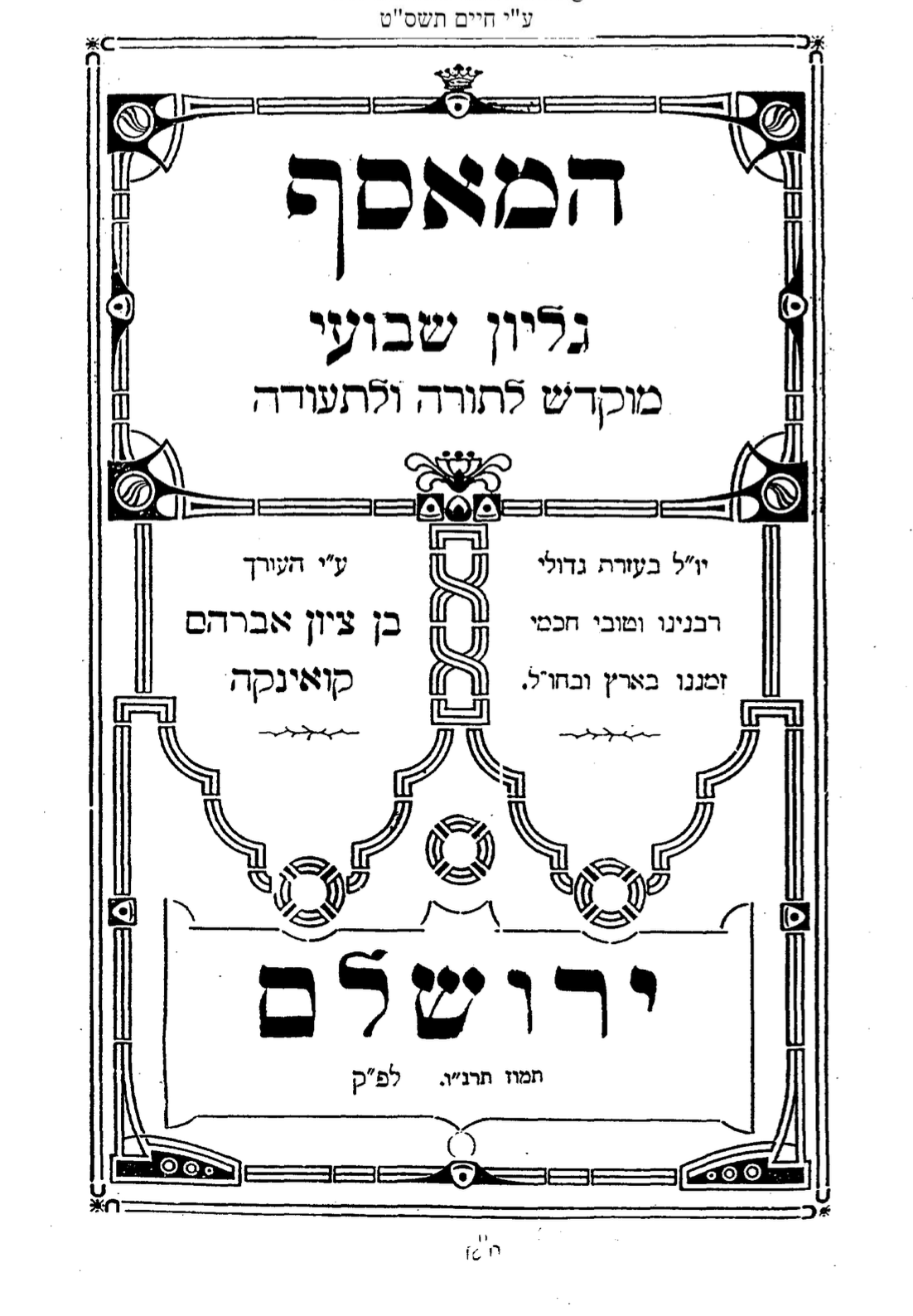
One of Rabbi Cuenca’s most important contributions was the creation of the extraordinary Halakha Journal called “haMe-asef,” a collection of halachic studies and articles by hundreds of rabbis, Sephardi and Ashkenazim from Israel and the diaspora. Presenting so many rabbis of different origins united in the same Journal was a very important positive innovation at that time. Rabbi Cuenca was in charge of all the stages of this publication, which was published for 19 years. The first volume appeared in 1897. Rabbi Cuenca was, of course, one of the main contributors. Two themes stand out in HaMeasef.

The first, everything related to the precepts associated with agricultural work. These commandments only apply in the land of Israel (terumot, ma’aserot, shemita, etc.) and therefore this theme remained dormant for centuries. But now, as the establishment of the Yehudim in the Yeshub of Israel took hold, these laws had to be applied again.

The second topic that interested Rabbi Cuenca was to give a rabbinical response to new inventions (electricity, new means of transportation, etc.). An example that can be seen in this link is the Rabbi’s response to the use of the train on Shabbat or Yom Tob.

At the beginning of each article Rabbi Cuenca introduces a brief biography of the writers, which given the tremendous lack of information we suffer from, especially about the Sephardic rabbis of the late 19th century, constitutes an invaluable contribution to modern Jewish history.

FINAL WORDS

Rabbi Yehuda Fishman Maimon wrote: “Rabbi Cuenca was a fervent Zionist, an extraordinary Rabbi and a man of the deepest faith… an illuminated Sage in Tora and Wisdom, who professed a tremendous love for the Creator and for humanity. And I think it would not be an exaggeration to say that there is no one left to replace him or no one who can imitate him…”.

Rabbi Cuenca died in Yerushalayim in 1937 and is buried in the Jewish cemetery on the Mount of Olives, Har HaZetim.


Testimony from a survivor of 1929 Hebron Massacre, Miriam Sasson (Hebrew)


Rabbi Isaac Abulafia (1830-1910) and the Education of the Jews of Damascus


RAISED BY HIS GRANDFATHER
Rabbi Isaac Abulafia was born in Damascus, Syria, in 1830. He came from a family of great luminaries dating back to the famous Ribbi Hayim Abulafia, who renewed the settlement of the Jews in the city of Tiberia at the beginning of the 18th century (see here). While still very young, possibly at the age of 10, Rabbi Isaac moved to Tiberia where he was raised by his grandfather, Ribbi Hayim Nissim Abulafia, who was also his Tora teacher. Soon after, Rabbi Hayim was chosen as Rishon LeZion, Chief Sepharadic Rabbi of Israel, so together with Rabbi Isaac and the rest of the family they moved to Yerushalayim. Soon Rabbi Isaac began to shine for his intelligence and his dedication to the Tora, and at age 23 he was sent to represent the Yeshibot of Israel in various Jewish communities around the world, where he was received with many honors for his knowledge, his honorable presence and his refined personality. From all over the world, including other cities in Israel, he received Halachic questions that he solved with his great illustration and his originality.

FAT COWS IN DAMASCUS
In 1861, when his grandfather died, Rabbi Isaac decided to return to Damascus where he served as one of the rabbis of the prestigious Rabbinical Court of the city. In 1873, when Chief Rabbi Rab Aharon Bagdadi passed away, Rabbi Abulafia was offered to serve as Chief Rabbi. At that time Damascus was a city with a vibrant Jewish community. A visitor from France, Rabbi Yerucham Ashkenazi who arrived in Damascus in 1859, wrote in his travel memoirs that many of Damascus’s Jews were affluent and famous for their generosity. The wealthiest had their own rabbinical library, which function as a small Yeshiba. Their greatest ambition was to support Talmide Hakhamim, Tora scholars, to study there.

SKINNY COWS
But in 1875 all this changed. The political situation was no longer the same, and the new government imposed higher taxes and more regulations that limited trade, especially imports and exports, which was what many Jews did there. Several of these affluent and generous community members left Damascus and went to Aleppo, Beirut (Lebanon) and other cities in the area. Rabbi Abulafia then decided that he had to create new opportunities to ensure the economic future of the young Jews of his community, helping them learning professions such as accounting, pharmaceutical, etc. so they do not depend only on trade. The Rabbi made a kind of alliance with the organization “Kol Israel Chaberim” which later became known as the “Alliance Israélite Universelle”;  this French-based Jewish institution provided funds for this purpose.

SCHOOLS WITH BENCHES!
Thus, in 1880 Rabbi Abulafia, with the approval of other Damascus rabbis, promoted the creation of a school where, apart from Tora, students would also learn to read and write in Arabic and French. Jewish schools were modernized and for the first time, students had benches to sit on, because until then they studied sitting on the floor. Rabbi Abulafia made sure that this type of education was also available for poor families. The most revolutionary thing Rabbi Abulafia did was also establishing a school for women, something very rare at that time. He was able to motivate parents by establishing a symbolic payment of “Half a Franc” to each family that sent their children to study there. 

SUCCESS OR FAILURE?
But in the long run this undertaking was not a 100% success… Over time parents and students demanded more and more training in secular matters, at the expense of Torah studies. But the more serious problem –that the Rabbis unfortunately noticed when it was already too late — was that the Alliance exerted an enormous influence causing the secularization of many Jews in Damascus and other Sepharadic communities in Turkey, Greece, the Middle East and North Africa. And although this should be the topic of a separate chapter, I will briefly relate what Rabbi Eliyahu ben Hayim SHELITA, who knew this subject first-hand, told his students in one of this recent classes: “In the Alliance, the teachers who taught mathematics or French language (secular European Jews or Gentiles) were young, dynamic, kind, and dressed in the latest European fashion. For Jewish studies, however, the Alliance would usually hire as a teacher an older man, generally poor and retired, who did not speak French, who had no modern pedagogical training and who was not dressed in a European style. The students naturally admired the secular teachers and aspired to become like them. This, inadvertently (or some believe that this was a sophisticated assimilationist strategy, that the rabbis at that time failed to foresee) the young students in the Alliance who did not admire the old Hakham, began to look at the Tora with those same eyes, and unfortunately religious practice became for them something to un-admire,  outdated and irrelevant. Rabbi Ben Hayim also explained that in virtually all communities where the Alliance arrived, secularization increased, and vice versa.

A JEW NEVER GOES TO ISRAEL. A JEW “RETURNS” TO ISRAEL.
Back to Rabbi Abulafia, he had only one daughter, who married the famous : “Señor” Hayim Moshe Laniado. Her son-in-law, who belonged to an aristocratic family, assisted the rabbi in publishing his books. Rabbi Abulafia’s most known work is “Pene Yitschaq,” a monumental six-volumes collection of Rabbinical Responsa (see the first volume of this book here).

In 1909 Rabbi Abulafia left the city of Damascus and returned to his beloved Eretz Israel to settle in Tiberia, the city of his ancestors, where he died a year later, on Adar 15, 1910.

(The story of his father, Rabbi Moshe Abulafia, is very sad, tragic and a bit complicated. So I will include it in the context of an article that I will dedicate especially to the subject: The Blood Libel of Damascus, 1840).


The Last Days of Maimonides

There is a very interesting letter that Maimonides writes for one of his students, Shemuel Ibn Tibon, who was translating “The Guide of the Perplexed” from Arabic to Hebrew. Ibn Tibon lived in Provence, France, and wrote to Maimonides in 1199, stating his intention to travel to Egypt to visit him, study with him for a few days, and asking him some questions regarding certain difficult passages of his Guide. Maimonides replied with a famous letter where he reveals his complex life and his extraordinary kindness.

“I live in Fostat and the sultan resides in Cairo…my obligations to the Sultan are many. I visit him every day, early in the morning; and when he or any of his sons, or any of the women in his harem are indisposed … I stay in the palace most of the day. It also often happens that one or two court officials become ill, and I must attend to them and heal them. Therefore, I usually arrived in Cairo very early in the morning and do not return to Fostat until late in the afternoon.

In our last article we discussed this aspect of Maimonides’ daily life, his work as a court physician of the famous Sultan Saladin.

DOCTOR WITHOUT BORDERS
What follows is less known. Maimonides relates in this letter what he did once he returned home, and after having worked all that day; today we would say: “in his free time”.

[Upon arriving at my house in Fostat] I’m starving… I find the hallways of my house full of patients, both Jews and Gentiles, nobles and common people, judges and bailiffs, friends and enemies, a mixed crowd waiting for the moment of my return. I dismount my animal, wash my hands, approach my patients and beg them to be patient with me while I take a light snack, the only food I eat in twenty-four hours. Then I go out to see my patients and write prescriptions and instructions for their various ailments. Patients come and go until nightfall, and sometimes, I solemnly assure you, up to two hours or more once night falls. I talk to them [about their ailments] and prescribe their medicines while I lie down from exhaustion and when night falls, I am so tired that I can hardly speak.

Maimonides had a “free” medical clinic at his home, where he cared for all kinds of patients: Jews, Gentiles, friends and enemies, poor and rich.

THE UNFINISHED WORK
Maimonides did not have extra time to waste. In fact, his literary work was still unfinished. Among his plans was to devote himself to writing a commentary on the Babylonian Talmud.
He also wanted to write a book on the Midrashim and Hagadot of the Talmud, where he would explain the logic behind the rabbinic metaphors and the Talmudic stories that seem to be fictions (something his son, Rabbenu Abraham, did briefly in his Ma-amar ‘al Hagadot Chazal)
But the most urgent thing he had to do was to protect the credibility of his most important work, “Mishna Tora”, the book that presents exhaustively all the articles of Jewish law. Some contemporary rabbis in Europe criticized this work because although it presented the final law, it did not show the specific sources from which there author had drawn his verdicts. And although leaving the sources out, and presenting the settled law was the deliberate intention of Maimonides’ code, he thought that the acceptance of his book by European Jews depended on quoting the sources of his Halakhot, and he intended to do so.
Now we can better appreciate the following point: how is it that with so much work left to do, Maimonides dedicated his free time to medicine instead of writing his books?

Because Maimonides decided that it was time to put into practice all that he had learn and taught in his innumerable writings. His precious time would now be devoted to something he could do better than any other man of his time: healing the sick.

HOW DID MAIMONIDES DIE?
Maimonides lived the final days of his life doing this monumental work of kindness, which costed him his life. Most of Maimonides’ biographers do not go too far explaining what the cause of Maimonides’ death was and merely indicate the exact date of his departure: December 13, 1204. Although a historian of the early twentieth century, De Goeje, points out that Maimonides died of “physical exhaustion”.
Hakham Yosef Faur z”l in his class on“ The Four Giants of Sepharad” reveals a very important detail, that today, in times of COVID19, we can appreciate better than ever: it is documented that Maimonides died as a result of an epidemic. Maimonides refused to stop caring for his patients, he became infected with a disease and after a while died for this reason (listen here, 1.17m)

Our Rabbis explain that the Tora begins with Chesed (benevolence) and ends with Chesed. And the examples of benevolence that the Sages bring are not acts of kindness performed by human beings, but by the Creator himself. In its beginning the Tora tells us that HaShem provided clothing for Adam and Eve, and providing cloths for those who do not have what to wear is indeed an act of Chesed, and the Tora ends by telling us that the Almighty buried Moshe Rabbenu. Burying the dead is another act of Chesed.

In the last years of his life, Maimonides reinvented himself. And he went from the studying to practicing the Tora, imitating God’s Chesed with His creatures.

I present below the “PRAYER FOR A DOCTOR” attributed to Maimonides . Thousands of doctors, Jews and Gentiles, in Israel, the United States and the rest of the world, recite this prayer every day, before beginning their medical work.

Master of the Universe, before I begin the sacred task of healing Your creatures, I express my plea before You, and beg You to grant me the courage and strength to do my medical work with integrity, and that the desire to accumulate wealth or gain fame won’t be guiding my work or blinding my eyes.

Master of the Universe, it is known by all Your subjects that You are the One who inflicts suffering to those who deserve it, and You are the One who takes pity on those who suffer. And with Your infinite Wisdom, You wanted me, Your humble servant of flesh and blood, made of dust and ashes, with my limited knowledge and my poor intellect, to have learned about the body and the mind of the human being that You created in this material world.

And behold, following Your orders and Your commandments and counting on Your help, I’m preparing myself to heal, according to the scope of my knowledge and knowing that ultimately, life, death and the cure of diseases are in Your hands and that it is You who determines the success or failure of my healing.

Lord of Heaven, Eternal King, may it be Your will to grant Your servant the strength and ability to continue learning the art of healing for the rest of my life from those who know more than I do.

Help me so that I never cease to feel compassion for all who suffer, and grant me the wisdom to assist those who come to consult my medical advice, without differentiating between the rich and the poor, the friend or the enemy, the good man and the bad man, so that when someone needs my help, that I only see the human being who suffers sickness and pain.

May my love for the art of healing give me the courage so that the truth may be the light that guides me, because I am aware that my negligence in my medical work can result in the suffering or death of the work of Your hands.

I beg you, Oh God, You compassionate and merciful, to grant strength to my body and courage to my mind, and implant in me a spirit of integrity.

Blessed are You, Master of all works, Creator of all living beings.


Maimonides (1135-1204), Sultan Saladin’s Personal Physician

Apart from being one of the most important Talmudists and jurists in the history of the Jewish people, Maimonides was also a famous doctor. His father, Ribbi Maimon, was probably the one who introduced him into medicine, which was a very common profession among Spanish Jews until the time of the expulsion in 1492.
At an early age, Maimonides had to leave Cordoba, Spain, due to the religious persecutions of a fundamentalist Muslim group: the Almohades. Maimonides’ family arrived in the city of Fes, Morocco and remained there for seven years. In Fes Maimonides had the opportunity to deepen his medical knowledge by training with Jewish and non Jewish experienced physicians. In 1165 he arrived in Egypt. Maimonides always opposed practicing the rabbinate professionally, and for many years he supported himself thanks to his bother and business partner David, who traveled the world for this purpose. But after his brother tragically died when his ship sank, Maimonides dedicated himself to practicing medicine for a living. And he was extremely successful.

In Egypt, he was called to work as the main doctor at the court of Sultan Saladin the Great (1138-1193 , famous for his wars against the crusaders and for having reconquered Jerusalem. Upon the capture of Jerusalem, Saladin summoned the Jews and permitted them to resettle in the Holy city). Being the court physician was not an easy job. In addition to examining and taking care of the Sultan Maimonides also had to take care of his entire family – his wives and children – and the officials of the royal court.
Maimonides was the most respected physician in all of Egypt. And many of Saladin court sages and advisers were very jealous of him and many times tried to conspire against him.

Many years ago my uncle Hakham Yosef Faur z ”l told me a few stories of Maimonides and the constant harassment he suffered from the envious sages of the court. I remember five stories. Let me share with you one of them.

In his medical books, Maimonides stated that blindness from birth could not be cured. The court sages and advisers challenged him and said that they had developed a surgical operation that could restore sight to the blind, and that they were ready to demonstrate their claim. They arranged for a special session where the Sultan and Maimonides were present. When the day came, the advisers brought a patient with his face and eyes covered and claimed that he was blind from birth, and had just undergone surgery. The bandage was removed and the man began to shout: “I can see, I can see! These sages have cured me! ” The sages then demanded the Sultan to expel Maimonides from the court for his ignorance and stubbornness. Maimonides asked the Sultan for permission to examine the patient. He asked him: “Sir, is it true that you are blind from birth?” And the man replied: “Yes! I was never able to see, since I was born until this very moment” Then Maimonides took a red handkerchief from his pocket and asked: “If you can really see, could you tell me what color is this cloth?” . “Red!” said the patient with great enthusiasm. “This cloth is red!”. Maimonides then told the Sultan : “Your majesty, a person who sees for the first time does not know the colors, and cannot possibly identify or describe them: this man is an impostor!”

Some of Maimonides’ medical works

  1. “Excerpts from Galen or the art of healing”, a summary of the extensive writings of the famous Greek physician.
  2. “Commentary on the Aphorisms of Hippocrates,” which Maimonides combines with his own views.
  3. “Medical Aphorisms of Moses”, 1,500 guidelines describing various medical conditions.
  4. “Treatise on Hemorrhoids” also discusses the mechanism of digestion.
  5. “Treatise on Cohabitation” recommendations for a healthy sex life.
  6. “Treatise on Asthma”, where he discusses how climate and diet affects asthma.
  7. “Treatise on Poisons and Their Antidotes”, this toxicology book remained popular for centuries.
  8. “A healthy regime” a discourse on healthy living and the mind-body connection.
  9. “Discourse and explanation of moderation”, advocates for a healthy life and teaches that one of the fundamental principles of preventive medicine is to avoid excesses.
  10. “Glossary of drug names” presents a pharmacopoeia with the names of a large number of drugs in Arabic, Greek, Syrian, Persian, Berber (Moroccan dialect) and Spanish.


Maimonides (1135 -1204). Elitism and Rationalism?

As many of my readers might have noticed, in these last days I am writing in honor of my uncle the Hakham Yosef Faur haLevi z ”l, commenting on one of his classes called “Four Giants of Sepharad”. So far we have mentioned Rabbi Ibn Paquda, Rabbi Yehuda haLevi and Rabbi Abraham Eben Ezra. And now, in this last presentation, we will write about the “giant among the giants”: Maimonides.

Ribbi Moshe ben Maimon, also known as HaRambam or Maimonides, was born in the city of Córdoba, Spain, in 1135 and died in Egypt in 1204.

It is impossible and absolutely unfair to dedicate a simple email to describe the life and work of one of the most important rabbis of all time. Aside from being a great rabbi and community leader, Maimonides was also a famous philosopher, a great doctor – the pioneer of preventive medicine – and had a vast knowledge of mathematics and astronomy. But today we will focus on a different angle of his personality: Maimonides as a jurist and legislator.

THE TALMUDIC OCEAN
It is not possible to appreciate the monumentality of Maimonides’ work if one does not have a clear idea of ​​what the Talmud is (and vice versa).
The Babylonian Talmud, with its 63 treatises and 2,711 pages, records the Jewish oral tradition and is the basis of biblical and rabbinical jurisprudence. The Talmud or Gemara, cites the Mishna, the oldest edition of Jewish oral law, and then registers a large number of debates in which that Mishna is exhaustively analyzed in terms of its authorship, language, scope, application , its exceptions, etc. It is necessary to develop a special way of reasoning (which is acquired as one immerses himself in the Talmud) to understand the Talmudic thinking . And although today we have many good translations and explanations, it is not easy to keep up with the Talmudic methodology and rhetoric. Apart from that, a topic that has to do, for example, with the laws of Shabbat can be found or redefined not only in the tractate of Shabbat but also in a completely different treatise as the Talmud analyzes a case of damages or perhaps ritual sacrifices. And in order to establish what the law is, which is not normally presented in the Talmud, one not only needs to understand the specific text but to know the Talmud exhaustively, since, as we explain, the references might be in multiple texts. Maimonides, who had a superb memory and an exhaustive knowledge of the Babylonian Talmud (and the Jerusalem Talmud, and Tosefta, and Baraytot, and Midrashe Halakha, and Geonim, etc.) identified all the laws, formulated them in perfect and very clear Hebrew, and reorganized them in 14 treatises, with 1,000 chapters with an average of 16 Halakhot, or “articles of the law” in each chapter.

WAS MAIMONIDES AN ELITIST ?
In my own words, the Talmud is like a vast sea with tens of thousands of beautiful pearls that are very difficult to collect. The pearls, which are at the bottom of the sea, sometimes under layers of sand, are also scattered many kilometers apart. Maimonides did the impossible and the unimaginable. He dedicated his life to diving at the bottom of the vast ocean of the Talmud and he collected one by one “all the pearls of the Talmudic sea”. He brought them to the surface, processed them, examined them with extreme care, classified them by colors, size, shape, weight, etc. and finally presented us with a beautiful 14 volumes catalog with 1,000 categories and more than 16,000 specimens of the precious pearls.

One of the aspects that Hakham Faur discusses in this class, is Maimonides’ supposed “elitism”. When in fact it was the opposite. For centuries the common Jew had no direct access to Jewish law. There was no way to know the details of the Law that he or she so much wanted to observe and fulfill, because access to the Talmud was very limited and even if you would understand the Talmud, you still someone to delve into it and brought from the depth even the simplest Halakha. Maimonides, far from perpetrating what might be perceived as “elitism”, i.e., that only the Talmide Hakhamim ‘elite’ had access to the knowledge of the Halakha, , he codified and presented the law in a style and language that was accessible to ALL people, even to the simplest Jew. You cannot be less elitist than that!

WHAT DOES RATIONALIST MEAN?
Hakham Faur also demonstrates the fallacy behind Maimonides’ supposed “rationalism”. In his book “Homo Mysticus”, where Hakham Faur exposes Maimonides ideas and beliefs as per his “Guide for the Perplexed”, he explains this topic in detail.

There are 3 levels of “thought” or intellectualism. .

IMAGINATION

The vast majority of human beings are carried away by their imagination, impressions, feelings, irrational fears, impulses, herd culture, popular opinions, etc. Very few people stop to think in order to act strictly following their common sense. How many people, for example, eat using strictly common sense? Consuming “only” what is good for them and avoid eating anything that is not beneficial for their health?

RATIONALISM

On the next level, superior to the first, we find intelligent, rational people, who only do, say and act according to their intellect and reason. Not only do they “know” what is right: they also acquire the discipline to improve their character, control their impulses, and be guided by their reasoning. A person who is guided by his or her reason is a “rationalist”. The epitome of a rationalist was Aristotle.

REVELATION

But for Maimonides, although reason is a higher level than that of the imagination, it is not the highest level that a human being can reach. There is something above human reason, that is, Divine Revelation. The Creator’s Wisdom is revealed in the Tora. Divine Wisdom is not determined or limited by reason. Proof of this is that we Jews guide ourselves by commandments that we understand but also by Divine commandments that are beyond our limited reasoning. Maimonides was not a rationalist, he was post-rational man or a “revelationist” . In medieval Hebrew: “Torani” (guided by the Tora).

It is quite possible that those who imagined Maimonides as a rationalist were based on the fact that Maimonides strongly rejected all kinds of nonsensical “superstitions”, including religious superstitions, very fashionable in his time (some of which, incredibly, persist to this day). For Maimonides astrology, necromancy, divination, and other superstitions were vestiges of the ‘aboda Zara (idolatry) and represented the thinking of the most primitive, pre-rational man.