🍷 ALL ABOUT THE FIFTH CUP OF WINE

והוצאתי והצלתי וגאלתי ולקחתי ….. והבאתי

Although today, at our Seder, we drink four cups of wine 🍷🍷🍷🍷, the original ancient tradition—mentioned by the Talmud and by Maimonides—included a fifth cup 🍷 connected to a special prayer.

This prayer is the well-known Psalm in Tehilim, Mizmor 136 📖. The Sages called it:

🎶 Hallel haGadol — the “Great Song of Praise” to HaShem.

This psalm has 26 verses, each one describing the kindness of HaShem toward His people:

🌍 It begins with the creation of the world

⛓ It includes our gratitude for the Exodus from Egypt

🇮🇱 And it concludes with the establishment of the Jewish people in the Land of Israel

ונתן ארצם לנחלה

👉 This fifth cup is NOT obligatory—it is optional.

👉 And unlike the first four cups, it was drunk only by the person reciting the psalm 👤, not by everyone at the table.

🇾🇪 Yemenite Jews maintain this custom to this day and continue to drink the fifth cup 🍷

❓ WHY IS IT CALLED ELIYAHU HANAVI’S CUP?

For centuries, the Sages debated whether this fifth cup should be drunk 🍷

The four cups correspond to the four expressions of redemption in the Torah:

📖 In Shemot (chapter 6), HaShem says:

➡️ “I will take you out”

➡️ “I will save you”

➡️ “I will redeem you”

➡️ “I will take you as My people”

But the next verse adds a fifth expression:

➡️ “And I will bring you to the Land of Israel” 🇮🇱

👉 This fifth idea is clearly reflected in Hallel haGadol

🤔 THE GREAT QUESTION

For many centuries, throughout our two thousand years of exile, the Rabbis faced a difficult question:

Yes, we were freed from Egypt ✨

Yes, we became the people of HaShem 🤝

But…

❗ We no longer had the Land of Israel

❗ We lost our land and independence after the destruction of the Bet haMiqdash

So what should we do?

❓ Should we celebrate this fifth promise because it already happened?

❓ Or should we wait until it is fully realized again, in the Messianic era?

⚖️ THE DIPLOMATIC SOLUTION

The Rabbis did not reach a final decision.

So they established a middle approach:

🍷 We pour the fifth cup

🚫 But we do NOT drink it

👉 We acknowledge the promise… but we are still waiting for its full fulfillment ✨

🚪 WHY IS IT CALLED THE CUP OF ELIYAHU HANAVI?

When a halachic question remains unresolved, we say that when Eliyahu haNavi comes (announcing the arrival of the Mashiach), all doubts will be clarified by the renewed Sanhedrin in the Bet haMiqdash.

This cup, which is poured but not drunk, is “waiting” for Eliyahu haNavi—who will tell us whether we should drink it or not.

We leave it ready, reminding us that we are still awaiting the future redemption ✨

🇮🇱 THE STATE OF ISRAEL

Today, Baruch HaShem, we once again have a sovereign Jewish state in Israel 🇮🇱.

For this reason, many contemporary Rabbis—Sephardic and Ashkenazic alike, such as Rabbi Hayim David HaLevi z”l and Rabbi Shelomo Goren z”l—have suggested:

👉 Since 1948, we may return to the original custom

👉 And drink the fifth cup 🍷

For this reason, today many Jews—especially those living in Israel—serve and drink the fifth cup in honor of Medinat Israel 🇮🇱✨


THE GOAL AND STRATEGY OF THE PESACH SEDER


🌙 For more than three thousand years, the night of the Seder has become the most powerful educational experience in Jewish life. Not only because we eat Matzah 🫓 and bitter herbs 🌿 — but because on this night we do something much greater:

👉 We teach our children the story of our people.

By doing so, we fulfill one of the most important mitzvot of the Torah:

📖 Sippur Yetzi’at Mitsrayim — telling the story of the Exodus from Egypt.

The Torah commands:

וְהִגַּדְתָּ לְבִנְךָ בַּיּוֹם הַהוּא

👉 “And you shall tell your child…” (Shemot 13:8)

🎭 THE RABBIS’ GREAT CHALLENGE

Our Rabbis went beyond the literal fulfillment of this mitzvah. They understood that if we simply “tell” or “read” the story, it would be difficult for children to absorb it: some can read, others cannot; some know how to ask questions, others do not. And the goal is that everyone participates.

They also taught that it is not enough to explain the story of the Exodus—we must go back and experience both the suffering and the freedom as if we were there.

Their guiding principle was:

בְּכָל־דּוֹר וָדוֹר חַיָּב אָדָם לִרְאוֹת אֶת עַצְמוֹ כְּאִלּוּ הוּא יָצָא מִמִּצְרָיִם

👉 In every generation, a person must see himself as if he personally left Egypt.

To achieve this, they designed the Seder—a structured “program” of 14 (or 15) steps as we know it today.

👉 A process that allows us, in one single night, to experience two opposite realities:

• The experience of slavery

• The experience of freedom

These two ideas are also at the heart of the Haggadah. We do not begin with the miracles or the splitting of the sea. We begin with:

👉 “Avadim hayinu” — We were slaves in Egypt.

We start from the lowest point—reliving it through the words of the Haggadah—and from there, we rise.

🌿 THE FLAVOR OF SLAVERY

The Rabbis did not want slavery to remain an abstract idea.

👉 They wanted us to feel it—at least in a symbolic way—as part of the Pesach meal.

That is why they established concrete symbols in the Seder:

💧 We dip the karpas in salt water or vinegar, to recall the tears of slavery.

🌿 We eat maror—a bitter herb, even though it was originally required only with the Korban Pesach.

🟤 We eat Charoset, a thick, paste-like mixture of fruits, resembling the mortar of the bricks we made in Egypt.

To experience slavery, we engage our senses:

We remember the tears.

We taste the bitterness.

We see the mortar.

🛋 EXPERIENCING FREEDOM

The Sages also taught that we must experience freedom in its fullest expression. For this reason, the Pesach Seder is meant to resemble the meal of nobles and aristocrats.

They derive this idea from a verse we recite in Hallel:

מְקִימִי מֵעָפָר דָּל … לְהוֹשִׁיבִי עִם נְדִיבִים

“He raises the poor from the dust… and seats them among nobles.”

Therefore, during the Seder:

🥬 We begin with karpas (a vegetable appetizer)—something associated with refined dining, where people do not eat out of hunger but to awaken their appetite.

🛋 We recline (hasibah) like free and noble individuals.

🍷 We drink four cups of wine, as was customary in formal aristocratic meals.

The Seder is not a history lesson. It is a carefully designed experience in which we move from slavery to freedom, from bitterness to dignity and celebration.

We do not just remember the Exodus—we relive it.


THE EIGHT MITSVOT OF PESACH

This list of eight mitzvot is based on the introduction of Maimonides to Hilkhot Pesach, and it does not include the mitzvot related to the Pesach sacrifice (Korban Pesach).

There are three positive commandments (things we do) and five prohibitions (things we must not do) connected to Pesach.

⭐ THE 3 POSITIVE COMMANDMENTS

1. אכילת מצה

🫓 Eating Matzah

On the first night of Pesach we eat matzah.
(In the Diaspora we eat matzah on the first two nights.)

Matzah reminds us that the Jewish people left Egypt very quickly, before their bread had time to rise.

During the rest of Pesach it is forbidden to eat chametz, but technically there is no formal obligation to continue eating matzah.

2. והגדת לבנך

📖 Telling Our Children the Story

On the first night of Pesach (in the Diaspora, the first two nights) we tell our children the story of:

➡️ the slavery in Egypt
➡️ how HaShem redeemed us

We do this by reading and explaining the Haggadah at the Seder.

This mitzvah includes many beautiful traditions:

🍷 Drinking the four cups of wine
🪑 Reclining like free people
🥬 Eating maror (bitter herbs) to remember the bitterness of slavery
🍎 Eating charoset, which reminds us of the bricks our ancestors made in Egypt
❓ Asking the Four Questions and discussing the story of the Exodus

All these traditions help us tell the story and remember what happened.

3. השבתת חמץ

🧹Disowning and  Removing Chametz

Before Pesach, we must disown any chametz that belongs to us (Bitul).

The Rabbis added that we must also physically remove chametz from our property—our homes, cars, offices, etc. (Bi’ur).

How do we get rid of our chametz? We can:

🏠 Remove it from our homes
🗑 Throw it in the garbage outside the house
🔥 Burn it
🐦 Feed it to birds or fish (in a lake or river)
🎁 Give it as a gift or sell it to a non-Jew

This should be done on the eve of Pesach, on the 14th of Nisan, in the late morning.

📅 In 2026:  

On Tuesday, March 31 at night, we do the Bedikat Chametz; we search the house for chametz.

The next day, Wednesday, April 1, is Erev Pesach. We must finish eating chametz by 10:00 AM and remove it (biur) and declare it ownerless (bitul) by 11:00 AM .


⛔ THE 5 PROHIBITIONS

4. איסור אכילת חמץ

🚫🍞 Not Eating Chametz or Se’or

During Pesach we are not allowed to eat chametz.

Chametz is food made from these five grains:

🌾 wheat
🌾 barley
🌾 rye
🌾 oats
🌾 spelt

If these grains ferment or rise, they become chametz.

Se’or is sourdough, used to make bread during the year. We may not keep this dough during Pesach.

5. איסור אכילת תערובת חמץ

🚫🥨 Not Eating Food that Contains Chametz

It is also forbidden to eat any food that contains chametz or natural yeast during Pesach.

The Gemara gives examples of foods that contained mixtures of chametz, such as:

🧀 Kutach ha-Bavli — a type of cottage-like cheese that contained small pieces of bread.
🍺 Shekhar ha-Madi — a drink made from grain, similar to beer.

6. בל יראה

👀🚫 Chametz or Se’or Should Not Be Seen

During Pesach we may not possess chametz anywhere that belongs to us.

Chametz should not be visible in our homes.

7. בל ימצא

🔎🚫 Chametz or Se’or Should Not Be Found

Chametz also should not be found in our possession during Pesach.

These two mitzvot (6 and 7) are actually identical.
They teach the same idea in two ways.

The Sages refer to them together with the famous words:

בל יראה בל ימצא
“Chametz should not be seen and not be found in your possession during Pesach.”

8. איסור אכילת חמץ ערב פסח אחר חצות היום

⏰🚫🍞 Not Eating Chametz on the Eve of Pesach

On the day before Pesach we must stop eating chametz at midday.

The Rabbis moved this prohibition earlier, so chametz may only be eaten until the end of the fourth hour of the day.

These hours are daylight hours, calculated by dividing the time from sunrise to sunset into twelve parts.

📅 In 2026:
This rule applies on April 1, Erev Pesach, the day before the Seder.

In many communities, such as UMJCA, the established practice is that chametz may be eaten only until 10:00 a.m. On that day, all activities related to chametz—such as selling it, giving it away, or eliminating it—must be completed by 11:00 a.m.


Pesach in the Bet-HaMiqdash


Pesach in the Times of the Bet HaMiqdash

Pesach was one of the most joyful and spiritually intense holidays in the life of Bene Israel during the era of the Bet HaMiqdash. It was one of the three Shalosh Regalim — the pilgrimage festivals — alongside Shavuot and Sukkot, when every Jewish man was commanded by the Torah to appear before HaShem in Yerushalayim. The result was a massive, magnificent gathering: hundreds of thousands of Jews — and according to some ancient sources, perhaps over a million — would make their way on foot from every corner of the Land of Israel, and even from distant communities throughout the diaspora, all converging on the holy city, ready to fulfill one of the most sacred commandments: bringing the Qorban Pesach.

The Journey to Yerushalayim

The roads leading to Yerushalayim would fill with pilgrims days before the holiday. Families and communities traveled together, singing songs of ascent — the Shir HaMa’alot psalms (Tehillim 120–134) — as they climbed toward the city. The atmosphere was festive and electric. The Mishna (Pesahim) and other sources describe the city swelling far beyond its normal capacity during these days.

Those who came from outside Yerushalayim stayed with relatives, acquaintances, or often in the homes of complete strangers. Hospitality was not merely customary — it was considered a sacred obligation. According to the Talmud Yerushalmi, no one in Yerushalayim ever said to a visitor, “I have no room for you.” The city was regarded as belonging to all of Israel, and homeowners were not permitted to charge rent for lodging during the festival. When a house was truly full and could take no more guests, a red cloth or sign would be hung above the door — a silent, respectful signal to those still searching for a place to rest.

The Haburot — Communal Groups for the Qorban

People gathered into family and communal groups called Haburot (singular: Habura), each of which would share a single Qorban Pesach. The Mishna in Pesahim discusses the laws governing these groups in considerable detail. A Habura could range from a small family unit to a large gathering of fifty, sixty, or even up to one hundred people — provided that there was enough of the lamb for everyone to eat at least a kazait (an olive-sized portion).

On the afternoon of the fourteenth of Nisan — Erev Pesach — one or two representatives from each Habura would bring their lamb to the Bet HaMiqdash. The Mishna describes how the courtyard was divided into three shifts (כיתות, kittot) to accommodate the enormous number of sacrifices. Each shift would enter the Temple court, the great doors would be shut, the Leviyim would sing Hallel, and the Kohanim would stand in rows holding golden and silver basins to catch the blood of the sacrifices and pass them in a continuous chain to be sprinkled on the altar. The atmosphere was at once solemn and jubilant — a sacred choreography involving thousands of people acting as one.

After the sacrifice, the animal was brought home and roasted whole — including its head, legs, and inner organs — on a pomegranate-wood spit, as prescribed by the Torah. It could not be boiled or cooked in any other way, and not a single bone could be broken.

The Seder Night

That night — the fifteenth of Nisan — Bene Israel celebrated the Seder, in many ways much as we do today. They reclined on cushions and pillows in the manner of free people, of noblemen and aristocrats, because on this night we are not slaves but a redeemed nation. The obligation to recline (hasiba) was universal — men, women, and children alike participated in the spirit of freedom.

The Haggadah was recited, the Ma Nishtana was asked by the children, and the story of the Exodus was told and retold. The meal was abundant. In addition to the Qorban Pesach, families also brought the Qorban Hagiga — a festive peace-offering eaten earlier in the meal — along with Matsa and Maror. The Maror in Temple times was a biblical commandment of the Torah, not merely a rabbinic enactment as it is today. Four cups of wine were drunk to celebrate the four expressions of redemption promised by HaShem in the Book of Shemot: vehotzeiti, vehitzalti, vega’alti, and velaqahti — I will bring you out, I will rescue you, I will redeem you, and I will take you as My people.

The Afiqoman — The Qorban Pesach as the Final Taste

Before midnight, the Qorban Pesach was eaten as the final food of the evening — what we call the Afiqoman. It was essential that it be eaten when people were already satisfied, not out of hunger but as a gesture of completion and sanctity. Every member of the Habura was obligated to eat at least a kazait of the roasted lamb. After the Qorban Pesach was consumed, nothing else could be eaten — its taste was to remain in the mouth through the night. This is the origin of our custom today: the piece of Matsa we call Afiqoman is eaten last, and nothing is eaten afterward, in direct remembrance of the Qorban Pesach.

Following the meal, the Habura recited Birkat HaMazon, thanking ה׳ for the food and for the Land.

The Hallel at Midnight — A Million Voices

Then came one of the most breathtaking moments of the entire Jewish year. Around midnight, the people of Yerushalayim — together with all the pilgrims who had filled the city — would ascend to the rooftops and terraces. From there, looking out over the illuminated Bet HaMiqdash — gleaming white and gold under the light of the full moon of Nisan — the entire Jewish People would sing the Hallel together: Psalms 113–118, the great hymn of gratitude to ה׳ for having taken us out of Egypt.

The Talmud (Pesahim 85b) records that the voices of the crowds singing Hallel were so powerful and so unified that the terraces of Yerushalayim seemed to tremble and shake. Imagine: a million or more voices, rising as one, in the still night air of the Judean hills — a sound that must have been unlike anything else in human history.

How We Preserve the Memory Today

After the destruction of the Bet HaMiqdash, our Sages instituted customs to keep the memory of the Qorban Pesach alive in our Seder night.

  • The shank bone (zero’a) — or among Ashkenazim, a chicken neck or wing — is placed on the Ke’ara (Seder plate) as a visual reminder of the Qorban Pesach. Sephardic communities traditionally use a roasted lamb shank, as close as possible to the original.
  • The Afiqoman — a piece of Matsa eaten at the end of the meal — commemorates the Qorban Pesach. When we eat it, we say: Zeher leQorban Pesach ha’ne’ehal al hasova — “In remembrance of the Qorban Pesach, which was eaten when one was already satisfied.”
  • The Hallel is recited twice: once in the synagogue, recalling the communal Hallel of the entire nation, and once again at home after Birkat HaMazon, recalling the Hallel sung on the terraces of Yerushalayim at midnight.

A Lost Tradition — Hallel While Baking the Matsot

There is one more beautiful custom — practiced today by only a tiny number of Jewish communities — that connects the living moment of preparation to the sacred past.

Do you know when the ideal time to bake the Matsot for the Seder is? The afternoon of the fourteenth of Nisan — Erev Pesach — exactly the same time that the Qorban Pesach was being sacrificed in the Bet HaMiqdash. This timing mirrors the way Challot are ideally prepared on Friday afternoon, in honor of Shabbat. The Matsot, baked at the very hour of the sacrifice, become part of the same sacred moment.

And while baking those Matsot, people would sing the Hallel.

This extraordinary custom — joining the act of preparing the Matsa with the song of redemption, at the exact hour of the Qorban — survived for centuries in certain communities. Today it has been almost entirely lost, preserved only among a handful of Jewish communities in Yemen and Kurdistan. It is a living thread connecting us to a world we can barely imagine.


יהי רצון שנזכה לחגוג את חג הפסח בבנין בית תפארתינו, במהרה בימינו, אמן!


Pesach Trivia for the Seder

One of the most helpful and practical ideas for the Seder is to prepare a list of questions at different levels.

The adult leading the Seder — the MC of the Seder — should keep these questions at hand, together with a bag of prizes.

Whenever it is time to regain attention, start a new stage of the Seder, or energize the table, the MC can ask a question and show the prize.

Children connect to this immediately.

If there are guests who are very knowledgeable and always answer correctly, the MC can decide who answers first, so the same person does not always win.

Save the best prizes for the end.

Below are 35 questions divided by level.


🟢 Beginner Level

  1. In which Hebrew month does Pesach begin?

  2. How many days is Pesach celebrated outside of Israel?

  3. What do we celebrate on the seventh day of Pesach?

  4. Who led the Bene Israel out of Egypt?

  5. Who were the brother and sister of Moshe?

  6. What were the names of Moshe’s parents?

  7. What food do we eat at the Seder to remember the bread of the Exodus?

  8. What bitter food do we eat to remember the bitterness of slavery?

  9. What sweet food on the Seder plate reminds us of the bricks made by the Bene Israel in Egypt?

  10. What are the four cups of wine part of?

  11. Who are the four sons mentioned in the Haggadah?

  12. What question begins Ma Nishtana?


🟡 Intermediate Level

  1. On what day of the month of Nisan does Pesach begin?

  2. Why were the Bene Israel commanded to mark their doorposts on the night of the Exodus?

  3. What are the five grains that can become chametz?

  4. What three elements are necessary for something to become chametz?

  5. What is Bedikat Chametz?

  6. What is Bitul Chametz?

  7. What is the difference between regular matza and Shemura matza?

  8. What two blessings do we say before eating matza at the Seder?

  9. What is Yachatz during the Seder?

  10. What is the Afikoman, and when do we eat it?

  11. What does dipping karpas in salt water symbolize?

  12. How many years did the Bene Israel live in Egypt?


🔴 Advanced Level

  1. What amount of chametz makes a food forbidden on Pesach?

  2. How do we make an oven kosher for Pesach?

  3. What does the abbreviation דצ״ך עד״ש באח״ב represent?

  4. What is the meaning of the text Vehi She’amda in the Haggadah?

  5. Name five things for which we thank HaShem in Dayenu.

  6. What special handwashing do we perform during the Seder that we normally do not do at other meals?

  7. How and when do we recline during the Seder, and why?

  8. What foods must be eaten while reclining?

  9. What is charoset, and what does it represent?

  10. Do we need to check whether soap or shampoo are kosher for Pesach? Why?

  11. What were the Ten Plagues that struck Egypt before the Exodus?


Tips to avoid a boring Seder

The night of the Seder is different from all other nights—not just because we eat Matsa and bitter herbs, but mainly because on this night, we educate ourselves and our sons and daughters about our history: how the children of Israel came to Egypt, thrived, were enslaved by Pharaoh, and were ultimately rescued by our God.

The Seder night is dedicated to all the guests, family, and friends who partake in the Seder with us, particularly our children. “Seder” means “order,” which refers to the program of 15 steps established for this special night. But it’s not enough to have a script; you also need an MC to run the Seder, keep the children awake, and prevent the adults from getting bored. The person leading the Seder should take their role seriously and feel responsible for the success of this event.

At the Seder, we fulfill one of the most important and beautiful Mitsvot of the entire Tora: Sippur Yetsi’at Mitsrayim, recounting the story of the Exodus from Egypt.

I will now give five brief tips about what the MC must do to make the Seder as successful as possible.

1. DIVIDE AND CONQUER

It’s essential to divide and assign the texts of the Haggada among the participants—who will read what part, and whether they will read it in Hebrew or English. Everyone participating is expected to read a paragraph, so the MC should communicate to the guests which parts they are responsible for, so they can prepare to read them well.

Young people and adults can participate by sharing explanations and comments about the symbols and foods of the Seder. For example: What is Matsa? What is the process to make Matsa? Why do we eat Matsa? Or why do we eat charoset, drink four cups on this night, or eat reclining on our left side? It would be great if the MC sent all participants the subjects they are to explain, along with links to ensure that their explanations are informative rather than opinion-based.

Here are some helpful links:

  • WHY CHAROSET?
  • WHY MATSA?
  • WHY FOUR CUPS?
  • WHY DO WE EAT RECLINING ON OUR LEFT SIDE?

The MC should also tell the “speakers” to limit their time to no more than two or three minutes—especially if these explanations are presented before dinner.

2. BE RELEVANT!

On that note, the MC should save deeper or potentially debatable subjects for after dinner.

Presenting a subject and then briefly discussing it makes the Seder more exciting and participatory. Let me share some ideas about slavery, for example, that can be discussed and compared with contemporary situations or events:

DEMONIZATION OF JEWS
One of the biblical paragraphs most highlighted in the Haggada is from Parashat Ki Tabo (Deuteronomy 26:6). It says that the Egyptians “demonized” us (vayare’u otanu) as part of their effort to turn public opinion against the Jews, portraying them as enemies of the nation and justifying their enslavement.
Question: In our days, are Jews, the State of Israel, or the Israel Defense Forces still being demonized? Are lies spread or used against Israel or its army to harm its image?

CHANGE OF GOVERNMENT
Slavery began with a change of government in Egypt. According to some commentaries, it was not just a new king but a different dynasty, one that hated the previous regime—which had been friendly to the Jews—and sought to cancel the Jewish people.
Question: Does a change in government—especially when a new political party comes to power—still affect Israel and the Jews today, in 2024? For instance, consider Brazil and Argentina and their relationship with Israel over the last two years.

SLAVERY
Is forced labor the only form of slavery you know? Does “mental slavery” exist in modern times—for example, when certain ideas or values are promoted or suppressed by media or governments to serve political agendas?
Question: Is it easier or harder to think freely for ourselves today than it was 50 years ago?

3. CHILDREN

All I’ve mentioned so far applies more to adults or teenagers. It is important that the adults are motivated to participate, learn, and engage in discussions. But we must also consider the children—”the main protagonists of this night.” The MC should ask parents to help their children prepare readings, explanations, or words of Tora they learned in school.

It would also be extremely nice to encourage the children to show and explain the drawings and art pieces they created at school to all the participants. Again, the more we prepare in advance, the better the results.

Children should also be encouraged to sing the primary songs of the Seder and, if possible, prepare a short play about the encounters between Pharaoh, Moshe, Aharon, the Ten Plagues, etc.


PESACH: Egyptian Slavery and Europe’s Concentration Camps

EXODUS 1:11

Then the Egyptians imposed [forced labor on the Jews] and taskmasters to [force them to work] and weaken them with hard labor. And the Jews built for Pharaoh the fortified cities of Pithom and Ramses.

TAXES

In the first phase of Pharaoh’s “final solution,” the people of Israel were not technically enslaved by Pharaoh. In fact, in Exodus 1:11–12, the word “slavery” or “captivity” is not mentioned. However, the Hebrew text emphasizes the word “taxes” (missim). Indeed, the Israelites worked for Pharaoh in the construction of Pithom and Ramses. But this form of forced labor was a legitimate legal procedure: it was a form of paying taxes to the government. Pharaoh, as sovereign, had the full right to demand from his subjects any service: joining the army to defend his territories or working on construction projects he deemed necessary. As we saw in Pharaoh’s speech, the Jews were considered foreigners; therefore, they had to contribute with labor instead of serving in the Egyptian army. In this first phase, the labor of the Jews consisted of building the cities of Pithom and Ramses, which, according to the most accepted interpretation, were military fortifications or garrison cities. These fortifications were not built with mud bricks but with hewn stones. We could assume that at this time, the Jews worked in the quarries extracting the rocks, carving them, and transporting the heavy stones for these fortifications. But although these taxes on foreigners were common, the purpose behind this forced labor aimed at the Jews was not lucrative: it was a genocidal plan, as we will analyze below.

GENOCIDE

When Pharaoh delivered his infamous speech (Exodus 1:9–10), warning his people about the seeming threat the Jews posed to Egypt, he proposed a strategic plan to (haba nitchakema lo) and weaken the Jews economically and demographically, forcing them to work in the construction of Pithom and Ramses and thereby making them abandon their jobs and sleep in the fields, far from their wives. In this sophisticated and non-violent way, the power and birth rate of the Jews would be significantly reduced. However, as the Torah explicitly states in the following verse, the Jews somehow managed to make Pharaoh’s plan not yield the expected results.

EXODUS 1:12

But the more [Pharaoh] oppressed them, [the Jews] the more they multiplied and grew. And the Egyptians felt threatened by the children of Israel.

Pharaoh’s plan failed. The people of Israel were not weakened but rather strengthened and continued reproducing and growing. At this point, Pharaoh decides to initiate Phase 2 of his plan: slavery.

EXODUS 1:13

And then the Egyptians enslaved the children of Israel with parekh.

For the first time, our text mentions “slavery,” vaya’abidu, followed by a crucial word: Parekh, which means “total slavery”, that is, the unconditional and indefinite submission of the slave to the master.

To better understand this phase, let us recall the previous phase: “taxes.” The Jews had to fulfill an assigned mission: building Pharaoh’s projects. Surely, they had to pay for the construction materials out of their own pockets, but they were probably allowed to hire workers to carry out these constructions for them. And more importantly, once the construction project was completed, they could return to their lives and routines.

However, in the second stage, parekh, the Israelites were not assigned a specific job, a construction project for Pharaoh. Now, they had to work as servants of the Egyptians! Pharaoh declared them “enemies of the people.” The Jews were captured, chained, and assigned to the Egyptians to work for them 24 hours a day. They were now completely at the mercy of their new Egyptian masters, who had total control over their lives.

PHARAOH’S WILLING EXECUTIONERS

Visualizing this scenario is very difficult from the comfort of our modern and prosperous lives. I could only think more realistically about this type of slavery by recalling the Shoah. The first time I read a comparison between Egyptian slavery and the Holocaust was in Elie Wiesel’s book, Job: Ou Dieu dans la tempête. Following Wiesel’s line of thought, in this second phase, the homes, properties, and goods of the Jews were confiscated by the government and handed over to Pharaoh. The Jewish men, women, and children were forcibly captured, taken from their homes, humiliated, and brought to “ghettos,” similar to European Jews in 1940. But then, instead of being taken to concentration camps, they were handed over to Egyptian civilians to be used as free labor. This little-known idea — that in this stage, the Jews did not work for the government but were handed over by the government to common Egyptians — was mentioned by Rabbi Meir Wisser, the Malbim (Russia, 1809–1879). He explains the word ”Mitzrayim,” mentioned in verse, not as “Egypt”, i.e., the Egyptian government, but as the genitive “Egyptians”: “And the ordinary Egyptians enslaved the children of Israel.” In other words, similar to what Daniel Goldhagen describes in his book Hitler’s Willing Executioners, ordinary Egyptian civilians were complicit in Pharaoh’s regime. The Malbim writes: “The Jews were taken as slaves, but no longer worked for the monarch [the government], but for the general population. The Israelites were now the slaves of the slaves [of Pharaoh] and were obliged to do any work that any Egyptian requested.”

EXODUS 1:14

“And [the Egyptians] embittered the lives [of the children of Israel, forcing them to do] the hardest labor, [like extracting] mud and [making] bricks…”

This verse describes the sadistic and brutal way the Egyptians treated their Jewish slaves. The biblical text mentions here the word vayimareru, “and they embittered their lives.” From this Hebrew word comes the word maror, the bitter herbs we eat on the night of the Pesach Seder to remember the bitterness of Egyptian slavery. But what was the source of this animosity against Jews? A master usually takes good care of his slave. The African slaves brought to America in the 18th and 19th centuries, for example, were traded at a high price. And the masters, although they exploited them in the cotton and tobacco plantations, also took good care of them. If not out of compassion, they did it out of convenience. Caring for slaves was like caring for one’s own assets: masters treated their slaves at least with the same care they treated their animals.

WORK TO DEATH!

However, the Jews in Egypt were treated differently, with “bitterness,”“resentment,” and “hatred.” There was something counterintuitive and personal in this mistreatment. One possible explanation is this: for several decades, from the time of Yosef until the new dynasty that ruled Egypt, the Jews lived a privileged life. They lived in a safe and fertile area, Goshen, where they enjoyed wealth and prosperity. And it’s even possible that many Jews had Egyptian servants working for them. Now, Jews were accused by the Pharaoh of having obtained their wealth by exploiting the ordinary Egyptians (ran veatsum mimenu). Now, Pharaoh gives the Egyptians Jewish slaves —perhaps their former prosperous masters! For the Egyptians, it seems, it was a moment of payback and revenge: the Jews were now absolutely at the mercy of their resentful Egyptian masters, who aimed to embitter their lives and make them suffer, torturing them physically and psychologically.

THE MOST UNSANITARY JOBS

The slavery of the Jews in Egypt was not a classic market slavery. The Jews were not treated with the deference given to assets or animals but as hostile and treacherous foreigners. The Egyptians must have felt that their mission was to take revenge on the Jews and make them suffer while they worked for them. The Jews were portrayed as the enemies of the people and eventually had to be eliminated. How to do that? Our text briefly mentions that the Egyptians assigned the Jews the most hazardous and deadly work, tasks that no one else in Egypt was willing to do. The examples mentioned in the Torah are chomer ulbenim, mud and bricks. Probably one of the most exhausting and dangerous work to be done in Egypt. Mud bricks or adobe were produced by mixing mud with silt, which was extracted from the bottom of the Nile River and dung. Silt clings to the skin and is very hard to remove. That mixture was stirred with hands and feet for 4 or 5 days until it reached the point of fermentation. Then, straw was added to that mixture so the bricks would be stronger, more solid, and more durable. All this work was done in the swamps of the Nile, infested with crocodiles, hippos, mosquitoes, etc., and under the scorching sun that burns the skin.

Maimonides explains that the Sages introduced the Mitsva of Charoset at the Pesach Seder to bring to memory these traumatic, unforgettable images. The brown paste recalls the color and texture of the silt and mud, the vinegar, the bitterness, or the tears we shed in our captivity. And the tebalin, edible herbs or spices cut into thin and long pieces that were part of the original recipe of our Sages’ Charoset — brings to visual memory the straw mixed with the mud. That labor became a trauma we will never forget.

THE EGYPTIAN SHOAH

The ultimate goal of Egyptian slavery, abodat parekh was the same as that of the European Shoah. The life of a Jew in Egypt, as in 1940’s Europe, had no value whatsoever. Not even the value of labor. Jewish slaves in Egypt were like prisoners in concentration camps. They had to work until they died. In the Egyptian working areas, as in the concentration camps of Europe, there were no infirmaries to treat sick or injured Jewish workers. If a Jewish prisoner became ill, he was left to die and quickly replaced by the next prisoner. The Jews in Egypt and in European camps were not treated as valuable labor slaves but as despicable enemies of the people to be exploited before they died from hunger, illness, or exhaustion. Both in Egypt and Germany, Jews were deliberately subjected to the most unsanitary and dangerous jobs, such as extracting mud from the Nile or working in the unsanitary coal mines in Mauthausen. Because for both the Germans and the Egyptians, the ultimate goal was not the product of the Jew’s labor but their extermination.

One last chilling observation: deadly slavery had a special name in Hebrew: abodat parekh. Incredibly, it also had a unique name in German: Vernichtung durch Arbeit, which means “extermination through labor.” 

This horrific expression defines specifically the practice of the Nazis in concentration camps against Jewish prisoners who had not been killed in gas chambers to exploit their labor until they died.

Wikipedia: “Extermination through labor” was the practice used in the concentration camps of Nazi Germany to murder prisoners through forced labor.

This shocking phrase — Vernichtung durch Arbeit — did not originate in ancient Egypt, but the reality it describes is tragically present in our earliest national memory. When we sit at the Seder and look at the texture of the Charoset, we are not only remembering slavery, we are bearing witness to a systematic attempt to erase us — and to the miracle of our survival.


What Is and What Is Not Chamets?

We cannot eat, benefit from, or even own Chamets during Pesach. Today, we will explain what is and what is NOT Chamets.

THE FIVE GRAINS Chamets (also written hametz or chametz) is any fermented substance, solid or liquid, from one of the following five grains: wheat, rye, spelt, barley, and oats. These are also the five grains that are generally used to make bread. Our sages established that only bread made from one of these five grains is considered for the berakha “HaMotzi” and “Birkat Hamazon.” For example, bread made from soy flour, rice flour, or corn is not considered real “bread.”

LIQUID CHAMETS The fermentation process only affects “flour” that comes from these grains. For example, beer is made from barley grains, which are soaked and then fermented. Beer (like whiskey and other alcoholic beverages made from one of these grains) is considered Chamets, although the grain was never converted into flour.

OTHER FERMENTED FOODS On the other hand, a fermented food that does not come from or does not contain any of these five grains cannot become Chamets, even if it undergoes a fermentation process. For example, wine is fermented, but it is made from grapes. The same applies to other alcoholic beverages, such as sake (known in Japan as “rice wine”), made from fermented rice.

Finally, only some things that come from these five grains are Chamets. Matsa to be used for Pesach can only be made from one of these five grains. Matsa is also a kind of “bread.” In Hebrew, it is called the bread of poverty or “lechem oni,” and in English is called “unleavened bread.”

THE DIFFERENCE BETWEEN CHAMETS & MATSA

  1. TIME The fundamental difference between bread and Matsa is time. Bread and Matsa are made with the same essential ingredients: flour and water. The difference is that when preparing Matsa, you cannot leave the dough to rest once the flour is mixed with water. The dough must be kneaded and baked in less than 18 minutes. If left idle for 18 minutes or more, from the time the flour gets in contact with water, that dough “ferments.” This fermentation is called “Himuts” in Hebrew, and the product of this fermentation is called “Chamets.” Regular bread is made with flour and water (and yeast, as we will later see), but the dough is deliberately left to rest. When fermented, the dough enlarges, and the bread-crumb, i.e., the soft, inner part of the bread, is formed.

  2. WATER If the flour made from one of the five grains is mixed “exclusively” with fruit juice, honey, or eggs without water, the fermentation or Himuts will not occur. Technically, if a dough is made by mixing wheat flour with pure fruit juice, with no water, and baked after resting for 18 minutes or more, this food will be called Matsa Ashira, and it is not considered Chamets.

  3. SE-OR Yeast (in Hebrew se-or שאור) is similar to Chamets. The biblical prohibition of Chamets, consumption and possession also includes the banning of yeast, though yeast is not an edible food by itself but an additive. Until a century ago, yeast was usually produced at home. Flour and water are mixed and kept for four days to prepare yeast. That sourdough, which smells like alcohol, is known as “natural yeast,” and it is used as a catalyst for fermentation in the preparation of homemade bread. In other words, when preparing bread, once flour and water are mixed, introducing some yeast into the dough will accelerate the fermentation process, and the dough will grow bigger, producing soft and tasty bread. All Chamets restrictions (use, possession, benefit) also apply to se-or, that is, natural or commercial yeast.


Pesach, through Haroset

“And [the Egyptians] embittered the lives [of the children and Israel, forcing them to do] the hardest works, [such as the extraction of] mud and [the manufacture of] bricks…”
Exodus 1:14
 
 
POLITICAL FREEFALL 
For several decades Jews had a privileged life in Egypt. They lived in a safe and fertile area: Goshen. They did not lack anything. They enjoyed prosperity and good health. This material well-being gave the Jews power and influence. But when a new Pharaoh came to the throne, founding a new dynasty (18th?), he sought to curb the power of the Jews and their demographic growth. First, he imposed excessive taxes on them to impoverish and weaken them. But he was not successful. Pharaoh then proceeded to the second stage of his plan: direct confrontation. The Egyptian ruler officially declared the Jews to be the “enemies of the people” and deprived them of their freedom.
 
SLAVES OF THE PEOPLE
Visualizing a scenario where Jews are denigrated and brought from the top of society to the bottom in a very fast change of events, is very difficult and it can only become more real – and terrifying – if we think of the Shoah. Elie Wiesel, in his book “Job: Ou Dieu dans la tempête” (French) was one of the first to compare Egyptian captivity with the Holocaust. According to Wiesel the properties and assets of the Jews were confiscated by the government. Men and women were forcibly removed from their homes and taken into labor camps (Pitom , Ramses), where they were forced to work for the government. According to Rabbi Wisser, better known as the Malbim (Russia, 1809 – 1879), many Jews were given to Egyptian citizens as free labor, and as “reparations” for all the money “the Jews made in the good old days.”. These are the words of the Malbim: “Jews were taken as permanent slaves, but they no longer worked for the monarch [the government], but for the general population. The Jews were now the slaves of [Pharaoh’s] slaves and were forced to do whatever work any Egyptian asked of them.”
 
THE REVENGE OF THE EGYPTIANS
The Torah describes how Egyptian citizens treated their Jewish slaves. “And the Egyptians embittered their lives with hard work.” There was something “personal” in this mistreatment of the Jews. Animosity. Resentment. Why? Because the new Pharaoh—a calculating revisionist—changed the narrative of history and demonized Yosef and his descendants. From being the hero who saved Egypt from famine, Yosef was now portrayed as the villain who took advantage of the Egyptian famine to favor his own family. Consequently, and in what appears to be the first manifestation of antisemitism, the Egyptians looked now at the Jews not as saviors of Egypt’s economy but as abusers and si loyal, and this resentment was translated into the most terrible revenge: the “rich” Jews were now the people’s slaves. Free labor for the resentful Egyptians, who got a lot of enjoyment from having the former nobles, under their feet.
 
WORK, UNTIL YOU DIE
The jobs assigned to the Jews were, of course, the most unhealthy and the riskiest jobs that no one else was willing to do. What do we know about these jobs? Little children draw pictures of Jewish slaves dragging stones, but this is not what the Tora says. The first reference in the Torah is “chomer ulbenim”, mud and bricks: not stones. Incidentally, in the south of Egypt, the stone was used for construction, but in the north, in the Nile delta, where the Jews resided, mud bricks were used. Apparently, of all the hard work that had to be done in Egypt, the most humiliating, exhausting, and deadly was producing these bricks. What did this job consist of? Egyptian bricks were made from two materials: 1. clay or mud, and 2. straw. These mud bricks, also known as “adobe” are used in rural areas almost everywhere on the planet, also on the banks of the Nile (see video at the end of this article) to this day. The Jewish slaves had to extract the mud from the Nile —which was rich in minerals, but harmful to the skin—, transport it, mix it with animal manure, and stir it with feet and hands for four or five days until the brick reaches the point of fermentation. Then, the straw was introduced into that mix to make it strong, solid, and durable. Finally, it was poured into the brick molds. All this work was done in the swamps of the Nile, a river infested with crocodiles, hippos, and mosquitoes, and under the scorching desert sun that burned the skin.
 
HAROSET AND NATIONAL MEMORY
There are two foods that the Tora instructs us to eat at the Pesach Seder: Matsa, which reminds us that it was God – and not Moses or any other political leader – who delivered us from Egypt. And Maror, a bitter vegetable that reminds us of the taste of slavery. The Sages added two more foods to help us experience slavery and freedom as physically as possible. On one side they introduced the four cups of wine, to celebrate our freedom. And on the other hand, they told us to prepare the Haroset, which according to Maimonides is a Mitsva established by the Rabbis, particularly when combined with the Maror, , to remember slavery. The Haroset is a paste made with fresh fruit, dried fruit, and wine (or vinegar, according to Maimonides) which reminds us of the color and texture of clay. The image of the mud in our hands has been engraved in the collective memory of our people as a national trauma, the symbol of slavery and oppression. And the Haroset reminds us of this at the Seder.
 
MAIMONIDES RECIPE
There is something else in the Haroset. Following strictly what the Talmud says, Maimonides indicates that “pieces of herbs” (tebalin) must be added to the Haroset, which visually represents the straw. We do not know what those herbs were, but we do know that they are not to flavor the Haroset but to create that special “visual effects”. That’s why Maimonides indicates that the herbs should not be ground but cut into small pieces so that it looks like straw (teben) and thus the Haroset looks like “mud with straws” (טיט ותבן). The presence of this ingredient, the herbs or tebalin, was considered essential in the times of the Talmud. The Gemara in Pesachim recounts that the general custom in Jerusalem was that when people arrived at the markets to do their Pesach purchases, the merchants announced: “Come and take [for free] the herbs to fulfill the mitzvah [the precept of Haroset]. ”
 
THE FUNCTION OF HERBS
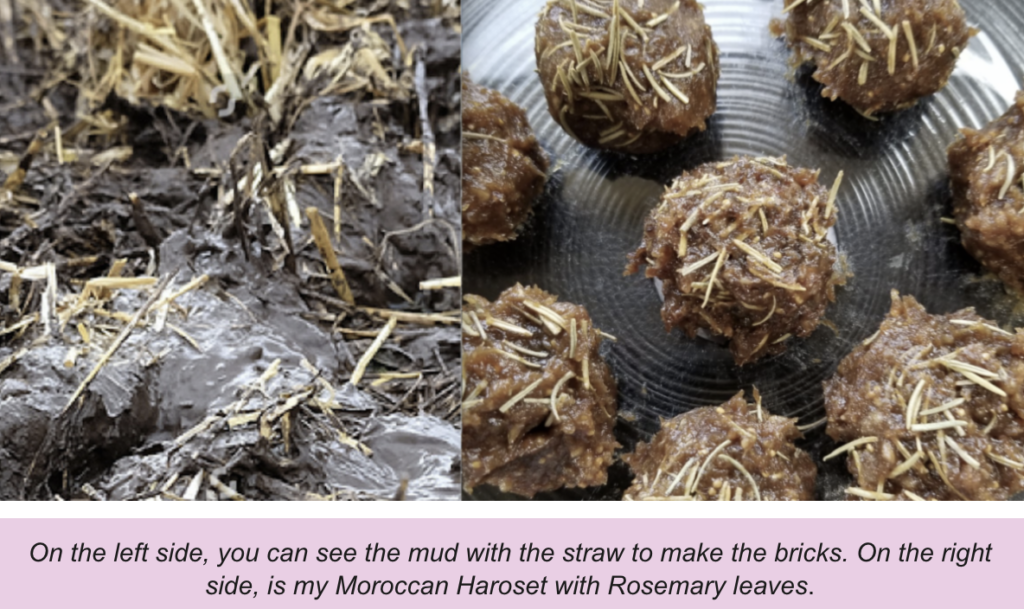
Since the effect of these herbs should be visual, there is no limitation on the type of herbs or vegetables that should be used for this purpose. Some rabbis mentioned cinnamon, ginger, or sprigs of hyssop, clarifying that they should not be ground but cut. The Maharil (1366-1427) was the most explicit, saying to cut the herbs into long, fine pieces (מחותכין ארוכין) to give them the appearance of “straws”. Today – for some reason that I have not yet been able to understand – almost all the recipes of the Haroset include spices or aromatic herbs, but no one mentions the herbs that give the Haroset the special visual effect that should awaken the memory of the mud and straw…. For some reason, this very important element has fallen into disuse… and this is when I decided to do my own Haroset…

MY HAROSET RECIPE

I am not allowed into the kitchen two days before Pesach… But this year (this article was written in 2019 Y.B.) I wanted to prepare a Haroset that was more like the recipe I learned from Maimonides.
According to Maimonides, the Haroset is made with dried fruits (figs, dates or raisins), wine vinegar and tebalin or herbs. The fruits give it the color and texture of clay; the vinegar its bittersweet flavor, and the tebalín, the look of the material that our ancestors used in the slavery of Egypt to make the “adobe”, that is, the mud-brick with straw.
Following Maimonides’ recipe, I easily prepared a paste with dried dates, dried figs and vinegar (no fresh fruits).
But since no one seems to give importance to the tebalin, I had to start looking on my own for something to put into the Haroset that would visually resemble the “teben” or straw.
I went shopping. First, I went to a supermarket and I saw alfalfa sprouts, which were long and thin… but I needed something dry, not fresh. I kept looking and then, “Eureka,” I found the straws! “Japanese Enoki mushrooms” with Kosher certification. They were long, white, thin and dry. Perfect for the desired visual effects. I bought a small bag to try. But my wife Coty wasn’t too happy about having Japanese mushrooms at the Seder. At that time I had to make a choice between my wife and Maimonides… and as everyone will understand, I discarded the “Enokis”…
Next, I went to “Everfresh,” the local kosher store, to find a more Jewish alternative. I saw cinnamon sticks, which could be the perfect shape, but they were too dark: too similar to the color of Haroset, and I needed the special color effects that would highlight the contrast between the mud and the straw. I found a bag of dried orange peels, but they seemed too short. Then I saw “Frozen Zucchini Spirals” in the freezer, but they were too similar to spaghetti… not exactly for the “spirit of Pesach”. The lavender branches looked perfect. I called my wife and she reminded me that I should use something edible. I ended up purchasing a little of everything: groceries, some non-food items, some frozen. I was undecided about what I could use… and this when a little miracle happened! Coty brought me a small packet of Rosemary Leaves and asked me to check if they were kosher for Pesach. 
When I saw those leaves I had an epiphany! These dried leaves were a perfect option. The color: light, between white and yellow. They were herbs as Maimonides required, and edible, as my wife required. But there was a problem. The leaves were too short. They would be lost inside the Haroset… and the visual effects would be lost … While I was looking at the leaves, and thinking about how to mix them with the Haroset, I had a second epiphany: I remembered the Moroccan Haroset, prepared in the form of balls, similar to falafel or meatballs. And I suddenly visualized that the Rosemary leaves had the perfect size to be mixed within the Haroset balls. I saw in my mind the mud with the straws, which for decades traumatized our ancestors! The rest was easy. And the result is right here below….


How To Drink Four Cups Without Getting drunk?

שתה ארבעה כוסות אלו מיין שאינו מזוג יצא ידי ארבעה כוסות ולא יצא ידי חירות


SIZE MATTERS

One might wonder: if the Seder requires four full cups of wine, and if a “full cup” means what it means today — somewhere between 8 and 12 oz. — wouldn’t drinking four of them leave a person intoxicated? After all, four standard glasses of wine at an average alcohol level is enough to be considered legally drunk.

We know that the Seder is meant to be an experience of joy and gratitude to HaShem for our freedom — but certainly not an occasion for intoxication. To understand why this concern is misplaced, we need to look briefly at the history of wine drinking, going back approximately 2,000 years to when the guidelines of the Seder were formulated by our Sages.


THE SIZE OF THE CUP

The wine cups used in antiquity were very different from the glasses we use today. As seen in the image above, there has been a dramatic increase in the size of wine glasses from the 17th century to the present day. The Sages of the Talmud specified that the cups used for the blessings of the Seder — and for all other religious ceremonies requiring a cup of wine — must be no smaller than a revi’it: approximately 3 oz. (86 ml. according to most opinions). That is a substantially smaller quantity than what we typically consider a cup of wine today.


PURE OR DILUTED WINE?

Maimonides (Hilchot Chametz uMatza 7:9) explains that the wine consumed at the Seder must be mazug — diluted with water. The ratio recommended by the Sages of the Talmud, and by Maimonides himself, may surprise the modern reader: 3 parts water to 1 part wine.

The reasoning is straightforward. The Sages taught that for wine to serve as an expression of freedom and nobility, it must be consumed in a pleasant, healthy, and moderate manner — what they called שתייה ערבה, a “pleasing drink.” Maimonides is explicit on this point: if one drinks four cups of pure, undiluted wine at the Seder, one has technically fulfilled the obligation of drinking the four cups, but has failed to fulfill the obligation of cherut — of conducting oneself on the night of the Seder as a free and noble individual.

Maimonides also establishes a precise minimum: across all four cups combined, the total amount of pure, undiluted wine must be no less than one revi’it — approximately 3 oz. The rest of each cup may be water. The requirement, in other words, is not that each individual cup contain a full revi’it of pure wine, but that the total pure wine content distributed across all four cups together reaches that minimum.


WHY SO MUCH WATER?

This may seem strange to us today. In our time, diluting wine is associated with poor quality. In antiquity, however, the opposite was true. Pure wine — yayin chai — was considered undrinkable, or at the very least unsuitable for refined and educated people.

This was not only a Jewish view. A friend who attended one of my classes — M.B., an expert in wines — pointed me to a Wikipedia article on the Greek krater, the vessel used for mixing wine at ancient symposiums. The Greeks followed a nearly identical practice, mixing wine with water at a ratio of 1 part wine to 3 parts water — precisely what the Talmudic Sages prescribed. Drinking ákratos, undiluted wine, was considered in ancient Greece “a serious error of judgment,” sufficient to characterize a person as a drunkard or someone lacking moderation and principles. Ancient Greek writers held that a 1:3 ratio was the optimal mixture.

The same article addresses the obvious question of how such a diluted mixture could still taste like wine. The explanation offered is that ancient wines were likely produced to a much higher concentration than modern wines — made from dehydrated grapes, with significantly higher alcohol and sugar content — and could therefore withstand substantial dilution while retaining their character and flavor. Rashi and Maimonides make a similar observation, noting that the wine of Talmudic times was considerably stronger than the wine we have today.


WHAT SHOULD WE DO TODAY?

Contemporary practice reflects these realities while remaining faithful to the underlying principles.

The minimum cup size has not changed — a revi’it, approximately 3 oz., remains the standard.

On the question of dilution, Rabbi Ovadia Yosef zt”l and other contemporary poskim explain that we should not add water in the proportions prescribed by the Talmud, because modern wines lack the concentration to sustain such dilution without losing their flavor entirely. Rabbi Yosef’s position is that more than half of each cup must consist of wine, so that the taste, essence, and in some cases the color of the wine still prevails. The maximum amount of water will vary depending on the type and quality of wine being used.

In my own experience, mixing a medium-quality wine — one not produced with added water — with up to one third water satisfies both essential requirements: it tempers the wine, as the halacha demands, while preserving its flavor and color. But the precise proportion will depend on the wine, and some experimentation is worthwhile.