BALAQ: Moshe’s Humility vs Bilam’s Arrogance

WHO WAS BILAM?

Although one of the Perashiot we read this week is named after the King of Moab, Balaq, the main protagonist is a very mysterious individual named Bil’am (Balaam). Who was Bil’am? Bil’am was a non-Jewish prophet. And according to our Sages, God revealed Himself to Bil’am on a level similar to that He revealed to Moshe (Moses).

But let’s not assume that because God revealed Himself to Bil’am, Bil’am was like Moshe. Actually, although both Moshe and Bil’am received a prophetic message, they processed this experience in a completely different way.

MOSHE’S EXPERIENCE

Communicating with God made Moshe realize how small and limited he was. An illustration. Moshe had many questions. One of the issues that most troubled Moshe was not understanding God’s administration of justice. How can it be that if God is all goodness (omnivolent) and all powerful (omnipotent), righteous men often suffer? However, after his “close encounter” with God, this question disappeared. But it did not disappear because Moshe found an answer to this question, but because closeness of God allowed Moshe to better realize his own insuperable limitations. His encounter with God made Moshe understand why he could not understand. As he approached the Infinity of God’s Wisdom, Moshe became aware of his own infinite smallness. And he understood that trying to grasp “God’s thoughts” is beyond the cognitive capacities of a human being, regardless of how wise or intelligent he may be. That is why after experiencing Divine revelation, Moshe, who was already a humble man, behaved with even more humility and became “the humblest man on the face of the Earth” (Bamidbar 12:03).

BILAM’S EXPERIENCE

Bil’am also had a close encounter with God, a similar overwhelming epiphany that Moshe Rabbenu experienced. But Bil’am’s reaction was exactly the opposite of Moshe’s. When God revealed himself to Moshe, Moshe focused on God, on his Infinite Wisdom and how far is from our grasp. But when God revealed to Bil’am, Bil’am focused on himself. Bil’am thought that if God communicated with him, it was because he, Bil’am, was a very special and unique person: an enlightened person. Bil’am convinced himself that if God spoke to Him it is because he was the most important man on the face of the planet. And he acted that way. Far from becoming aware of his finitude by becoming more aware of God’s infinity, Bil’am boasted that he could now understand Divine Wisdom. And at one point he uttered the most arrogant phrase ever written in the Tora: yode’a da’at ‘Elion,“ [I am Bil’am], the one who understands the mind of the Almighty. ”

THE RELIGIOUS EXPERIENCE

The same spiritual experience affected Bilam and Moshe Rabbenu in completely opposite ways. Moshe became the humblest man and Bilam, in the most arrogant. Bil’am, for example, referred to himself in the third person. And he also boasted that God spoke “through his mouth,” as if he were His chosen one. Bil’am boasted that he had the ability to destroy an entire nation, Israel, with the power of his word, without the need for a military confrontation. Bil’am thought that he could “force” the Divine will and “compel” God, through his magic to do whatever he, Bil’am, wanted.

WHEN DONKEYS SPEAK

Our rabbis point out that Bil’am learned a lesson in humility from whom he least imagined: his donkey.

When Bil’am was on his way to meet Balaq, who hired him to curse Israel, he was riding on his ass (a female donkey). The animal suddenly stopped and strayed from its path. The Tora explains that the animal was frightened because she saw an angel, and therefore stopped. But Bil’am punished his donkey and threatened her with his sword. God, then, “opened the mouth” of the animal and the donkey revealed to Bil’am why it had strayed.

Our rabbis explained the following:

Bil’am boasted that God “spoke through his mouth.” Now, Bilam saw that even a donkey, who was never considered a very intelligent animal, could also speak and transmit a Divine message, if God wants it. Ergo: Bil’am was not even superior to his donkey.

Bil’am also claimed that he could wipe out the entire nation of Israel with his magical curses. But then, why did he threaten to kill his donkey with his sword? Bil’am flaunted powers that he himself knew he did not have.

Finally, Bil’am claimed that he could understand the Divine Mind. And God shows Bil’am that he was not even able to understand the mind of a donkey…

The humble man is like Bamboo, says a Chinese proverb, the higher he grows the more he leans.


SHELACH LEKHA: The Biblical Origin Of Fake News

The Israelites are in the desert, ready to conquer the promised land. Moshe decides to send twelve men on an intelligence mission, behind enemy lines, to explore the land’s strengths and weaknesses. This information is absolutely necessary for the military expedition to be a success, and to have the fewest possible casualties. The spies explore the land from South to North. After 40 days, they come back to the desert. The Israelites, understandably, were anxious to have some information about the land in which they will very soon live. They congregated around the spies to hear what they are saying to Moshe. And thus the problem begins, and a tragic situation is created that will literally “erase” an entire generation of Jews. The spies give their report not only to Moshe but now, in front of a huge and anxious audience. And the spies had an agenda. In the beginning, we do not notice it, and it seems that they all speak with the same voice. But very soon we notice that there are two groups among the spies. Those who want to go to Israel, and had faith in God, and those who did not. The speech of the spies who oppose continuing to Israel is a superb example of demagoguery and “media” rhetoric used to manipulate and persuade the masses, something of great relevance in our times of Fake News, where objective journalism virtually disappeared.
Let’s look at some illustrations.

FEAR OF FREEDOM

The Rabbis clarified in their commentaries that the spies had already an opinion and an agenda even “before” their mission began. Apparently, they were not interested–or they were very scared– to fight and risk their lives to live in an unknown land. They preferred to return to the “stability” of Egyptian slavery. Perhaps, they thought, if they would lead the people back to Egypt, they will be rewarded by the Egyptian with leadership, wealth and power.   And when an individual —especially a tribe leader, i.e., a political player— already has a fixed idea of what he or she “feels”,  it is very unlikely that facts or reality would change his way of thinking. A few years ago, two anti-Israeli (and anti-Semitic) US congresswomen announced to the press that they wanted to visit Israel “to see with their own eyes the situation of the Palestinians there.” Some people, very naive Jews, thought that it was an extraordinary opportunity for them to see the reality of Israel with their own eyes; understand that the Arabs living in Israel are the most privileged in the Middle East, and change their minds! The Israeli government was less naive: it doesn’t matter what they see or won’t see: the anti-Israeli opinion of these congresswomen is already formed, it is part of their platform, and nothing would succeed in changing it! Regardless of what they would see in Israel, they will come back repeating the same prejudices about Israel. It is very difficult for people to change their opinion when it has already been transformed into a “political” ideology.

PRESENT FIRST WHAT YOU OPPOSE

The ten spies surprisingly began speaking positively of Israel: “Israel is a land flowing with milk and honey”, that is, it is suitable for raising livestock (from which “milk” is obtained) and for agriculture (“honey”, which in this case refers to the sweet juice of ripe dates). Why did they start from a positive angle?  When a demagogue wants to convince the audience that “A” is better than “B”, he cannot simply ignore the arguments of “B”. If he does, the people will doubt the credibility of his or her opinion. Therefore, he would briefly introduce “B”, with selected arguments, pretending that he has an objective and balanced view of the matter at hand. And when would the demagogue start introducing “A” or “B”? When at the end of a trial a judge presents his verdict, if his final veridic is for example “not guilty” he will present first the arguments for “guilty”, which he will discard. And will end up with the non-guilty arguments. When a demagogue presents two possible ideas, he would first present the idea he wants to discard.

MORE FEAR
Demagogues do not address human intelligence or logic: they usually aim their discourse toward people’s emotions. One of the easiest emotions to target in order to manipulate the masses is “fear”. It does not matter if what the demagogue says is real or is exaggerated or imaginary. Fear penetrates our emotions, bypassing the filter of the mind. You can see that in our case, after they praised the land, they now start the intimidation campaign. Examples: 1. “The men we will have to fight against are giants and savages!” No matter how strong we are, they will defeat us! 2. “They’re huge savages!, compared to them, we looked like insects. 3. “Amaleq” is there too!” Amaleq was a traumatic experience for the Jews. The first nation to attack Israel, targeting women, children, and the elderly, and they will be the first enemy that we will have to face. 4. “The land swallows its inhabitants”. In their efforts to discourage the people, the spies described Israel as if it were Iceland: a rocky, volcanic region where seismic movements abound.
The discourse of fear is always a favorite of tyrants and dictators, who usually make up an enemy to blame for all the evils “that they create”.

YOU CAN’T DO IT!

The spies were sent on an intelligence mission to objectively identify the power and weaknesses of the enemy. But instead of reporting the facts, the spies became “political advisers” and reflected their own personal fears (or personal agendas, according to others). When they said: LO NUKHAL LA’ALOT “we will not be able to conquer the land”, the people began to cry and went into a state of panic and despair. The two loyal spies, Yehoshua and Caleb, tried to calm everyone down, and offered a very rational argument: Have we forgotten that HaShem has been and is with us? Don’t you remember that He defeated Egypt and Pharaoh’s mighty army? Don’t you realize that it is God who is leading us to the Promised Land and that it is He who is giving us this land? Do not be afraid! With God’s help, we will conquer the land! ” But it was already too late. Caleb and Yehoshua’s “logical” arguments fell on deaf ears. Political ambitions and manipulation won. And we all lost.


The Blessing of the Kohanim

יברכך ה’ וישמרך 

יאר ה’ פניו אליך ויחנך 

ישא ה’ פניו אליך וישם לך שלום

Bircat Cohanim, the blessing of the Priests, is found in this week’s Parasha, Naso. This three verses text contains the words with which God instructs the Cohanim to blessing the congregation of Israel. It is worth clarifying that although the Cohanim are the ones who “recite” this prayer, it is the Creator, and not the Cohanim, who grants us these blessings.

We will now examine its content.

The first pasuq says 

“May HaShem (= God) bless you and protect you.”

BLESS YOU: This means: May HaShem grant me all the material blessings I need: a house, food, clothing, money, etc. Of course, the fact that God blesses me does not mean that I don’t have to work to make it happen. God’s blessing does not replace human effort. The farmer works the land and sows the seeds. And when God grants His blessing, the farmer reaps the fruits. The Divine blessing, therefore, implies a kind of association between man, who must strive and work, and God who blesses that effort with succes.

AND PROTECT YOU: We need Divine assistance in order to enjoy His blessings. How? We ask God to protect us from disease, accidents, tragedies. In this case, we also have the obligation to take the first step and become a “deserving” recipient of this blessing: if we ask HaShem to watch our health, we have to do everything in our power to stay healthy. We must avoid taking unnecessary risks and not exposing ourselves to accidents, misfortunes. 

Furthermore, Divine protection comes to complement Divine blessing. In a way, we are asking God to protect us from His material blessing. Firstly, because when all my material needs are met, my character can be negatively affected. I can fall into ostentation, arrogance, ungratefulness, and forgetfulness of God.

We ask HaShem to generously grant us what we need and at the same time to protect us from the adverse effects of material abundance.

“May HaShem enlighten you with His presence and grace you.”

ENLIGHTEN YOU: Now it is not about material but more spiritual blessings.  How does God enlighten us? Granting us  wisdom to understand His Tora. We must dedicate time and effort to study Tora. And the Almighty will bless us by illuminating our intelligence. By opening our eyes so that we understand His Tora and absorb its values. But wisdom is not enough …

AND GRACE YOU:

When a person has too much wisdom, sometimes he or she might lack social skills or “emotional intelligence”. An individual may be wise but not sensitive or empathetic enough. The smartest kid in the class isn’t always the most popular. In this blessing we ask HaShem to “grace us ”, that is, to inspire us to be loved by others, to  find grace in the eyes of others.  

“May HaShem direct His presence towards you and grant you peace.”

DIRECT HIS PRESENCE: This means “May God favor you,” may He grant you a special, particular attention. The greatest punishment for the Jewish people is to be “abandoned” by God. In fact the Tora affirms that if the Jewish people abandon the Tora, God will withdraw His special protection and we will be exposed to our numerous enemies. When the Tora describes this state of abandonment,  a consequence of our abandonment of God, it calls it  hester panim, “the hiding of God’s Face from us”.  

Our blessing, on the other hand, speaks of the ideal situation: when God directs His Face (His Presence, His Protection, His blessing) towards us, watching us closely. This is a privilege that we must earn. The closer we get to God, the closer He will get to us.

AND GRANT YOU PEACE: The best way to understand this expression is to think about the State of Israel. If Medinat Israel were a corrupt, marginal third world country the world would probably leave us alone. But Israel is under permanent Divine protection (or Intervention). Israel miraculously survives the constant attack of her tireless enemies. Israel won all the wars waged against her. Israel grows and thrives. This is surely thanks to the Jews who live in Israel, who fight to protect Israel and make it a prosperous country. But human effort is not enough. Israel is privileged to have  Divine assistance. The “eyes of God” permanently watch our beloved land and its inhabitants. However,  when the Creator grants us the privilege of His blessings, our enemies cannot tolerate it. And they will do everything in their power to prevent us from living in happiness, peace and prosperity.

We ask HaShem to favor us with His blessings but we also ask Him to save us from those who envy us and try to destroy us. So we may enjoy God’s blessings in peace. This is the ideal to which we aspire, as individuals and as a nation.


BEHAR: Colombian Universities and the Sabatical Year

In this week’s Parasha we find a very interesting Mitsva, Shemita, or in English Sabbatical year. This means that the in the land of Israel the cultivation fields should rest during the seventh year. In the seventh year the land is not plowed; neither sown nor harvested. The reason for this Mitsva was explained in different ways.  The first thing that might come to mind is that letting the soil rest for a year contributes to the conservation of the soil and allows to improve its fertility.

GROWTH

I think the best way to understand  “Shemita” is comparing this Mitsva with “Shabbat”. During Shabbat we also “rest” and one of the benefits of rest is that it allows us to renew our physical strength for the next working week.

However, the meaning of the Shabbat goes beyond material rest. Actually, physical rest is not the purpose of Shabbat, but just an incidental consequence of the Shabbat. If I live on the 12th floor I have to go up and down the stairs every time I come to or I leave my house. Something that does not really add a lot with to my physical rest …

The meaning of the Shabbat and Shemita must be sought in the effect it leaves in the worker, the “human”, not the ground or the body. Once every seven years / days the Jewish worker stops working, plowing and harvesting to engage in another completely different activity. In Yerushalayim, for example, the year of Shemita coincided with the Mitsva of Haqhel, where all the people gathered to hear and study the Tora from the Kings and Priests of Israel. We do the same every Shabbat. Since we do not work, we can leave our mundane occupations and dedicate ourselves to pray, listen to and study the Tora with our family and our congregation.

In this sense, Shabbat and Shemita present an identical scenario: on Shabbat we stop working and we stop “growing economically”. Not to dedicate ourselves to physical rest but to “growing spirituality”. Increasing not our financial gains but  our Tora knowledge, wisdom and our closeness to HaShem. In the year of Shemita we stop dedicating ourselves to “the growth of the plants and the fruits” of the land and we occupy ourselves “in our own growth.”

This concept of intellectual growth and mental renewal is recognized today throughout the world. The most prestigious universities in the world grant their faculty “a Sabbatical year”, one year of rest every seven years of work. The university pays the professor his or her full salary so that she can spend twelve months studying, researching and writing. Thus, without the burden of the teaching work, the professor can exponentially renew his knowledge, grow intellectually and then bestow all his new intellectual wealth into his students.

The academic sabbatical year is perhaps the best illustration of the nature and benefits of the Shabbat and the year of the Shemita.  I received a great article from one of my readers in Bogota, Colombia. This article clearly explains and defends the adoption of the Sabbatical year for Colombian Universities teachers in a very pragmatic way. The suggestive title says:  “The Sabbatical year has nothing to do with resting. Colombian universities see in this strategy [implementing a Sabbatical year for their faculties] the ideal opportunity to improve the quality of their teachers’ education and to increase the number of their articles, research and academic books.  “  See the full article HERE (Spanish)

EMUNA

There is one more element, very deep, that Shabbat and Shemita have in common. Emuna, our faith that our sustenance ultimately comes from HaShem. Let’s start with Shabbat. We all know of the anti-Semitic prejudice that accuses the Jews of being able to sell his soul for money. In fact, the best argument to unmask this malicious accusation is by understanding what Shabbat is. When a Jew observes Shabbat he is sacrificing a very significant part of his income. How many times have I heard that  in retail, for example, ”Saturdays are a very important day for business”. When a Jew observes Shabbat, he demonstrates  that for him economic benefit lies on a secondary plane. And that he believes in God’s intervention in our livelihood.

In the year of Shemita there is similar, but almost miraculous, scenario, and on a larger scale phenomena. The Tora assures the Jewish farmer that if he observes Shemita, he has nothing  to fear. This is what the Tora says in Vaiqra, chapter 25: “(20) And if you ask yourself, What shall we eat in the seventh year, if we neither sow nor reap our produce? ” (21) [Therefore, you must know that] in the sixth year I will send you a blessing so great that the earth will produce [enough] for three years. (22) When you sow during the eighth year, you will still be eating from the previous harvest, and you will continue to eat of it until the harvest of the following year. ”

When the earth rests during the seventh year, it must be worked during the eighth year to begin producing fruits only in the ninth year. The Jewish farmer must “have faith” that the agricultural production of the sixth year, will be enough for the sixth, for the seventh, and for the eighth year.

The observance of  Shabbat and the observance of the Shemita are a testimony of our Emunah: when we observe the “Sabbatical rest”, we testify with our actions (with our rest and with our economic sacrifice) that Hashem, the Creator of the World, is the ultimate responsible for our livelihood.


TAZRIA-METSORA: How to improve your quality of life

This Shabbat, we will read two sections of the Torah: Tazria and Metzora. One of the most discussed topics in these two sections is tzara’at, which is a disease or condition (neg’a) generally associated with leprosy. Once diagnosed with this disease, the individual was isolated and quarantined until their cure. The Sages learned from the case of Miriam, Moses’ sister, who contracted tzara’at, that there is surely a relationship between tzara’at and speaking ill of others, which is known as Lashon Hara, i.e., speaking badly about others. Since those who engage in the addiction of gossip and destructive speech must be “isolated” so that their behavior does not “spread” and their example does not become “normalized” in Jewish society.

We present here a brief reflection on one of the ways to avoid Lashon Hara, according to the teachings of Pirkei Avot.

“And judge every person favorably.” – “Yehoshua ben Perachyah used to say: Make yourself a mentor, acquire a friend, and judge every person favorably.”

Judging others favorably is a commandment of the Torah. Where does this commandment appear? In the book of Leviticus 19:15 it says: “You shall judge your neighbor with righteousness.” The Sages explained this important precept as follows:

There are three categories of people: the righteous person (tsadiq), the wicked person (resha’im), and the average person. The righteous person has an impeccable record of good deeds. These individuals, who are more like angels than humans, are not the majority. They will be between 1% and 5% of the total. At the other extreme, we have the true wicked people, the resha’im, those selfish individuals with bad intentions and a record that condemns them. I estimate that this is also a maximum of 5% of the total population (the book “The Sociopath Next Door” claims that sociopaths are 4% of the population). And then we have the ordinary people: all of us, who generally have noble intentions, do good things, but also have our flaws – sometimes we behave altruistically and sometimes selfishly. People with average morality will make up 90% of the population.

The Torah says:

  1. To the righteous person, you must judge them with indulgence. Even if you are not sure if they acted well or badly, or when you perceive a suspicious situation but do not have all the evidence in front of you: do not condemn them in your heart. Judge them generously. Positively. Give them the benefit of the doubt.
  2. To the wicked person, who already has a record of deliberately acting with evil, you cannot give the benefit of the doubt until they repent because their behavior can affect you. You must be suspicious of a truly wicked person, even when it seems they want to do something noble (we will talk more about this later).
  3. And what about the average person? With most of our friends, family, acquaintances, etc., the Torah indicates that with the average person, you should judge them as if they were a “righteous person” and give them the benefit of the doubt unless you have clear evidence to the contrary. In other words, this commandment, “You shall judge your neighbor with righteousness,” should be read more or less as follows: “You shall judge your neighbor (the average person) just as you judge the righteous person (the tsadiq).” Thus, according to the Torah, we must give the benefit of the doubt to the vast majority of people!

Judging others in this way brings enormous benefits for society and individuals in material, spiritual, and emotional terms.

Firstly, because “with the same measure that you measure, it will be measured to you.” How do we want to be judged by God after 120 years? Do we expect Him to judge us severely or indulgently? Surely we want the Supreme Judge always to find an extenuating circumstance, a justification for our mistakes… The Sages explain that God will judge us with the same measure we use to judge others. If we learn to judge others with the benefit of the doubt, that’s how we will be judged by Him. And something else: not only will God judge us as we judge others, but our gestures and attitudes are usually reflected and imitated by the people around us. If you want other people to judge you indulgently, not to rush to suspect you or condemn you before having all the information at hand, then learn to judge others with the benefit of the doubt. When you give others the benefit of the doubt, you also receive it from others.

Finally, judging with the benefit of the doubt is the best antidote to avoid Lashon Hara. When we speak badly of others, it’s because we think badly of those people. Often we hear a destructive comment about another individual, and we “believe it” and repeat it, even though we may not have evidence or know the complete story and all versions of the story. If we learn this great commandment of giving others the benefit of the doubt in our hearts, we will be much more careful not to listen, not to believe, and especially not to repeat negative comments about others. This way, we will avoid Lashon Hara, and our quality of life will improve immensely.


ZAKHOR. Antisemitism does not stop: it must be stopped

The Shabbat that precedes Purim is called Shabbat zakhor (= Remember!). This Shabbat we take out two Sefarim, one for the weekly Parasha,  this year 2022: Vayqra, and the other Sefer for a special Maftir in Debarim 25:17, zakhor. “Remember… what Amaleq did to you when you left Egypt … Amaleq attacked the defenseless … and did not fear God … do not forget !!!”.
 
THE STORY OF AMALEQ
When we left Egypt, escaping a 140 years period of slavery, Amaleq attacked us. It was an unprovoked attack, without reason or motive. Israel was not a threat to Amaleq’s possessions or territory.  The reasons for Amaleq to attack the Jews were not “logical” but rather, using a modern term “ideological”. Moreover, we were superior in number to Amaleq. But Amaleq still –irrationally—attacked us.  To be more effective and cause maximum damage, Amaleq attacked the weak, the infirm, the old.
 
There was nothing specific about the Jews that triggered Amaleq’s hatred.  It was not the power of the Jews, or the money of the Jews. The Jews had just escaped from a lengthy captivity. What power or money would slaves have?  It was not a territorial issue either: we were in the desert, not even in the Promised Land. Amaleq territory was not in our plans!
What characterizes Amaleq is a radical irrational hatred for Jews. 
 
I think the best way to identify Amaleq  (and anti-Semitism in general) is that Amaleq hates Jews “unconditionally”. Is not because of  what we Jews “have” or what we Jews “do” but because of what we Jews “are”: the people of God.  It is an existential hatred. What the Jew has or does is something Amaleq might use as an excuse to justify his hatred. To  disguise hatred as a politically correct fight against this who wish to dominate the world, etc.  
 
Amaleq and his “ideological” descendants (known as ”zekher Amaleq”) can be clearly identified by the following characteristics:
 
1. UNCONDITIONAL HATRED
Amaleq’s hatred towards Jews is not motivated by territorial disputes, revenge or by feeling threatened. It is an obsessive hatred toward the Jewish people . Look for example at Iran. Iran threatens to wipe Israel off the map although it has no common borders with Israel. There are not disputed territories between the two countries. 
 
2. CIVILIANS
Amaleq would attack and would try to kill Jews, whether they are civilians, women, elder or children. Remember Ma’alot in 1974?  22 little children were massacred by Arafat and the PLO. The murder of the Fogel family in Itamar, including a woman, her children and a baby.  The synagogue of Har Nof in Jerusalem. And many more. In the last years, representatives of Amaleq have killed Jews in Israel and have stabbed to death Jews also outside Israel. In Paris, Milan, London, Brussels, Miami, California, Buenos Aires, New York, Pittsburg, and unfortunately there are no signs that this will stop.  
 
3. SUICIDAL
Amaleq’s hatred for Israel is suicidal. Amaleq is willing to practice martyrdom (self-immolation, suicide attacks, etc.) if as a consequence he would kill a Jew. Amaleq’s hatred towards Jews is greater than Amaleq’s love for their own lives or even the lives of their own children.
 
4. SINGLE OBSESION
Amaleq may hate other people temporarily, but his endless obsession is against Israel. Amaleq does not hate the Jews for what happens in Israel. On the contrary, Amaleq hates Israel because is a Jewish state.  Anti-Zionism is Amaleq’s way to disguise its anti-Semitism.
 
5. EXISTENTIAL HATRED
The most important and practical point to consider in our confrontation with Amaleq is that it is not possible to negotiate with Amaleq. Because Amaleq will never be satisfied with land, money, or even with us changing our religion. Think of the Shoa. The Nazis killed also those Jews who were willing to renounced their religion. Amaleq wants the Jewish People to disappear, period. Israeli politicians and Jews around the world are divided precisely on this point: Everyone Jew wishes to live in peace. But some believe that peace with our enemies can be achieved through negotiations. Others believe that, like Amaleq, our enemies (Iran, Palestinians, Hizbollah, BDS, etc.)  will NEVER stop attacking us, even if Jews or Israel concede their demands.  The greatest internal conflict of the modern Israeli politics has to do with identifying or not identifying our modern enemies with the Amaleq the Tora warned us about.
 
6. SELF HATRED
For many Jews, especially for those who are unfamiliar with or unwilling to accept the Biblical concept of Amaleq, it is extremely difficult to recognize and acknowledge the true nature of Amaleq. And since the behavior of Amaleq is beyond rationality, intelligent and educated but extremely naive Jews, believe that something “rational” must be triggering Amaleq’s hatred toward us. And instead of accepting the irrational nature of Amaleq’s hatred, they blame it on ourselves!. They assume, for example, that terrorist attacks or Amaleq killing of Jewish civilians, or the BDS movement that aims to delegitimize Israel  is the consequences of a new settlement. Or that hatred to Jews has to do with some Jews being wealthy or powerful. When a Jews accepts Amaleq’s narrative he or she might end up hating their own people instead of holding Amaleq accountable.  
 
7. DENIAL
Foreseeing the danger of the well-meaning but naive Jew, the Tora warned us not only to “zakhor” (remember) Amaleq. In the same text, with an exceptional tautology, the Tora exhorts us to not forget Amaleq’s suicidal obsession and irrationality (“Lo Tishkakh”).
 
Our Hakhamim prescribed  to publicly read the text where the Tora mentions Amaleq the Shabbat before Purim. Why? Because Haman was the first descendant of Amaleq who was about to succeed in erasing the entire people of Israel off the map.
 
The Tora assures us that HaShem will not let Amaleq destroy us. But it exhorts us not to be naive about the true nature and intentions of Amaleq.  Forgetting, can be tremendously costly for us.
 
Parashat Zakhor has the special status of being a biblical text whose reading is a direct commandment of the Tora. Women are also expected to fulfill this obligation and attend Synagogue to hear Parashat Zakhor.


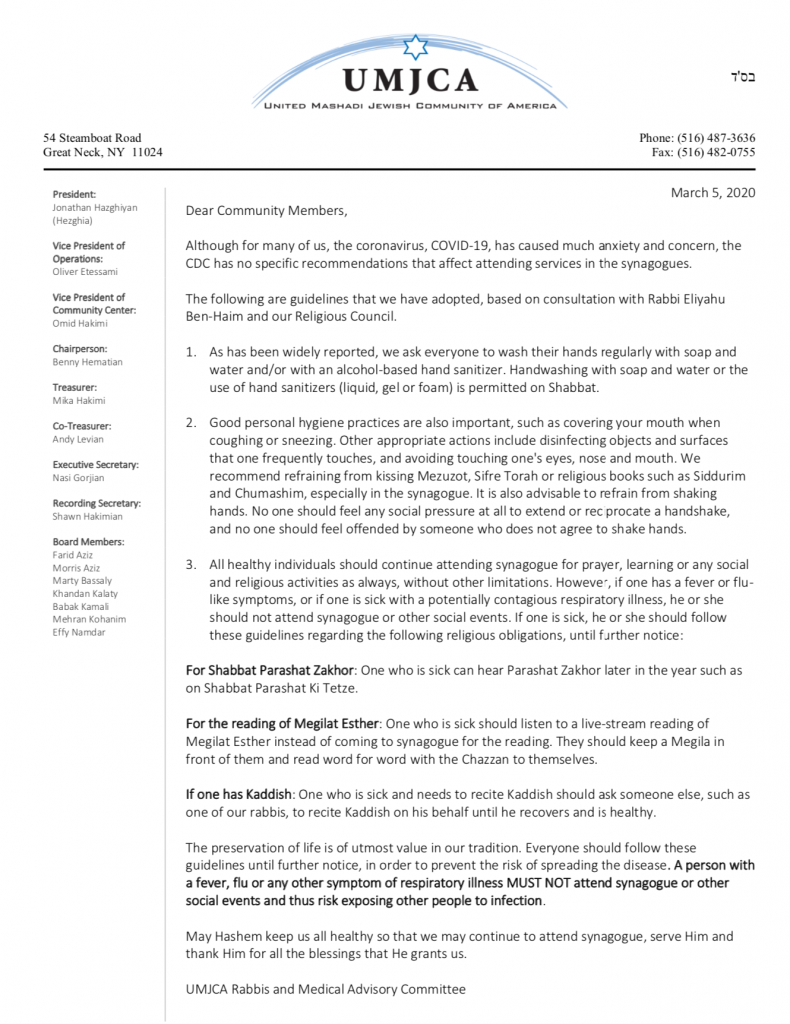
UMJCA Community Notice on COVID-19


Shabbat And Cellphones

Great minds discuss ideas; average minds discuss events; small minds discuss people.

Addiction to electronic devices is a growing concern in our modern society because we never part with them. Even when we finish our work and come home to relax, we still connect to our computers, cables, and Wi-Fi. Cell phones are particularly problematic, especially for children and adolescents. Teachers don’t know what to do to control their use. And many parents have already given up, until one day they realize that their little children would rather have an iPhone in their hands than hold hands with them. The syndrome of “separation anxiety,” which in the recent past referred to the fear of being separated from their parents, has become the panic adolescents feel when their cell phones are not within reach.

Being able to disconnect from this addiction is extremely important, but it seems that no one knows how to do it. Except for the Jewish people. In the first part of this Parasha, the Tora tells us about the “Sabbath rest.”  Shabbat is a Divine gift whose relevance is not for modernity but for eternity. Miraculously — I have no other way of explaining it– the meaning of Shabbat has always been transforming, adapting to what we most need in those moments. In the times of slavery, when we left Egypt, Shabbat helped us feel free and experience physical rest, which we did not have for generations. In difficult times, in our long exile,  Shabbat was an emotional refuge, a family space, a community identity, and an island of peace. In times of poverty, the Shabbat table, with its mandatory “two” loaves, helped us regain a sense of dignity.

In modern times, Shabbat once again surprises us, revealing its magical renewed significance to the point that it makes me think that Shabbat was NEVER more necessary than in 2023. From Friday afternoon to Saturday night, all contact with the electronic world is suspended. On Shabbat, we relearn to enjoy the true pleasures of the real world. We sit down to talk, not chat, with our beloved families. We don’t listen to digital music; we sing along with our children. We talk about Tora without the intromission of Alexa or Siri, and our children do not listen to a podcast but to words that come from human lungs and vocal cords.

The images of our family around the Shabbat table will not be shared in family chats, nor will they end up in a virtual cloud. They will be stored in the hearts of our children and will create memories that will become their identity and the feelings that will unite parents and children for generations. Shabbat invites us to disconnect from a fake virtual world to build a real family.

It has never been so necessary.


What should we do with our Broken Tablets?

אמר רבי יהושע בן לוי לבניו: הזהרו בזקן ששכח תלמודו מחמת אונסו, שלוחות ושברי לוחות מונחים בארון
ברכות דף ח

THE GOLDEN CALF

In this week’s Parasha the people of Israel experience one of the most shocking events in its long history: the worshipping of the Golden Calf. When Moses ascended Mount Sinai, he announced that he would return in 40 days. On the eve of the 40th day, the people thought that Moses would never return (“no human could survive without food or water for so long”, they thought). To replace Moshe, they built a golden idol, a calf, one of the many Egyptian idols. This was a great sin. Only a few days ago, the people of Israel witnessed the revelation of God at Mount Sinai. And just a few weeks before that, they saw the opening of the Red Sea and the ten plagues in Egypt. How could it be possible that now they come back to idolatry? Moshe was coming down the mountain with the Tablets of the Law, but when he saw the people completely uncontrolled and worshiping an Egyptian idol, he threw the Tablets and broke them into pieces.

THE OLD TABLETS

Today, I will not focus on the most important question: why Moshe broke the tablets? I want to concentrate on something that perhaps seems secondary or irrelevant but has a great moral lesson for all of us. As we know, later on, Moses received a “copy” of the Tablets of the Law. He placed a new set of Luchot in the Ark of the Covenant (Aron haBerit). And the question is: what happened to the first Tablets, the little pieces of the broken Tablets? Perhaps they were left there, abandoned, in the desert, because now they were useless tablets? Our rabbis explain that the remains of the broken tables were collected by Moshe and deposited in the Ark of the Covenant next to the new tables. A famous rabbi of the Talmud, Rabbi Yehoshua ben Levi derived from this action a wonderful lesson in respect to our elders. “This event comes to teach us, he said, that to an old man who lost his memory, we owe the same respect we gave him when his memory was intact …”.

BROKEN MEMORY

Imagine a great Tora scholar, someone who for years was invited to sit in the front row of the synagogue because he taught Tora to others and captivated everyone present with his eloquent speeches. And now, at his advanced age, he lost his eloquence and his memory because of senility or Alzheimer, and he can no longer speak or even reason as before. What type of honor do we owe him in his present situation? Do we still invite him to sit in the front row? Or perhaps, because he has lost his memory and does not have any content to give, we sit him in the back? The unequivocal answer of Rabbi Yehoshua ben Levi is: we honor him as we used to do. Why? Because this old man is like the broken Tablets of the Law, which were no longer intact, complete, or useful, and still Moshe placed the broken, “useless” old Tablets in the same honorable place: inside the Ark! This old man has lost his wisdom. His memory is now broken, and his mind is in one piece anymore. He no longer has any content to share with us. And still, we should honor him exactly as when his memory and mind were intact. This is a beautiful lesson of respect and honor that we learn from a seemingly superfluous detail of the Tora: the placement of the old, broken Tablets.

BROKEN MEMORIES

There might be another answer to why the old broken tablets were not discarded or buried but “treasured” alongside the new ones. Perhaps the Tablets were not buried to serve as a testimony for the Jewish people. So we Jews never forget the greatest sin we committed. And future generations don’t repeat the same mistakes. We all had bad experiences. We all make mistakes. But we should not bury these mistakes in our memory. Rather, we should learn from those negative experiences. With the right mindset, past negative experiences can be transformed into critical lessons for the future. And not only for ourselves but also for our loved ones, friends, and others in need.

In 2016, I received the devastating news that I had been diagnosed with stage 3 colon cancer. It was undoubtedly the most difficult and painful experience of my life. However, with the grace of God, I am now in a much better place and feeling healthier than ever before. Despite my hesitance to talk about it, I am writing about my cancer for the first time today. The memories of chemotherapy, nausea, pain, fatigue, hospital rooms, dizziness, fears, and tears still linger in my mind. Still, I try to keep these broken memories safely stored away from the world, and even my family,  in my personal Ark.

However, there are instances when I open up about my experiences. When? When I meet a community member, a friend, or anyone who was diagnosed with cancer, I feel compelled to show them my scar from the chemo port. The scar may be small, but it carries immense weight for the person sitting across from me. By sharing this vulnerable aspect of myself, I hope to show them that I truly understand what they are going through. As a rabbi, I have always tried to understand and support people with cancer. However, I now realize that despite my best intentions and genuine efforts, there are some things that can only be truly understood through personal experience. My own struggles have given me a new perspective and empathy for those who are facing similar battles. While I may still keep my broken memories in my personal ark, I am now more open to using them as a source of comfort and support for others who are going through difficult times.

.


TETZAVE: The Cohen Gadol and the Responsibility of Wearing a Jewish Uniform

A BRIEF HISTORY OF MORALITY

The first time the Tora refers to clothing, using the most generic word Kutonet, is in the context of creation. After tasting the forbidden fruit, Adam and Eve, the first humans, experienced a “reset” of their minds. Until then, their neshama, ruach memalelah, or verbal intelligence endowed them with the ability to think linguistically–with words–which allowed them to possess a supernatural ability: freedom of choice. While animals “perceive” reality in images (or smells or sounds) and react instinctively to them, human beings process reality with words—that is, they “think.” Humans can see, hear, and then calculate, speculate, contemplate, anticipate, obey, and disobey. By rebelling against the first (and only) Divine order, man, paraphrasing Maimonides, activated the power of his “imagination,” making it an integral part of his thought process. The consequences of this could be potentially disastrous. Now, human supernatural powers, “words” are not used to serve God but to justify disobedience.  Human beings can now “see” the advantages of their abilities for personal benefit. Power can be used to help or do good to others—as the Creator does—and to subdue or oppress others. Sexuality, beyond its two explicit purposes—1. To intimately unite husband and wife, 2. To imitate the Creator in recreating another life—can also be channeled toward abuse, infidelity, rape, etc. By covering his nakedness and differentiating himself from animals, man reminds himself that he must employ his powers for the purpose for which the Creator conceived them.

YOSEF AND THE BURDEN OF REPRESENTATION

The second time kutonet appears in the Tora is when Jacob gives his son a special robe: colored clothing that functions as a uniform and represents the authority granted by his father to supervise the tasks of his brothers and inform them about their behavior. As we already know, the consequences of Jacob’s decision and the humbleness not exercised by Yosef, were crucial in our history. This colored uniform, or kutonet, led us to Egypt and then into slavery. In our Parasha, Tetzave, the kutonet appears for the third and last time in the Tora when describing the Cohen Gadol’s uniform. The Cohen’s clothing, more than a garment to cover nudity, is a uniform that conveys a representative position, and his wearer carries the weight of the responsibility of representation.

THE DOUBLE REPRESENTATION

On the one hand, the Cohen represents the ideal of a Jew: the consecration of one’s life to achieve closeness to (by serving) the Creator. The Cohen Gadol also represented the Jewish people before God. And this was manifested in the twelve stones that he wore on his breastplate, with the names of the 12 tribes of Israel. The Cohanim knew very well that their privileged position implied greater responsibility. And the Tora commands them to be aware that, even involuntarily, one can get carried away by the splendor of his uniform, feeling as if it were an honor displayed to the person and not his office. The consequences can be disastrous. A police uniform, for example, should inspire honesty, trustworthiness, and service. If a police officer were to use the power of his or her uniform for personal gain or abuse of power, he or she would be misrepresenting the uniform, the office, and by extension, dishonoring the entire Police Department.

I remember, as a teenager asking one of my teachers about the benefits and risks of wearing a Jewish uniform while traveling on buses and trains and interacting with non-Jews. I asked my teacher if wearing a cap or a Kippa on the street would be more appropriate. My teacher replied, “It all depends on how you behave.” The Kippa is a catalyst that clearly identifies you as a Jew, unlike a more generic baseball cap or hat. If I behave properly, I will likely fulfill the great Mitzva of Qiddush HaShem, which means elevating God’s name and enhancing the reputation of the Tora and its Divine Author. However, if I behave badly and let myself be carried away by my impulses and imagination more than by my reason and by the Tora among gentiles, I would be transgressing the most serious of all sins in the Tora: Chillul HaShem, affecting negatively the reputation of the Creator.

My teacher added a memorable reflection: “Never forget that to wear the Kippa, you must first have a head!”


Yosef and the secrets of his success

YOSEF, THE MANAGER

Yosef was sold by his brothers and transported to the slave market in Egypt, where he was acquired by Potiphar, a minister in Pharaos court. In Potiphar’s house, Yosef stands out. His master realizes that the slave he had bought for manual labor was a genius at administration. And he also inspired trust. Potiphar leaves all his assets and household, probably hundreds of people, in the hands of Yosef. Seemingly, Yosef had found his final destination; even though he was away from his family, at least he was in a privileged position. Being promoted to “manager” was the ultimate dream, the utopia, of any slave.  However, got worse for Yosef. Potifar’s wife provokes him. But Yosef does not succumb, and he rejects her advances with great subtlety but firmness. He tried to reason with the woman and explained to her that what she wanted to do would be a great sin against her husband and, above all, against God. “How could I do something so wrong and sin against God” (Gen. 39:9). But Potiphar’s wife did not take Yosef’s rejection well: she felt offended that a man, a slave under her command! rejected her. And she falsely accused Yosef of abuse. Potiphar, I think,  did not believe his wife – if he had, he would have killed Yosef on the spot – but he could not ignore her and had to save his family’s honor, so he sent Yosef to a dungeon.

YOSEF IN AND OUT OF PRISON

Yosef’s situation is now desperate. His sentence is for life. Yosef goes from being a successful manager with privileges to the lowest level a human being could reach in Egypt: a slave sentenced to prison. In Egypt, the value of a slave’s life was probably less than that of a horse or a dog.  What can be said then about the insignificant value of a slave in prison? However, thanks to his personality and hardworking character, Yosef also wins the trust of the head of the prison, who, like Potifar, leaves the administration in the hands of Yosef.

Yosef takes care of two VIP prisoners, Pharaoh’s ministers. Both had very strange dreams. And Yosef, who knew a lot about dreams,  tells one of the two ministers, the one in charge of Pharaoh’s beverages (making sure that the drinks were not poisoned), that he was going to be released and restored to court. And Yosef takes advantage of this fortuitous circumstance and asks the minister to remember him, and as payback for interpreting his dream positively, he begs him to tell Pharaoh, through one of his officers,  to release Yosef from prison, since he is innocent!

A HAPPY END 

But as the days or weeks go by, Yosef realizes his hope is a fantasy. Pharaoh’s minister forgot Yosef and consciously erased him from his memory. Because, naturally, the last thing the minister would have wanted was something to remind his boss — who had given him a second chance — of his days in jail! One day, however, Pharaoh has a disturbing dream, and no one can interpret it. At that moment, the minister –knowing that now he was not “asking” but “doing” Pharaoh a favor– informs him that there is a young Hebrew man in jail who knows how to interpret dreams. Yosef is brought into the palace and then, as we all know, becomes Pharaoh’s right-hand man, which allows him to identify his brothers and eventually reconcile with them.

WHAT WOULD HAVE HAPPENED IF…?

One of the great life lessons that Yosef’s story teaches us is that we often desperately want something to happen NOW. We pray and beg HaShem and do everything we can to achieve it… and in the end, it might NOT happen. But after a while, we might be looking at our lives and realize that THANKS TO WHAT WE WANTED TO HAPPEN AND DID NOT HAPPEN,  we now have a better opportunity, or we are now in a better position!
Yosef desperately wanted Pharaoh’s minister to exert all his influence to get out of prison. I suppose that Yosef must have waited impatiently day and night for someone to come and get him out of jail on behalf of Pharao’s minister. But imagine for a second if that had happened: Yosef would be now out of jail, with no money, no family, and with the record of an ex-convict slave. He could not have gotten very far…. He would have been sold as a slave a second time. And in the best of cases scenario, he would have ended his life being a good slave manager in someone’s household. The same would have happened if Potiphar’s wife would not have accused Yosef of improper behavior.

PATIENCE AS A FORM OF FAITH

Yosef learns and teaches us that patience is a form of Emuna, faith. Because many times, things that happen or are not happening to us are eventually for our own good. All the negative experiences that Yosef lived at first made him get lower and lower, to the point of despair. But when Yosef hits rock bottom unexpectedly, and without Yosef ever dreaming of such a scenario, Yosef’s life improves meteorically.

Not all of us have the same privilege as Yosef. It is not always possible to see an excellent final resolution for all our problems in life. However, this lesson is so important. I hear virtually every day of someone who did not get the job he so much wanted or someone who failed in a potential shidduch date or in a business deal. We might feel then that God has abandoned us. But then, I hear many people saying, “thanks to the fact that what I so much wanted didn’t happen, HaShem helped me to get something better. Or, “, Now I realized that God protected me from a terrible business/job/shidduch, etc.” 

This is a critical attitude to cultivate in life. Knowing that (or even: strategically acting as if... ) when what I pray for is not happening, ultimately, something better might be waiting for me around the corner. 

SHABBAT SHALOM