ESTHER 3:14. Hiding Genocide From The King

 פַּתְשֶׁגֶן הַכְּתָב, לְהִנָּתֵן דָּת בְּכָל-מְדִינָה וּמְדִינָה, גָּלוּי, לְכָל-הָעַמִּים–לִהְיוֹת עֲתִדִים, לַיּוֹם הַזֶּה.

Hiding the inconvenient truth is an essential  part of any political plot.  


The plot of Megillat Esther, at least at its superficial level, only makes sense if we assume that King Ahashverosh was not aware of the content of Haman’s decree. As it happens innumerable times in all kinds of political contexts, monarchies and democracies, ministers, government officials or advisers many times hide certain information from the King or the president due to partisan or personal considerations, etc. Haman not only did not reveal to Ahashverosh that the edict he was about to write decreed the genocide of the Jews, but it is reasonable to assume that he did everything necessary to prevent the content of that edict from reaching the ears of the king.
Rabbi Almosnino in his masterful work Yede Moshé explains one of Haman’s tactics to hide the information from the king, and how this is mentioned with exquisite subtlety by the text of Megillat Esther.

KETAB HADAT
There were two official documents announcing the edict. The first document was the ketab hadat (chapter 3:14). This was the official text. And in spite of not having been written directly by the king, this document was officially read in presence of the king for final approval. According to Rabbi Almosnino, this document was drafted in an ambiguous way. It only mentioned that all the subjects of the empire “should be prepared for that day (להיות עתידים ליום הזה), the 13th of Adar”, awaiting new instructions. Like a modern ad saying “Save the date, instructions to follow” . This document was read publicly in Shushan as well as in all the cities of the Persian empire.
With this ambiguous document Haman made the king think that the final plan was to strip the Jews of their civil privileges and take their properties and assets (לאבדם), and thus, forcing them into slavery. In this way, Haman suggested, the Jews “who disobey the king’s laws and follow their own laws” would be punished, and an important sum of money would be collected for the royal coffers. Haman would have justified the deliberate inaccuracy of this text, explaining to the king that if the edict were more explicit, the Jews would discover its content, escape, hide their property, etc. and the surprise factor would be lost.

PATSHEGEN HAKETAB
The second document was the patshegen of the ketab hadat (chap. 3:13). The word patshegen means: explanation. This second text (called in that verse sefarim) provided the details of the implementation of the ketab hadat and explicitly mentioned that on that day it would be allowed, I quote, “in all the provinces of the king, to destroy, kill and exterminate all Jews, young and old , children and women, on that same day, the thirteenth day of the twelve month, which is the month of Adar, and their possessions would be given to looting. “ Rabbi Almosnino maintains that this second text was written by Haman, without the king’s knowledge, and was sent through the “couriers” to all corners of the empire, together with the first document. However, this second document was not revealed in the capital city, Shushan, to prevent its content from reaching the ears of the King. All that was announced in Shushan was the ketab hadat, the first ambiguous document that only mentioned the date for which citizens should prepare while waiting for new instructions. The king, thus, did not know the nature of Haman’s true plan.
In this way it is also understood why while in all the cities of the empire Jews were in mourning (Esther 4: 3), in Shushan, the city was perplexed, that is, people–Jews and non Jews– were confused because they did not know what that mysterious edict was about.

THE TWO DOCUMENTS
At the beginning of chapter 4, the Megilla says that Mordekhai knew about the content of the second document, and in verse 8 we can clearly see the distinction between these two texts. Verse 4: 8 says that Mordekhi “gave to Hatakh a copy of the Patshegen, [the instructions for the implementation of the] ketab hadat … mentioning the genocide of the Jews, so that Hatakh would show it to Esther, to be notified, and he will send her to see the King, to implore his favor and to intercede before him for her people. ” Mordekhai hands Hataj a copy of the second document,” the patshgen” of the ketab hadat, a document that the common people of Shushan did not know about, to show to Esther and proceed with the plan: INFORMING Ahashverosh that he had been tricked by Haman–who is hiding from the King the genocidal plan– and convince the King to prevent this.

The rest of chapter 4 deals with Esther’s difficulties in reaching the next step: getting an audience with the king.

To read the book of Rabbi Almosnino, see this link. The subject that we explained today is briefly mentioned on pages 452-453 (.רכו ע”ב-רכז)
To read the book of Rabbi Almosnino, see this link. The subject that we explained today is briefly mentioned on pages 452-453 (.רכו ע”ב-רכז)


ESTHER 6:12 What You Wish For Others…

יב וַיָּשָׁב מָרְדֳּכַי, אֶל-שַׁעַר הַמֶּלֶךְ; וְהָמָן נִדְחַף אֶל-בֵּיתוֹ, אָבֵל וַחֲפוּי רֹאשׁ

Chapter 6 of Megillat Esther tells us that after the first banquet that Queen Esther prepared for Ahashverosh, and for an unexpected guest, Haman, the king was not able to sleep. The King is consumed with jealousy or suspicion, thinking that Haman might easily find allies among the guards who had access to the king, or among the servants who could poison his food, etc. In his unusual insomnia, the King requests to bring the book of the Chronicles, the official historical records that were written by the historians of the Empire. The King was interested to find the records of his rewards to those who had protected him, informing about possible attacks on his life. Being generous with the informants loyal to the king was essential for others to imitate this gesture. And the king wanted to make sure that in these uncertain moments, the King’s subjects knew of his generosity. Thus, the King finds out that five years ago, Mordekhai, the Jew, uncovered the plot of Bigtana and Teresh, two treasure guards who sought to poison the king. The King asked if Mordechai had been rewarded in any way for this, and his servants told him “no”. At dawn, just before the King gave the order to reward Mordechai, Haman arrives at the palace. What was Haman doing so early in the palace? In the previous chapter we saw that Haman was consumed with rage upon seeing Mordekhai not kneeling before him. The main reason for celebrating Purim is that the mega-revenge that Haman plans to retaliate against Mordechai, the extermination of his people, was miraculously thwarted . And the wicked Haman thought that his revenge would be more pleasant if Mordekhai saw with his own eyes the death of his people, and that is why he left him alive. But now Haman confesses to his wife and friends that he can no longer bear the presence of Mordekhai. His wife, Zeresh, suggests Haman to go and see the King in the morning and “denounce” Mordekhai, so that he would be immediately executed. But what was Haman going to accuse Mordechai of? The text does not provide us with any details. According to Professor Yonathan Grossman, Haman was advised by his wife Zeresh to accuse Mordekhai of “high treason”. Where can we see a hint to this? Grossman shows the similarity between the words the text uses when Zeresh speaks to her husband Haman, and the words that Izebel used when speaking to her husband King Ahab (I Kings 21: 4-7).

Ahab, one of the Kings of the Kingdom of Israel (ca. 900-850 BC) desired the vineyard of his neighbor, a Jew named Naboth. The King offered to pay for Nabot’s land, but Nabot did not want to sell his inheritance. Ahab became depressed, and his wife Izebel — a Phoenician woman who did not respect Jewish laws at all — bribed two witnesses to falsely accuse Nabot of cursing the King, an act of treason against the King. Taking advantage of the prevalent corruption of Ahab’s government,  Izebel managed to get the judges to condemn Naboth, execute him and confiscate his vineyard, which became now available to the King. (הרוגי המלכות, נכסיהן למלך).

Grossman explains that although the text of Esther does not mention these details explicitly, we can deduce from the allusions to the text of Ahab that Zeresh and Haman had in mind a similar plan: to falsely accuse Mordekhai of treason, and proceed to his immediate execution. When Haman arrived in the morning to the palace he was probably with a couple of false witnesses, ready to execute his plan. Haman was so sure of the success of his mission, that before leaving his house he ordered to erect a pole 25 meters high, to execute Mordechai.

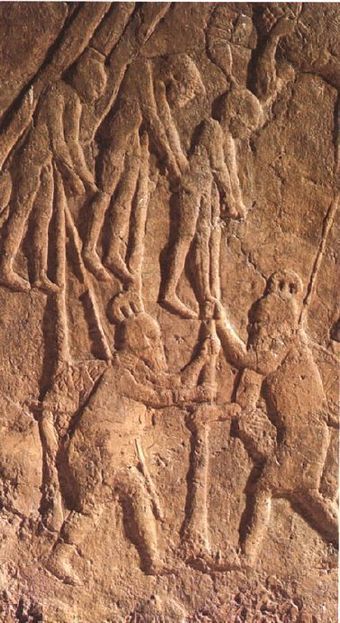
Incidentally, the traditional form of execution of traitors in the Persian Empire was not the gallows, as it is usually understood from the conventional translations, but “impalement”. This terrible form of execution consisted in piercing the body with a sharp stick, and leaving the victim to bleed to death (see THIS). This horrible form of torture/ execution was practiced by the Assyrians and later adopted by the Persians. A few reliefs have been found that illustrate this execution

This illustration shows the impalement of Jews from Lakhish ז”ל, who were executed by Sanherib, King of Assyria, in 701 BCE.  

Apparently Bigtana and Teresh were also executed in this way. Haman wanted to execute Mordekhai in this way. The kind of execution and the unusual height of the pole — the height of an eight or nine story building— are an additional evidence that Haman’s plan was to accuse Mordekhai of high treason. Keeping in mind that the Empire wanted the execution of the traitors to be as public as possible, so that nobody would dare to act against the King.
In the end, as we read in Megillat Ester, venahafokh hu, everything turned upside down for the enemies of Israel. Haman was subjected to the same horrible execution he wished for Mordekhai, in the same pole that he prepared for Mordekhai. And the evidence of Haman’s treason? Ahashverosh (falsely? mistakenly? childishly?) accused Haman of “courting his wife”, Queen Ester. And that’s high treason; punishable by impalement

בור כרה ויחפרהו, ויפול בשחת יפעל


ESTHER 3:8. When All Jews Were Persian

The book of Esther (Megillat Esther) records one of the most dramatic moments in the history of the Jewish people. When Haman, the powerful prime minister of the Persian Empire of Ahashverosh (ca. 485 BCE), issued a royal decree to murder all the Jews of the Empire.
 
These events –what led Haman to plan the elimination of the Jewish people, the Providential way in which Queen Esther foiled his plans, and the happy ending of this story– are registered in Megillat Esther. Besides being a very accurate historical document, the Book of Esther could also be classified as a book of “musar” (= Jewish behavioral psychology) since it generously describes the mental and psychological profiles of its main characters, particularly the dysfunctional personality of the main villain of the Megilla, Haman.
 
But before discussing all these fascinating aspects of the Megilla we should have some idea of the historical background of the events of Purim.
 
After leaving Egypt, the Yehudim lived for about 800 years as a sovereign people in the land of Israel. In the year 586 BCE Nebukhadnezzar, the emperor of Babylon, conquered Jerusalem. Hundreds of thousands of Jews died of starvation, or diseases, or were killed. The Bet haMiqdash was destroyed and about 70,000 Jews were taken captives to Babylon.
 
In 539 BCE, Cyrus (in Hebrew “Koresh”) defeated and conquered the Babylonian Empire and proclaimed himself as the first emperor of the Persian empire.
 
In 538 BCE, a great miracle happened: the Persian Emperor invited the Jewish people to return to Israel and rebuild the Bet haMiqdash. This great event is recorded in the last words of the Tanakh, the Hebrew Bible. (See below)
 
Thousands of Jews returned to Jerusalem led by Zerubabel and in 516 BCE, 70 years after the exile, as Yirmiyahu had prophesied, the construction of the second Bet haMiqdash began.
 
Over time the Jewish population of Israel continued to grow, and in the days of Purim, about the first half of the V century BCE no less than 50,000 Jews lived in Israel.
 
But not all Jews resided in Israel. As unfortunately happens today, although all Jews were able to live in Israel, most Jews still lived outside Israel.
 
We will try to understand now how and why so many Yehudim lived in that voluntary exile.
 
The Persian Empire was the largest empire that existed in the history of mankind (some say that the Mongol empire, in the 25 years of Genghis Khan ruling, surpassed in extension the Persian) and that gave the Jews the opportunity to establish an international trade network which proved to be very successful.
 
There are documents and evidences that Jews were scattered in all corners of the Persian Empire, which reached what today is the border between India and China. In Persia, they were legal citizens, free to trade. They took advantage of the fact that the terrestrial trade routes were protected by order of the Persian emperor and set up a network dedicated to the exchange trade between Indochina and the West. Jews traded spices and also used the incipient “Silk Road”, also protected by imperial guards. They imported silk and gold from China and exported to China spices, dyes, jade, lapis-lazuli, and glass. There is a book, unfortunately unknown but fascinating, which describes in detail all the commercial enterprises Jews were engaged at the time of the Persian empire. It’s called “The Eighth Day”, by Samuel Kurinsky.
 
The fact that Jews were, as confirmed by Haman (M. Esther 3:8) “scattered among all the nations of the Persian empire” greatly facilitated this type of international trade. And it also allowed the Yehudim to establish a new industry, in which they also excelled: the credit industry. A promissory note (probably written in Hebrew) by a Jew from Turkey, could be cashed in India, when presented to another Jew living there. There are important archaeological evidences about this, among them, the records of a Jewish family of “bankers” of that time, Murashu family (see here ).
 
All this data is important to understand two things:
 
1. That the Jews lived scattered throughout the Persian Empire.  And that actually ALL the Yehudim of the world, including those in Israel,  lived within the Persian Empire.
 
2. Given the success of their businesses, the Yehudim did not think at that moment to return to Israel. Although it is important to clarify that Jews permanently supported financially the Jews in Israel,  sending generous donations to the Bet haMiqdash and to the Yehudim who resided there.


Dates in Megillat Esther

 מתוך התוכן : 

  •  בשנת 3 לאחשורוש

  •   במשך 180 יום משתה לשרים ולפקידי המלכות  ולאנשי הצבא  

  •   במשך 7 ימים

  • משתה לכל תושבי שושן הבירה .

  • בשנת 7 לאחשורוש

  • חודש טבת: אסתר נלקחה אל המלך שלא ברצונה  ונתמנתה  למלכה.

  • בשנת 12 לאחשורוש

  • ראשית ניסן: המן מכין תוכנית השמדה של היהודים והפור לקביעת  מועד – י”ג באדר.

  •   י”ז בניסן

  • חוק ההשמדה נתאשר ונתפרסם .

  • י”ד -ט”ז בניסן

  • תענית אסתר ומרדכי ויהודי שושן.

  • ט”ז בניסן

  • משתה אסתר עם המלך והמן.המן הכין את העץ.

  • י”ז בניסן 


  • בלילה נדדה שנת המלך.

  • מרדכי עלה לגדולה.

  • המשתה השני של אסתר.

  • מפלת המן  ותלייתו .


  • כ”ג בסיוון

  • חוק התגוננות היהודים נתפרסם.

  • י”ג באדר 

  • היהודים במדינת פרס התגוננו בגבורה מפני אויביהם בדיוק  ביום  שהיה מיועד  להשמדתם.   תוצאות הפעולות: כך היה “ונהפוך הוא” .

  • י”ד באדר 


  • במדינות פרס חגיגת הניצחון ליהודים.

  • בשושן הבירה נמשכו פעולות ההגנה.

  •   300 הרוגים נוספים.

  • בני המן נתלו .


  • ט”ו באדר

  • בשושן הבירה חגיגת ניצחון

https://tora.us.fm/tnk1/ktuv/mgilot/70.html


ESTHER 4:3. 70 days of terror

The idea that characterizes Purim, and distinguishes Purim from other celebrations, is venahafokh hu, a phrase mentioned at the beginning of the ninth chapter of the book of Esther, that summarizes the final outcome of what happened in those days. venahafokh hu means, more or less than in the end “everything turned upside down”, in an unexpected positive way.
Unlike other occasions in which our existence as a people was threatened, in Purim we not only survived the threat of total extermination, but in the end we also liberated ourselves from those who sought our death.
In the next lines I will try to explain this in more detail.

THE DEATH SENTENCE

Purim happened in the year 474 BCE, 12th year of Ahashverosh. At that time the Jewish people was in a vulnerable situation. Why? Because all Jews lived under the same “political roof” and the death sentence decreed upon the Jews of the Persian Empire meant the extermination of all the Jewish people; the “final solution” with which every anti-Semite dreams.The strategy to assassinate every single Jew was to encourage the murderers to kill their Jewish neighbors and acquaintances assuring them that, according to the new law, the executors would suffer no consequence for those crimes, and in addition, the assets of the Jewish victims would be available for the executors. The Jews were forbidden to defend themselves. And the imperial army would be on the side of the perpetrators. All this is expressed directly or indirectly in the edict that Haman signed and sent on behalf of King Ahashverosh to every city throughout the Empire.The decree established that the genocide of the Jews, the mega execution of approximately 250,000 souls, would take place on the 13th of Adar of that year. The letters containing the royal edict were sent 11 months earlier, the 13th of Nisan.After Ester and Mordechai thwarted Haman’s sinister plan and he was executed, new official letters were sent announcing that the Jews could defend themselves against their enemies, and that they would count on with the backing of the imperial army. These letters were dispatched on Sivan 23, that is, 70 days after the first letters were sent.

WERE THE JEWS ABLE TO ESCAPE?

When you read the Meguilla seriously, you have to make a huge effort to visualize what the Yehudim must have suffered during those 70 days of terror. The Midrashim tell us that many Gentile neighbors were showing their sharp knives to the horrified Jewish mothers, telling them that with those weapons they would kill their little children. The Midrash also explains that the perpetrators celebrated in advance the massacre, and distributing their possessions.
Referring to the seemingly inexplicable urgency of Mordechai to overturn Haman’s decree, despite the fact that it would have taken nine months for its implementation, Rabbi Yom Tob Tsahalon (1559-1619) explains in his book leqah tob that the Jews were probably “detained” or “enslaved” (משועבדים), with the collaboration of the imperial army, to prevent them from escaping with their possessions, or saving their lives, before the 13th of Adar.
Thinking of Europe 1940-1945 it is not difficult to imagine “forced labor camps” where thousands of Jews were imprisoned, awaiting the day of their execution. The Yehudim were not able to do anything to defend themselves. They prayed, fasted and waited for a miracle, which ultimately happened.
Following this idea of ​​rabbi Tsahalon, we can suppose that with the arrival of the second letter in which the previous edict was reversed, the Jewish prisoners were released, and the perpetrators were deprived of their freedom, waiting for their execution on the day 13 of Adar.

WHO WERE THE ENEMIES OF THE JEWS?

It is quite possible that the enemies of the Jews were “opportunists,” ordinary people who responded to Haman’s invitation to “kill a Jew and keep his assets.” During Second World War, something similar happened with ordinary citizens of Poland, Ukraine, Hungary, etc. who betrayed their Jewish neighbors, knowing that they will be killed, to keep their houses and possessions …
In his book Eshkol haKofer, Rabbi Abraham Saba (1440-1508) suggests a different theory. The Persian Empire had an approximate population of 50,000,000 people. Almost half the population of the entire planet at that time (Wikipedia). The gigantic empire included 127 provinces with thousands of different civilizations, peoples and tribes. Rabbi Saba says that to exterminate the Jews, Haman recruited his own people, the Agaguites, the ethnic descendants of Amaleq. These first “anti-Semites” believed, like the modern Nazis, that their existential mission is to destroy the Jewish people. The Agaguitas became the executing arm of their highest representative: Haman. Rabbi Saba explains that once Haman was executed for treason to the king, all those who collaborated with Haman suffered the same fate as Haman, that is: execution by order of the King, since they were considered accomplices in the crime of “high treason”.

Venahafokh hu “and at the end, things turned upside down” means that in Purim not only did we miraculously save ourselves from a certain death, but we also freed ourselves from those who sought to destroy us. The number of criminals executed on the 13th and 14th of Adar of 474 BCE, 75,800, gives us a rough idea of ​​the magnitude of the Jewish genocide that was providentially prevented.


ESTHER 5:4: Black Knight Down

אם על המלך טוב יבוא המלך והמן היום אל המשתה אשר עשיתי לו
Esther 5:4

Last time, we explained that Queen Esther risked her life by entering the area of ​​maximum security of the King —a crime that was punished by execution on the spot. However, providentially, when the King saw her, “she found grace in his eyes” and he spared her life. 

Now, we have assumed that as soon as Esther gets the King’s attention, she would inform the King about the genocidal plan of the wicked Haman, and beg for mercy for her people. But surprisingly Esther did not ask for any of that…. When the King saw Esther he asked: “What’s the matter with you, queen Esther? What is that you want? “ This question coming from the King must be understood with drama. “Esther, I see that you risked your life to get my attention. I’m sure that whatever you want to ask from me must be very important to you. What is that you want Esther?”
Esther’s answer was absolutely unexpected for the king: “If it pleases the King… let the king, and Haman come today [tonight] to the banquet that I have prepared for him.”

The King must have wondered why Esther would risk her life for a dinner, and particularly, why would she risk her life to have Haman present at the dinner.… This must have bothered the King a lot. Why? Imagine how ridiculous (and suspicious!) It would sound if the wife or Mr. A says to her husband: “I want you to take me to dinner tonight … and bring with you Mr. B”. Why would and wife, and particularly Esther that had not seen her husband in a month, invite a third party to a dinner?

With the sophistication of a chess-master the Queen planted in the head of the King the seeds of suspicion and jealousy towards his most trusted man. Rabbi Moshe Almosnino explains that this point was subtly mentioned in the Megilla. When Queen Esther invited the King to the first banquet she said: “Let the King, and Haman come …to the banquet that I have prepared for him”.  The words “for him” could be interpreted as referring to Haman! In other words, it is as if the Queen wanted the King to think that she risked his life to ask the King to attend a banquet that she would do … for Haman!”  The King must have though that something did not make sense! And that Haman must be planning something against him!

Rashi, following the opinion of Ribbi Yehoshua ben Qorha, explained that Esther’s intention was to eventually sacrifice her life. She was sure that at the moment that Ahashverosh would suspect the existence of some kind of connection between Esther and Haman, he would execute the two of them.

Be that as it may, Esther’s strategy consisted in awaking in the King feelings of “jealousy and suspicion” toward Haman, instead of presenting her request directly to the King. Why? Because Esther knew that she had only one chance to convince the King. And she reasoned that if she simply informed the King about the edict and asked for compassion, this King, famous for his chauvinism, could have told Esther that it was not her place to interfere in matters of state, or in the best case scenario, that he would discuss the issue with Haman, and then, Esther will not have a second chance to avoid the genocide of the entire Jewish nation. 

Esther then decided that the best move would be to make from this issue a “personal matter”. Making the King think that there was some kind of common interest between her and Haman. The Queen knew of the extreme narcissism of the King (chapter 1), she also knew that this King saw women as his possessions (chapter 2), and she correctly calculated that it would not be difficult to arouse the jealousy of such a man. And although the plan did not go exactly as Esther planned (it actually worked out better) we see that Esther was very right. In the end, at the culminating moment of the second banquet, when King Ahashverosh reacts to the news of Haman’s plan, he did not make his decision to execute Haman based on political considerations.

The King sentenced Haman to death because Haman “knelt in front of Esther’s bed to beg for mercy.” And when the King saw Haman so close to Esther, he reacted with jealousy and said: “And now, what else do you want? Conquering the Queen right under my nose? “

Those were the last words that Haman, the Black Night, heard from King Ahashverosh. 

Checkmate! 


ESTHER 9:26. What does “Purim” mean?

על כן קראו לימים האלה פורים על שם הפור

When Haman decided to eliminate the Jewish people, he “casted lots” to determine what day would be designated to carry out his evil plan.

This is how the text of the Megilla describes this event:
“In the twelfth year of King Ahashverosh, in the first month, the month of Nisan, the pur (that is, the lot) was cast in the presence of Haman to select a day and month. And the lot fell on the twelfth month, the month of Adar.

The Persian custom is to celebrate the beginning of spring, Nouruz, which marks the new year. The first month of the Persian and Babylonian year was the month of Nisan, towards the end of March. Historians report that on the sixth day of that month the coronation of the king (or Emperor) was formally renewed as well as the king’s oath of loyalty to his people. On the ninth day of Nisan, the Persians continued their festivities by exhibiting statues and idols of pagan deities and celebrated with drinks, dances, etc.Then, starting on the 10th of Nisan, the citizens consulted wizards and astrologers about their resolutions for the new year. The key point was to determine which days in the coming year were auspicious for weddings, doing business, starting new ventures, etc. The magicians threw small stones, “purim” at random which revealed the fate of the days of the coming year. Once the times were determined, they claimed that nothing could change it …
With this interesting historical information in mind we can better understand the details of what happened with Haman.

הוא חודש ניסן

The evil minister Haman wanted to make sure that his genocidal project would be carried out successfully; and for that there was nothing better than having the advice of the astrologers, חכמים יודעי העתים, the most qualified men in the empire to determine what was the best day for their plans to succeed. In the month of Nisan, in the twelfth year of King Ahashverosh’s reign, 474 BCE, the magicians “cast the lots in front of (= for) Haman, who sought to carry out his plan that same year, and the date of the genocide was set on the eleventh month, Adar.”

הפיל פור

Purim is the plural of “pur”. There are those who say that pur is a Persian word, which indicates a kind of container where the lots were drawn. “Pur” can also mean in Hebrew a small stone. When a rock breaks into pebbles, or when a bread crumbles into crumbs, the Hebrew verb “p / r / r” (לפורר, פרורים etc.) is used. These small stones were thrown (להפיל) at random— falling on one of their sides, like dice, or on a special place, similar to a roulette -to indicate what the fortune-tellers would reveal to their clients. This routine, as well as other similar practices such as the famous oracles, were very common among the Pagans. They were associated with practices of idolatry (divination, cleromancy, etc.) which our Torah obviously forbids.

הוא הגורל

The Megila mentions that “these little stones” were used as a kind of lottery, or “goral”. The Tora mentions and approves of the use of draw to resolve or prevent conflicts; The allocation of land in Israel was established by this type of “goral”. See https://halakhaoftheday.org/2018/08/22/yona-16-7-who-loaded-the-dice/
This is similar to a draw in which the parties agree to abide to the result, as a way to solve, decide or assign. (something similar is done in sport events when a coin is flipped to decide which of the two teams will start the game, etc.)

PURIM and YONA

The mention of the “goral” in Megilat Ester reminds us of what happened to the prophet Yona. When Yona tried to escape from his Divine mission by fleeing Israel on a ship, and HaShem caused an unusual storm that threatened to destroy the ship, the sailors decided to “cast lots” so that the stones would reveal who was to blame. When we studied that text, I explained that although it is forbidden to assume divine intervention, and or read a Divine message in a matter that is left to chance, on that specific occasion, God intervened so that “the lots would assign the blame on Yona” and so the prophet would resume his important mission. It is very possible then that by connecting “Pur” or Purim with the “goral” the Megila subtly alludes to the event of Yonah, indicating that in the lots of Purim we should also see the Divine intervention.

THE LATEST POSSIBLE TIME

Rabbi Eben Ezra explains that the Divine intervention determined that furthest month from Nisan, the last month of the year, would be chosen, so that the Jews would have the opportunity to repent of their wrong deeds —since they had assimilated and turned away from the Tora — to deserve to be saved.In the end, the genocidal plan of Haman was thwarted, and that same day, the 13th of Adar, which was designated “by casting lots” as a bad day for the Jews, became a day of salvation in which the Yehudim managed to get rid of the enemies that were looking for our destruction.
In this way, the name of the festival, “Purim”, reminds us that it is not the little stones, dices, luck or chance what determines the destiny of the people of Israel, but our behavior, and the Divine Providence.


ESTHER 2:16 The Four Missing Years in The Megila

וַתִּלָּקַח אֶסְתֵּר אֶל-הַמֶּלֶךְ אֲחַשְׁוֵרוֹשׁ, אֶל-בֵּית מַלְכוּתוֹ, בַּחֹדֶשׁ הָעֲשִׂירִי, הוּא-חֹדֶשׁ טֵבֵת–בִּשְׁנַת-שֶׁבַע, לְמַלְכוּתוֹ

The first words of the book of Esther mentions a date: The third year of Ahashverosh. “And it happened in the days of Ahashverosh, the one who reigned from India to Ethiopia, a total of 127 provinces, in the third year of his reign, the king made a feast to [entertain] all his ministers and subjects, the armies of Persia and Media, the governors and the leaders of the provinces, for 180 days … “

This party was followed by another more modest celebration of only seven days, to which all the people of Shushan were invited. It was in this second celebration, during the last day of festivities, that Ahashverosh got drunk and sent for his wife Vashti to show off her beauty. Vashti refused to obey the king’s order, and then, according to the provisions of the rigid Persian law, the king had to order her dethronement (and possibly her execution).

The next time-reference is found in the second chapter. The subjects of the king organize the search for the next queen, and bring, in some cases by force, all the young and pretty girls of the empire, for the king to select one of them as his consort. On that occasion, Esther, a young Jewish woman, orphan of father and mother, was chosen by the king. The text indicates the new date when it describes the coronation of Esther: “On the tenth month, Tebet, of the seventh year of the reign of Ahashverosh.

Unlike what happens with other Biblical books, the book of Esther can be confronted to numerous contemporary non-Jewish historical sources, that not only confirm the historical accuracy of Megillat Esther but also help us to understand some apparent “loopholes” in the text.

From the third year the Megillah jumps to the seventh year. Why? What happened during those 4 lost years?

Let’s see.

First of all we must remember the identity of Ahashverosh. And for that, nobody better than the Jews of Iran, direct descendants of the protagonists of the Purim story. Persian Jews identify King Ahashverosh with “Khashayarsha”, the fourth Persian emperor. Known in English as “Xerxes”, or Ahasuerus, who reigned between the years 486-465 before the common era.

Ahashverosh is famous in world history for having organized, directed and led in person the largest military expedition in the history of mankind, trying to defeat Greece and thus expand the Persian Empire to the rest of Europe.

The Greek historian Herodotus (484-425, BC, considered the father of modern history) begins his detailed historical accounts with Ahashverosh and his attempted invasion of Greece. He says that the Persian emperor prepared an army of five million souls. To be more precise: 5,283,220 men, between soldiers and auxiliaries of soldiers. Apart from a fleet of 1,207 ships, which accompanied the army from the coast.

How long did that war last?

According to Herodotus, 4 years! Including the intense preparations for an invasion of such magnitude, for example the colossal construction of two floating bridges in the Bosphorus Strait. See here .

Even though Ahashverosh conquered and reduced Athens to ashes, his invasion of Greece failed miserably. Ahashverosh fell into a trap set by the Greek general Themistocles, tempting him to enter with his ships in the Strait of Salamis. There, Ahashverosh lost about 500 ships, and decided then to retire and return, defeated, to Persia.

Since then Ahashverosh gave up his conquest of Greece and instead dedicated himself to supervise pharaonic constructions and endless extensions of his palace.

Now we can better understand several things mentioned in Megillat Esther.

1. That the book of Esther, with exquisite historical precision, does not mention those four years (that is, from 483 to 479 BCE) since Ahashverosh was not in the palace but overseas, training, building  and  fighting (also remember that “officially” the emperor is the main protagonist of Megillat Esther).

2. It is probable that the first “party” mentioned was not a party but an intense “strategic gathering” where the emperor summoned the armies, from all corners of the empire, to prepare his ambitious military campaign. Herodotus relates that in the army of Ahashverosh there were soldiers from 46 nations (including Yehudim). In the picture above, you can see a Persian relief showing the ethnic variety of the soldiers of Ahashverosh. The most important evidence that shows that this party was not a normal celebration is that the guests were mainly the armies of Persia and Media (חיל פרס ומדי). Also, it is striking that the text does not describe the sumptuous details of this “party”, as it does with the next celebration, where the decorations, the alcoholic beverage, the luxurious utensils that were used to serve and drink the wine are mentioned, etc.

3. It is possible that in this case “party” is a euphemism for a “gathering”. We explained last time that Esther’s text seems to have been written with local sensitivities in mind. It is not surprising then, that the Megilla would not mention (or risk to remind the Persian rulers) the preparation of the military expedition that failed and that everyone preferred to forget …


ESTHER 1:4. King Achashverosh and King Solomon

אחשורוש … בא לישב על כסא שלמה ולא הניחוהו
The first thing that the book of Esther reports is about a party (mishte) that King Ahashverosh offered to entertain all the rulers, the ministers and the subjects (‘abadav) of his 127 provinces Empire. This feast was celebrated in the third year of his Kingdom , once Ahashverosh finished quelling all the rebellions against him and felt established on his throne.
After the Megilla gives us the technical details of this feast (Chapter 1: 1-3) it explains the purpose of the big celebration (1: 4): Ahashverosh wanted to “show off his wealth and the honor [or glory] of his Kingdom (‘osher kebod malkhuto) in front of all his guests.
On the last day of the party, the King gets drunk and sends for his wife Vashti to appear before the men. The Megilla delicately and euphemistically explains why Ahashverosh called Vashti. “To show off her beauty in front of the people and the nobles, as she was beautiful “. Vashti refused to fulfill the order of the King, and at this point begins the plot that will conclude not only with the dethronement of Vashti, but also with the humiliation of King Ahashverosh, due to his impulsiveness, and his lack of wisdom.
Last week we explained that the book of Esther contains two parallel narrations: the official version, Persian friendly; and the hidden version, the Jewish narrative, which conveys the Jewish point of view on the events narrated in the common text. We also said that to “discover” this second text we must find the key words that direct our attention to similar contexts ion the Tanakh that deepen our understanding of what the Megilla superficially says.
The book Meguilat Setarim, by Bar Ilan Bible professor Yonatan Grossman, explains that in this text the text very subtly compares Ahashverosh with King Solomon.
Let’s see. The book Melakhim Alef (Kings I) writes that during the third year of his Kingdom (2:39), once king Solomon exacted justice from the last of his father’s enemies, Shim’i ben Guera, and he felt safe in his throne (2:46), the King held a party (mishte) and invited all his subjects (‘abadav, 3:15). So far everything looks the same. Except for the meaning of two similar words: “עושר וכבוד”, wealth and glory. On this point King Ahashverosh and King Solomon are at two different extremes.
When King Solomon was about to occupy his throne he had a dream. And in that dream HaShem offered to fulfill any of his wishes. Solomon, who could have opted to have wealth or fame, asked God to grant him “wisdom”, an intelligent heart to guide his people with righteousness and justice. God granted Solomon wisdom, and as we know, King Solomon became for the Jewish people the wisest man that ever existed. The biblical text also records that God appreciated what King Solomon did NOT ask for, and rewarded him with it (3:12): “Also what you did NOT ask of me, I will grant you: wealth and honor.”
Now we can close the circle. The author of the Megilla assumes that we will identify those two words “wealth and honor”, and connect the dots between Ahashverosh and King Solomon.
1. Ahashverosh held a party to celebrate his wealth and honor. Solomon, to celebrate his God-given wisdom.
2. The honor of Ahashverosh depended on his subjects noticing his wealth, and praising him for that. This is why he so desperately needed to show off his riches, his trophy wife, etc. For the Jewish King, on the other hand,  wealth and glory were dispensable. He did not care about his own image. Solomon wanted wisdom for the benefit of his subjects.
3. At the end of the party, Ahashverosh gets drunk, makes some grotesque mistakes and ends up making a fool of himself, in front of his entire empire. His wealth and glory did not help to enhance his image because he lacked wisdom.  King Solomon, on the other hand, asked for wisdom, and God, in the end, also grants him wealth and honor.
We see now how the author of Esher subtly tells us what he thinks of Ahashverosh, by directing our minds to King Solomon story. Our Sages noticed all this and said with few but very significant words, that Ahashverosh wanted to sit on the throne of King Solomon, but he never succeeded to do so (Esther Rabba 1:11).


ESTHER 9:20: One Book and Two Stories

“ויכתב מרדכי – היא המגילה הזאת כמות שהיא”

We still have some time before Purim, and especially this year, 5779, that we have two months of Adar, and Purim is celebrated in the second. This year Purim falls on March 20 and 21.
But although it is still long before Purim I would like to start writing about Purim. More specifically about the book of Esther (Megillat Esther). I am fascinated by this book, because it has some unique elements. It was not written like virtually all the other books of the Tanakh, in the land of Israel, under a Jewish government, but as it explicitly says in the text, it was written in Shushan, the capital of the Persian Empire.
This text, although written in Hebrew, was not a private text “for Jews only”. It was “published” and sent to the Jewish communities of all the provinces of the Persian Empire. Therefore, the book had to be known also by non-Jews. Including Persian government officials. And for that reason we must assume that the text was written taking into account the imperial sensitivities and avoiding to offend the Persian ruler and Persian laws and traditions. When this simple point is taken into account we can better understand some particular aspects of this book.Two examples:
1. The preferential treatment of King Ahashverosh. On the surface, it seems that the main protagonist of the Purim story is King Ahashverosh. The book begins and ends with his praises. And his name, Ahashverosh, or more commonly “The King”, is the name that most appears in the Megilla. The text not only treats the King with utmost respect and honor. His actions, his character, his decisions, are never criticized; something very uncommon in the Bible, that always mentions the faults of its heroes, so that we learn to avoid the same mistakes. And Ahashverosh did not lack defects. He was weak in character, and could not make one decision for himself. He made grotesque political mistakes. He was ostentatious and insatiable. Addicted to alcohol, women and parties. But in the text there is no explicit criticism of the King. The monarch is not blamed for any of the entanglements that he provoked. On the surface, the King is presented as a hero, who was carried away by the bad advice of the wicked Haman. And at the last moment had the wisdom to reverse his wrong decree and do justice. All this diplomatic effort is better understood if we assume that the author of Megillat Esther knew that this book will reach the hands of the officers of the emperor, or the enemies of the Jews. 
2. The next element that sets Megillat Esther apart from all the other books of the Hebrew Bible (Tanakh) is that the name of God is NOT mentioned. How is it possible that the miraculous salvation of the Jewish people has not been explicitly attributed, as it always is, to Divine intervention? Identifying God behind the story, especially a miraculous salvation of the entire Jewish nation, is the unambiguous essence of the Torah! Moreover: if we look closely at the text we will see that not only God’s name is absent. In fact, no miracle, no ritual or religious act, Jewish or Persian, is explicitly mentioned. Example: when Esther is about to risk her life and she asked all the Jews of Shushan to gather for her, she asks them to “fast”! And the expected, normal, natural action and verb “to pray”, is conspicuously absent! It is as if the book of Esther had been written on a “secular” level, rather than on a Jewish level, avoiding very carefully to crossing the limits of what is called today, “the separation between church and state …”
All these mysteries, I think, are resolved if we assume that the book of Esther was written taking into account the sensitivity, and possible censorship, of the King, and for that same reason the religious aspects, which are the “Jewish nationals” elements of the story, could not be mentioned explicitly.
Only once we understand these points we can move on to the next level.
3. The book of Esther has two narratives, a Persian, and a Jewish one. The Persian version is “the official story”. The one that is read superficially. The Jewish version is what the author really wants to convey. It is subliminal. You have to read between the lines. The text is full of allusions to other biblical events, easily recognizable by a reader who knows the Bible fairly well. And when the reader identifies these “allusions” the words of Megillat Esther become like hyperlinks, and a secular Persian story converts into a sacred Biblical text. This Jewish subtext shows us among other things, the sacrifice of Esther and the courage of Mordecai. It reveals with no censorship the vanity and the materialism of Ahashverosh, so that we learn to move away from those vices. And above all, it helps us to un-cover the Providential Divine Intervention, the main message of this, and of every Biblical book.
To be continue