The Pharaoh Of Gaza
EGYPT
One of the best-known themes in the story of the Exodus from Egypt is that of the ten plagues with which the Creator struck Egypt. They were devastating plagues, to the point that some Egyptologists, such as David Rohl, suggest that the invasion of the Hyksos, who took over Egypt for more than 150 years, was a direct consequence of this devastation that left the mighty Egyptians weakened, both militarily as well as economically.
But how could Egypt allow that to happen? How can we explain that Pharaoh systematically refused to free the Jewish slaves and thus caused his own destruction? As we all know, Moses, in the name of the God of the Hebrews, says over and over again to Pharaoh: “If you do not let the Israelites leave, you will suffer the consequences. But if you free my people. There will be no more plagues. The ‘ceasefire’ is 100% in your hands.”
Pharaoh’s refusal to free the Israelites seems inexplicable. First of all, he shows that he doesn’t care about his civilians or those citizens he supposedly should protect. There is a dramatic scene that illustrates this situation. The text is in Shemot (Exodus 10:7-8). When Pharaoh’s servants reproach their boss: “How long will you continue to bring about our downfall (“lanu” refers to the Egyptian citizens). Let these people—the Jews—out before we realize that Egypt is completely destroyed.”
I repeat: Pharaoh only had to do one thing to prevent the destruction of Egypt: free the Israelites. If he let him go, the plagues would come to an end.
The million-dollar question is why Pharaoh acted in that irrational way, causing the destruction and ruin of Egypt.
The pharaohs only cared about their honor, reputation and especially staying in power. And this entire power apparatus would collapse if it showed weakness. Pharaoh only relented in the last plague when the issue affected him personally: when he lost his firstborn and felt that his own life was in danger.
From the biblical point of view, Pharaoh’s stubbornness was the product of divine intervention. Maimonides explains that there was a combination of both factors: the Pharaoh’s initial stubbornness, the result of his arrogance, had put him at a dead end; he had crossed the red line of his own will, and once there, the Creator, no longer allowed him to turn back.
God had told Moshe explicitly that he was going to harden Pharaoh’s heart to give Egypt its well-deserved punishment for having done so much harm to our people, and it would demonstrate who the true God is.
GAZA
The international press reports that more than 20,000 people have already died in Gaza. The cities are destroyed. The humanitarian situation is catastrophic: hunger, diseases, and devastation. The entire world demands a ceasefire. And the Israeli army is ready to suspend its offensive. Yes, really! All the Pharaoh of Gaza has to do is surrender and free the Israelis. Let them come out of his captivity. As Anthony Blinken said this week (see below), the solution to this conflict is 100% in Hamas’s hands. So why doesn’t the leader of the Palestinians free the Israelis held captive by him? Why does he continue to bring about the destruction of his cities and the ruin of the citizens he is supposed to protect?
The leaders of Gaza seem to act with the same arrogance as the Egyptian monarch and act towards his people with the same disregard for their lives that the Pharaoh had.
This insistence on preferring the destruction of Gaza and the loss of lives to “turn back and free the captive Israelis” has put them at a dead end. They have crossed the red line, and once there, the Mighty Hand (יד חזקה ) of HaShem’s army gives them a well-deserved punishment for the terrible massacre they have caused to our people.
Some political commentators are also surprised by the self-destructive irrationality of the Houthis in Yemen: why did they begin these maritime aggressions by provoking the United States and a coalition of European countries? Will the same happen with the pharaohs of Hezbollah, who, despite having so much to lose by provoking Israel – as has been demonstrated up to this point – do not stop their attacks? Could the Pharaohs of Yemen, Lebanon, and Tehran follow the same path as those of Gaza? Or could the invisible Mighty Hand of Heaven be hardening the hearts of the new Pharaohs to bring an epic victory to the State of Israel and reshape the Middle East, as Netanyahu anticipated?
As we watch these events unfolding day by day, I confess that to me, this confrontation between Israel and its bad neighbors looks more and more like “a biblical story.”
May God protect Medinat Israel.
May the Creator grant our heroic soldiers final victory.
May God grant our political leaders the wisdom, temperance, and courage to make the best possible decisions.
Rabbi Yosef Bitton
Who doesn’t want a ceasefire in Gaza?
Israel is facing a military operation that is essentially a rescue mission. Hamas has invaded Israel, violated, tortured, wounded, and massacred thousands of Israeli civilians, and currently holds over 100 Israelis hostage in Gaza.
One of Israel’s military objectives is the liberation of the kidnapped Israeli civilians and soldiers who have been taken as prisoners of war.
Israel has assured Hamas that if they release the hostages, there will be a ceasefire. Unofficially, one day of ceasefire for every ten hostages released.
Incredibly, it is HAMAS that does not want to release the kidnapped individuals! It is Hamas that has no interest in a ceasefire. However, it is Israel that is cynically pressured in all international forums to declare a ceasefire WITHOUT OBTAINING THE FREEDOM OF THE ISRAELI HOSTAGES.
Pressure should be placed where it belongs: on HAMAS.
I ❤️ ISRAEL: Bread and Jerusalem
One of the deepest spiritual experiences I have in Israel has to do ironically with food. More specifically, eating a meal with bread, something I usually don’t do during the week. This extraordinary spiritual experience comes at a price. In my case, it means gaining about 6 or 7 extra lbs in less than three weeks. But I believe it’s worth it…
Before eating, we Jews recite a blessing, or in Hebrew, “berakha”. This first blessing expresses recognition to God before enjoying the benefits of what He created. If we don’t recite this blessing before eating, we will consume what He created without asking for His permission. Then, after eating, we recite another blessing, this time to “give thanks”. The ultimate blessing of gratitude is the Birkat HaMazon, the only blessing, and prayer explicitly registered in the Tora, recited after eating a meal with bread.
Reciting the Birkat HaMazon in Israel holds great significance. Why?
Birkat HaMazon consists of three biblical blessings (plus one rabbinic). The first one refers to how the Creator takes care of and sustains His creations and provides us with food. Then comes the central blessing, which specifically focuses on thanking God “for the land of Israel and the food it produces” (על הארץ ועל המזון). Israel is described as a “generous” fertile land, the land that we Jews long for, and a land of extraordinary abundance (ארץ טובה חמדה ורחבה).
The third blessing focuses on Jerusalem, and the endless pleas and prayers to see His Holy City rebuilt. It concludes with a millennial (and for centuries, impossible) longing, “May God rebuild Jerusalem soon in our days,” that we may witness it.
Of course, one can go to a restaurant in Jerusalem, like Cafe Rimón or Noya Restaurant, and enjoy literally “the best food in the world”, then take a prayer book, recite the ritual blessing, and be done with it. But in doing only that, one misses the incredible “meaning” of eating in abundance in the land of Israel.
The difference between perceiving events in Israel as natural or supernatural lies in the mental ability to contextualize or the mental laziness of “normalizing”. If one does not contextualize, everything is taken for granted, the present is experienced as something normal, and the realization of living a miracle is missed. The rabbis denounced this spiritual myopia—which unfortunately does not affect only a few Jews—with the following words: “en ba’al hanes makir benisó,” “whoever lives a miracle resists seeing it as such.”
Contextualizing is what Tefila (Jewish prayer) aims to inspire in us. In the case of the Birkat HaMazon, it is this prayer that awakens in my heart the idea that what I have just eaten is a gift from the Creator. The ultimate intention of the Birkat HaMazon is to de-normalize the privilege of having food on the table. The Tora warns us about the danger of forgetting who provides the bread we have just eaten. Birkat HaMazon is the antidote against the danger of “forgetting God”.
There is something more.
When I am in Israel, the Birkat HaMazon transports me to an additional dimension. I think of the extraordinary (and perhaps undeserved) privilege I have as a Jew living in this generation. I think, for example, of the poverty that the land of Israel endured for so many centuries, how this land never yielded its fruits; it was a land of swamps, arid, dry, without water, and yellow from neglect. With thousands of miles of desolation and solitude, as Mark Twain described it in 1890. But exactly as the prophet Ezekiel prophesied 2,500 years ago, “once the children of this land returned to it,” Israel gradually became a paradise, a true Garden of Eden that bears fruit, and an extraordinary super-abundance which is evident in Israeli supermarkets, restaurants, and the eccentric flavors, colors, and aromas in the Mahane Yehuda Market on Friday afternoons.
“Contextualizing” is understanding that the reality of present-day Israel was unimaginable and infinitely better than what even the boldest of prophets could have foreseen. As our sages said, “The human eye is incapable of envisioning what only God can accomplish” (עין לא ראתה, א‘ זולתך).
I also think of the millions of Yehudim who recited this same text of Birkat HaMazon over the past 2,000 years. What did they think when mentioning the abundance of this land? How did they imagine it? I think of the unbearable poverty of Jerusalem described by Rabbi Obadiah of Bertinoro in his letters or the abuse and humiliation that the few Jews who lived here at that time had to endure. What did they think when they prayed—and dreamed—of a rebuilt Jerusalem? Could they have envisioned the Mamilla neighborhood, the tram that traverses the city, or the train that connects Jerusalem to the airport?
Albert Einstein said, “There are two ways to live your life: one is as though nothing is a miracle, the other is as though everything is a miracle.”
The first way is the result of “normalizing” our blessings.
The second is the essence of Jewish spirituality and the secret to falling in love with Israel.
I ❤️ ISRAEL: The Western Wall and Aladdin’s Lamp Syndrome
JERUSALEM, BEFORE SUNSET
For the past week, I have been in Bak’a, a beautiful neighborhood in Jerusalem. Last Shabbat, my wife and I decided to go to the Kotel, the Western Wall. It’s a long walk, a little over 45 minutes. Jerusalem can be very hot in the summer, but at that time, around 6:15 PM, it’s not as hot anymore. Moreover, as the sun sets, you can feel the cool breeze that immortalized the famous song “Yerushalayim shel Zahab,” the freshness of “the air of the mountains of Yehuda, with the scent of pure wine mixed with the fragrance of the pines, brought by the evening wind” of this magical city. I arrived at the Kotel and found a Minyan that had just started Mincha. I joined them, and once we finished, I took a white plastic chair and approached the Wall a little closer. There was no space. So I waited a few minutes, and as soon as a small corner became available, I hurried toward the stones. I touched them. I closed my eyes and surrendered to that intense moment of connection with our people, where the long Jewish history passes through the mind, from King David and his son King Solomon, who built the Bet Hamiqdash with these stones, to our heroic soldiers of Israel who recently regained back this Wall. But these stones mainly represent the Shekhina, the Divine Presence, which never left this Wall. And thus, inspired by the conviction of being as literally as possible “in front of God’s presence,” I began my prayer. Needless to say, prayers are very intimate. But today, I want to share the non-private part of my experience, which may be useful to someone else.
A STORY OF A GLASS
Until a few years ago, when I visited the Kotel, the first thing I used to do was ask God for my parents, z”l, for my wife, my children, for my grandchildren, my health, etc. Being in front of the Kotel is to encounter the Creator, “firsthand”. And instinctively, the first impulse, which drives the thousands of people who pray here every day, is to ask God for help, after all, He is able “to grant everything you need.” But some years ago —I believe it was after I understood that I survived cancer– I changed my plans. Sometimes, the difficulties we go through help us become more aware of the famous “half glass.” Like most of us, I realized my glass is much more full than empty… I became aware that instead of asking God for a million things I need, I should dedicate this first reunion to thanking Him for everything He has given me and continues to give me. This is also considered “praying.” In fact, and although I suspect that most notes placed in the Western Wall do not contain just the words “Thank You,” praising God and expressing gratitude is the true essence of Jewish prayer. Remember that the word “Jew” in Hebrew is “Yehudi,” derived from “Yehuda,” which comes from the word “todá” = thanks. That is to say, in Hebrew, “Jew” literally means “grateful,” the individual who remembers God primarily to give thanks!
It’s simply realizing “who owes whom.” And that’s when I started thinking about Aladdin’s Lamp Syndrome.
HASHEM AND THE GENIE
The most famous scene in the story of Aladdin is when the thief of Baghdad rubs the mysterious lamp and suddenly finds himself “firsthand” with a genie coming out from inside the lamp. In the beginning, Aladdin is afraid of this supernatural being that seems so powerful. But to his surprise —and fortune—the genie not only has no intention of harming Aladdin, but he offers to fulfill three of his wishes, “and he can grant you anything you want”! Now Aladdin has to decide “what” to ask the genie not to waste any of his wishes. I started thinking about this story, and it seemed to me that sometimes, without realizing it, we act before God, just as Aladdin acts with the genie. Especially when we come to the Kotel and meet God firsthand in our minds and heart, selfishly, we might focus just on our wishes. I realized that in The One Thousand Nights story, Aladdin rescued the genie from his horrible captivity, where he was trapped for centuries. The genie owes his freedom to Alaaddin. But unlike the genie, HaShem, our Creator, doesn’t owe us anything, absolutely nothing (when He listens to our Tefila, He does it out of love or Hesed, not out of duty or obligation). As we say mention in our prayers so many times every day, He liberated us from centuries of living in captivity and fast-forwarding 3500 years of history; it was He who helped us regain our State of Israel in 1948 and who delivered Jerusalem to us in 1967. It is we who owe Him!
WHO OWES WHOM?
That’s why I decided that when I return to Kotel, at least the first time around, I should forget about my particular needs and concentrate on everything I have that I’m grateful for. I recite then Nishmat Kol Hay. By the way, Jewish prayer fulfills its mission when we allow it to inspire us. And the prayer Nishmat Kol Hay is precisely formulated for this purpose: to open our eyes and help us become aware of everything we constantly receive from the Creator and usually take for granted. This Tefila has no expression of requests or pleas to God. It exclusively focuses on one theme: the infinite gratitude we owe to our Creator and our appreciation for everything He has done and continues to do for us constantly. When I finished Nishmat Kol Hai and while still possessed by its poetic influence, I began my prayer. First, I thanked HaShem for being alive and reaching this present “now and here” (Shehecheyanu). Then, I thanked HaShem for my wife and revisited the names of our children, their spouses, and our beloved grandchildren. And as I whispered their names, visualizing their faces, I said, “Thank God,” or in the improved Hebrew version: “BARUKH HASHEM.”
A part of the beautiful Tefila: Nishmat Kol Hay:
“… and even if our mouth were as full as the sea with songs, and our tongue was filled with music like the multitude of its waves, and our lips multiplied in praises like the expanse of the heavens, and our eyes shone with devotion like the sun and the moon, and our hands extended toward You like eagles opening their wings in the sky, and our feet were swift [to move toward You] like the deer, still, we could not thank You enough, HaShem our God and the God of our ancestors, and it would not be sufficient to properly acknowledge You for the thousands upon thousands and tens of thousands of miracles, favors, and wonders that You did for our ancestors and for us… You rescued us from Egypt, HaShem our God, and You liberated us from the house of captivity. In times of hunger, You fed us, and in abundance, You sustained us. You saved us from the sword of our enemies, You protected us from plagues, and You healed us from serious illnesses… Therefore, every organ that You bestowed upon us in our body and the soul that You breathed into us, and the tongue that You placed in our mouth, will thank You, bless You, praise You, glorify You, exalt You, honor You, and proclaim praises to Your Name: our King, our Creator…”
Leiluy Nishmat Ziva Tzvia Bat Evyatar z”l
ISRAEL 2023: Where can you find God?
“If you will follow My decrees and keep My commandments, and you shall perform them. And I will give your rains in their time, and the land will yield its produce, and the tree of the field will give its fruit. … and you shall eat your bread to satiety, and you shall dwell securely in your land. And I will give peace in the land, and you will lie down, and there will be no one to frighten [you].
Yesterday, thank God, I arrived in Israel. I recognize that with each visit, my emuná, my faith in HaShem, grows and strengthens. Not only because here I feel that Tefilot (prayers) reach directly to heaven but because I see our beloved Israel renewed, increasingly prosperous, and more beautiful. Exactly as anticipated by the Torah and our prophets. Of course, to appreciate the miracles of this country, they must be put into context.
IN THE MIDDLE OF THE MIDDLE EAST
Israel is located in the world’s most unstable and complex geopolitical context. Surrounded by countries with which it is at war, such as Lebanon and Syria, or with those with whom it maintains a tense relationship of diplomatic peace but cultural (and religious) hostility, such as Egypt and Jordan. In addition, it faces constant explicit threats from Iran, the contemporary version of Amalek, the enemy who hates Israel without any territorial conflicts in the middle (Israel and Iran do not share any border). Iran threatens to attack Israel and “wipe it off the map,” for which it is developing a special nuclear program. Israel is the only country in the world under this explicit threat.
SLEEPING WITH THE ENEMY
But that’s not all: within its borders, Israel faces a Palestinian population that is largely hostile and refuses to renounce terrorism. A population that, with the consent of the entire world, has not been educated to seek and negotiate peace but to hate Israel. They have absorbed the ideal of jihadist martyrdom in their homes and schools: “Sacrifice your life to kill a Jew: man, woman, child, or baby!”. Now, under these circumstances – with so many military threats, hostilities, and terrorism – any other country in the world would be in a state of permanent panic and completely paralyzed. Its economy would be in ruins. Its government would be focused on surviving. And the population would be afraid to go out on the street. This would be the norm, the expected, the statistical, in a country with these problems. But the Jewish people have always known how to be the exception to statistics. Israel, inexplicably in non-supernatural terms, defies all expectations.
Let’s look at some examples:
GROSS PRODUCT
The Gross Domestic Product (GDP) per capita indicates a country’s economic prosperity. Israel has shown steady growth since 2018. From $42,407 per year in 2018, it has increased to $52,171 in 2021, and the International Monetary Fund’s projection predicts that by 2023 the GDP per capita of Israel will reach $58,270. This would place Israel as the 13th most prosperous country in the world, far above Japan, Italy, Spain, and Germany.
ISRAEL’S ENERGY
In recent years, Israel’s progress is reflected in its energy industry. For decades, Israel was considered a country without natural resources. I remember a joke from many years ago that said that Moses had gotten the destination wrong, and that he should have gone to an oil-rich country like Saudi Arabia. However, in recent years, Israel is becoming a major country with gigantic offshore natural gas reserves. As Israel Katz, Israel’s Minister of Energy, said in June 2023, “Natural gas reserves have already changed the face of the local energy economy and turned the Israeli state into a global power in this field.” See also this: https://www.jns.org/israel-news/natural-gas/23/6/4/292488/
OPEC AND THE JEWS
Do you remember OPEC and the pressures from oil-exporting countries on the US and Europe to boycott Israel? Well, listen to this news that you probably don’t know yet: apart from having found gigantic reserves of natural gas, Israel has discovered oil deposits on its Mediterranean coast. In February 2023, the company “Energean” recently produced the first crude oil extraction from Israel, a historical milestone for the country. The extraction of crude oil from the Karish offshore field represents the first time in Israeli oil production that Israel now exports to international markets, as Energean revealed on Tuesday, February 14, 2023, that Israel has joined the club of oil exporters. Who would have thought? See this article https://www.spglobal.com/commodityinsights/en/market-insights/latest-news/oil/021423-israel-makes-first-ever-crude-oil-exports-as-karish-gas-giant-ramps-up
ISRAEL LEARNED TO DEFEND ITSELF
Israel’s military might is equally notable. As a result of so many wars and threats, and after experiencing international arms embargoes when it needed them most, Israel produces its own weapons, which are among the most sophisticated in the world. Israel specializes in everything that is missile defense, in air, land, and sea. Recently, Israel announced the final experimental stage of a new anti-missile defense system based on laser technology. This places Israel in a forefront position on how to face new supersonic missiles. Israel exports weapons to India and Azerbaijan, among others. And that’s not all. This is what journalist Herb Keinon wrote on June 16, 2023: “Israel sells its missile defense system to Germany…last week, Berlin preliminarily approved the purchase of the Arrow-3 missile defense system from Jerusalem for $4.3 billion. Such news would have been completely inconceivable 80 years ago…not long ago, the only thing Israel had to offer the world was Jaffa oranges, a revolutionary hair removal device called Epilady, and the Uzi machine gun. But today it provides missiles that shoot down other missiles in the stratosphere and software that drives industries, and exports natural gas and oil to European countries seeking to reduce their dependence on Russian oil.” See this: https://www.jpost.com/israel-news/article-746500
DEMOGRAPHIC GROWTH
Israel’s Jewish demography is becoming increasingly robust. In 2023, Israel is the Western democracy with the highest birth rate. With 3.13 births per woman, the Jewish birth rate in Israel surpasses the rate of 2.85 of the Arab population. Soon, very soon, the majority of the Jewish people will be here in Israel. This demographic dynamism fuels the economy, strengthens national security, and promotes a less timid foreign policy.
THE PURSUIT OF HAPPINESS
There is something else. A statistical data point that, unlike the aforementioned, can be seen on the street and perhaps represents the most miraculous statistic of all. Let me tell you. In 2012, the UN created a new international index that measures countries according to the degree of “happiness” of their population. With all the external and internal conflicts — Iran, Palestinian terrorism, Hamas, etc.— and due to the constant tension that this would normally produce, the average Israeli citizen should be the most worried, depressed, terrified, and unhappy person on the planet. However, Israel is among the happiest countries in the world! Israel competes in the same zone as the most “boring” countries: stable and with a total absence of war, like Finland, Denmark, and Iceland. In fact, in 2023, Israel is ranked incredibly as the fourth country with the happiest population in the world. Above Norway, Sweden, and the Netherlands. Can anyone explain this anomaly in rational or statistical terms? I don’t think so.
God promised our patriarchs that in the future, their descendants would inherit the land of Israel and enjoy all His blessings: fertility, prosperity, and peace. There is a Tefilá (prayer) that we say every night, “UFROS ALENU SUKAT SHELOMEKHA,” we ask the Boré Olam (Creator of the Universe) to extend over us his “protective cover” of peace, which I would like to interpret as mental tranquility, which is exactly the opposite of the fear that terrorism naturally causes. This “psychological peace” is a Divine blessing.
For all this, if anyone needed proof of the existence of God — the God who protected and blessed with prosperity and fertility Abraham, Isaac, and Jacob — let him or her come to this land and open his eyes to the miraculous Biblical reality that is lived here: Israel, in the midst of adversity, not only survives but also grows and thrives.
PS: I almost forgot… Israel also stands out in the “most important arena of international sports”: soccer :), achieving the honorable third place in the Under-20 World Cup of 2023!
What did Ezekiel see?
הִנֵּה אֲנִי פֹתֵחַ אֶת-קִבְרוֹתֵיכֶם וְהַעֲלֵיתִי אֶתְכֶם מִקִּבְרוֹתֵיכֶם עַמִּי; וְהֵבֵאתִי אֶתְכֶם, אֶל-אַדְמַת יִשְׂרָאֵל
יחזקאל ל”ז
This is a very symbolic week, a week that represents the transition between two completely opposite historical milestones that affected the Jewish people more than any other historical event. On the one hand, this past Tuesday we cried and mourned on Yom HaShoah, the Holocaust Remembrance Day. On the other hand, this coming Tuesday night, we will celebrate Yom ha’Atzmaut, the day of Independence of the State of Israel. Jews have suffered countless persecutions, massacres, and pogroms everywhere and at all times. However, we have never suffered as in the Shoah. Both in absolute and relative terms, there has never been such a devastating massacre as the Shoah. The Jewish people were never so close to being exterminated. At one point in 1944 or 1945, when the Nazis murdered half a million Hungarian Jews in just six months, when no one dared to oppose the Third Reich, or when Rommel was preparing the gas chambers in Tunisia to transport and gas there, the Jews of North Africa, Palestine, Syria, Iran, and Iraq. At such times we lost all our hopes. We felt we were doomed to die or we were already dead. We were buried. It was the end.
But then the greatest miracle, promised so long ago by our prophets, happened. In a span of just three years, which in the context of the history of our people is less than the blink of an eye, the Kibbuts Galuyot, the return to our land, began. HaShem took us out of our graves, lifted us, and brought us back to Israel. And from the ashes, we, the Jewish people, began to revive. More than 2500 years ago, Ezekiel (Yehezqel) had a very special prophetic vision (nebua). In this vision (Chapter 37), HaShem transported him to a valley. In that valley, there were bones. Many bones. Human bones. Probably millions of bones. Dry bones. There is nothing more dead than a dry bone. Ezekiel saw it and said nothing. And then HaShem told Ezekiel: “Son of man: Do you believe that these bones will ever come alive? And Ezekiel, in a combination of humility and surprise, replied: “HaShem, God, You would know that.”
And then, there was a deafening noise. The bones began to move, came together and formed skeletons. Veins and nerves covered the skeletons and, finally, flesh and skin. Now, they were no longer bones but bodies; dead human bodies, corpses. Then, HaShem said to Ezekiel, “Prophesy to these bodies to insufflate into them a breath of life, and let the spirit of life enter into these bodies and let them live again.” And so it was. A breath of life entered the bodies, and they stood up. It was a great army, very large. HaShem told the prophet Ezekiel, “Son of man, these bones are the house of Israel. They say, ‘Our bones dried up, we lost our hope, we have been sentenced to disappear.’ So, I prophesy and say to them [Israel]: Thus said HaShem, God: behold, I will open your graves, and I will raise up from your graves, and I will bring you to the land of Israel. And it will be known that I am HaShem when I open your graves and bring you from them, My people. I will grant you a spirit of life, and you will live again. And I will lead you into your land. And you will know that I am HaShem. I have promised, and I delivered.”
It is impossible not to connect this prophecy with 1945 and 1948. In 1945, we were doomed to disappear. We were dry bones or, perhaps worse: ashes. And then, when so many Goyim thought that we had disappeared, that we would never again become a people, that all those promising prophecies would never be fulfilled, the greatest miracle occurred, just like Ezekiel saw in the valley of the dry bones. HaShem opened our graves, lifted us, and brought us back to Israel. HaShem promised, and He delivered.
What did Zekharia see?
כֹּה אָמַר ה’ צְבָאוֹת: עֹד יֵשְׁבוּ זְקֵנִים וּזְקֵנוֹת בִּרְחֹבוֹת יְרוּשָׁלִָם, וְאִישׁ מִשְׁעַנְתּוֹ בְּיָדוֹ מֵרֹב יָמִים. וּרְחֹבוֹת הָעִיר יִמָּלְאוּ יְלָדִים וִילָדוֹת מְשַׂחֲקִים בִּרְחֹבֹתֶיהָ
זכריה ח’ 5-4
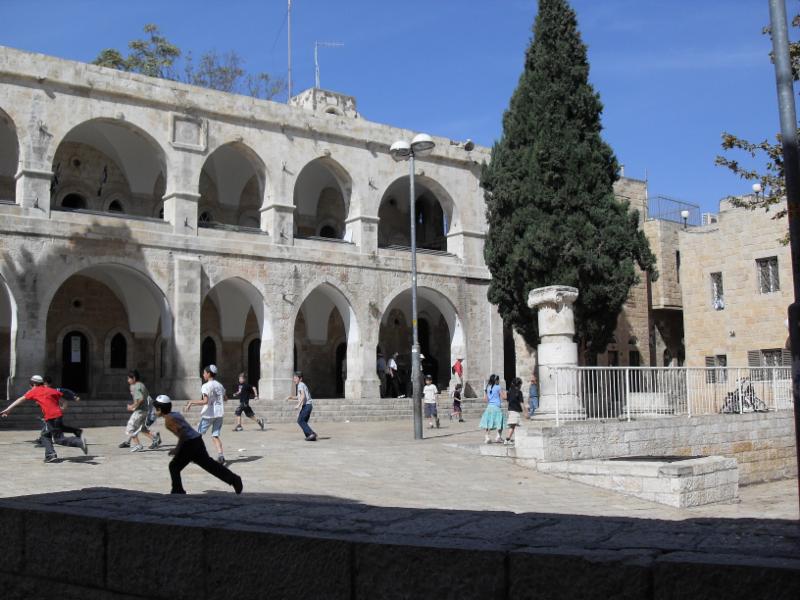
Look closely at this picture. Do you see anything special? Just children playing in a square. Right? Well, not so fast…
This is the Old City of Jerusalem. Some children are playing in a square (and a street) called Bate-Mahase. This is a very important place in the Old city. The two-story building with arches that you see was built in 1871 with funds provided by Baron Wolf Rothschild of Frankfurt to house poor families. The Rothschild family coat of arms is still at the top of the building. Today, it houses the offices of the Jewish Quarter Municipality. In this courtyard, you see a very familiar scene: children running and playing. This happens every day because there are two schools close to this courtyard: The No’am Talmud Tora and the Sylberstein Yeshiva.
What you don’t see in the picture is another familiar view: elders, old men, and women sitting on the benches of the square. Elders love the sight of children, and many times after school hours, grandparents would come to this square to play with their grandchildren.
There is something else in this place. Look at the following picture.
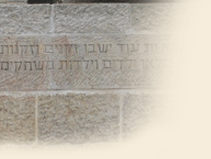
There is a scripture carved in stone. It’s a quote from the prophet Zekhariah, 8:4-5. Zekhariah was a child when the Jews lived in the Babylonian exile 2500 years ago. Without their own land and without the Bet HaMiqdash, the future of the Jewish people looked very grim. They were hopeless. In normal circumstances, Jews would have naturally integrated (assimilated) into the Babylonian population and disappeared. But a miracle happened. Cyrus, the Persian emperor, was moved by HaShem (as he explicitly declared) and encouraged the Jews to come back to Israel and rebuild Jerusalem. Although the majority of the Jews chose to remain in Babel (the first but not last “voluntary exile”), thousands came back.
Zekhariah was among them. They found a completely destroyed city. Everything was ruins, ashes, and desolation. There was not even a wall to protect the city, which made living in the city a mission impossible (imagine living in a house without one of its outside walls).
But from the midst of this desolation, Zekhariah had a prophetic vision, a very unlikely scenario to happen, given the terrible conditions of Yerushalayim in his days.
This prophecy, engraved on that stone, is in Chapter 8, verses 4-5:
כֹּה אָמַר ה’ צְבָאוֹת: עֹד יֵשְׁבוּ זְקֵנִים וּזְקֵנוֹת בִּרְחֹבוֹת יְרוּשָׁלִָם, וְאִישׁ מִשְׁעַנְתּוֹ בְּיָדוֹ מֵרֹב יָמִים. וּרְחֹבוֹת הָעִיר יִמָּלְאוּ יְלָדִים וִילָדוֹת מְשַׂחֲקִים בִּרְחֹבֹתֶיהָ (זכריה ח’ 5-4)
“And now, HaShem says: I will return to Mount Zion, and I will dwell in Yerushalayim…. And once again, old men and women will walk Jerusalem’s streets with their canes and will sit together in the city squares. And the streets of the city will be filled with boys and girls playing in it.”
Let us now see the whole picture: you are in Bate Mahase, reading this extraordinary verse engraved on the stone in front of you. On any given day, elders sit on a bench and children play in the street. Then you realize that you have the incredible merit of being a living witness to the fulfillment of Zekhariah’s prophetic words. You also understand that you are not just a witness of Zekhariah’s prophecy but rather the embodiment of that prophecy. You get the feeling that 2500 years ago, in his incredible vision, Zekhariah saw you.
My opinion on Israel and the end of democracy
SMOKE SCREEN?
Our beloved State of Israel is currently experiencing a deep crisis: weekly demonstrations against the government, media hysteria, and even threats of military desertion and civil war. This time, it is not an armed conflict with the enemy – though those never cease – but rather a civil protest from the opposition. The political mobilization has declared its goal to prevent “the end of democracy” in Israel. What is happening in Israel that poses such a danger to its democracy? The official story from the opposition is that the new Knesset, or Israeli Parliament, which took office a couple of months ago, is proposing a judicial reform that “will bring irreparable negative consequences to Israel in the short and long term.” Initially, I was concerned about these arguments, but then I applied some basic principles of Talmudic logic, which trained me to differentiate between empty slogans and solid facts. I realized that I have nothing to worry about regarding the future of democracy in Israel. So, what is this reform proposing? Listening to the opposition, one would think that there will be no more elections in Israel, women would not be able to vote, or every man will be forced to wear a Kippa. Let’s start by understanding a little better what the proposed judicial reform is all about. There are four points in the proposal, with the first and most fundamental being that future new judges of the Supreme Court of Justice of Israel shall not be elected through the vote or veto of the judges currently serving in the court. Instead, the new judges shall be elected by the representatives of the people, as happens in all democracies around the world. While there are other details, this is the most relevant issue. I know this because it is the first point the government is addressing, and it is the only point of the reform that the Minister of Justice, Yariv Levin, is unwilling to negotiate.
WHAT IS THIS REFORM GOING TO MODIFY?
So far, the system for electing new judges in Israel is “unique” in the democratic world, and not in a positive way. In Israel, sitting judges have the veto to disqualify new candidates. Let’s compare it with the United States, for example. When a vacancy in the Supreme Court opens up, new justices are nominated by the President, vetted, and after many investigations, inquiries, and public hearings, are approved by the Senate with a majority of at least 51 to 49. SITTING JUDGES DO NOT HAVE ANY SAY, VOTE, VOICE, OR VETO IN THIS PROCESS. On the contrary, they stay completely out of the picture to avoid the perception of a conflict of interest and to allow the process to be genuinely democratic and transparent. With some minor variables, this is the case in almost all democracies worldwide. In Israel, unbelievably, the judges of the Court (in Hebrew BAGATZ) choose the new judges. The candidates are not even subjected to a public hearing by the Knesset! Without these hearings, nepotism, conflict of interest, favoritism, lack of diversity, discrimination, or overrepresentation may remain undetected under the radar. This definitely non-democratic system has allowed the Supreme Court to multiply and perpetuate itself ideologically by choosing new judges from the same ethnicity, the same political views (socialism), and the same religious ideology (secular) as their predecessors. This outrageous fact was denounced a few days ago by the President of Israel, Isaac Herzog, who said that the Supreme Court of Israel “does not have significant Sephardic representation.” I add to that: neither religious nor conservative representation, although these sectors constitute more than 60% of Israel’s Jewish population today! It is clear then that the new proposal for the election of judges is anything but anti-democratic. But why, then, so much scandal? Who can be bothered by the fact that the Knesset would choose the future judges as the rest of the world does? Especially considering that the maximum term of a Knesset is four years (although in practice, it is much less; from 2019 to 2023, for example, the Knesset changed five times!). In four years, three or four judges may retire or resign and need a replacement. This implies that if this Knesset, which is leaning to the right, chooses judges of a similar ideology, the next Knesset, if it leans to the left, will be able to choose its left-leaning judges. And so, the balance is always restored. Take, for example, the case of the US Supreme Court. Thanks to its normal democratic system of electing new judges, a balance in terms of ideological representation will be achieved in the long term. Even if, once in a while, the US court might be 6 to 3, in the long term, the ratio between liberal and conservative judges will normally be 4 to 5 or 5 to 4. This is the new system that the new Knesset is proposing to elect new judges: a transparent and absolutely democratic one, while the present system is definitely not! Why so much noise, then? I believe this relates to the problems of the Israeli left-leaning parties.
IN THE BEGINNING
The modern State of Israel was founded in 1948 by European Zionist Jews who came from a socialist and secular culture. For example, David Ben Gurion and the vast majority of those who signed the Declaration of Independence of Medinat Israel belonged to socialist parties such as Mapai and Mapam, or Maki. These parties founded left-wing institutions such as the Kibbutzim, a social experiment unique in the world that put into practice the communist socio-cultural-economic utopia in its purest form. According to Professor Mordechai Kedar (see see this video for more detailed information), the socialist ideology that prevailed in Israel during those years was the reason why the Soviet Union was the first country in the world to vote in favor of the creation of the new Jewish State. The reason why Czechoslovakia, then a Soviet satellite, was the only country that supported Israel with planes and weapons in its independence war was that a socialist state was supporting another socialist state. Let there be no misunderstanding! The generation of Ben Gurion produced heroes who, although they did not have formal Jewish education, were responsible for founding the wonderful Jewish state that we enjoy today. They were the ones who literally gave their lives for Medinat Israel! We owe them a lot! And I believe that despite his secular ideology, David Ben Gurion did not ignore the religious magnitude of his political achievements. He said, “In Israel, whoever does not believe in miracles is not realistic.” And I think that part of that miracle is that the modern state of the people of the Book , the homeland of the people chosen by God, was founded by Jews who “declared” themselves atheists (I definitely believe that they were not!).
THE DISAPPOINTING PEACE PROCESS
Let’s now return to our topic. Over time, many changes took place in Israel that implied a transformation of the left and a sustained loss of its electoral strength. On the one hand, the fall of the Soviet Union and the collapse of communism meant that the Jewish state grew economically through booming capitalism. Mapai’s socialist platform was transformed, and the national Zionist values that characterized Ben Gurion were replaced by less Jewish and more universal ideas. On the other hand, there was the well-intentioned willingness to dialogue with the Palestinians and concede territories in exchange for peace. However, the average Israeli citizen became tired of seeing that concessions only brought more attacks and wars. Then came the Oslo fiasco and the unilateral withdrawal from Gaza, which did not bring peace to Israel but, on the contrary, led to suicide attacks, terrorism, intifadas, underground tunnels, missiles, etc. This is when many left-leaning pacifist Israelis, such as Gadi Taub or Professor Mordechai Kedar, who believed in a sincere peace dialogue with the Palestinians, woke up from their illusion and realized that they were naive. They understood that on the Palestinian side, there is no partner for peace and that the Palestinians do not want to coexist with Israel but to replace Israel. It was a tough blow for the left, as more and more Israelis leaned to the right or at least to the center. Extreme left-wing parties, such as Shinui, Chadash, and what is now Meretz, became less representative of Israeli society.
RETAINING BUREAUCRATIC POWER
Although the left has been in decline in terms of its electoral power, it has strategically consolidated itself within the “deep state” – powerful institutions that do not depend on the votes of the Knesset. The Israeli left now dominates universities, the air force, elite army groups like the 8200 intelligence unit, the media, the national prosecutor’s office, and the secret services, among others. In this way, the socialist elite has retained much of the power it lost at the polls. The most coveted prize, however, is the Supreme Court. In 1995, Aharon Barak, the President of the Supreme Court, a man who identifies with the left and has recently confessed his complete ignorance of basic Judaism, obtained the authority to veto any law issued by the legislative body, the Keneset, in a questionable manner (see this video). Barak proclaimed his Court of Justice as the supreme authority virtually “above the Keneset”. It should be clarified that Israel does not have a constitution; it is a parliamentary democracy, like England. Therefore, when the Supreme Court rejects a Kenset legislation it is not because that law is against the constitution, as might happen in the US, for example. In Israel, the Supreme Court can veto a law even if it considers it “unreasonable,” giving the Court an authority higher than the Parliament and seriously disabling the Keneset’s ability to legislate. This does not exist in any democracy, whether constitutional or parliamentary). To ensure that the Court will not change its ideology in the future and will remain faithful to the left-wing philosophy, an election system was established in which current judges can veto new judges. In other words, Barak produced a “judicial coup or dictatorship” with the power to annul laws legislated by any Keneset, especially right-leaning, and maintained its hegemony, cloning itself regardless of the results of democratic elections. Today, according to Israeli journalist Jacob Vardugo, 12 o 13 of the 15 current judges are left-leaning judges! Can you imagine the US Supreme Court with 8 out of 9 conservative or liberal judges with a say and a veto in the election of new judges?
CHANGES
And this “inbalance of power” is exactly what the judicial reform promoted by Justice Minister Yariv Levin wants to modify. They desire a Supreme Court that reflects the serving Knesset, whether right or left. If the demand is for “democracy,” then let the left win the next elections and choose their judges, as it happens in all countries worldwide! Moreover, if the opposition wins the next election, they can “reverse” all the other points of the judicial reform. These are the rules of any healthy democracy. However, the Israeli left is losing more and more supporters, and in the last elections in November 2022, the left-leaning party Meretz did not receive enough votes. For the first time in history, it was left out of the Knesset! This is why the Israeli left is in “panic” mode, organizing demonstrations to survive the “mortal”- but democratic- blow it received . If this analysis is correct, then the opposition to the judicial reform proposed by the new government is not the reason for this crisis, but a new excuse used by the opposition’s leaders who are desperately trying to regain relevance. They are threatening a civil war, withdrawing money from Israel, and trying to destabilize or damage the current government. In this political war, the opposition has many allies in all media outlets, such as channels 11, 12, and 13 (except for channel 14), newspapers such as Haaretz, retired army generals formed with a socialist ideology, former Prime Ministers who have lost relevance, political rivals of Netanyahu, and even right-wing political adversaries. However, the opposition only has 47 seats (without counting the Arab parties) against the government’s 64, which means that the judicial reform will pass through a democratic vote.
FEAR OF DEMOCRACY OR FEAR OF DEMOGRAPHY?
As long as it is done within the law, every attempt to survive politically is valid. But it hurts me that the left is cynically spreading fake news and arguing that all these demonstrations are being held to prevent the “end of democracy”, when in reality, the goal is to prevent the “end of the left’s monopoly” in a Supreme Court that is anything but democratic. The left knows that if the future Supreme Court judges are democratically elected by the Knesset, they will lose representation in the long run. Why? On the one hand, as we have explained, the traditional left lost countless supporters who were disappointed by the insistence on negotiating peace with those who only seek our extermination. But there is something else: the left fears that they are irretrievably losing their electorate due to Israel’s demographic projection. In 1999, the experienced religious and political leader Menachem Porush said the following to his left-leaning political opponents: “Instead of protesting, secular Israelis should have more children… we… every time we open a Talmud Torah or a traditionalist or religious school, they immediately fill up! While secular schools are increasingly empty! Why don’t you help your own schools and institutions grow? Today, left-leaning Israelis have negative birth rates… the biggest tragedy you have created is this low birth rate… have more children and I assure you that we will get along just fine together…”. In the long run, this demographic projection that includes traditionalist and right-wing Israelis will render the left irrelevant. Once we understand this, we will realize that the left’s demonstrations and threats of civil war are not because they fear losing democracy, but because of the panic over the new demographic reality, which was already felt in the last elections. THIS IS THE REAL PROBLEM OF THE OPPOSITION.
In conclusion, no one wants a civil war. The new government does not want to impose religious lifestyles by force or limit individual freedoms. The goal of this new government and the judicial reform is precisely to respect the will of the people expressed through democratic elections, in the present and in the future. The judicial reform is a historic step towards a truly democratic Israel, proudly reclaiming its national and Jewish identity. Towards that end, with God’s help, the State of Israel is heading.
Israel’s Supreme Court and the Upcoming Judicial Reform
As a general rule, I tend to steer clear of political issues, but today I’m making an exception. The reason is simple: what’s happening in Israel right now has historical significance that could positively impact the strengthening of the Jewish and democratic character of the State of Israel. And, as a Jew, I feel compelled to weigh in.
The new government of Israel recently announced plans to undertake a comprehensive reform of the country’s judicial system in the coming months, with a particular focus on the Supreme Court of Justice, known as BAGATZ ( בית דין גבוה לצדק). Led by Minister of Justice Yariv Levin, the reform aims to address a number of conflicting points in the current system. Today I want to focus on one in particular.
Currently, Israel is the only democratic country in the world where judges are not confirmed by the people or their representatives in Congress. In the United States, for example, judges are confirmed by the Senate, and in most European countries, they are either confirmed by political representatives or elected directly by the people. Only in Israel do Supreme Court judges participate in the election of other Supreme Court judges and have the power to veto candidates.
The system works like this: there’s a special commission to elect judges (הוועדה למינוי שופטים) that includes three judges from the Supreme Court, two representatives from the Keneset (Israel’s parliament), two representatives from the Ministry of Justice, and two representatives from the country’s Lawyers Association. For a new judge to be confirmed, he or she must receive the votes of seven out of the nine commission members. The problem is that the three representatives of the Supreme Court, all appointed by the President of the Court, always vote as a bloc. This has led to a Supreme Court that perpetuates itself in power by “cloning” itself every time a new judge is elected.
This system has caused a number of problems, one of the most severe being nepotism. Nepotism in the Israeli judicial system is endemic and unlike anything seen in any other country in the world. Why? Because the Supreme Court doesn’t even try to hide it, it’s an open and verifiable operation. The former President of the Israeli Supreme Court of Justice, Aharon Barak, who was responsible for establishing this disturbing system in 1992, has explicitly declared: “The Supreme Court of Justice of Israel is a family, someone who does not belong to that family cannot be allowed to enter it” (see minute 1.10 of the video below). And to make clear that Barak was not “metaphorically” speaking about a family, one can verify the jobs held in the judiciary by Barak’s friends, children, and especially his wife, as you can see in the video below. To identify and begin to understand the endemic nepotism of the judicial system with names and last names, please watch this video made by “The Movement For Governability And Democracy” (https://meshilut.org/en/) a non-profit organization that believes that nepotism and democracy should not go hand in hand.
The State of Israel is a melting pot of Jewish ethnic diversity, religious observance, and ideologies, making it one of the most diverse countries in the world. Sephardic, Ashkenazi; left, right, center; secular, religious, traditionalists, etc. However, this diversity is not reflected in the composition of the country’s highest court, the Supreme Court of Justice. With 15 judges, the court maintains diversity in only one aspect, gender. In every other aspect, especially in terms of ethnicity and religion, the court is anything but diverse. There is a lack of representation from religious or right-wing or Sephardic population segments, despite these groups being the ethnic, religious, and ideological profile of most Israeli citizens, as was demonstrated in the last election this past November. The court is mainly composed of secular and progressive individuals, mostly Ashkenazi Jews, making it a virtual extension of the left-wing political party MERETZ, which has recently lost its representation in the Keneset and represents a tiny percentage of Israel’s population.
The proposed judicial reform aims to change this elitist system by removing the power of the Supreme Court judges to veto the appointment of new judges and giving the power to the people’s representatives in the Keneset. This reform is not an attack on democracy, as some media outlets may suggest, but rather an effort to restore democracy in Israel by making the court more diverse and representative of all sectors of society. This can only happen if judges are democratically elected, as is the case in every civilized democracy in the world.
Another crucial aspect of the proposed judicial reform in Israel is the need to address the overreach and ideological activism of the Supreme Court of Justice. One particularly concerning issue is the concept of “ilat hasbirut” or “the monopoly of commonsense” in my free translation. This non-precedent clause allows the court to make decisions based on their own interpretation of common sense rather than following established legal precedents. This undermines the separation of powers and can lead to the Court making decisions based on their own personal beliefs and ideologies rather than on the letter of the law. This is a crucial and complex issue that needs to be addressed, and I will delve deeper into it in a future article.
The Supreme Court’s nepotism has led to a lack of diversity in the court. The judges are mostly from the same socio-economic background, with similar ideological leanings, and often have personal connections to one another. This lack of diversity has led to a lack of checks and balances, allowing the court to become a tool for advancing a specific agenda rather than serving as an impartial arbiter of justice.
https://www.msn.com/en-us/news/world/israels-judicial-reform-will-strengthen-its-democracy-opinion/ar-AA167Wch
It is disheartening to see the lack of serious and in-depth coverage of the proposed judicial reform in Israel, particularly in English. To truly understand the significance of this reform and why it is necessary for a democratic Israel to avoid a judicial dictatorship, I highly recommend that Hebrew speakers take the time to watch this video: https://youtu.be/aMStvnDwbKc. It provides a comprehensive overview of the problem and solution. For those who may not have the time or patience to watch the full video, I recommend this shorter presentation by Professor Talia Einhorn, an expert in comparative international law, which illustrates the excess power attributed to the Supreme Court: https://youtu.be/IkhdmZOdmcQ. Additionally, for those who read Hebrew, I recommend these articles for a more detailed understanding of the issue. One explains how the judicial veto works: https://www.globes.co.il/news/article.aspx?did=1001435502, and the other describes the problem of lack of diversity in the Supreme Court: https://www.inn.co.il/news/435824. It is crucial that we educate ourselves on the proposed reform and its implications for the democratic and representative nature of Israel’s judiciary.