PREPARING YOUR KITCHEN FOR PESAH: Dishwasher, Microwave, Oven, etc.

Sink and countertops: The sink, metal or porcelain, should be cleaned of any food residue and then pouring on it boiling water. Countertops and tables, if possible, should be cleaned and then by pouring on them boiling water. If pouring hot water  is not possible because of the material they are made of (a wood table or countertop, for example) they should be cleaned and covered for Pesah. If you are using a regular table, clean it carefully and then place on it a Pesah or a new tablecloth. 

Dishwasher:  Before Pesah begins, after the dishwasher is completely clean and empty, it should run on an empty cycle with detergent.  After this, it will be suitable for Pesah. 

Oven:  The oven should not be used for 24 hours and then cleaned thoroughly afterwards. If it is a self-cleaning oven, it should go through one self-clean cycle, and then it becomes Kosher for Pesah. If the oven does not have a self-cleaning feature,  after it is thoroughly cleaned it should run on its highest temperature setting for half hour (including the oven racks). Following this the oven is Kosher for Pesach.

Microwave: Fill a microwave-safe bowl with water and some detergent. Insert it in the microwave and turn it on until the microwave walls are filled with its steam. The vapor penetrates the walls rendering the microwave Kosher for Pesach. 


HOW TO KOSHER THE KITCHEN (Sephardic Tradition)  


HOW TO KOSHER THE KITCHEN (Ashkenazi Tradition)  


PESAH: Why Matza?

In just a few days, on Wednesday, April 5th, in the evening, we will begin the celebration of Pesach. As mentioned below, there are eight biblical precepts in Pesach. The first two are “Telling the story of our redemption from Egypt ” and “Consuming Matsa.” In the following lines, we will try to understand this second commandment a little better.

The most characteristic Mitsva of Pesach is the consumption of Matsa. The Matsa replaces the “bread,” and in fact, it is a “bread,” but flat and with no spongy crumb. It is made without waiting for the dough to rise through the normal fermentation process and without adding yeast. Now then, why do we eat Matsa on Pesach?

There are two reasons. One of them is explicitly mentioned in the Tora. The second reason, less known, is briefly mentioned at the beginning of the Haggada that we read at the Seder.

THE POOR MAN’S BREAD (לחם עוני)

Let’s start with what the Haggada says. For many years, when we lived enslaved in Egypt, we only ate Matsa: breakfast, lunch, and dinner. This low-cost “bread” – called at the beginning of the Haggada  ‘Lachmá aniyá or ‘poor man’s bread’ – has no yeast, salt, or additives. The Matsa was the food conceived by the cruel Egyptian masters as the ideal food for Jewish slaves. It was not a nutritious or balanced meal, but it was digested slowly and lasted longer in the stomachs of Jewish slaves, who thus complained less about hunger. Matsa was also the lowest-cost food that could be produced: all that was needed to prepare Matsa was flour and water, two of the cheapest and most abundant elements on the banks of the Nile.  In selecting the Matsot as the food for slaves, there was an additional purpose related to the psychological torture of the Jews: the time factor. Normally, to produce a common bread, the dough should rest for about 20 minutes, and only then, once the dough rises due to fermentation, it is placed in the oven. But the Egyptian masters did not want to give the Jews a twenty minutes lunchtime: the Hebrew slaves had to prepare the dough and bake it immediately, as it was, so no work time was going to waste. The improvised flat “bread” obtained thru this process was flavorless and did not have the smell of freshly baked bread, a luxury reserved for the masters.   We probably ate Matsot in this way for at least three or four generations. The Haggadah reminds us of this by indicating that the Matsa we eat at the Seder “is the bread of poverty that our ancestors ate in Egypt.” The experience of eating only Matsa for so many years, and its psychological effect, was engraved in our memory. When we eat the Matsa, we reexperience the flavor of captivity.

THE OTHER MATSA

The explicit reason that the Tora mentions regarding Matsa is different: at the time of our exodus from Egypt, “we also ate Matsa.” Why? Because the order to leave Egypt occurred ‘suddenly’ (bechipazón), on the night of the 15th of Nisan, after the last plague, when Pharaoh finally gave in after so many refusals and negotiations, practically expelling us from his territory. The exodus from Egypt was a “lightning operation” that lasted only a few hours. Let’s try to visualize it: we have to get ready to leave our homes for ever and leave behind all our possessions. We know we are going to the desert, but we don’t know for how long we are going to walk. The most urgent thing we need, apart from water, is food for the journey. And we have just a couple of hours to get ready. We need to prepare as much food as possible in no time: who can patiently wait twenty minutes for each dough to rise? And so, when we left Egypt, we did not take bread with us but carried the Matsot on our shoulders. This event created an emotional memory in our DNA that the Tora immortalized with the commandment to eating Matsot at the Pesach Seder. Many Sephardim Jews dramatize this unforgettable event repeating at the Seder  the words of the Tora משארותם צרורות.  Watch this video of a teacher in a Sephardic school in Mexico teaching his students to pretend taking the Matsot on their shoulder and say (in Arabic): Where do you come from? From Egipt. And where are you going? To Yerushalayim!

DID YOU KNOW THIS?

Some time ago, while teaching Masechet Rosh Hashanah, I noticed a detail that I hadn’t paid attention to it in previous years. The Sages say that our slavery did not end on Pesach, that is, in the month of Nisan: the forced labor was interrupted on Rosh haShana of that year, that is, 6 months before the departure from Egypt (this fact is also referenced in the psalm of Tehillim that we recite on Rosh haShanah הסירותי מסבל שכמו). If so, I suppose that once our slavery ended, we began to consume “normal egyptian bread”, that is, fermented bread. But now, that we had to prepare to leave Egypt in a hurry, ironically,  we were forced to bake the “poor man’s bread” again… But as we explained it, this time the Matsa had a different flavor: the taste of the freedom that was taking place hastily, in front of our eyes.

THE DOUBLE TASTE OF MATSA

The Matsa then represents both the bitterness of slavery and the sweet taste of our providential freedom. On the one hand, we remember the affliction we suffered as slaves in Egypt. When eating Matsa, we celebrate our redemption without forgetting our suffering. And on the other hand, our exodus from Egypt was not the result of a progressive “revolution” that fermented in the people over several years, and whose final outcome occurred after endless battles… We were rescued by the Creator in a Divine act of redemption, irrepetible in the history of humanity.


Handmade Matzot vs. Machine Made Matzot

ALL MATZOT ARE MADE EQUAL 

in terms of their composition (flour, water, and a process that takes less than 18 minutes) and for centuries all Matzot were made by hand. This changed in 1838 when Isaac Singer invented the first machine for making Matzot. By the middle of the 19th century there was a great debate among  European Rabbis. Some opposed the machine made Matzot arguing that it was impossible to clean the getting rid even of the slightest remaining of dough between one production and the other. This meant that for Rabbi Shlomo Kluger and others, machine-made Matzot were not be Kosher for Pesach! On the other hand, other rabbis argued that machine-made Matzot had a Kashrut standard higher than the handmade Matzot, machines would decrease the possibility of human errors, like leaving a portion of the dough unattended, that could lead to some accidental fermentation (Ketab Sofer and others).

This controversy lasted for a few years. But at the end most rabbis concluded that by establishing certain guidelines for cleaning thoroughly the machines, the Kashrut of machine-made Matzot was indisputable.

HUMAN VS ARTIFICIAL INTELLIGENCE 

There is another point of debate that continues to this day. It is the subject of “intentionality” or kavana. To explain this point, I’ll have to elaborate a little more widely.

When a religious article is manufactured this article, and its accessories, must be done with the specific intent to be used for this particular Mitzva. Example: we cannot use a piece of leather, originally manufactured to make shoes, belts, furniture, etc., for making a Tefillin or its straps. Why? Because Jewish law requires that the leather used to make Tefillin has to be processed “explicitly” for the purpose of being used for the Mitzva of Tefillin. For this reason, before beginning the production of the leather to be used for the Tefillin, the person in charge says: “leshem mitzvat tefillin” [ “I am processing this leather to be used …] for the Mitzva of Tefillin.”   Intentionality in the production of a religious article is a Halakhic requirement. The same principle applies, for example, for the threads of the Tzitzit (the fringes of the Talit). They must be made from the beginning for this specific purpose. If you have threads which were manufactured with a different purpose in mind, to produce curtains, or even without a specific purpose, these threads are not suitable to fulfill the Mitzva of Tzitzit. The same applies to the other Mitzvot.

Back to our subject: the Matzot that we consume during the first two nights of Pesach are “Matzot Mitzva” and must be made with the explicit purpose of fulfilling the Mitzva of eating Matza. And the question that arose when the machines to produce Matzot were invented was: can we assume that the “human intentionality” required for the production of any religious item is  transferred from the man who activates the machine saying “leshem matzot mitzva  to the machine itself? Or, should we assume that the intentionality is disrupted when a non-human factor gets involved in the process? This fascinating debate still remains. And it affects not only Matza production but many other areas of Jewish law, for example, many people would only use a Tzitzit with threads elaborated by hand.

FOR TWO NIGHTS ONLY

In the case of Matzot, we must clarify that this discussion applies only to the Matzot that are used during the Seder, when we say the Berakha ‘al akhilat Matza and we need to have Matzot Mitzva. Some rabbis would say that machine made Matzot (there is also machine made Matza Shemura!) can be used for the first two nights, while other rabbis including Rabbi Obadia Yosef z”l, would recommend, when possible, using handmade Matzot for the first two nights of Pesach. For the rest of Pesach any Matzot could be used.

Hasidim (Chabad and many other Hasidic groups) are very strict on this issue, and they would use exclusively handmade Matzot throughout Pesach.

Sometimes, there might be an economic issue involved in this matter. Handmade Matzot are more expensive than machine-made Matzot. Thus, in the case of a family that cannot afford the cost of the handmade Matzot, many rabbis would approve the use of machine made Matzot even for the two night of the Seder, relying on the less stringent views. 

How to differentiate between handmade Matzot and machine made Matzot?

1. Handmade Matzot are significantly more expensive. 🙂

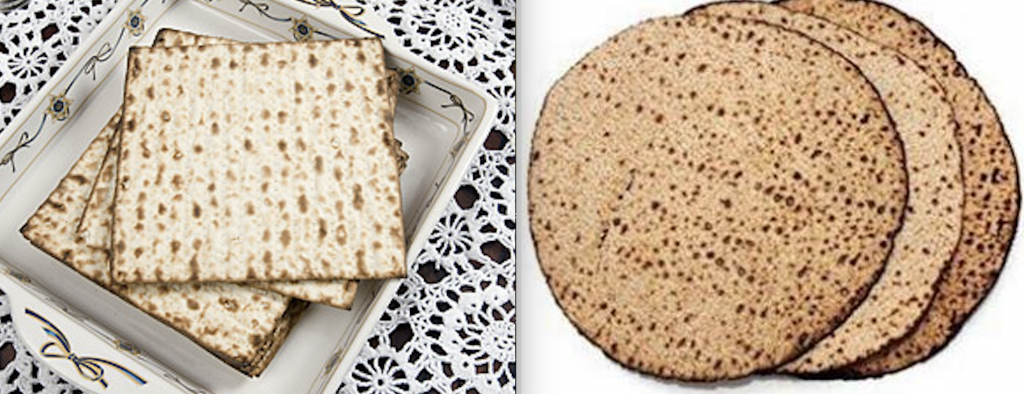
2. Machine made Matzot are square and of a standard size. Handmade matzot are circled, and with a more rustic look

Machine Matzot Handmade Matzot


Medication and non-edible products

 Products that are not edible, such as cosmetics, glues, shampoos, deodorants, soaps, detergents, and other cleaning products, may be kept in possession or used during Pesach, even if they contain Chamets. Therefore, it is unnecessary to verify the absence of Chamets or obtain a special rabbinical seal or certification for these products (Rabbi Obadia Yosef, Yalqut Yosef, 360: 31, 361: 68).

For Sefaradim, medications that come in the form of non-chewable capsules or hard pills can be used during Pesach, as they are considered “inedible.” This includes medication that may contain Chamets elements. However, nowadays, it is highly unlikely (Yalqut Yosef Mo’adim, 362: 40). Rabbi Eliezer Melamed, a prominent rabbinic authority, notes that many Ashkenazi rabbis follow a similar Halakhic criterion and that most medical hard pills are made with potato or corn starch, which is permitted for Pesach consumption (see Penine Halakha Pesach 102, 103).

If possible, asking doctors to prescribe non-chewable pill medication for Pesach is advisable (obviously, in the case of a serious medical condition, any necessary medication should be taken).

Some Ashkenazi rabbis hold stricter opinions regarding consuming non-edible Chamets for Pesach, with some Ashkenazi rabbis stating that only non-chewable medication should be allowed. Vitamins, even in the form of non-chewable capsules or pills, cannot be used during Pesach unless it has been verified that they do not contain Chamets (many Sephardic rabbis agree with this criterion). Additionally, some Ashkenazi rabbis adopt a stricter stance on using non-edible Chamets for Pesach, such as cleaning products or perfumes made from wheat alcohol.

Both Sephardic and Ashkenazi rabbis agree that liquid or chewable medicines, syrups, powdered vitamins and/or medications, or vitamins with a pleasant flavor that is drinkable and/or chewable should be certified as “Kasher for Pesach” or verified not to contain any Chamets ingredients. Many dietary supplements and vitamins are made with elements that are 100% Chamets (e.g., grain fibers, wheat germ, etc.), so it is important to be cautious. Similarly, oral perfumery or personal hygiene products with a pleasant taste, such as toothpaste or flavored lipsticks, should also be checked for any Chamets elements.

We recommend the advanced level reader who wants to understand the relevant Halakhic details of the issue of medications in Pesach to see the following links:

Rabbi Melamed (Hebrew)

Star-K (English)

As the reader can appreciate, in all these Halakhot, there are diverse customs and traditions. For a final verdict, consult with the Rabbi of your community.


MEKHIRAT CHAMETS: When is OK to sell your Chamets?

Most communities, Ashkenazi and Sephardic,  arrange a Hamets-selling system in which the community members empower the rabbi to sell their Hamets.  This procedure is a Halakhic leniency done to prevent people from keeping “expensive” Hamets at home during Pesah.  Obviously, the validity of this selling should not be questioned since every Rabbi leads his community according to what he considers the best for his congregants. Personally, I don’t sell my Hamets, and I encourage my community members to do the same.
 
Historically, Sephardic Jews did not practice the mekhirat hamets (=selling of Hamets) procedure. They simply got rid of their Hamets before Pesah began in accordance with the Mitsva of “tashbitu”, as we explained before( see this) .


The only exceptional case in which Sephardic rabbis authorized selling the Hamets was the case of a food-store owner. In this case, a non-Jew would make a down payment for the total of the merchandise, and from the moment he made that payment, the Hamets merchandise would belong completely to the buyer, and he would be entirely responsible for the goods, if damaged, stolen, etc. So, for example, if the goods were stolen during Pesah, the buyer will have to pay for them to the seller after Pesah. The buyer would also rent the store where the merchandise is stored for the duration of Pesah, and he would keep the store’s keys, which granted him total and unrestricted access to the premises of the store. The non-Jewish buyer had the right to use, consume or even trade the Hamets merchandise during Pesah. And if he wished so, he could pay the balance and keep the merchandise for himself. As you can see, although the clear intent was that the seller would eventually buy back the Hamets after Pesah, the selling transaction was real, legal and binding.  The rabbis would not have accepted any phony selling transaction, which would not have complied with Jewish and local Law because obviously, they took the prohibition of owning Hamets during Pesah very seriously.


Except for food business owners Sephardic community would not sell their Hamets.   What would they do with their leftovers of Hamets food?


1. First, before Pesah, people would buy just whatever was necessary until Pesah, avoiding having extra Hamets-food close to Pesah.


2. Second, whatever leftovers of Hamets, if in good condition, would be given to a non-Jew as charity or as a gift, or if that is not possible, it would be disposed of.  Disposing of Hamets leftovers the day before Pesah is a Biblical Mitsva. So this is not considered “waste” ( בל תשחית).


3. If some Hamets accidentally had not been detected, then the Bitul Hamets, the formula of renunciation to our ownership of any unseen Hamets in our properties, would prevent the transgression of owning Hamets during Pesah.


If one follows these simple steps, then there is no real need to “sell and buy back” any Hamets.

The popularization of the selling of the Hamets started basically as an Ashkenazi tradition 400 years ago. In Europe, and still, in some Ashkenazi communities in America, the selling of the Hamets was such an accepted custom that the community rabbis get an extra salary for taking care of it.

I would obviously encourage Sephardic Jews to preserve our ancient Minhag and not sell the Hamets but get rid of it.


(TO clarify all the technical problems involved in the Mekhirat Hamets procedure, I wrote a separate text SEE HERE where I briefly describe the main Halakhic objections to the selling of Hamets. )

Remember that you only have to get rid of Hamets, a food item (for human or animal consumption).


You do not need to sell your pots and pans or anything that might contain “invisible” hamets (hamets balua’). Just put those utensils away during Pesah.

Medical pills, perfumes, cosmetics or any nonedible items could be kept, regardless of their composition.

Food items: you could keep anything as long as you make sure that it does not contain any of these five grains: wheat, barley, oats, rye, spelt (FYI, anything which contains gluten is Hamets. Check online!).


All those community members who wish to follow the tradition of removing all Hamets from your premises and avoiding the selling of the Hamets, can email me (rabbibitton@yahoo.com) a list of food you wish to keep and I will email back the status of that food (K: Keep.  D: Discard, or give as a gift to a non Jew).


Conclusion:
Selling or not selling your Hamets, is at the end of the day, as any other halakhic leniency or stringency,  a personal choice we do in consultation with our community’s rabbi.


Those who wish to keep their valuable hamets products (whiskey, vodka, or liquors made from grain alcohol, etc), should arrange the selling of the Hamets through their local rabbinate and avoid online selling.

Read also this great recent article (Hebrew, 2019) by an Israeli journalist עובדים על עצמנו: מספיק עם מכירת החמץ


The Challenges of Selling the Hamets

One of the best and most informed documents to learn all the details and debates around the modern selling of Hamets is a response written by rabbi Eliyahu Zini, a famous Sephardic rabbi who is also a professor of Mathematics in the Technion , Haifa.

Rabbi Zini explains that the precedent for selling Hamets is learned from a
Tosefta that says that if a Jew is in a ship, bringing with him some hamets goods, and his ship is late and will not arrive before pesah, as planned, the Jew could give his Hamets to a non Jew, and he is permitted to acquire the Hamets back from him after Pesah is over.

This case was considered by the rabbis an exceptional case, since this person is in the middle of the ocean and has no other resource than sell all his merchandise.

Rabbi Zini brings many sources, specially from the time of the Geonim, which sustain the opinion that the Tosefta refers to an exceptional case. He points out for example, that the Mishna and the Gemara discussed at length all the different ways to dispose of Hamets (burning, throwing it to the sea, feeding it to birds, etc.) and never mentioned, discussed or conceived selling the Hamets as one of the ways of disposing of Hamets. Moreover, following the modern way of selling the Hamets, all the rules the rabbis instituted like bediqat hamets or bitul hamets, will be meaningless and unnecessary. Following the Tosefta, Sephardic rabbis authorized a food-store owner to sell his Hamets to a non Jew, since it is an exceptional case, and even then, they authorized to do so under very specific conditions.

Rabbi Zini also explains that in the case of the Tosefta there was a transference of the goods from the Jew to the non-Jew, in other words, the non-Jew takes possession of the Hamets goods (משיכה) which is an unequivocal legal act of acquisition. Rabbi Zini brings several sources which assert that if the goods would remain in the house of the Jew, that is an unequivocal sign of ha’arama (in this case, “a bogus sale”). This requirement, that the goods will be transferred to the house of the non Jew, is brought as a prerequisite for the valid selling of the Hamets by Terumat haDeshen, which is the source of the Bet Yosef. Once and again Rabbi Zini brings the Geonim and Rishonim who quoting the Tosefta emphasize that the selling would be valid only if it is not a phony sale  (ובלבד שלא יערים).

The next element which would be considered a sign of הערמה or a bogus transaction for most rabbis, is that the Tosefta discusses an exceptional case, where a person is in the middle of the ocean, in a ship that was probably delayed for a few days and could not arrive at home before Pesah. And, as Maimonides points out,  הגיעה שעת החמישית the time for getting rid of Hamets had arrived and this person has no other resource. In halakhic terms this is known as she’at hadahaq, extreme unpredicted circumstances, the equivalent of bedi’abad. However, when one deliberately plans to sell the Hamets every year as a way of circumventing the Mitsva of disposing of Hamets, according to rabbi Zini, this is an unequivocal sign that the sell is insincere and therefore invalid.

Another point brought by rabbi Zini is that when valid and binding this selling transaction implies that the buyer owns the Hamets and he is entirely responsible for it. The whole point of the sell is that once the non-Jew pays the down payment, the Hamets belongs to him. The balance is made into a debt (similar to a promissory note), and the fact that the buyer did not pay the balance yet, does not affect his ownership of the Hamets. In these conditions the entire responsibility for those good is the buyer’s. Thus, for example, if during Pesah the whisky that I sold to the buyer and I kept in my house was stolen or broken, I should not care, because the goods are under the buyer’s responsibility and therefore he will pay me back for those destroyed goods once Pesah is over. As we know, this is not the case in the practical terms of the modern selling of Hamets. Most people would definitely care that the Hamets (“their” Hamets) will not be stolen or damaged, which again, is a sign that they consider this Hamets, their property.

The main opinion among modern Halakhic authorities who accepts as valid this selling of the Hamets is the Hatam Sofer (1762–1839). And as we said, relaying just in this opinion, against the opinion of most rabbis, would be an exceptional leniency. Especially for Sephardic Jews who never followed this practice. Even among Ashkenazi rabbis this type of sell was criticized. The champion of this cause was no other than the Gaon of Vilna (1720-1797) who considered that whoever sell his Hamets with ha’arama is violating two Biblical prohibitions (bal yera-e, and bal ymatse) and failing to comply with one positive Biblical commandment (tashbitu).
To read the complete article of rabbi Zini go to this link:

http://www.orvishua.org.il/heb/files/art/1144659147.pdf


Portions for the Seder

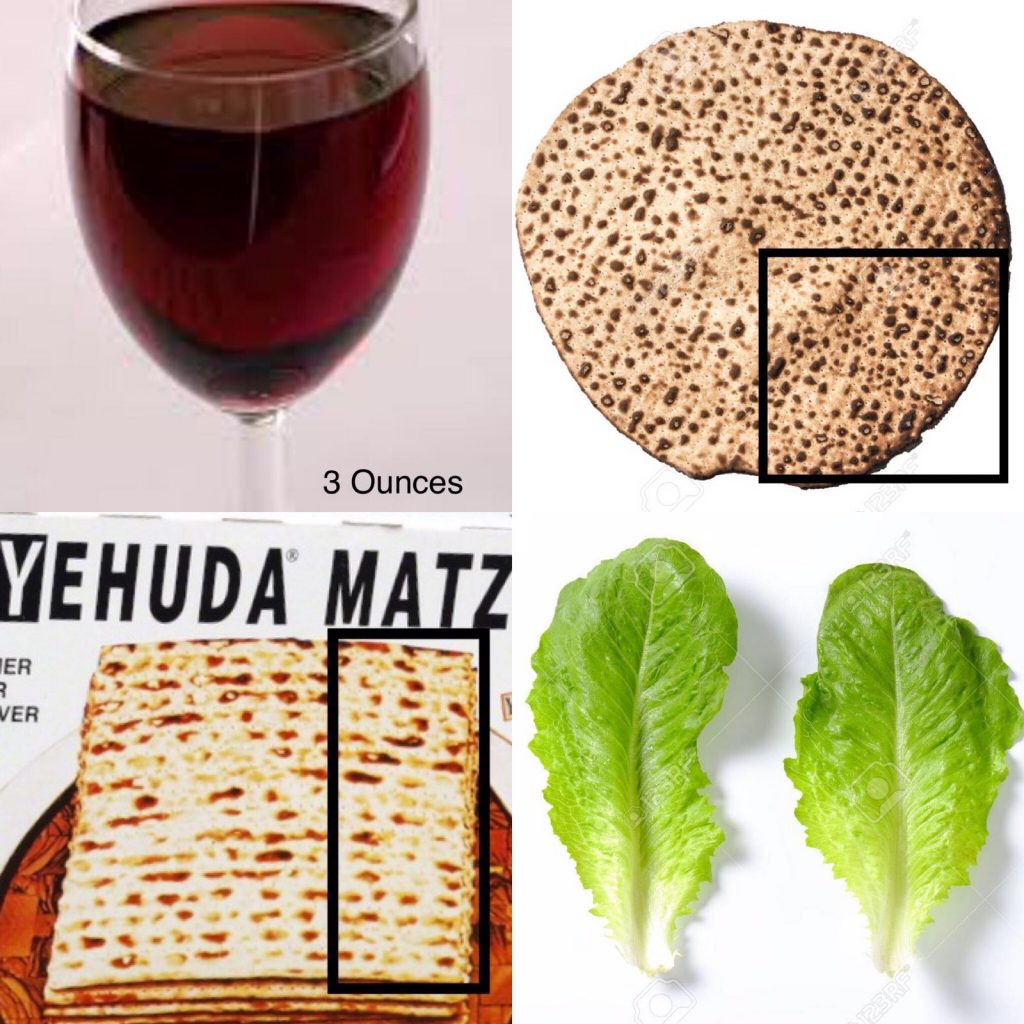
WINE: We drink 4 cups throughout the Seder, reclining on the left. The minimum quantity of wine per cup is rebi’it, approximately 3 oz. per cup.  For more information, see here.

MATZA: Minimum portion for Matza is kazayit. In abodat yad Matza, circle Matza, that is is 1/4 of matza per portion. Machine Matsa, square matza, 1/3 per portion. We eat a minimum 3 (or, preferably, 4) portions of Matza during the Seder, while reclining on the left.

MAROR: The minimum portion of Maror is also Kazayit. That is, a whole large Romaine lettuce leaf or two Romaine lettuce stems (or half of a medium size endive).


IS RICE CHAMETZ? 🍚

We’ve already established that chametz comes specifically from one of five grains: wheat, barley, spelt, rye, and oats. That means rice, by definition, is not chametz — and this isn’t a modern ruling or a recent leniency. It goes all the way back to the Gemara.

In fact, the Talmud records an explicit debate on this very question. Rabbi Yochanan ben Nuri — a sage from the Land of Israel who lived in the first century of the Common Era — argued that rice should not be eaten on Pesach. But the other sages pushed back, and the Gemara’s conclusion is unambiguous: rice is not chametz, and it may be eaten on Pesach. The Talmud even tells us that Rabbah, one of the most celebrated sages of Babylonia, used to eat rice at the Pesach Seder itself. 📖 (Pesachim 114b)

So the halacha is clear. Case closed — or so you’d think.


SO WHY DON’T ASHKENAZIM EAT RICE ON PESACH? 🤔

Here’s where things get interesting. Ashkenazi Jews refrain from eating rice on Pesach — but not because they consider it chametz. That’s an important distinction. The Ashkenazi tradition is to avoid an entire category of foods known as kitniyot: legumes, certain grains, and related products. Rice falls into this category, and so Ashkenazim don’t eat it on Pesach. This is a very old custom, and it remains widely observed to this day.

But where did this tradition come from? The answer is rooted in very practical, very real historical concerns.

Think about what the world looked like 100 or 200 years ago — or even more recently than that. Food wasn’t sold the way it is today, neatly packaged in sealed bags on supermarket shelves with clear labels and ingredient lists. 🛒 Food was sold in open-air markets, by weight, in bulk. Merchants would scoop out whatever you needed using shared scoops, pallets, and scales — the same tools they used for every other grain they sold. Rice and wheat sat in neighboring stalls. Sometimes in neighboring sacks.

And it gets even closer than that. The fields where rice was grown were often right next to — or even mixed in with — fields of wheat and barley. When harvest time came, it wasn’t unusual at all for a few grains of wheat to end up mixed in with the rice. 🌾

Now here’s why that matters so much: the prohibition of chametz during Pesach is extraordinarily strict. So strict, in fact — as we will discuss in more detail later — that a single grain of wheat is enough to render an entire plate of rice forbidden. Just one grain. Given that reality, and given how easily and how commonly wheat and rice got mixed together, it’s completely understandable why communities developed the practice of avoiding rice on Pesach altogether. Why take the risk?

And there’s another reason that reinforced this concern: rice and wheat look remarkably similar. The ears and grains of brown rice bear a strong resemblance to wheat. Rice flour and wheat flour are nearly indistinguishable by appearance alone. 👀 The average person — and even the careful person — could easily confuse one for the other.

Put all of that together: similar appearance, shared markets, shared tools, adjacent fields, and a prohibition so strict that one grain makes the difference — and the kitniyot custom starts to make a lot of sense.


BUT WAIT — ASHKENAZIM AREN’T THE ONLY ONES 🌍

It might surprise you to learn that avoiding rice on Pesach is not exclusively an Ashkenazi practice. Among Sephardic communities, the question of rice is actually a point of division.

Moroccan Jews and Jews from other North African communities — with the exception of Egypt — also refrain from eating rice during Pesach. So this caution around rice is not something unique to Eastern European Jewry.

On the other hand, Jews from Israel, Iran, Iraq, Syria, and other Middle Eastern communities do eat rice on Pesach — and rice plays a central role in their Pesach cooking. If potatoes are the Ashkenazi Pesach staple 🥔, rice is the Middle Eastern equivalent 🍚. It’s on the Seder table, it’s in the soups, it’s in the side dishes — it’s everywhere.

To address the concern about accidental wheat contamination, the custom in these communities is to check the rice carefully — not once, not twice, but three times — before using it for Pesach. That triple-checking is the practical safeguard that allows them to use rice with confidence.


ONE MORE THING WORTH KNOWING 📌

Here’s something that genuinely surprises many people, even those who are quite familiar with Pesach laws:

Even if you follow the tradition of not eating rice and other kitniyot during Pesach, you are completely permitted to keep them in your home. You do not need to throw them out. You do not need to sell them. They can sit in your pantry throughout all of Pesach without any problem. This is explicitly stated in the Shulchan Aruch (Rama, 453:1). The kitniyot restriction is about consumption — not about possession.

And there’s a further nuance, noted by Rabbi Eliezer Melamed in his Penine Halacha, based on the Mishna Berura (ibid., 9): the custom to avoid kitniyot applies when the kitniyot product is the food, or when kitniyot constitute the majority of a given product. But if kitniyot appear as a minor ingredient, or as a food additive — think corn starch, corn fructose, and similar substances — that food is not forbidden during Pesach, even for those who observe the kitniyot restriction.

As always, check with your rabbi about the specific traditions of your community. 🙏


Mekhirat Chamets: Selling your Chamets This Coming Pesach

In our days, most communities—Ashkenazi and Sephardic—arrange a Chamets-selling system in which the community members empower the rabbi to sell their Chamets.


This procedure is a Halakhic leniency done to avoid people from keeping “expensive” Chamets at home during Pesach.
Obviously, the validity of this selling should not be questioned, since every rabbi leads his community according to what he considers best for his congregants.


Personally, I don’t sell my Chamets, and I encourage other Sephardic Jews to do the same.

Historically, Sephardic Jews did not practice the mekhirat Chamets (=selling of Chamets) procedure.
They simply got rid of their Chamets before Pesach began, fulfilling the Mitsva of tashbitu.


The only exceptional case in which Sephardic rabbis authorized selling the Chamets was the case of a food store owner. In this case, a non-Jew would make a down payment for the total of the merchandise, and from the moment he made that payment, the Chamets merchandise would belong completely to the buyer, and he would be entirely responsible for the goods if damaged, stolen, etc.


So, for example, if the goods were stolen during Pesach, the buyer would have to pay for them to the seller after Pesach.
The buyer would also rent the store where the merchandise was stored for the duration of Pesach, and he would keep the store’s keys, which granted him total and unrestricted access to the premises of the store.
The non-Jewish buyer had the right to use, consume, or even trade the Chamets merchandise during Pesach. And if he wished to, he could pay the balance and keep the merchandise for himself.
As you can see, although the clear intent was that the seller would eventually buy back the Chamets after Pesach, the selling transaction was real, legal, and binding.
The rabbis would not have accepted any phony selling transaction that did not comply with Jewish and local law, because obviously, they took very seriously the prohibition of owning Chamets during Pesach.

Except for food business owners, the Sephardic community would not sell their Chamets. What would they do with their leftover Chamets food?

  1. First, before Pesach, people would buy just whatever was necessary until Pesach, avoiding having extra Chamets-food close to Pesach.

  2. Second, whatever leftovers of Chamets, if in good condition, would be given to a non-Jew as charity or as a gift. If that was not possible, it would be disposed of. Disposing of Chamets leftovers the day before Pesach is a Biblical Mitsva. So this is not considered “waste” (bal tashchit).

  3. If some Chamets had accidentally not been detected, then the bitul Chamets—the formula of renunciation of our ownership of any unseen Chamets in our properties—would prevent the transgression of owning Chamets during Pesach.

If one follows these simple steps, then there is no real need to “sell and buy back” any Chamets.
I would obviously encourage Sephardic Jews to preserve the ancient Minhag and not sell their Chamets, but get rid of it.

To clarify  the technical problems involved in the mekhirat Chamets procedure, see below 

Remember that you only have to get rid of Chamets which is a food item (for human or animal consumption).
You do not need to sell your pots and pans, or anything that might contain “invisible” Chamets (Chamets balua’). Just put those utensils away during Pesach.

Medical pills, perfumes, cosmetics, or any non-edible items can be kept, regardless of their composition.
Food items: you can keep anything as long as you make sure that it does not contain any of these five grains: wheat, barley, oats, rye, spelt. (FYI: anything that contains gluten is Chamets. Check online!)

Conclusion:
Selling or not selling your Chamets is, at the end of the day—like any other Halakhic leniency or stringency—a personal choice made in consultation with your community’s rabbi.

Those who wish to keep their valuable Chamets products (whiskey, vodka, or liquors made from grain alcohol, etc.) should arrange the selling of the Chamets through their local rabbinate and avoid online selling.

xxxxxxxxxxxxxxxxxxxxxxxxxxxxxxxxxxxxxxxxxxxxxxxxxxxxxxxxxxxxxxxxxx

One of the best and most informed documents to learn all the details and debates around the modern selling of Chamets is a response written by Rabbi Eliyahu Zini, a famous Sephardic rabbi who is also a professor of Mathematics at the Technion, Haifa. I first heard about this article in a lecture given on the subject of Mekhirat Chamets by H. Joseph Mosseri, נ״י (the original article cannot be found online anymore)

Rabbi Zini explains that the precedent for selling Chamets is learned from a Tosefta that says that if a Jew is on a ship, bringing with him some Chamets goods, and his ship is late and will not arrive before Pesach as planned, the Jew could give his Chamets to a non-Jew, and he is permitted to acquire the Chamets back from him after Pesach is over.
This case was considered by the rabbis an exceptional case, since this person is in the middle of the ocean and has no other resource than to sell all his merchandise.

Rabbi Zini brings many sources, especially from the time of the Geonim, which sustain the opinion that the Tosefta refers to an exceptional case. He points out, for example, that the Mishna and the Gemara discussed at length all the different ways to dispose of Chamets (burning, throwing it into the sea, feeding it to birds, etc.) and never mentioned, discussed, or conceived selling the Chamets as one of the ways of disposing of Chamets.

Moreover, following the modern way of selling the Chamets, all the rules the rabbis instituted—like bediqat Chamets or bitul Chamets—would be meaningless and unnecessary.

Following the Tosefta, Sephardic rabbis authorized a food store owner to sell his Chamets to a non-Jew, since it is an exceptional case, and even then, they authorized it under very specific conditions.

Rabbi Zini also explains that in the case of the Tosefta, there was a transference of the goods from the Jew to the non-Jew. In other words, the non-Jew takes possession of the Chamets goods (meshikha), which is an unequivocal legal act of acquisition.

Rabbi Zini brings several sources which assert that if the goods would remain in the house of the Jew, that is an unequivocal sign of ha’arama (in this case, “a bogus sale”).

This requirement—that the goods be transferred to the house of the non-Jew—is brought as a prerequisite for the valid selling of the Chamets by Terumat haDeshen, which is the source of the Bet Yosef.

Once and again, Rabbi Zini brings the Geonim and Rishonim, who, quoting the Tosefta, emphasize that the selling would be valid only if it is not a phony sale (ubalvad shelo ya’arim).

The next element which would be considered a sign of ha’arama, or a bogus transaction for most rabbis, is that the Tosefta discusses an exceptional case where a person is in the middle of the ocean, in a ship that was probably delayed for a few days and could not arrive at home before Pesach.

And, as Maimonides points out, higi’a sha’at ha’hamishit—the time for getting rid of Chamets had arrived—and this person has no other resource.

In halakhic terms, this is known as she’at hadahaq, extreme and unpredicted circumstances, the equivalent of bedi’avad.
However, when one deliberately plans to sell the Chamets every year as a way of circumventing the Mitsva of disposing of Chamets, according to Rabbi Zini, this is an unequivocal sign that the sale is insincere and therefore invalid.

Another point brought by Rabbi Zini is that, when valid and binding, this selling transaction implies that the buyer owns the Chamets and is entirely responsible for it.

The whole point of the sale is that once the non-Jew pays the down payment, the Chamets belongs to him. The balance is made into a debt (similar to a promissory note), and the fact that the buyer did not pay the balance yet does not affect his ownership of the Chamets.

In these conditions, the entire responsibility for those goods is the buyer’s.
Thus, for example, if during Pesach the whisky that I sold to the buyer and kept in my house was stolen or broken, I should not care, because the goods are under the buyer’s responsibility and therefore he will pay me back for those destroyed goods once Pesach is over.

As we know, this is not the case in practical terms with the modern selling of Chamets. Most people would definitely care that the Chamets (“their” Chamets) not be stolen or damaged, which again is a sign that they consider this Chamets their property.

The main opinion among modern Halakhic authorities who accepts as valid this selling of the Chamets was the Hatam Sofer (1762–1839). And as we said, relying just on this opinion, against the opinion of most rabbis, would be an exceptional leniency—especially for Sephardic Jews who never followed this practice.

Even among Ashkenazi rabbis, this type of sale was criticized. The champion of this cause was no other than the Gaon of Vilna (1720–1797), who considered that whoever sells his Chamets with ha’arama is violating two Biblical prohibitions (bal yera’e and bal yimatse) and failing to comply with one positive Biblical commandment (tashbitu).