Rabbi Obadia de Bertinoro (1455-1515), from Italy to Jerusalem

EARLY LIFE

Rabbi Obadiah ben Abraham of Bertinoro, popularly known as “Bartenura”, was born in 1455. He was a student of the famous Rabbi Yosef Colon, מהרי”ק, and served as rabbi of his own city, Bertinoro, in the province of Cesena, Italy. There he also worked as a banker. His name is mentioned at the top of the list of bankers authorized to grant loans to Christian residents in an official document of Pope Innocent VIII, dated February 12, 1485. When he was 30 years old, he decided to move in the land of Israel, and settle specifically in Yerushalayim, Jerusalem. We have a detailed description of his journey to Israel – which in those days was neither easy nor short – since many of the letters describing this trip were found and published, as we will mention later on.

FROM ITALY TO JERUSALEM

At the end of 1486 he left his native city. He went through Rome and Naples and finally arrived in Palermo, Sicily, where he spent three months preaching every Shabbat in the local synagogue. In Palermo, the main city of Sicily, there were around 850 Jewish families, all living in the same quarter located in one of the best areas of town. The Jews were artisans, blacksmiths, and farmers. The community leaders of Sicily tried to convince him to stay as Rabbi of that Synagogue, but he refused the offer because his greatest desire was to settle in Yerushalayim. He traveled through Rhodes, Greece, and Alexandria, Egypt, where he arrived in early 1488. From Alexandria, he proceeded to Cairo, where Rabbi Natan ha-Kohen Shoulal, the chief leader of the local community (naggid), received him with great honors. There, too, he was offered to remain as a rabbi. The leaders warned him that the situation of the Jews in Jerusalem was very precarious and beyond repair, but he again refused. He continued his journey through Gaza— the fourth-largest Jewish city those days (after Jerusalem, Safed, and Hebron)—and from there he moved to Hebron. He finally arrived in Yerushalayim on the eve of Passover 1488. Upon his arrival, he was received by the rabbi of the city, and stayed in his house for the rest of the holiday.

IF I FORGET YOU, OH JERUSALEM…

In those years, Jerusalem was under the control of the Mamluks, a Muslim group that ruled the city until 1517. Some 4,000 Gentile –Muslim and Christian– families lived in Jerusalem. The local Jewish community numbered approximately 70 families.  The wealthiest had fled because of the exorbitant taxes demanded by the Mamlukes. The poor had nowhere to go, and their life became unsustainable. Many were literally starving to death. As Rabbi Obadiah writes: “in the city there were many widows and poor old men…those who have some bread to eat…are considered to be rich…”. Rabbi Obadiah also says that the person who received him upon arrival was an Italian rabbi, Ya’aqob from Colombano. This man was so poor that he was only allowed to eat a piece of bread during Shabbat, while during the week he ate the dried carob pods that the producers discarded after producing the famous syrup known as “carob honey” .

THE SYNAGOGUES

Rabbi Obadiah also writes that a few years before his arrival, there were some 300 Sifre Torah in Jerusalem—ritual Torah scrolls that are read in the Synagogue. But now, virtually all the Scrolls disappeared.   The “me’ilim” , that is, the decorated covers made of fine fabrics that wrap these scrolls; and the decorations that are often made of precious metals, also vanished because the synagogues were frequently looted. The only Synagogue that still operated in Jerusalem was very precarious, narrow and dark. However, the Rabbi notes that the prayers in Jerusalem were not comparable in their beauty to any other place he had prayed. On Saturday mornings, the rabbi writes, “the men rise an hour or two before dawn to sing the sweet religious poetry (baqashot), …then they recited the Kaddish, and then two officiants (chazanim) began the prayers with the recitation of the Shema Israel, at exactly sunrise (vatiquin).

CORRUPTION

Rabbi Bartenura complains about the widespread corruption in Jerusalem. He recounts as an example that a Muslim man killed his own mother, slashing her throat with a knife, in a moment of rage. When they brought him before the local court, the murderer justified himself by saying that he was drunk.  Muslims are forbidden by their religion to drink alcohol, and therefore they do not produce or sell alcoholic beverages. What was then the verdict of the judges? The court blamed the Jewish community for producing wine, which caused this man to get drunk and murder his mother. The judges, who were always looking for some economic benefit, imposed a fine of 6 gold coins on the Jewish community, and the murderer was set free.

FROM YOUR RUINS I WILL BUILD YOU. מחורבותיך אבנך

Rabbi Obadiah committed himself to restore Yerushalayim, and he did that, single-handedly. He had to personally take care of all the material needs of the community. Including, for example, digging the graves in the Jewish cemetery and burying the dead, as no one else was able, or strong enough, to engage in this religious duty. The Rabbi then decided to devote his effort to raising funds for the Jewish community of Yerushalayim. He reached out to his family, friends and acquaintances in Italy, who generously provided him with funds to assist the poor. Over time and thanks to the solidarity of the Italian Jews he was able to establish charitable institutions and medical infirmaries for the sick. Emanuel Hai Camerino of Florence, who was in charge of administrating Rabbi Obadiah’s state in Cesena, would send him 100 ducats (gold coins) every year, to which he added another 25 ducats from his own pocket for charity. In this way the Jewish community grew and also the name of the main benefactor:  Rabbi of Bertinoro. Since he arrived in Jerusalem, he brought a huge blessing to the entire city. Within a few years, thanks to Rabbi Obadiah’s excellent reputation for integrity in Jerusalem, Muslims themselves were turning to him for legal disputes and business disputes, knowing of his wisdom and honesty.

FROM CASTILE TO JERUSALEM

In 1492 the Jewish world was shaken by the news of the expulsion of the Jews from Spain. The refugees soon arrived in Turkey, Egypt, Safed and also in Jerusalem. Rabbi Obadiah became the spiritual leader of these refugees and helped them to support themselves, since they arrived without any money, and in order to stay in the city they had to pay the tax to the Mamluk government, the jiziah, which was charged per person. Which meant that with the increase in the Jewish population, the already heavy taxes increased even more. However, after a few years, these Jews who came from Spain with nothing but had professional skill and training in international trade, began to grow economically, and the Jewish community of Yerushalayim flourished again!  As a token of their enormous gratitude to their benefactor, the refugees from Spain and Portugal granted Rabbi Obadiah of Bertinoro the best gift he could have dreamed of: they built him his own Yeshiba (rabbinical academy) in Yerushalayim! The first Yeshiba in Jerusalem after 1200 years!

Rabbi Obadiah was named “abi hayishub”, patron or maximum benefactor, of the city of Jerusalem.

He died in 1515 and his body rests in the Har HaZetim (Mount of Olives) the most famous cemetery in Yerushalayim.

REVIVING THE HEBREW LANGUAGE

Rabbi Obadiah of Bertinoro is primarily known for his commentary to the Mishnah, a text that comprises the oral rabbinical traditions, that is, the application and details of all the precepts of the Torah. The Mishnah is usually studied in conjunction with the Gemara (Talmud) which explains, expands and elaborates on the details of the Mishna. Maimonides was the first rabbi to write an independent commentary on the Mishnah. Rabbi Obadiah followed his example and wrote his own commentary, which became the most popular for centuries. To the point that it is difficult to find an edition of the Mishnah that does not contain the “Bartenura commentary”.  Rabbi Obadiah’s book was more accepted than Maimonides’ commentary because Maimonides originally wrote his commentary in Arabic, while Rabbi Obadiah’s commentary was written in Hebrew.

Aside from this work, Rabbi Obadiah also wrote a book on Rashi’s commentary to the Tora called amar neqe (See Daniel 9:7, עמר נקא “Pure Wool”). He also wrote three long letters describing in detail his journey and containing invaluable descriptions of the people and customs of the Jewish communities he visited in his journey from Italy to Jerusalem. These letters were addressed to his father and his brother and were published under the name “Darkhe Ẓion” (the Roads leading to Zion, Jerusalem) and “HaMasa le-Eres Yisrael” (The journey to the land of Israel) .



Rabbi Ya’aqob Castro (1525-1612) and the Jewish community of Egypt

FROM SEPHARAD TO EGYPT

Rabbi Ya’aqob Castro was a Tora scholar, a rabbinical judge, an author  and a leading lawmaker (poseq) in the Cairo Jewish community. 

The Castro or “de Castro” family was originally from southern Spain. At the time of the expulsion they escaped to Portugal and from there, many members of that family arrived in Turkey, North Africa, Egypt, etc.

The father of Rabbi Castro (some historians say he was his uncle) was the famous Abraham de Castro (died in 1520, see here). Abraham de Castro was one of the most prominent Jews of his time. He was the manager of the Royal Mint of the Turkish Sultan Suleiman the Magnificent (1494-1566), the most powerful man in the world in those years. In his honor, the Sultan agreed to reinforce the walls of Jerusalem adding several rows of solid rock to the original wall. This stones are still there to this day.

HIS TEACHERS

Rabbi Ya’aqob de Castro belonged to a wealthy family. Apart from being a  rabbi, Rabbi Castro also engaged in trade, something that was common among rabbis living in Egypt, such as Rabbi David ben Zimra or Rabbi Isaac Luria(the Ari haQadosh) who dealt with import and export of pepper and grains.

Rabbi Ya’aqob was a student of two great luminaries: the illustrious Rabbi David ben Zimra (Radbaz), and Rabbi Levi ibn Habib (Ralbah) of Yerushalayim. Rabbi Ya’aqob is also known by his acronym Mahariqash (מהריק”ש), and he is considered the last “Chief Rabbi” of Egypt, that is, the rabbinical authority accepted by all the communities of the country, including the two most important: Cairo and Alexandria. At that time most of the Jews of Egypt were musta’arabim, that is, indigenous of Egypt; while the community of the Sepharadim, that is, the refugees of the expulsion from Spain, was just beginning.

RABBI CASTRO AND RABBI CARO

In 1570, he visited the city of Sefat in Israel, where he was invited to the home of Rabbi Yosef Caro (1488-1575), the author of the Shulhan Arukh. In his writings, Rabbi Castro describes his encounter with Rabbi Caro and relates, probably with deep emotions,  seeing with his own eyes Rabbi Caro acting in accordance with the customs that he himself had established in the Shulhan Arukh.

Rabbi Castro wrote several books. We will mention two of them.

“Erekh Lehem.” Glosses and comments that Rabbi Castro wrote in the margins of his manuscript copy of the Shulhan Arukh. In these notes he expresses his opinion, and sometimes his objections, to some halakhic determinations of Rabbi Yosef Caro. The reputation of Rabbi Castro was so high that in Egypt his opinion had more weight than that of Shulhan Arukh himself.

LIFE IN THE JEWISH COMMUNITY OF EGYPT

Another of his works is “Ahole Ya’aqob”, a book of rabbinical responsa on real cases that happened in his community. This book also presents the Halakhic debates between Rabbi Castro and some of his contemporaries, which allows us to have a better vision of his legal thinking.

It should also be noted that this book of Rabbinical questions and answers is a priceless source of information for historians to learn a little more in detail about the social and community life, and the difficulties of the Jewish community in Egypt in the 16th century.

SOME EXAMPLES

One of the Taqanot, or community decrees, that Rabbi Castro mentions in one of his answers, is related to the mores and etiquette that should be observed in the celebration of wedding parties. Apparently, in some weddings, gentile dancers were hired as part of the celebration; this caused more than once some improper attitudes. Rabbi Castro, together with the other rabbis of the city, forbade this practice and encouraged the community to hire only musicians, and not dancers.

Another controversial issue that appears in his questions and answers is the legal status of the claim of a wife who refused to live in the house of her in-laws, in a situation where there was no mistreatment from their part. Rabbi Castro debated with another very famous Egyptian rabbi, Rabbi Hayim Kafusi, about considering this claim as a justified cause for divorce.

Finally, I will mention a more sensitive topic. Rabbi Castro dealt with the case of two young married men, members of his community, who went out of town in a business trip and disappeared. Two Egyptian men, father and son, testified that these merchants were attacked and killed by a gang of 12 assailants. The Halakhic question was whether this testimony was enough to declare the wives of these merchants as widows, and allow them get married again. Rabbi Castro adopted a more strict opinion, since the evidence was ambiguous, and he considered that the witnesses could obtain a personal benefit from his testimony. Rabbi Kafusi confronted Rabbi Castro and presented an more permissive opinion so that these two women would not be trapped (agunot) in a situation without a possible solution.


Rabbi Yosef of Terani (1569-1639) and the Philanthropists  of Constantinople


LIFE IN ERETS ISRAEL in THE 16th CENTURY

Rabbi Yosef of Terani (or “Miterani” רבי יוסף מטראני) was born in Safed, Israel, in 1569. He is considered one of the leading Talmudists of his generation. He is also known by the initials of his name “Maharit” (Hebrew: מהרי”ט). His father was the famous rabbi Moshe de Terani, author of Beth Eloqim. He died when Yosef was 12.  From that young age Rabbi Yosef was adopted, and he became the favorite student, of the great sage Ribbi Shelomo Sagis.  Rab Yosef married in 1586 and that year a great plague broke out in Safed that claimed the lives of many Yehudim and among them Rabbi Sagis.  Rabbi Yosef left the land of Israel and escaped to Egypt, where he lived with his brother Shelomo, who was a community rabbi in Egypt. He spent 15 years in Egypt devoting himself to intensive Talmudic studies.  When he returned to the land of Israel, he lived in Safed and then in Yerushalayim, where he wrote the book “Tsurat haBayit”, describing the design and architecture of the Bet HaMiqdash. This book, unfortunately, has been lost, and we only know about it because it was quoted in the book of one of his students, Rabbi Hayim Alfandari.  Rabbi Yosef was already famous at this time. He received and answered numerous Halakhic questions which were coming from all over the Jewish world. But living in Erets Israel then, was becoming very difficult and Rabbi Yosef and his family suffered poverty, disease and persecution.

FROM SAFED TO CONSTANTINOPLA

After a few years Rabbi Yosef moved to the city of Constantinople, in Turkey, where he found a large Jewish community established by the Jews expelled from Spain, known as Sepharadim. In Constantinople, Rabbi Yosef was welcomed enthusiastically by the Ben Ya’ish brothers, who were very kind benefactors and Jewish patrons. The Ben Ya’ish brothers hosted Rabbi Yosef at their state and offered to maintain him and his family with dignity while he dedicates himself to teach Tora and to write his books. From that moment all the hardships of Rabbi Yosef came to an end, and without serious material concerns he dedicated fully to teach Tora. Under the wings of the Ben Ya’ish brothers Rabbi Yosef established a Yeshiba, or rabbinic academy, which he called “Qahal Qadosh Gerush”, the holy congregation of refugees from Spain. This Yeshiba became a magnet for young Tora scholars who came from all over the world to study with Rabbi Yosef. According to the testimony of his children Rabbi Yosef had more than 80 students studying directly under him.

CHIEF RABBI OF TURKEY

After 20 years of arriving in Turkey, Rabbi Yosef was also chosen as the head rabbi of Constantinople. As such, he was granted the title of Hakham Bashi, the chief rabbi of Turkey, which at the time was the most prosperous Jewish community in the Jewish world. Apart from continuing teaching, Rabbi Yosef decided to improved the community’s system of social assistance, training and using his own Rabbinical students for this important task. He sent his students to visit the sick, console the mourners, assist the brides and grooms, and to distribute food, clothing and everything necessary for the poor, the widows and the orphans. Among his students we can mention for example: Ribbi Hayim Alghazi, Ribbi Aharon DeLapapa and Ribbi Hayim Benveniste, all of them became very famous rabbis and served in different communities. 

HIS LAST WISHES

Rabbi Yosef was blessed with many children,  all of them became great Tora scholars. Before dying he asked two things from his children. 1. That they publish his books, which were in manuscripts. And 2. to take his remains to the land of Israel, so that he could be buried close to his father. Shortly after his death, in 1639, his children faithfully fulfilled his two wishes.


HIS BOOKS

Among the books of Rabbi Yosef Miterani stands out his collection of 152 questions and answers that were published in Constantinople in 1641.

In this link you can get another book of Rabbi Yosef, Tsafnat Pa’aneah, (Frankfurt, 1694) a commentary on the Tora. One illustration: In the first pages of this book Rabbi Yosef exposes 15 different ways, opinions and insights about the nature of Adam’s first sin —eating the fruits of the forbidden tree. How is it that this sin caused man to perceive himself naked; why the Creator dressed him with a garment of leather (or “light”, according to Ribbi Meir), etc.

HIS GRAVE

His children took his remains to Safed, and buried their father there. For some reason the exact place of his grave was not known for centuries. However, in 2008 his resting place was identified in the old cemetery of Safed, next to the grave of rabbi Moshe Alshekh, by Rabbi Shelomo Epstein.


Rabbi Abraham Azulay (1570-1643) and the Sultan’s Sword in Hebron

From FES to HEBRON

Rabbi Abraham Azulay (also “Azulai) was born in the city of Fes, Morocco, in 1570. The city of Fes was a very important Jewish center where many Jews found refuge when they escaped the expulsion from Spain.

The family of Rabbi Azulay also came from Spain (Castilla). Living in Fes was far from being in a paradise. Apart from the constant persecution by Muslim extremists, the area was very poor and often suffered from long droughts. Rabbi Shaul Serero says that in the Jewish community of Fes, between 10 and 20 people died every day… of starvation. After one long drought that lasted for more than 3 years, Rabbi Azulay left Fes and headed towards the land of Israel. Traveling by sea was extremely dangerous. When rabbi Azulay arrived near the port of Capotakia (Port Said) a great storm destroyed his ship and all his belongings sank. Miraculously, Rabbi Azulay survived and arrived (presumably swimming) to the coast. This miracle was never forgotten by Rabbi Azulai. And as a sign of his eternal gratitude to HaShem for this miracle, Rabbi Azulay designed his signature in the shape of a boat (see illustration above).

From HEBRON to GAZA

Once he arrived in Israel he settled in the city of Hebron (also known as Kiryat Arba) where he met with the great rabbis of that time such as Rabbi Eliezer Arha and others. But a terrible epidemic broke in 1619 and rabbi Azulay had to leave the city of Hebron and he moved to Yerushalayim. But the plague also reached Jerusalem, and Rabbi Azulay moved to the city of Gaza where he lived for some years. At that time 70 Jewish families lived in Gaza. Some families were engaged in agriculture and others in commerce, since Gaza was part of the trade route between Syria and Egypt. The Rabbi of Gaza between 1620-1625 was the illustrious rabbi Israel Najara (a native of the Spanish city Nájera), who befriended rabbi Azulay .  In Gaza, Rabbi Azulay wrote two of his most famous books: a commentary on the book of the Zohar “Hesed LeAbraham” (“The goodness that God did with Abraham”, in reference to the fact that he himself, Abraha, was twice saved from the terrible epidemic that claimed so many lives). He also wrote “Ba’ale Berit Abram”, a mystical commentary on the Tora.

COMMENTARY ON THE MISHNA

Rabbi Azulay is known for his mystical writings  but he also wrote a few traditional rabbinical works.  One of the least known books of Rabbi Azulay, is “ahaba bata’anuguim”, a beautiful and extensive commentary on the Mishna. In this book, unfortunately not as well known as his books on mysticism, Rabbi Azulay explains the elementary meaning of the words and ideas of the Mishna  —following the footsteps of Maimonides— incorporating the commentaries of the Talmud, the midrashim and other famous books, including Geonim, Rishonim and the Shulhan Aruch. He also mentions the teaching of some rabbis who lived in Erets Israel on those days , and of whom nothing else is known to us, like Rabbi Soleiman Ohana and Rabbi Yosef Ashkenazi, the “Tana from Safed”.  This book was republished in Israel recently (1985, Seder Neziqin). It was edited among others by Rabbi Masud Ben Shimon ( had the privilege to study under him in my youth)  and the introduction of this new edition was written by none other than Rabbi Obadiah Yosef (see the book HERE.    We also present HERE a link where you can download the comment of Rabbi Azulay on the Mishna of Pirque Abot, (courtesy of hebewbooks.org).

When the plague ended, Rabbi Azulay returned to Hebron, where he lived until the end of his days.

THE SWORD IN THE CAVE of MAKHPELA

In 1643 the Sultan of the Ottoman Empire, Mohamed IV, the most powerful man on earth in those days, visited the land of Israel and came to Hebron, and following the Muslim tradition, went to pray in Me’arat HaMakhpela, the cave where Abraham, Yitshaq and Ya’aqob are buried. At the time, there was a very deep hole on the floor of the hall dedicated to Yitshaq Abinu, through which there was access to the interior of the original cave of Makhpela. But nobody entered there, since it was considered very dangerous, perhaps due to the absence of oxygen, the presence of toxic gases, etc. The Sultan came very close to the hole and when he bent to take a closer look his valuable sword, made of gold and ornamented with diamonds,  fell down the hole. The Sultan sent a pair of soldiers tied with ropes to bring the sword back, but both died. The local Arab leaders decided that they would not risk the lives of other Muslims and demanded the Jews, under the threat of extermination, to bring back the Sultan’s sword. Rabbi Azulai, who was 73 years old at that time, volunteered for the risky task and after an incredible experience he was able to recover the sword of the Sultan (see the full story on the Hebron webpage, http://en.hebron.org.il/history/ 228).

HIS DEATH

Rabbi Azulay died the day after he emerged from the depth of the cave of Makhpela,  Friday Ereb Shabbat, Perashat Haye Sara (that is, today!).

Rabbi Abraham Azulay is buried in the old cemetery of the city of Hebron. His grave, as was the custom in Hebron, carries no inscription, not even his name (I think this was done as a gesture of deference to our Patriarchs, buried in that city).

One of his great-grandchildren was the famous Rabbi Hayim Yosef David Azulay, also known as the Hida (1724-1806).


Rabbi Hayim Vital (1543-1620) and the Dilemma of the True Cabalists

HIS FAMILY
Rabbi Hayim Vital was born in the city of Tsefat (Safed, Israel) in 1543. His father was Ribbi Yosef Vital, an expert scribe (sofer). The Tefillin written by Ribbi Yosef were very appreciated by Ribbi Yosef Caro, author of the Shulhan Arukh and chief rabbi of Safed in those times, not only for the sanctity and purity of that great Hakham who wrote them but also for having been written following some very ancient traditions, for example, the letter kaf sofit (peshuta = extended) written with the upper part rounded, not rectangular (ך). Rabbi Moshe Galante wrote that more than a thousand pairs of Tefillin had arrived in the Jewish community of Egypt from Safed, written by the famous “Calabrian rabbi”. The Vital family was originally from Calabria, so Rabbi Yosef and his son Rabbi Hayim were known as the “Calabrian” rabbis (calabreses).
SAFED (צפת)
The city of Safed became one of the most important destinations for many Jews who arrived from the Iberian Peninsula after the expulsion from Spain (1492) and Portugal (1497). In the year 1540 there were 5,000 Jews in the city of Safed, 719 families. Rabbi Vital’s teacher was the famous Rabbi Moshe Alshekh, also from Safed. When Rabbi Yosef Caro passed away, he was succeeded by Rabbi Alshekh, who inherited from Rabbi Caro the authority to order new rabbis. Rabbi Alshekh granted his ordination only to one Rabbi: that is Rabbi Hayim Vital. While Rabbi Hayim Vital is best known for his writings on Qabbala, his early studies were conventional rabbinical studies. His son, Rabbi Shemuel Vital, tells in his book “Source of waters of life” (be-er mayim hayim) that his father only allowed himself to start studying Qabbala when he had completed his advanced rabbinical studies , which includes a total mastering knowledge of all Talmudic and Halakhic works, which usually takes many decades of dedication.
THE GREAT TEACHERS
In Safed Rabbi Hayim also studied with the famous cabalist rabbi (mequbbal) Moshe Cordobero (Ramak) until the year 1570, when Rabbi Yitshak Luria, known as the Ari haQadosh, arrived to the city of Safed from Egypt. The Ari haQadosh is considered one of the most famous cabalists in history. According to rabbi Vital, while the works of the first cabbalists — from Nahmanides (1270) to the Ari himself — were formulated on the basis of the human intellect, the teachings of his master, the Ari, were revealed by divine inspiration. In the year 1572 the population of the city of Safed was decimated by a terrible plague that also claimed the life of the Ari HaQadosh at the young age of 38 years. After the death of the Ari, Rabbi Hayim Vital was recognized as his principal student and his successor.
FROM JERUSALEM TO DAMASCUS
In 1578 rabbi Vital left Safed and settled in Yerushalayim (Jerusalem). There he founded his own academy and helped the community along with other great Talmudic luminaries such as Rabbi Betsalel Ashkenazi, of Egypt, author of Shita Mequbetset and teacher of his teacher, the Ari haQadosh.
In 1597 Rab Hayim Vital moved to the city of Damascus, Syria, to serve as rabbi of the community of Sephardic Jews who had arrived from Sicily, Italy. His main mission in that community was to teach the bases of Tora to Jewish families, many of whom were returning to Judaism after having lived in panic of the Spanish Inquisition for one, two or more generations.
Rabbi Hayim Vital died in Damascus in 1620, at the age of seventy-seven.
HIS WORK
The Ari haQadosh did not write his teachings, but taught his Qabbala privately to a small select group of students. With the authorization of his teacher Rabbi Vital took notes that after the death of the Ari he organized, drafted and edited those notes, but by express will of the Ari, he did not publish them. For many years Rabbi Vital’s main work “Ets HaHayim” remained “buried” (גנוז), and the rabbi did not authorized its publication. Rabbi Tsemah tells in his book that a very wealthy individual improperly obtained the book of Rabbi Vital and published 100 copies of it without his permission.
TO TEACH OR NOT TO TEACH?
One of the most controversial issues in this area (to this day) is the question of publication and promotion of Qabbala’s books and ideas. The Hebrew word “qabbalá”, which means “reception”, indicates that cabalistic knowledge must be received by the student directly from his teacher, and not through the study of a written text (or a video on Youtube …). The popularization of esoteric knowledge carries the serious risk that the mystical knowledge be trivialized, or worse, used by unscrupulous individuals for material or personal gain. This happened unfortunately more than once. For example, in the times of the false messiah, the impostor Shabetay Tsevi (1666), who used cabalistic concepts to defend and promote his false messianic claims.
When Qabbala is popularized it can be exploited by charlatans and unscrupulous individuals, as it happens even in our days, because most people do not know what the Qabbala is about, and therefore, they have no way to distinguish between the master and the impostor. Although one of my teachers taught me the following idea which can help a little but in this area:“He who knows it does not say it; and he who says it does not know it”
xxxxxxxxxxxxxxxxxxxxxxxxxxxxxxxxxxxxxxxxxxxxxxxxxxxxxxxxxxxxxxxxxxxxxxxxxxxxxx
SHA’ARE QEDUSHA
Rabbi Vital wrote many books. One of his most accessible works, for those who master basic Hebrew, is Sha’are Qedusha, a book of Musar (Jewish ethics) that inspires the reader to practice love and dedication to HaShem, studying His Tora and deepening in the meaning of the prayers
To read online Sha’are Qedusha click HERE


Rabbi Hayim Benveniste (1603-1674) and the false Messiah Shabbetai Zevi

In the picture above you can see Balat, the old Jewish quarter 

Rabbi Hayim Benveniste was born in Istanbul, Turkey in 1603. At the time the city was called Constantinople and had a very large and thriving Jewish population, formed primarily by Jewish refugees who were expelled from Spain in 1492. While the poor Sephardic Jews were rejected from everywhere else in the world, or forced to convert to Christianity or Islam in order to be accepted, the Turkish Sultan Bayezid II (1481-1512 ) formally invited the expelled Jews from Spain to come to Turkey. And he issued a law forbidding persecution or discrimination against Jews throughout the Ottoman Empire. Jews settled in two major cities: Constantinople and Salonika (=Thessaloniki, which became the only city in the world in the 16th century with a majority Jewish population). Over time more and more Yehudim arrived in Turkey, not only in Spain Portugal and Spain but also from Poland, Germany, and France.

Rabbi Hayim Benveniste came from a prestigious family of Rabbis who came from Spain. In his youth, he studied with the great luminaries of Turkey, including Rabbi Yosef Miterani. At the age of 21, Rabbi Benveniste was chosen as one of the two chief rabbis of Smyrna, together with the famous Rabbi Aharon Lapapa.

In 1665 the false Messiah Shabetay Zevi came to Turkey. He enjoyed enormous popularity in virtually every Jewish community in the world, Sephardic and Ashkenazi. The suffering of the Yehudim was so intense that people blindly clung to what they perceived as a ray of hope. Shabetay Zevi was very charismatic, and he was also supported by many Rabbis. Rabbi Hayim Benveniste and his colleague Rabbi Aharon Lapapa were the main opponents to Shabetay Zevi in Turkey. In Shabbat, December 12, 1665, Shabetay Zevi burst into the main Synagogue of Smyrna, confronted Rabbi Benveniste and caused a huge uproar in the community. Many Rabbis, and most people were captivated by his charisma (and surely pressured by their great despair) and Shabetay Zevi became virtually the highest authority of the Jewish community in Turkey. Rabbi Benveniste was overwhelmed by this situation. Rabbi Aharon Lapapa, which continued vigorously opposing Shabetay Zevi, was expelled from the community (sic.).

Most other Rabbanim supported Shabetay Zevi. This weird situation lasted for nine months. Shabetay Zevi went to meet the Vizier and was threatened by him to convert to Islam or be executed. (It is believed that the Sultan Mehmed IV told him: “If you are so powerful and can do miracles as you say, I will ask my soldiers to shoot 10 arrows at you. If you’re still alive, I myself will become one of your followers”. Shabetay Zevi did not accept the challenge and chose conversion to Islam). When he converted, though some of his followers said it was only a temporary strategy of the Mashiah, Rabbi Benveniste and others realized the great deception. This whole story was very painful and very harmful, not only for the Turkish Jewish community, which was the epicenter of this movement but also for almost all Jewish communities around the world for years.

BOOKS: Rabbi Benveniste wrote many very famous books. Among them: “Keneset Hagedola“, a book of four volumes about the Tur Bet Yosef and Shulhan Arukh. This book is so important that the famous rabbi HIDA (Rabbi Hayyim Yosef David Azulay, 1724-1806) said that a rabbi can not issue a verdict (pesaq) without consulting the Keneset Hagedolah. “הרב הנזכר מאיר עיני גולה הוא בספרי כנסת הגדולה אשר נדפסו בשמונה חלקים, ובלעדו לא ירים איש מורה הוראה הבקי בדרכי הוראה והוא מיראי הוראה את ידו בשום הוראה עד שילך מהרה לבית הכנסת ויראה מה בפיו ומה ירמזון עיני חכמתו, ואחר צאתו מבית הכנסת בנחת רוח יערה יורה יורה “.

He also wrote BA’E HAYE, a book of rabbinic Responsa, that is, questions and answers about many cases that occurred in the community and required a rabbinical expert opinion. This book also serves as a great historical document to study the details of the Jewish life in 17th century Turkey.


Rabbi Shelomo Oliveyra (1635-1708) and the importance of learning Hebrew

Amsterdam Synagogue
Rabbi Shlomo ben David de Oliveyra haLevy, came from Lisbon, Portugal, from a family of anusim, converts in Spain, whose original name was Benveniste. The Oliveyra surname was adopted by the family after the Inquisition, and it was chosen because according to their family tradition they were descendants of Yitshar, the son of Qehat, (Shemot 6:16) of the Tribe of Levi. Yitshar means, “fine olive oil.”
Rabbi Oliveyra served as teacher in Yeshibat Keter Tora in Amsterdam. In 1698, after the death of rab Ya’aqob Sasportas, he was appointed in his place as Ab Bet Din, Senior Rabbi of the Rabbinical Court of Amsterdam, which later on included all the Sephardic communities in Europe.
The signature and haskamot (rabbinic authorizations and introductions to Jewish books) of Rabbi Oliveyra are found in dozens of books published at that time.
Rabbi Oliveyra was a prolific author. And while he wrote several books that are no longer in our hands, such as a commentary on Maimonides’ Mishne Torah, we now have access, thanks to the magic of the Internet, to most of his writings.
Here are some of them.
DARKHE NOAM (Hebrew): A student’s guide of the Talmud. It analyzes many Aramaic terms and especially Talmudic technical expressions. This book is an indispensable tool for beginners who want to study Gemara. And it is based on two previous books, which record the way Gemara was studied in Spain: mebo haTalmud, by Rabbi Shemuel haNagid, and  Darkhe haTalmud, by the famous Rab Isaac Canpanton.
DARKHE HASHEM (Hebrew) is a compendium of the 613 mitzvot, biblical commandments, arranged in alphabetical order.
Before describing the next books, I would like to explain that Sephardic communities had a very specific order in terms of Tora studying, which today many communities have lost. Along with the intensive study of Tanakh (the 24 book of the Hebrew Bible) one of the first disciplines to which the student was exposed, during elementary school, was the study of diqduq, or Hebrew Biblical grammar.
This includes, first, learning to pronounce correctly the Hebrew constants and also know how and when to pronounce the Hebrew vowels (as sheva, qamets qatan), which is not always evident from the visible text.
This knowledge must also include a total mastering of the te’amim, what is known as musical notes, but which really are firstly tonic accents and punctuation marks. If a student did not have a complete mastery of Biblical pronunciation, he was not considered to be yet “literate”.
Only then, once he had learned the precise pronunciation of the words, he would proceed to study Hebrew semantics, that is,  theunderstanding of words.
The same happened with the Aramaic language: for a beginner student, to understand all the books of the Tanakh (including Daniel Ezra and Nehemiah) it was necessary to know Biblical Aramaic. Which was also a prerequisite to move into the next level of Aramaic: Talmudic and Rabbinical Aramaic.
Without these basic intellectual tools, Tora study would be deficient. And the student would always be depending on a teacher to translate the basic texts.
A deep and solid knowledge of the Hebrew language was considered a prerequisite for the serious learning of any other Tora discipline, such as Mishna, Gemara, Halakha, etc.
Now, we can proceed to present the literary production of Rabbi Oliveyra, who was literally “a master of the Hebrew language”.
Among his many books we can mention:
ZAYIT RA’ANAN: An alphabetical Glossary and explanations in Portuguese of many difficult words of the Mishna, Gemara and medieval philosophical books.
TE’AME HATE’AMIM (Hebrew): Explanation of the te’amim, the biblical accents and punctuation marks, especially the te’ame emet, that is, Yiob, Mishle and Tehilim, which are different from the rest of Tanakh. This book is mentioned by the Hida in his book Shem haGuedolim.
YAD LASHON: A treaty of Hebrew grammar, explained in Portuguese.
ETS HAYIM: A book of Hebrew semantics, which includes a glossary presented in alphabetical order, with words in Hebrew and Aramaic (translated into Portuguese).
DAL SEFATAYIM: A book that explains the principles Aramaic grammar in Portuguese.
SHARSHOT GABLUT: Another book of Hebrew and Aramaic semantics, presenting the roots of the words in alphabetical order. This was an essential tool for writing poetry in Hebrew (learning rhyme and metrics), an  area in which Rabbi Oliveyra excelled.
AYELET AHABIM: A long poetic and philosophical composition on Aqedat Ytshaq, that is, the sacrifice of Isaac.
Rabbi Oliveyra also translated parts of the book Shene Luhot haBerit by Rabbi Yesha’ayahu Rabbi Horowitz (the Shela”h haQadosh, 1565-1630).
He also translated from Arabic to Portuguese the famous Canon of Medicine by the Persian physician Avicenna.
Min HaShamayim (=providentially) I found a link in Googlebooks with almost all the books of Rab Oliveyra in a very clear and readable digital edition. The book is called in the original Portuguese: “Livro da gramatica Hebrayca and Chaldayca”. (Amsterdam 5449.1682) and HERE is the link. The reader will note that after the first book, the others were scanned backward. Therefore, I recommend to start from the end, with the book Darkhe No’am, the guide for studying Gemara.


Rabbi Ya’aqob Yehuda León (1602-1675) builds a Bet haMiqdash

Yesterday we explained that Rabbi Yahacob Yehuda Leon was born in Portugal and lived in Amsterdam. We mentioned that among his many works are: the vocalization, Spanish translation and illustration of the Mishna (the latter two texts are lost) and the translation into Spanish, with commentary of the book of Tehillim.
We also mentioned that his name has many variations. He called himself “Leon Hebreo” but most authors of his day called him “Leon or Yehuda Templo”. Why “Templo”?  Rabbi Leon was also a great artist and designer, specialized in heraldry, the designing of coats of arms.
Rabbi Leon used his artistic talents to build a miniature model of the Bet haMiqdash, the great Temple of Jerusalem.
To build his Temple Rabbi Leon used all available Jewish sources: biblical sources, the Talmudic treaty of Middot, the writings of Josephus Flavius and the detailed description of Maimonides in his Mishne Tora.
In 1641 Rabbi Leon finished his elaborate model of the Temple on a scale of 1: 300. The model measured in meters  1,30 x 1,20 x 0,60.
jleon-1
Together with this miniature Bet haMiqdash Rabbi Leon also wrote an explanatory book that guides the reader, and those who visited his exhibition, inside the Bet haMiqdash, describing each of its enclosures, vessels,  utensils, etc. This book was called “Portrait of the Temple of Solomon”.
The book was originally published in Spanish, but aroused much interest among the Yehudim of the world and even among Gentiles. It was soon translated into Hebrew, Dutch, French, English, German and Latin.
Rabbi Leon exhibited the model of the Bet haMiqdash in his own house. And the exhibition got a lot of attention.
In 1642 the Jewish community in Amsterdam had an illustrious visitor. Henrietta Maria of France (1609-1666), Queen consort of England, wife of Charles I, who accompanied by Prince William of Orange and his fiancee Mary Stuart, came to the house of Rabbi Leon to visit his miniature  Bet haMiqdash.
According to some historians in 1671 Rabbi Leon took the model of Bet haMiqdash to London. We have a beautiful letter of recommendation written by Constantijn Huygens addressed to King Charles II,  See here .  (Some historians say that while in London Rabbi Leon designed the first coat of arms used by the British Freemasons). The model of the Bet haMiqdash remained in London for nearly 100 years, and was exhibited by the descendants of Rabbi Leon, including Isaac de Leon and Moshe Isaac de Castro.
One such exhibition was held in London in 1729. In the journal of the court he put a sign that read: “You can see every day in the Royal Exchange, the model of the Temple of Solomon in all halls, walls, Gates , Chambers and holy vessels, the great Altar of Sacrifice, the bronze sea, the laundry and the Holy of Holies with the Ark of the Covenant, the chair of Mercy and the golden cherubs, the altar of incense, the candlesticks, the tables, and the two famous columns Yakin and Boaz. “
Rabbi Leon also published the book “Treaty of the Ark of Testament” written in Dutch in 1647. This book describes in detail and draws the Aron haBerit, the ark of the covenant.
He also wrote in Latin “Treaty of cherubim”, where eh explains, describes and illustrates the cherubim on the Ark of the Covenant.
And finally he wrote the book “Portrait of the Tabernacle of Moseh”, in Spanish, published in Amsterdam in 1654.
Here is this beautiful book, which describes what we are reading in the parashiyot of these weeks. I recommended to see in the first pages the original artwork of Rabbi León, in full color, of the Mishkan and all its details. Click  here
Rabbi Yahacob Yehuda Leon Hebreo “Templo” died in 1675.


8th PRINCIPLE: Presentation of the book Mate Dan, by rabbi David Nieto

The subject of the Oral Tora was explained by many of our sages. One of them was Maimonides, who expanded on this theme in his Mishne Tora and in his commentary on the Mishna. It is this last text which we are using to analyze the different categories of laws including in the Oral Tora.

However, even if we would write for two or three weeks on this issue, I believe that it will not be enough for the reader who really wants to learn about the Oral Tora. That’s why today I’m presenting a book, which unfortunately is little known, called MATE DAN,  written by Rabbi David Nieto (Venice, 1654 – London, 1728). MATE DAN was written in a bilingual edition Hebrew and Spanish. What is the book MATE DAN about? This is a book about the nature of the Oral Tora, which Rabbi Nieto, following the Sephardic custom, called in Spanish “Mental Law”. The book MATE DAN was virtually impossible to get, even in special libraries, up to 3 or 4 years ago. Nowadays, we have the great merit of having access to this book online public. And this is the link to find and download Mate Dan in the original bilingual edition, London, 1714.
Mate Dan was recently reprinted by “The Spanish and Portuguese Congregation of London” and “Mechon Haktav”. I have the book, which has an impecable English translation done by Louis and Raphael Loewe, Jerusalem, 5768.  (I have the English edition “The Rod of Judgement” which was given to me as a gift by my friend Rabbi Abraham Levy, when visiting London. I don’t really know if and where this English edition can be purchased…)
Rabbi Nieto wrote this book for the BENE ANUSIM of his time, that is, for those Jews that after the Inquisition and the Expulsion from Spain (1492) and Portugal (1496), lived as Christians for generations, and now they were looking into their roots to start again living as Jews in Amsterdam, London and the Americas. These descendants of ANUSIM knew the Bible  because of their Christian past, but almost completely ignored the Oral Tora and its principles.
Mate Dan is divided into five chapters, which the author calls “dialogues”, because Mate Dan was deliberately written as imaginary dialogues between a rabbi, the Hakham, and a Gentile king whom the author calls “the Cuzari” the king of the Khazars,  who converted to Judaism in the 8th century.  Rabbi Nieto took the model of the famous book “The Cuzari” by Rabbi Yehuda Halevi (1075-1141). Because, as he himself explained, “In the Cuzari the author demonstrated the truth of the Written Tora, and in this book, which will be also called ‘the second Cuzari’  I will prove the truth of the Oral Tora.”
Let us review this book, chapter by chapter.
1. In the first dialogue Rabbi Nieto shows that the Oral Tora existed even before the written Tora. And that an oral tradition is always necessary to understand a written law.
2. In the second dialogue, in my opinion the most original of all, Rabbi Nieto demonstrates with logical arguments and using principles of psychology, that the Oral Tora could not be “fabricated” by the Rabbis, it was transmitted to them by previous generations.
3. The third chapter talks about the different categories of laws including in the Oral Tora, which is the subject we started to analyze last week. It also explains on what kind of laws exists consensus between the rabbis and in what not.
4. The fourth chapter demonstrates that our Sages of the Mishna and the Gemara (חז”ל) had very deep knowledge of sciences, like medicine, physics, biology, etc.
5. The fifth chapter deals almost exclusively with the Hebrew calendar. Knowledge of the Jewish calendar involves a very profound knowledge of sciences related to astronomy, physics, mathematics, etc. This issue is very complex because in the Hebrew calendar combines the lunar calendar with the solar, and for this combination to be possible, one must know very very precisely  (a number followed by 4 or 5 decimals) the exact duration of the moon and sun cycles. To demonstrate that this data is not easy to get, Rabbi Nieto brings the example of Pope Gregory XIII, who in 1582 had to adjust the Christian calendar: that year the calendar jumped from October 4th to October 15th in 24 hours, because they did not have an accurate information about the solar cycle.    This is perhaps the most technical chapter of the book, and I think that is a must reading for those who want to know about the details of our lunar-solar calendar, and to understand the role that the Oral Tora plays in this and in many other cases.
Maté Dan should be a required reading for any student who wants to study Mishna and Gemara, or for any Yehudi who wants to know the basic principles of orthodox rabbinical Judaism.
FOR THOSE of YOU WHO WOULD DARE TO READ MATE DAN IN SPANISH
I think the modern Spanish reader will not have major problems in understanding the content of this book, as the vocabulary, although with a style that today is outdated, it is very similar to ours.
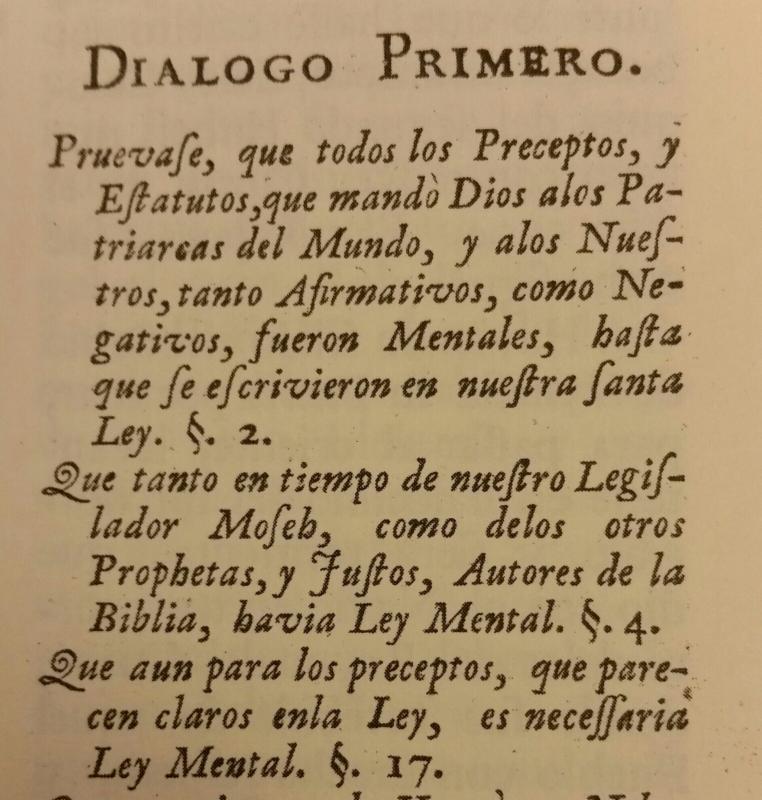
From my own experience I think the only difficulty a beginner reader will have is to identify the letter “S” when it is written at the beginning or in the middle of the word. In old Spanish (or English) the “S” in this position was “taller” than today, and the modern reader often confuses between the “S” and the “F”.  Beyond that, I think, it is very easy to read this book, and the advantages of studying a book of this category and this authority in the original are, I think, priceless.
To further facilitate the reading in Spanish, I will copy a short paragraph of the book and re-write it in a more modern version.
mate dan
Pruebase que todos los preceptos y  estatutos que mando Dios a los patriarcas del Mundo y a los Nuestros, tanto afirmativos como negativos fueron mentales, hasta que se escribieron en nuestra santa ley. Página 2
Que tanto en tiempo de nuestro legislador Moshe, como de los otros Profetas y Justos, autores de la Biblia, había Ley mental. Página  4
Que aun para los preceptos que parecen claros en la ley, es necesaria Ley mental. Página 17 
לע”נ שלומית קריגמן, ,23 הי”ד 


Rabbi Isaac Aboab da Fonseca (1605-1693), first rabbi of the Americas

Rabbi Isaac Aboab da Fonseca was born in 1605 in the town of Castro Daire, Portugal. His birth name was Simão da Fonseca. His parents were “marranos”, Jews who had been forcibly converted to Christianity. When Isaac was seven, the family moved to Amsterdam. Many Portuguese Jews who for a century lived as Jews in secret to escape the Inquisition, emigrated to Amsterdam, where freedom of worship was declared in 1596, something inconceivable until then in Christian Europe. There, they created a community that became very prosperous in every way.  Arriving at Amsterdam, the Aboab family was finally able to practice their religion openly. Simão renamed Isaac, with its ancient Jewish last name: Aboab (also spelled Abohab). In Amsterdam, Rabbi Aboab studied with one of the few rabbis who at the time were in the city: Rabbi Isaac Uziel, a native of the city of Fez in Morocco. At eighteen Rab Aboab was ordained as a Rabbi (hakham) of the Beth Israel community, one of three Sephardic communities that existed at that time in Amsterdam. In 1638 he was named as one of the four Rabbis in the main community of Amsterdam: “Talmud Tora”.


In those years the Dutch colonized several parts of Brazil. And many Jews from Amsterdam, who were prominent in international trade, moved to the city of Recife, in Pernambuco, Brazil. In 1641, Rabbi Isaac Aboab was sent to Recife as the rabbi of  “Kehal Zur”, the new congregation in Recife, the first Jewish community in the Americas. Rabbi Isaac Aboab da Fonseca was therefore the first official rabbi in the Americas. Most European citizens of this city were Jews from Amsterdam. In Recife Rabbi Aboab developed a beautiful congregation, modeled after the Jewish community in Amsterdam. “Kehal Zur”  had a synagogue, a Mikve and a Yeshiva, where Rabbi Aboab taught Torah, particularly Talmud.


Rabbi Aboab da Fonseca enjoyed a few years of prosperity in Recife. In 1645 the Portuguese began to attack the Dutch colonies in Brazil. The long history of these battles is too extensive to be discussed in these few lines. What we can say is that the Portuguese, when achieved victory, allowed an honorable surrender to all Dutch, but not to the Jews, who were ordered to convert. Several Jews escaped, among them the 24 Jews who in 1654 would reach the city of New Amsterdam, now “New York”.
On 26 January 1654 the Portuguese occupied the city of Recife in 1654. Rabbi Aboab escaped to Amsterdam. Back in Amsterdam, he was appointed as the chief rabbi of the Sephardic community in that city. In 1656, he was one of the rabbis who excommunicated Spinoza.
During the years 1664-1666 began a messianic movement around Shabbetai Zevi. Back then, most  rabbis of the world, Sepharadim and Ashkenazim, believed that Shabbetai Zevi was the Messiah. And although he was not militant, Rabbi Aboab was no exception. In 1666 when the Turkish Sultan gave Shabbetai Zevi the choice between death and conversion to Islam, he decided to convert. Jews understood then that they had been victims of a huge hoax, with devastating consequences for the global Jewish community.


Despite all these difficulties, the Jewish community in Amsterdam flourished under the Rabbinate of rabbi Aboab and it produced, among other things, hundreds of Talmide Hakhamim who served the community and wrote thousands of books in Spanish and Portuguese.


In 1647 rabbi Aboab wrote a Hebrew grammar book that has not yet been published “melekhet ha-Diqduq. He also translated from Spanish to Hebrew (sic) a Qabbala book written by Abraham Cohen Herrera, called ” Las puertas del Cielo” in Hebrew “Shaar HaShamayim”.
Rabbi Isaac Aboab da Fonseca died in Amsterdam on April 4, 1693, at the age of 88 years.