Rabbi Yom Tob Tsahalon, Purim and the First Book Ever Printed In Israel

EARLY LIFE

Rabbi Yom Tob ben Moshe Tsahalon (1559-1619), also known by his acronym מהריט” ץ, was a student of Rabbi Moshe of Tirani (the Mabbit) and Rabbi Moshe Alshekh haQadosh. He may have also occasionally studied under Rabbi Yosef Caro, author of the Shulchan’ Arukh. Rabbi Tsahalon was a child prodigy. From an early age, he combined advanced intelligence and a passion for studying Tora. Referring to his learning as a teenager with the Mabbit and Rabbi Alshekh, he writes: “I devoted myself to studying day, evening and night, without interruption … clinging to the dust of the feet of the two great luminaries [his two teachers] and drinking with thirst their words and teachings … [During all this time] I did not rest or pause, and I only dedicated myself to learning the Divine Judgments [the Laws of the Tora] …. I suffered the mockery of my friends when they saw that I was walking so strictly on these good paths; they despised me because I did not do what the youth of my age used to do … but I did not distract myself… since my greatest delight was always to learn Divine Laws … “The effort paid off. When he was 20 years old, the young Rab Tsahalon began to write his Pesaqim, his Rabbinic Responsa, something reserved for very experienced Rabbis. We have evidence that at the age of 25, some of the most important rabbis of that time, such as Rabbi Shemuel Yafe of Constantinople (1525-1595) consulted with the young rabbi Tsahalon, to know his opinion in all kinds of rabbinical jurisprudence cases. Some of those responses were published in the most famous book of Rabbi Tsahalon “She-elot Utshubot Maharitats”. The book was printed in Venice, Italy, in 1694  (see link here). It is a collection of Rabbinical questions and answers on Jewish rituals and legal issues.

THE BEST GIFT FOR PURIM

One of Rabbi Tsahalon’s lesser-known books, but perhaps the most fascinating, is a commentary on Megillat Esther, the Book of Esther. The name of the book is “Leqach Tob”. And I found three reasons to assert that this is an amazing book. 1. Rabbi Tsahalon published this book in the year 1577. Considering that he was born in 1559, he then published his book he was 18! Which means that he wrote this book in his early teens! 2. Like every good book, its content makes this work fascinating: Rabbi Tsahalon bases his commentary on two fundamental elements: 1. The Talmud, and the ideas of the Midrash. 2. a critical and meticulous analysis of the Biblical language, where many times a new meaning can be discovered by rereading the same text with a “mental microscope,” analyzing the almost imperceptible details of the Hebrew words. 3. Finally, what makes this book truly unique is that it was the first book ever printed in the land of Israel! Until the year 1577, there were no printing presses in Israel. Jewish books were printed mainly in Italy (Rome, Ferrara, Venice) or Turkey. The first printing press in the history of Israel was established in Tsefat by Rabbi Eliezer ben Ytshaq Ashkenazi, who had his printing in Lublin (Poland) and Constantinople (Turkey). Anyway, this printing press did not last long, only ten years, in which only the book of Rab Tsahalón and five other books were printed (for the fascinating story of the first printing press in Israel, see the article: “Early Hebrew Printing from Lublin to Safed: The Journeys of Eliezer ben Isaac Ashkenazi” by Marvin Heller). Rabbi Tsahalon dedicated this book to his father as a mishloach manot, a gift, for the festival of Purim.

We will now see a couple of examples of his commentary.

1. RELIGIOUS EXCEPTION One of the most famous questions of the Megilla is why Mordekhai refused to bow to Haman. The Midrash explains that Haman had an idol around his neck, which made him a representative (virtually: a human incarnation) of that god. Therefore, kneeling before Haman would amount to idolatry. The question then is: Why did Mordechai stay at the King’s court? If he could not kneel before Haman, he should have quit his position in the court and not endangered the lives of the Jews of the Persian empire! Rab Tsahalon (page 34) observed that the last words describing what Mordekhai did are written in the future tense, and although in many cases like this, this type of continuous tense can be understood as a past tense, in this particular case, we must preserve the original conjugation. Thus, this Pasuq would say, “All the officers at the King’s court knelt and prostrated before Haman because the King had so ordered … but Mordekhai should not kneel, and should not prostrate [before Haman]. “Thus, Rabbi Tsahalon explains that the King actually granted Mordekhai special permission, a religious exemption, so that Mordekhai, a known Jew, would not have to kneel before Haman. Obviously, Haman was not happy with seeing Mordekhay standing. Despite the King’s exception, Haman felt humiliated and plotted to kill the entire Jewish people in response. When he presents his case to the King, he never mentions anything about Mordekhay’s refusal to bow down. As far as I know, this explanation is unique and original to Rabbi Tsahalon.

2. 70 DAYS OF HORROR When you read the Meguilla, you must make a huge effort to visualize what the Yehudim must have suffered once the edict reached their residence. In that edict, there were explicit instructions that at a certain date, the 13th of Adar, all Jews would be killed. No appeals. No exceptions. This terrible letter from Shushan the 13 of Nisan (11 months before the “execution day”) and it must have arrived after a few days or weeks to all the corners of the empire. Now, what happened once the letter arrived? Were the Jews able to be free and continue with their lives? Were they allowed to escape? Part of the sinister plan of Haman was that the volunteer executors could keep the assets of the victims, so all the prospective volunteers wanted to make sure that no Jew escaped with anything of value until the day of the genocide. The Midrashim tell us that many times after the letter got there, many non-Jewish neighbors showed their sharp knives to the horrified Jewish mothers, mocking them and showing that they would kill their little children with those weapons. The Midrash also explains that the perpetrators celebrated in advance of the massacre and planned how to distribute the Jews’ assets and property possessions. In his book Leqach Tob, Rabbi Tsahalon explains that once the edict was publicly read, the Jews were “detained” or “imprisoned” (משועבדים), probably with the collaboration of the imperial army to prevent them from escaping with their possessions or from saving their lives. Thinking of 1940-1945 Europe, it is not difficult to imagine the “labor camps” where thousands of Jews must have been imprisoned and awaiting the day of their execution. The Jews were not able to do anything to defend themselves. They prayed, fasted, and hoped for a miracle. Which ultimately happened. It took 70 days until the second letter was sent from Shushan reversing the mandate and “condemning to execution all those who planned to execute the Jews”.

You can find this and other original insights of Rabbi Tsahalon in his book Leqach Tob  (hebrewbooks.org).


Rabbi David Nieto (1654-1720) and the Sephardic community of London

Portrait of Rabbi David ben Pinehas Nieto
 

FROM VENICE TO LONDON
Rabbi David Nieto was born in Venice, Italy, in 1654. At an early age he moved to Livorno, a very important Jewish community at the time, and devoted himself to Tora study. In Livorno, he acted as a rabbi, Dayan and also as a physician , since like many other rabbis in Italy at that time, he studied medicine at the University of Padua. Rabbi Nieto was also a Renascence man: a distinguished scientist, philosopher, physician, poet, mathematician, and astronomer. In 1702 at the age of 48 he was appointed Hacham of the Sephardic Community of London “Sha’ar HaShamayim”. Let us remember that the Jews were expelled from England in 1290, during the reign of Edward I, and did not return for centuries. In 1655, following the intervention of the famous Rabbi Manasseh ben Israel, Oliver Cromwell readmitted Jews to England and thus began what is to this day called the  Spanish and Portuguese Sephardic community and its splendid building, Bevis Marks, the oldest synagogue in England (see here). The first members of this Spanish-Portuguese community in London were mainly Jews from Amsterdam, including some highly successful businessmen. All members of the community spoke and wrote in Spanish or Portuguese, since they or their parents were originally from Spain or Portugal. Rabbi Nieto served the London community until his death in 1728. His son, Rabbi Isaac Nieto, was appointed in his place as rabbi of this community.

HIS FIRST BOOKS
Rabbi Nieto wrote his first book on one of his favorite subjects: the calendar. “Pascologia”, was written in Italian and explains the differences between the Gentile calendars—the Greek Orthodox calendar, the Roman calendars—and the Jewish calendar, showing the miscalculations in the gentile calendar since the first Council of Nicaea. (325) until 1692. Two years later, he published his book “De la Divina Providencia” which explains, among other things, that the concept of “nature”, as opposed to “Creation”, is a secular idea. The way Judaism explains the dynamic between God and Creation is by using the verbal construction “hif’il” which in Hebrew defines when: “A” causes “B” to produce “C”. Thus, for example, when the Sages describe that the Creator produces rain, they formulate the idea using this conjugation. For example: mashib haruach morid hageshem, which means: God (A) produces natural phenomena (“B”) —temperature changes, air pressure air, etc.— that produce wind and rain (“C”). What  Gentiles call “nature” is, so to speak, God’s modus operandi. But nature cannot be confused with God, as Spinoza, a contemporary of Rabbi Nieto, affirmed. This book was highly praised by the famous Hacham Zevi Ashkenazi and by Rabbi Hayim Yosef David Azulai (the “Jidah”).

THE SECOND CUZARI
Rabbi David Nieto’s most famous book is undoubtedly “Matteh Dan” (this is how the author writes these two words in Hebrew). It was written in a bilingual edition: Hebrew and Spanish, and published in London in 1714. In this book, Rabbi Nieto shows the authenticity of the rabbinical tradition (Tora SheBealpe) demonstrating the intellectual integrity of the rabbis of the Talmud. He explains that the disagreements among the Sages—supposed evidence of a faulty tradition—never focus on the essential laws of the Torah (shorashim or roots) but only on the details (anafim or branches) of the commandments, or the new halakhic cases that had no legal precedent. “Matteh Dan” is also called the Second Cuzari, and is divided into five chapters, which the author calls “dialogues”, because it was written in the style of imaginary conversations between a rabbi and a gentile king, “the Cuzari”, the king of the Khazars. Rabbi Nieto explains that the reason he modeled his book after the famous book by Rabbi Yehuda haLevi (1075-1141) is that “…the Cuzari demonstrates the truth of the Written Torah, and this book, which will be called the second Cuzari will prove the truth of the Oral Torah.”

MATTEH DAN, CHAPTER BY CHAPTER
1. In the first dialogue Rabbi Nieto demonstrates that the Oral Torah existed even before the written Torah, and that an oral tradition is always necessary to understand any written law.

2. In the second dialogue, in my opinion the most original of all chapters, Rabbi Nieto proves —using arguments and principles of history, psychology, logic, and even economics— that the Oral Tora could not have been made up by the rabbis, because it benefits no one, particularly the rabbis who transmitted and sanctioned it. Rabbinic Judaism, he says, was received and passed down from generation to generation with extreme care and devotion.

3. The third chapter talks about the different categories of laws included in the Oral Torah. He also explains what kind of laws there is consensus among the rabbis and what laws do not.

4. The fourth chapter shows that the Sages of the Mishnah and the Gemara (חז”ל) had a very deep knowledge of the sciences, such as medicine, physics, biology, etc.

5. The fifth chapter deals with the Hebrew calendar. Knowledge of the calendar demands a very deep expertise on astronomy, physics, mathematics, etc. Because it is the only calendar that combines the lunar year —354 days— with the solar year —365 days— and for this combination to be calculated accurately, it is necessary to know very precisely the exact duration of the moon’s cycle and the exact duration of earth orbit. Rabbi Nieto mentions that the Christian calendar, which is only based on the orbit of the earth around the sun, had to be modified by Pope Gregory XIII in 1582: that year the calendar jumped from October 4 to 15 in 24 hours, and all this was because gentile scientists did not have the exact information of the solar cycle. The Elders of Israel knew the lunar cicle with an accuracy of 5 decimal places, something that was recently confirmed by NASA (see Video below). This is perhaps the most technical chapter in the book, and one that can be difficult for the beginner, but it is a must-read for those who want to know more about the details of our Hebrew calendar, and understand the role that rabbinic tradition plays in it and in many other cases.

WHAT AUDIENCE IS THIS BOOK ADDRESSED TO?
Rabbi Nieto wrote this book for the bene anusim of his time, that is, for the descendants of those Jews who, due to the Inquisition in Spain and Portugal, lived as Christians for generations, and now returned to Judaism and wanted to know more about it. Many Bene Anusim were university students, professionals, doctors, and knew the Bible very well —because of their Christian background— but they were completely ignorant of the Jewish Oral Tora and its principles. Matteh Dan was also written with religious dissidents in mind, such as the disciples of Spinoza and Uriel de Acosta, who criticized Rabbinic Judaism.
Matteh Dan should be required reading for anyone beginning to study the Mishnah and Gemara, or for anyone wishing to understand the most basic principles of normative Rabbinic Judaism.


Rabbi Portaleone And The Four-Hours A Day Tora Curriculum

EARLY LIFE
Rabbi Abraham Portaleone (אברהם משער אריה , 1542-1612) was born in the city of Mantua (Mantova), Italy. The family of Rabbi Abraham was in a comfortable economic position and that allowed the family, among other things, to provide the children with the best possible education, both in Tora and secular studies. The young Abraham began studying Tora with his father, as was the tradition at that time. Then, his father hired for him private tutors who were great Tora luminaries, like Rabbi Moshe Kazés,  and Rabbi Ya’aqob MiPano. He also studied in depth the books and ideas of Maimonides with Rabbi Yosef Sinai. His rabbinic ordination was given to him by his mentor, Rabbi Abraham Provenzal, who was  his constant source of inspiration (רבו המובהק). With him, Rabbi Portaleone emphasizes, he had the merit to study Gemara, that is, the Talmud. Seemingly, this observation seems to be an unnecessary emphasis, unless we remember that the endless persecutions that Jews had to endure in Christian Europe included the confiscation and burning of every copy of the Talmud that the Church and its officers were able to find.  In 1553, for example, the Inquisitors confiscated every copy of the Talmud and in Rosh Hashanah of that year ( September 9th) the Talmud and many other Jewish books were burnt in the Campo dei Fiori. In 1559  by the order of Paul IV, one of the most antisemitic Popes ever,  Jews had to deliver their Talmud or risk to be expelled and their properties confiscated. From April to May of that year, the Church burned between ten and twelve thousand volumes of the Talmud. Thus, throughout the remainder of the sixteenth-century, a complete edition of the Talmud could not be found anywhere in Italy.

DOCTOR IN MEDICINE

Parallel to his Tora studies, the young Rabbi Portaleone studied medicine. For Sephradic and Italian rabbis, practicing medicine became the source of a dignified income. The Portaleone family already had four generations of doctors. Rabbi Provenzal himself taught the young Abraham the basics: physiology, sciences and Latin, the language of academic studies. After three years of intensive studies, Rabbi Portaleone received his Doctor of Medicine degree from the University of Pavia, a city near Milan, at the age of 21 (sic!). In his book Shilte haGibborim he asserts that even during those years that he studied medicine intensively, he never spent a day without studying Tora. And he credits his consistency in Tora studying to the inspiration of Rabbi Provenzal.   At the age of 24, he received his license to practice medicine from 35 doctors in the city of Mantua.  At the beginning he worked under his father in his medical practice and little by little he replaced him, since his father was no longer in good health. In those days, Jewish doctors were forbidden to treat non-Jewish patients, unless they had special permission. In 1573 Pope Gregory XIV granted Rab Portaleone a special dispensation to treat Christian patients. He was also appointed as the Doctor of Don Guglielmo Gonzaga, Duke of Mantova and at his request he wrote two treatises on medicine: the best known is a book about the healing properties of gold. Throughout his life, he also served as the Mohel of the community: he reports to have performed the circumcision of 360 babies. He was also the chief physician of the Jewish community, and treated the needy members of the community for free.

SHILTE HAGUIBBORIM
At the age of 62, Rabbi Portaleone was affected by hemiplegia, a paralysis on one side of the body.  He spent nine months prostrated in bed. When he finally recovered, he began to write his masterpiece, the book “Shilte haGuiborim”. This text was written as a guide for prayer and Tora study for his three children (two of them were also physicians), and most of the book’s 90 chapters are dedicated to the Bet haMiqdash, the Holy Temple of Jerusalem, since the prayers that we recite are actually instead of the service in the Holy Temple. The author describes the  building and architecture of the Temple, the utensils that were used there, the Divine Services, –the sacrifices, the incense, etc.   Shilte haGuibborim is perhaps the most comprehensive  book ever written on the Temple of Yerushalayim.  It is practically an encyclopedia of everything you need to know about the Bet HaMiqdash. In addition, the author enriches our knowledge comparing every topic with contemporary scientific, technical and historical information, showing that the Tora anticipated present knowledge by centuries or thousands of years.  The book describes, for example, the different songs the Levites used to sing, and the musical instruments used in the Temple; gemology and mineralogy to identify the stones Cohen Gadol used to wear. My favorite is the eleven chapters (78-88) he devotes to explore and identify one by one all the plant and species used in the Qetoret (Incense).

MAAMADOT

In the times of the Bet HaMiqdash, sacrifices and incense were offered daily. These tasks were performed by the Cohanim and Leviim.  The 24 guards of Priests who served two weeks every year, are known as Mishmarot.  While the services were performed in the Temple, inside the Temple (see main picture) and outside the Temple in towns across Israel. A select groups of volunteers, 24 groups, mostly Israelites, but also Cohanim and Levites,  participated in a different kind of Divine Service: devoting a few hours a day to intense prayer, fasting and Tora study: focusing each day of the week on a different text. These groups were known as  Ma’amadot  (see more information here).     Now, the sacrifices can no longer be offered because the Temple no longer exists, but following the Rabbis’ idea, we “replace” the sacrifices with our prayers: Shacharit, Mincha and Arbit.  From the other side, we don’t need to “replace” the Ma’amadot. Rabbi Portaleone was of the idea that we should “reenact” the Ma’amadot through an elaborated  study program, a Tora curriculum, of texts to be recited and studied every day.  He exhorts his son –and his readers– to adopt this regimen of four hours of Tora study, which he calls Ma’amadot.  The program includes: Biblical verses of the Parasha of the week, the Aramaic translation, texts from the Prophets, the Scriptures (Ketubim),  Mishna,  Talmud, Mdrash  and the Zohar. Unlike the famous book Hoq LeIsrael, Rabbi Portaleone’s daily program is divided into three sections or sessions: the first session, which should last for about two hours, should be studied in the morning (Shacharit). The second session, around thirty minutes, in the afternoon (Mincha). And the night session, which should take an hour and a half, is for the night (Arbit).  According to Rabbi Portaleone, these four hours –a sixth of our day– is the minimum time a Jewish individual needs to devote to the study of Tora.

LEILUY NISHMAT

Abraham ben Shafia Abadi z”l

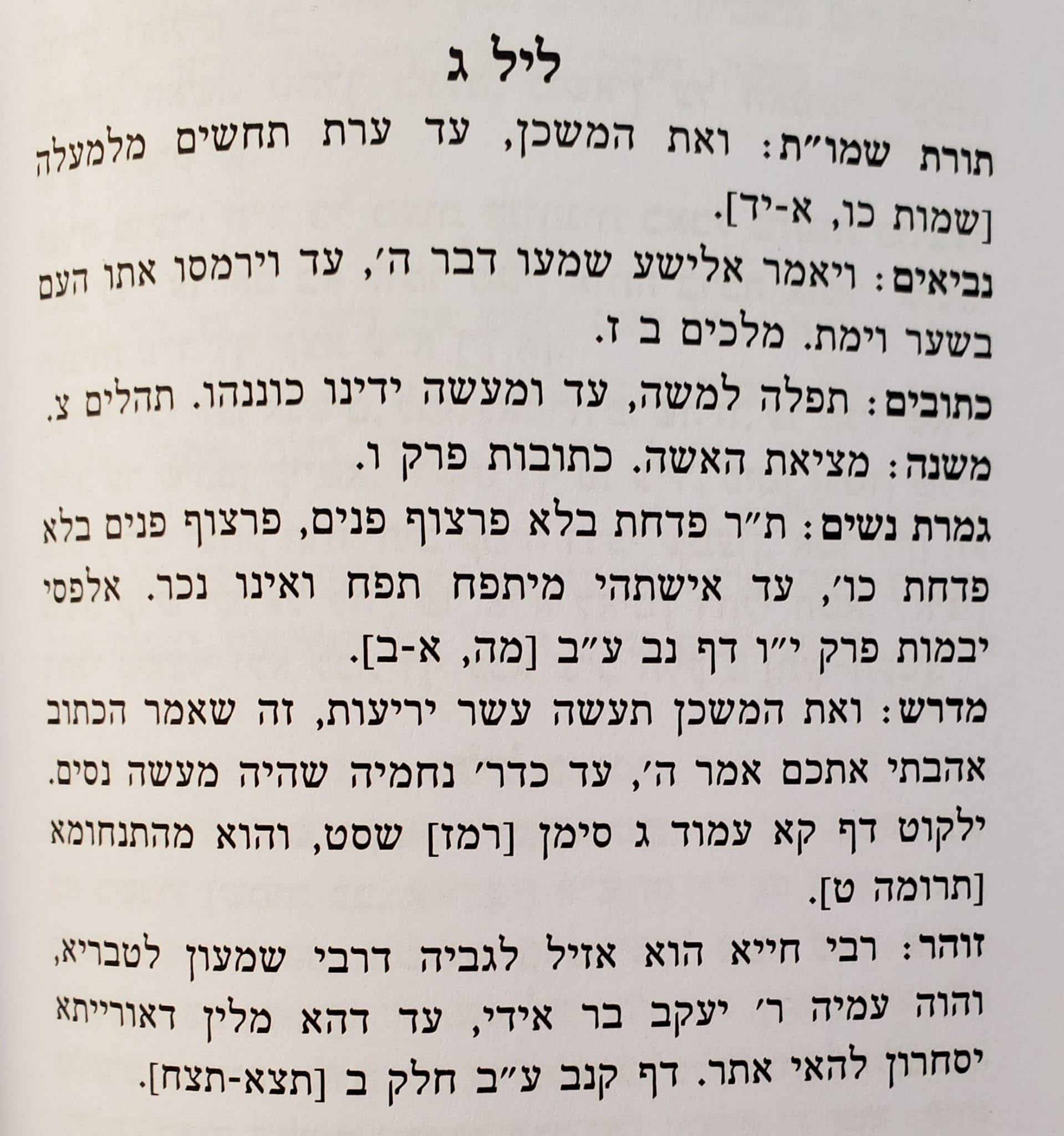
We present here a text with an example of the Tora program corresponding to Tuesday of the week of Parsahat Teruma, night session.

How did I find this book?

This book came to my hands, literally, from heaven.  Around three months ago, there was a big snowstorm in NY on a Thursday.  The next day,  JFK Airport was closed, and hundreds of Shomer Shabbat Jews got stacked in NY for the weekend.  In our community we hosted for Shabbat 12 young boys and girls from Argentina. And we had also an unexpected guest of honor, also affected by the storm, who visited anonymously our Synagogue: Mr. Shlomo Neeman, the current mayor of Gush Etzion, Israel.  
Among many other things we discussed, he told me about a special Kolel in the city/settlement Karme Tsur, where he and his family live.  In this Kolel, Bet haBehira, the students study EXCLUSIVELY the laws and subjects pertaining to the Bet haMiqdash.     A short time later, Mr. Neeman graciously mailed me a copy of the book Shilte haGibborim, which I never knew before. It is a new modern and beautiful edition, published in 2010 by the Kolel Bet haBehira, with an introduction by Rabbi Shalva, the head of the Kolel, and commentaries by Rabbi Abigdor Neventzal, an expert in the field.
 I’m holding the book right now in my hands…. and I can’t let go! 
The book Shilte haGibborim is unique. I call it “the book of the future”, because B”H, very soon this book will probably serve as the main reference we will use for everything related to the Abodat haQodesh of our Third Bet haMIqdash, תותבב”א
If any reader wants to order the book, or make a donation to this wonderful Kolel כולל בית הבחירה,  you can do it via PayPal using the following email address of the Kolel: “kolelb@gmail.com”.


Rabbi Obadia de Bertinoro (1455-1515), from Italy to Jerusalem

EARLY LIFE

Rabbi Obadiah ben Abraham of Bertinoro, popularly known as “Bartenura”, was born in 1455. He was a student of the famous Rabbi Yosef Colon, מהרי”ק, and served as rabbi of his own city, Bertinoro, in the province of Cesena, Italy. There he also worked as a banker. His name is mentioned at the top of the list of bankers authorized to grant loans to Christian residents in an official document of Pope Innocent VIII, dated February 12, 1485. When he was 30 years old, he decided to move in the land of Israel, and settle specifically in Yerushalayim, Jerusalem. We have a detailed description of his journey to Israel – which in those days was neither easy nor short – since many of the letters describing this trip were found and published, as we will mention later on.

FROM ITALY TO JERUSALEM

At the end of 1486 he left his native city. He went through Rome and Naples and finally arrived in Palermo, Sicily, where he spent three months preaching every Shabbat in the local synagogue. In Palermo, the main city of Sicily, there were around 850 Jewish families, all living in the same quarter located in one of the best areas of town. The Jews were artisans, blacksmiths, and farmers. The community leaders of Sicily tried to convince him to stay as Rabbi of that Synagogue, but he refused the offer because his greatest desire was to settle in Yerushalayim. He traveled through Rhodes, Greece, and Alexandria, Egypt, where he arrived in early 1488. From Alexandria, he proceeded to Cairo, where Rabbi Natan ha-Kohen Shoulal, the chief leader of the local community (naggid), received him with great honors. There, too, he was offered to remain as a rabbi. The leaders warned him that the situation of the Jews in Jerusalem was very precarious and beyond repair, but he again refused. He continued his journey through Gaza— the fourth-largest Jewish city those days (after Jerusalem, Safed, and Hebron)—and from there he moved to Hebron. He finally arrived in Yerushalayim on the eve of Passover 1488. Upon his arrival, he was received by the rabbi of the city, and stayed in his house for the rest of the holiday.

IF I FORGET YOU, OH JERUSALEM…

In those years, Jerusalem was under the control of the Mamluks, a Muslim group that ruled the city until 1517. Some 4,000 Gentile –Muslim and Christian– families lived in Jerusalem. The local Jewish community numbered approximately 70 families.  The wealthiest had fled because of the exorbitant taxes demanded by the Mamlukes. The poor had nowhere to go, and their life became unsustainable. Many were literally starving to death. As Rabbi Obadiah writes: “in the city there were many widows and poor old men…those who have some bread to eat…are considered to be rich…”. Rabbi Obadiah also says that the person who received him upon arrival was an Italian rabbi, Ya’aqob from Colombano. This man was so poor that he was only allowed to eat a piece of bread during Shabbat, while during the week he ate the dried carob pods that the producers discarded after producing the famous syrup known as “carob honey” .

THE SYNAGOGUES

Rabbi Obadiah also writes that a few years before his arrival, there were some 300 Sifre Torah in Jerusalem—ritual Torah scrolls that are read in the Synagogue. But now, virtually all the Scrolls disappeared.   The “me’ilim” , that is, the decorated covers made of fine fabrics that wrap these scrolls; and the decorations that are often made of precious metals, also vanished because the synagogues were frequently looted. The only Synagogue that still operated in Jerusalem was very precarious, narrow and dark. However, the Rabbi notes that the prayers in Jerusalem were not comparable in their beauty to any other place he had prayed. On Saturday mornings, the rabbi writes, “the men rise an hour or two before dawn to sing the sweet religious poetry (baqashot), …then they recited the Kaddish, and then two officiants (chazanim) began the prayers with the recitation of the Shema Israel, at exactly sunrise (vatiquin).

CORRUPTION

Rabbi Bartenura complains about the widespread corruption in Jerusalem. He recounts as an example that a Muslim man killed his own mother, slashing her throat with a knife, in a moment of rage. When they brought him before the local court, the murderer justified himself by saying that he was drunk.  Muslims are forbidden by their religion to drink alcohol, and therefore they do not produce or sell alcoholic beverages. What was then the verdict of the judges? The court blamed the Jewish community for producing wine, which caused this man to get drunk and murder his mother. The judges, who were always looking for some economic benefit, imposed a fine of 6 gold coins on the Jewish community, and the murderer was set free.

FROM YOUR RUINS I WILL BUILD YOU. מחורבותיך אבנך

Rabbi Obadiah committed himself to restore Yerushalayim, and he did that, single-handedly. He had to personally take care of all the material needs of the community. Including, for example, digging the graves in the Jewish cemetery and burying the dead, as no one else was able, or strong enough, to engage in this religious duty. The Rabbi then decided to devote his effort to raising funds for the Jewish community of Yerushalayim. He reached out to his family, friends and acquaintances in Italy, who generously provided him with funds to assist the poor. Over time and thanks to the solidarity of the Italian Jews he was able to establish charitable institutions and medical infirmaries for the sick. Emanuel Hai Camerino of Florence, who was in charge of administrating Rabbi Obadiah’s state in Cesena, would send him 100 ducats (gold coins) every year, to which he added another 25 ducats from his own pocket for charity. In this way the Jewish community grew and also the name of the main benefactor:  Rabbi of Bertinoro. Since he arrived in Jerusalem, he brought a huge blessing to the entire city. Within a few years, thanks to Rabbi Obadiah’s excellent reputation for integrity in Jerusalem, Muslims themselves were turning to him for legal disputes and business disputes, knowing of his wisdom and honesty.

FROM CASTILE TO JERUSALEM

In 1492 the Jewish world was shaken by the news of the expulsion of the Jews from Spain. The refugees soon arrived in Turkey, Egypt, Safed and also in Jerusalem. Rabbi Obadiah became the spiritual leader of these refugees and helped them to support themselves, since they arrived without any money, and in order to stay in the city they had to pay the tax to the Mamluk government, the jiziah, which was charged per person. Which meant that with the increase in the Jewish population, the already heavy taxes increased even more. However, after a few years, these Jews who came from Spain with nothing but had professional skill and training in international trade, began to grow economically, and the Jewish community of Yerushalayim flourished again!  As a token of their enormous gratitude to their benefactor, the refugees from Spain and Portugal granted Rabbi Obadiah of Bertinoro the best gift he could have dreamed of: they built him his own Yeshiba (rabbinical academy) in Yerushalayim! The first Yeshiba in Jerusalem after 1200 years!

Rabbi Obadiah was named “abi hayishub”, patron or maximum benefactor, of the city of Jerusalem.

He died in 1515 and his body rests in the Har HaZetim (Mount of Olives) the most famous cemetery in Yerushalayim.

REVIVING THE HEBREW LANGUAGE

Rabbi Obadiah of Bertinoro is primarily known for his commentary to the Mishnah, a text that comprises the oral rabbinical traditions, that is, the application and details of all the precepts of the Torah. The Mishnah is usually studied in conjunction with the Gemara (Talmud) which explains, expands and elaborates on the details of the Mishna. Maimonides was the first rabbi to write an independent commentary on the Mishnah. Rabbi Obadiah followed his example and wrote his own commentary, which became the most popular for centuries. To the point that it is difficult to find an edition of the Mishnah that does not contain the “Bartenura commentary”.  Rabbi Obadiah’s book was more accepted than Maimonides’ commentary because Maimonides originally wrote his commentary in Arabic, while Rabbi Obadiah’s commentary was written in Hebrew.

Aside from this work, Rabbi Obadiah also wrote a book on Rashi’s commentary to the Tora called amar neqe (See Daniel 9:7, עמר נקא “Pure Wool”). He also wrote three long letters describing in detail his journey and containing invaluable descriptions of the people and customs of the Jewish communities he visited in his journey from Italy to Jerusalem. These letters were addressed to his father and his brother and were published under the name “Darkhe Ẓion” (the Roads leading to Zion, Jerusalem) and “HaMasa le-Eres Yisrael” (The journey to the land of Israel) .


Rabbi Ya’aqob Castro (1525-1612) and the Jewish community of Egypt

FROM SEPHARAD TO EGYPT

Rabbi Ya’aqob Castro was a Tora scholar, a rabbinical judge, an author  and a leading lawmaker (poseq) in the Cairo Jewish community. 

The Castro or “de Castro” family was originally from southern Spain. At the time of the expulsion they escaped to Portugal and from there, many members of that family arrived in Turkey, North Africa, Egypt, etc.

The father of Rabbi Castro (some historians say he was his uncle) was the famous Abraham de Castro (died in 1520, see here). Abraham de Castro was one of the most prominent Jews of his time. He was the manager of the Royal Mint of the Turkish Sultan Suleiman the Magnificent (1494-1566), the most powerful man in the world in those years. In his honor, the Sultan agreed to reinforce the walls of Jerusalem adding several rows of solid rock to the original wall. This stones are still there to this day.

HIS TEACHERS

Rabbi Ya’aqob de Castro belonged to a wealthy family. Apart from being a  rabbi, Rabbi Castro also engaged in trade, something that was common among rabbis living in Egypt, such as Rabbi David ben Zimra or Rabbi Isaac Luria(the Ari haQadosh) who dealt with import and export of pepper and grains.

Rabbi Ya’aqob was a student of two great luminaries: the illustrious Rabbi David ben Zimra (Radbaz), and Rabbi Levi ibn Habib (Ralbah) of Yerushalayim. Rabbi Ya’aqob is also known by his acronym Mahariqash (מהריק”ש), and he is considered the last “Chief Rabbi” of Egypt, that is, the rabbinical authority accepted by all the communities of the country, including the two most important: Cairo and Alexandria. At that time most of the Jews of Egypt were musta’arabim, that is, indigenous of Egypt; while the community of the Sepharadim, that is, the refugees of the expulsion from Spain, was just beginning.

RABBI CASTRO AND RABBI CARO

In 1570, he visited the city of Sefat in Israel, where he was invited to the home of Rabbi Yosef Caro (1488-1575), the author of the Shulhan Arukh. In his writings, Rabbi Castro describes his encounter with Rabbi Caro and relates, probably with deep emotions,  seeing with his own eyes Rabbi Caro acting in accordance with the customs that he himself had established in the Shulhan Arukh.

Rabbi Castro wrote several books. We will mention two of them.

“Erekh Lehem.” Glosses and comments that Rabbi Castro wrote in the margins of his manuscript copy of the Shulhan Arukh. In these notes he expresses his opinion, and sometimes his objections, to some halakhic determinations of Rabbi Yosef Caro. The reputation of Rabbi Castro was so high that in Egypt his opinion had more weight than that of Shulhan Arukh himself.

LIFE IN THE JEWISH COMMUNITY OF EGYPT

Another of his works is “Ahole Ya’aqob”, a book of rabbinical responsa on real cases that happened in his community. This book also presents the Halakhic debates between Rabbi Castro and some of his contemporaries, which allows us to have a better vision of his legal thinking.

It should also be noted that this book of Rabbinical questions and answers is a priceless source of information for historians to learn a little more in detail about the social and community life, and the difficulties of the Jewish community in Egypt in the 16th century.

SOME EXAMPLES

One of the Taqanot, or community decrees, that Rabbi Castro mentions in one of his answers, is related to the mores and etiquette that should be observed in the celebration of wedding parties. Apparently, in some weddings, gentile dancers were hired as part of the celebration; this caused more than once some improper attitudes. Rabbi Castro, together with the other rabbis of the city, forbade this practice and encouraged the community to hire only musicians, and not dancers.

Another controversial issue that appears in his questions and answers is the legal status of the claim of a wife who refused to live in the house of her in-laws, in a situation where there was no mistreatment from their part. Rabbi Castro debated with another very famous Egyptian rabbi, Rabbi Hayim Kafusi, about considering this claim as a justified cause for divorce.

Finally, I will mention a more sensitive topic. Rabbi Castro dealt with the case of two young married men, members of his community, who went out of town in a business trip and disappeared. Two Egyptian men, father and son, testified that these merchants were attacked and killed by a gang of 12 assailants. The Halakhic question was whether this testimony was enough to declare the wives of these merchants as widows, and allow them get married again. Rabbi Castro adopted a more strict opinion, since the evidence was ambiguous, and he considered that the witnesses could obtain a personal benefit from his testimony. Rabbi Kafusi confronted Rabbi Castro and presented an more permissive opinion so that these two women would not be trapped (agunot) in a situation without a possible solution.


Rabbi Yosef of Terani (1569-1639) and the Philanthropists  of Constantinople


LIFE IN ERETS ISRAEL in THE 16th CENTURY

Rabbi Yosef of Terani (or “Miterani” רבי יוסף מטראני) was born in Safed, Israel, in 1569. He is considered one of the leading Talmudists of his generation. He is also known by the initials of his name “Maharit” (Hebrew: מהרי”ט). His father was the famous rabbi Moshe de Terani, author of Beth Eloqim. He died when Yosef was 12.  From that young age Rabbi Yosef was adopted, and he became the favorite student, of the great sage Ribbi Shelomo Sagis.  Rab Yosef married in 1586 and that year a great plague broke out in Safed that claimed the lives of many Yehudim and among them Rabbi Sagis.  Rabbi Yosef left the land of Israel and escaped to Egypt, where he lived with his brother Shelomo, who was a community rabbi in Egypt. He spent 15 years in Egypt devoting himself to intensive Talmudic studies.  When he returned to the land of Israel, he lived in Safed and then in Yerushalayim, where he wrote the book “Tsurat haBayit”, describing the design and architecture of the Bet HaMiqdash. This book, unfortunately, has been lost, and we only know about it because it was quoted in the book of one of his students, Rabbi Hayim Alfandari.  Rabbi Yosef was already famous at this time. He received and answered numerous Halakhic questions which were coming from all over the Jewish world. But living in Erets Israel then, was becoming very difficult and Rabbi Yosef and his family suffered poverty, disease and persecution.

FROM SAFED TO CONSTANTINOPLA

After a few years Rabbi Yosef moved to the city of Constantinople, in Turkey, where he found a large Jewish community established by the Jews expelled from Spain, known as Sepharadim. In Constantinople, Rabbi Yosef was welcomed enthusiastically by the Ben Ya’ish brothers, who were very kind benefactors and Jewish patrons. The Ben Ya’ish brothers hosted Rabbi Yosef at their state and offered to maintain him and his family with dignity while he dedicates himself to teach Tora and to write his books. From that moment all the hardships of Rabbi Yosef came to an end, and without serious material concerns he dedicated fully to teach Tora. Under the wings of the Ben Ya’ish brothers Rabbi Yosef established a Yeshiba, or rabbinic academy, which he called “Qahal Qadosh Gerush”, the holy congregation of refugees from Spain. This Yeshiba became a magnet for young Tora scholars who came from all over the world to study with Rabbi Yosef. According to the testimony of his children Rabbi Yosef had more than 80 students studying directly under him.

CHIEF RABBI OF TURKEY

After 20 years of arriving in Turkey, Rabbi Yosef was also chosen as the head rabbi of Constantinople. As such, he was granted the title of Hakham Bashi, the chief rabbi of Turkey, which at the time was the most prosperous Jewish community in the Jewish world. Apart from continuing teaching, Rabbi Yosef decided to improved the community’s system of social assistance, training and using his own Rabbinical students for this important task. He sent his students to visit the sick, console the mourners, assist the brides and grooms, and to distribute food, clothing and everything necessary for the poor, the widows and the orphans. Among his students we can mention for example: Ribbi Hayim Alghazi, Ribbi Aharon DeLapapa and Ribbi Hayim Benveniste, all of them became very famous rabbis and served in different communities. 

HIS LAST WISHES

Rabbi Yosef was blessed with many children,  all of them became great Tora scholars. Before dying he asked two things from his children. 1. That they publish his books, which were in manuscripts. And 2. to take his remains to the land of Israel, so that he could be buried close to his father. Shortly after his death, in 1639, his children faithfully fulfilled his two wishes.


HIS BOOKS

Among the books of Rabbi Yosef Miterani stands out his collection of 152 questions and answers that were published in Constantinople in 1641.

In this link you can get another book of Rabbi Yosef, Tsafnat Pa’aneah, (Frankfurt, 1694) a commentary on the Tora. One illustration: In the first pages of this book Rabbi Yosef exposes 15 different ways, opinions and insights about the nature of Adam’s first sin —eating the fruits of the forbidden tree. How is it that this sin caused man to perceive himself naked; why the Creator dressed him with a garment of leather (or “light”, according to Ribbi Meir), etc.

HIS GRAVE

His children took his remains to Safed, and buried their father there. For some reason the exact place of his grave was not known for centuries. However, in 2008 his resting place was identified in the old cemetery of Safed, next to the grave of rabbi Moshe Alshekh, by Rabbi Shelomo Epstein.


Rabbi Abraham Azulay (1570-1643) and the Sultan’s Sword in Hebron

From FES to HEBRON

Rabbi Abraham Azulay (also “Azulai) was born in the city of Fes, Morocco, in 1570. The city of Fes was a very important Jewish center where many Jews found refuge when they escaped the expulsion from Spain.

The family of Rabbi Azulay also came from Spain (Castilla). Living in Fes was far from being in a paradise. Apart from the constant persecution by Muslim extremists, the area was very poor and often suffered from long droughts. Rabbi Shaul Serero says that in the Jewish community of Fes, between 10 and 20 people died every day… of starvation. After one long drought that lasted for more than 3 years, Rabbi Azulay left Fes and headed towards the land of Israel. Traveling by sea was extremely dangerous. When rabbi Azulay arrived near the port of Capotakia (Port Said) a great storm destroyed his ship and all his belongings sank. Miraculously, Rabbi Azulay survived and arrived (presumably swimming) to the coast. This miracle was never forgotten by Rabbi Azulai. And as a sign of his eternal gratitude to HaShem for this miracle, Rabbi Azulay designed his signature in the shape of a boat (see illustration above).

From HEBRON to GAZA

Once he arrived in Israel he settled in the city of Hebron (also known as Kiryat Arba) where he met with the great rabbis of that time such as Rabbi Eliezer Arha and others. But a terrible epidemic broke in 1619 and rabbi Azulay had to leave the city of Hebron and he moved to Yerushalayim. But the plague also reached Jerusalem, and Rabbi Azulay moved to the city of Gaza where he lived for some years. At that time 70 Jewish families lived in Gaza. Some families were engaged in agriculture and others in commerce, since Gaza was part of the trade route between Syria and Egypt. The Rabbi of Gaza between 1620-1625 was the illustrious rabbi Israel Najara (a native of the Spanish city Nájera), who befriended rabbi Azulay .  In Gaza, Rabbi Azulay wrote two of his most famous books: a commentary on the book of the Zohar “Hesed LeAbraham” (“The goodness that God did with Abraham”, in reference to the fact that he himself, Abraha, was twice saved from the terrible epidemic that claimed so many lives). He also wrote “Ba’ale Berit Abram”, a mystical commentary on the Tora.

COMMENTARY ON THE MISHNA

Rabbi Azulay is known for his mystical writings  but he also wrote a few traditional rabbinical works.  One of the least known books of Rabbi Azulay, is “ahaba bata’anuguim”, a beautiful and extensive commentary on the Mishna. In this book, unfortunately not as well known as his books on mysticism, Rabbi Azulay explains the elementary meaning of the words and ideas of the Mishna  —following the footsteps of Maimonides— incorporating the commentaries of the Talmud, the midrashim and other famous books, including Geonim, Rishonim and the Shulhan Aruch. He also mentions the teaching of some rabbis who lived in Erets Israel on those days , and of whom nothing else is known to us, like Rabbi Soleiman Ohana and Rabbi Yosef Ashkenazi, the “Tana from Safed”.  This book was republished in Israel recently (1985, Seder Neziqin). It was edited among others by Rabbi Masud Ben Shimon ( had the privilege to study under him in my youth)  and the introduction of this new edition was written by none other than Rabbi Obadiah Yosef (see the book HERE.    We also present HERE a link where you can download the comment of Rabbi Azulay on the Mishna of Pirque Abot, (courtesy of hebewbooks.org).

When the plague ended, Rabbi Azulay returned to Hebron, where he lived until the end of his days.

THE SWORD IN THE CAVE of MAKHPELA

In 1643 the Sultan of the Ottoman Empire, Mohamed IV, the most powerful man on earth in those days, visited the land of Israel and came to Hebron, and following the Muslim tradition, went to pray in Me’arat HaMakhpela, the cave where Abraham, Yitshaq and Ya’aqob are buried. At the time, there was a very deep hole on the floor of the hall dedicated to Yitshaq Abinu, through which there was access to the interior of the original cave of Makhpela. But nobody entered there, since it was considered very dangerous, perhaps due to the absence of oxygen, the presence of toxic gases, etc. The Sultan came very close to the hole and when he bent to take a closer look his valuable sword, made of gold and ornamented with diamonds,  fell down the hole. The Sultan sent a pair of soldiers tied with ropes to bring the sword back, but both died. The local Arab leaders decided that they would not risk the lives of other Muslims and demanded the Jews, under the threat of extermination, to bring back the Sultan’s sword. Rabbi Azulai, who was 73 years old at that time, volunteered for the risky task and after an incredible experience he was able to recover the sword of the Sultan (see the full story on the Hebron webpage, http://en.hebron.org.il/history/ 228).

HIS DEATH

Rabbi Azulay died the day after he emerged from the depth of the cave of Makhpela,  Friday Ereb Shabbat, Perashat Haye Sara (that is, today!).

Rabbi Abraham Azulay is buried in the old cemetery of the city of Hebron. His grave, as was the custom in Hebron, carries no inscription, not even his name (I think this was done as a gesture of deference to our Patriarchs, buried in that city).

One of his great-grandchildren was the famous Rabbi Hayim Yosef David Azulay, also known as the Hida (1724-1806).


Rabbi Ya’aqob Kholi (1689-1732) and the book that changed the Sephardic communities

Rabbi Ya’aqob Kholi (many pronounce his surname incorrectly: Culi or Koli, etc.) was born in Yerushalayim in 1689. His father was Ribbi Makhir Kholi, who belong to a family living for generations in Crete, today the largest island in Greece. Crete belonged for a long time to the Kingdom of Venice until 1645, when it was conquered by the Turks. In 1650 Rabbi Makhir Kholi emigrated to Israel and settled in Yerushalayim. He married the daughter of the famous rabbi Moshe ben Habib, who was the Rishon leTsion, that is, the chief rabbi of the Sepharadim in Erets Israel. Rabbi Moshe ben Habib was the grandson of the famous Rabbi Ya’aqob ben Habib, the author of the book ‘en ya’aqob (see this ).
Rabbi Kholi studied for a few years with his grandfather, and received a great influence from him. In those days, the situation of the Jews in Israel was disastrous, politically and financially. Rabbi Ya’aqob moved to Constantinople, Turkey, to publish his grandfather’s manuscripts, but in the end he stayed there. In Constantinople he met the famous rabbi Yehuda Rosanes. Rabbi Kholi became one of his main students and soon after Rabbi Rosanes assigned him as Dayan (rabbinical judge) of Constantinople. Rabbi Rosanes died in 1727 leaving behind a vast literary work written by hand. Rabbi Kholi took upon himself to publishing the books of his teacher, and also those of his grandfather, knowing that this difficult task would require many years of dedication, and he will have to postpone the writing and publication of his own books. In 1728 he published Parashat Derakhim by Rabbi Rosanes, and in 1731 Rabbi Kholi published the most famous book of Rabbi Rosanes Mishne laMelekh, a commentary on Mishne Tora of Maimonides.
THE ME’AM LO’EZ
Then he dedicated himself fully to write and publish his revolutionary book: Me’am Lo’ez.
Me’am Lo’ez is a monumental anthology of Midrashim and Halakhot (Jewish Law), organized according to the weekly section. Apart from the rich Talmudic material, Rabbi Kholi introduces in his book many autobiographical notes and anecdotes, which makes the reader feel transported to the ancient Sephardic communities of the Balkans. By reading this book one can also feel that Jews were victims of permanent abuses and persecution, and the Me’am Lo’ez comforted them. Rabbi Kholi, for instance, taught that Jews should see the Shabbat as an “island of peace”, a 24-hours opportunity to disconnect from sadness and adversity and enjoy peace and family. To his readers, most of them living in difficult conditions, he advised to practice Hesed (kindness, charity) with those who were in a worse situation. Rabbi Kholi insists that the best antidote to face personal difficulties is not self-compassion, but to opening the heart and help those who are poorer, or assist widows and orphans and visiting the sick.
The special thing about this book is that unlike other books it was not written for Jews with advanced Tora knowledge, but for ordinary Jews. Even, or especially, for Jews who did not understand Hebrew.
THE BOOK THAT MADE LADINO FAMOUS
Me’am Lo’ez was written in Ladino, that is, old Spanish with some Hebrew words, written with Hebrew letters. I copy below the first line of the introduction to Me’am Lo’ez, which can be seen in the picture above, so that the reader can have a taste of the sweet style of this beautiful language.
דיקלארו דיל ארבע ועשרים אין לאדינו דאנדו אה אינטינדיר איל ריז’ו די לה וידה קי דיב’י ריז’ירסי לה פירסונה סיגון קומאנדו לה ליי סאנטה
Transliteration: “Declaro del arba ve’esrim en Ladino dando a entender el reg’o de la vida que debe reg’irse la persona segun comando la ley santa”
Translation: The Me’am loe’z is “the declaration [=exposition] of the twenty-four [books of the Hebrew Bible, what we today call Tanakh] in Ladino, to make understand the regiment of life by which a person must be led, as commanded by the Holy Law [the Tora].”
At that time, the eighteenth century, Ladino was the colloquial language of the Jews in Turkey, Greece and many communities in the Middle East. Me’am Lo’ez represented an educational revolution and became immensely popular in Sephardic communities since every man or woman, who knew how to read Hebrew letters, had now the opportunity to study Tora, something that until then was unthinkable.
EDITIONS OF THE MEAM LOEZ
Rabbi Kholi published the first edition of his book in 1730, in the city of Constantinople. But his work remained unfinished. Rabbi Kholi died in 1732, at the very young age of 43 years. He only managed to complete the book of Genesis and two thirds of the book of Shemot.
But his work was so popular and necessary that his students did not allow his passing to mean the end of his book. And just as Rabbi Kholi dedicated himself to publishing the books of his teachers, his students and followers continued to write and complete “the twenty-four books” that Me’am Lo’ez was intended to cover, in the same style as the original work.
Some examples.
Rabbi Ytshaq Magriso completed the book of Exodus (Shemot) and wrote the commentary on the books of Leviticus and Numbers.
Deuteronomy was written by Rabbi Ytshaq Bekhor Agruiti.
The book of Yehoshua was written by Rabbi Rahamim Menahem MiTerani.
The book of Esther by Rabbi Rafael Hiya Pontremoli.
Rabbi Shemuel Kravitzer (aka “Rabbi Shmuel Yerushalmi”, 1992-1997), completed many missing books of Me’am Loez and translated parts of it to Hebrew.
Rabbi Aryeh Kaplan, who died in NY in 1983, translated Me’am Lo’ez from Ladino to English.

MY FAMILY and the MEAM LOEZ

The book Me’am Lo’ez has a special place in my heart. First, because from my mother’s side we are descendants of Rabbi Kholi (“Kholi” was also the surname of my maternal grandmother, Sofia Aurora Joli, from Damascus, Syria, z”l).
On the other hand, my wife’s grandfather, Ribbi Shemuel Chocron, z”l, from the city of Melilla, Spain, received his great Tora erudition  “exclusively” from the Me’am Lo’ez.  R. Shemuel lived in Franco’s revolution time and was forced to retire from his work in 1937, at a very young age. R. Shemuel’s parents owned the complete set of the Smyrna edition of Me’am Lo’ez (more than ten very large books) in Ladino, and R. Shemuel dedicated himself, for the rest of his life, to study Me’am Lo’ez every day for eight hours or more. He mastered the books to the point that he knew it by heart. I had the great merit of knowing Ribbi Shemuel and seeing when my wife Coty, or one of her seven sisters, read the Me’am Lo’ez to him — when he was not able to read by himself because of his old age, and I saw first hand when he corrected a mistake or completed the next sentence by heart. Ribbi Shemuel, and I guess that there were many, many like him, became a “direct” student of Ribbi Ya’aqob Kholi. My love and admiration for Me’am Lo’ez grew exponentially when I saw the impact that this book had on my wife’s grandfather. Beyond the Tora knowledge he had acquired, the Tora lessons of Me’am Lo’ez shaped his personality and made Ribbi Shemuel a role model of decency, integrity, nobility, kindness without limits, love of Tora and fear of God.
This past Sunday was the anniversary of Ribbi Shemuel ben Mordekhai Chocron, and I dedicate today’s Halakha of the Day to his memory.


Rabbi Hayim Vital (1543-1620) and the Dilemma of the True Cabalists

HIS FAMILY
Rabbi Hayim Vital was born in the city of Tsefat (Safed, Israel) in 1543. His father was Ribbi Yosef Vital, an expert scribe (sofer). The Tefillin written by Ribbi Yosef were very appreciated by Ribbi Yosef Caro, author of the Shulhan Arukh and chief rabbi of Safed in those times, not only for the sanctity and purity of that great Hakham who wrote them but also for having been written following some very ancient traditions, for example, the letter kaf sofit (peshuta = extended) written with the upper part rounded, not rectangular (ך). Rabbi Moshe Galante wrote that more than a thousand pairs of Tefillin had arrived in the Jewish community of Egypt from Safed, written by the famous “Calabrian rabbi”. The Vital family was originally from Calabria, so Rabbi Yosef and his son Rabbi Hayim were known as the “Calabrian” rabbis (calabreses).
SAFED (צפת)
The city of Safed became one of the most important destinations for many Jews who arrived from the Iberian Peninsula after the expulsion from Spain (1492) and Portugal (1497). In the year 1540 there were 5,000 Jews in the city of Safed, 719 families. Rabbi Vital’s teacher was the famous Rabbi Moshe Alshekh, also from Safed. When Rabbi Yosef Caro passed away, he was succeeded by Rabbi Alshekh, who inherited from Rabbi Caro the authority to order new rabbis. Rabbi Alshekh granted his ordination only to one Rabbi: that is Rabbi Hayim Vital. While Rabbi Hayim Vital is best known for his writings on Qabbala, his early studies were conventional rabbinical studies. His son, Rabbi Shemuel Vital, tells in his book “Source of waters of life” (be-er mayim hayim) that his father only allowed himself to start studying Qabbala when he had completed his advanced rabbinical studies , which includes a total mastering knowledge of all Talmudic and Halakhic works, which usually takes many decades of dedication.
THE GREAT TEACHERS
In Safed Rabbi Hayim also studied with the famous cabalist rabbi (mequbbal) Moshe Cordobero (Ramak) until the year 1570, when Rabbi Yitshak Luria, known as the Ari haQadosh, arrived to the city of Safed from Egypt. The Ari haQadosh is considered one of the most famous cabalists in history. According to rabbi Vital, while the works of the first cabbalists — from Nahmanides (1270) to the Ari himself — were formulated on the basis of the human intellect, the teachings of his master, the Ari, were revealed by divine inspiration. In the year 1572 the population of the city of Safed was decimated by a terrible plague that also claimed the life of the Ari HaQadosh at the young age of 38 years. After the death of the Ari, Rabbi Hayim Vital was recognized as his principal student and his successor.
FROM JERUSALEM TO DAMASCUS
In 1578 rabbi Vital left Safed and settled in Yerushalayim (Jerusalem). There he founded his own academy and helped the community along with other great Talmudic luminaries such as Rabbi Betsalel Ashkenazi, of Egypt, author of Shita Mequbetset and teacher of his teacher, the Ari haQadosh.
In 1597 Rab Hayim Vital moved to the city of Damascus, Syria, to serve as rabbi of the community of Sephardic Jews who had arrived from Sicily, Italy. His main mission in that community was to teach the bases of Tora to Jewish families, many of whom were returning to Judaism after having lived in panic of the Spanish Inquisition for one, two or more generations.
Rabbi Hayim Vital died in Damascus in 1620, at the age of seventy-seven.
HIS WORK
The Ari haQadosh did not write his teachings, but taught his Qabbala privately to a small select group of students. With the authorization of his teacher Rabbi Vital took notes that after the death of the Ari he organized, drafted and edited those notes, but by express will of the Ari, he did not publish them. For many years Rabbi Vital’s main work “Ets HaHayim” remained “buried” (גנוז), and the rabbi did not authorized its publication. Rabbi Tsemah tells in his book that a very wealthy individual improperly obtained the book of Rabbi Vital and published 100 copies of it without his permission.
TO TEACH OR NOT TO TEACH?
One of the most controversial issues in this area (to this day) is the question of publication and promotion of Qabbala’s books and ideas. The Hebrew word “qabbalá”, which means “reception”, indicates that cabalistic knowledge must be received by the student directly from his teacher, and not through the study of a written text (or a video on Youtube …). The popularization of esoteric knowledge carries the serious risk that the mystical knowledge be trivialized, or worse, used by unscrupulous individuals for material or personal gain. This happened unfortunately more than once. For example, in the times of the false messiah, the impostor Shabetay Tsevi (1666), who used cabalistic concepts to defend and promote his false messianic claims.
When Qabbala is popularized it can be exploited by charlatans and unscrupulous individuals, as it happens even in our days, because most people do not know what the Qabbala is about, and therefore, they have no way to distinguish between the master and the impostor. Although one of my teachers taught me the following idea which can help a little but in this area:“He who knows it does not say it; and he who says it does not know it”
xxxxxxxxxxxxxxxxxxxxxxxxxxxxxxxxxxxxxxxxxxxxxxxxxxxxxxxxxxxxxxxxxxxxxxxxxxxxxx
SHA’ARE QEDUSHA
Rabbi Vital wrote many books. One of his most accessible works, for those who master basic Hebrew, is Sha’are Qedusha, a book of Musar (Jewish ethics) that inspires the reader to practice love and dedication to HaShem, studying His Tora and deepening in the meaning of the prayers
To read online Sha’are Qedusha click HERE


Rabbi Eliyahu Benamozegh (1822-1900) and Conversion to Judaism

Rabbi Eliyahu Benamozegh was born in Livorno (Leghorn), Italy. The Jewish community of Livorno is one of the youngest in Italy. The first records of the arrival of Jews to that city date back to the late 16th century, when Ferdinand I de Medici (1549-1609), the Duke of Tuscany, granted the Jews of Livorno the right to freely exercise their religion, something that was uncommon at that time. The original Jewish population of Livorno was of Sefaradim who were expelled from Spain and lived in the Balkans, or of those converted to Christianity by force (anusim) that moved to Livorno from Spain or Portugal to openly practice their religion.
When Rabbi Benamozegh was born, Livorno had a Jewish population of between 7,000 and 10,000 members. There were synagogues, Jewish schools, charitable institutions, etc. and a very important Hebrew printing company founded in 1650.
The parents of Rabbi Benamozegh came from Fez, Morocco. His father Abraham, married Clara Coriat at 70 years old (sic.) And he died when Eliyahu was only 4 years old. Rabbi Eliyahu was educated in Tora by his uncle and received his semikha, rabbinic ordination at thew age of 18. He spoke and wrote Italian, French, Spanish, English and, of course, Hebrew.
Rabbi Benamozegh dedicated his life to teaching and defending the Tora.
An example.
In those times, around 1840, the ideas of the first Jewish reformists spread from Germany to all of Europe. The message was that traditional Judaism was out of fashion and represented a huge impediment to the integration (assimilation) of European Jews into modern Christian society. The call of the day was to modernize Judaism. How? Leaving only its universal message, and eliminating all its ritual (Mitsvot) such as circumcision, Shabbat, Kashrut,Tefillin, etc. As we know most of the leaders of the Reform Movement , or their children, ended up completely abandoning Judaism, and many, converting to Christianity.
Much of Ribbi Eliyahu Benamozegh’s work focuses on demonstrating the preeminence of Judaism, and that the is eternal. One of Rabbi Benamozegh’s most important books is called “Morale Juive et Morale Chrétienne …” (“Jewish morality and Christian morality, a comparative examination, followed by some reflections on the principles of Islam”). This book was published in Paris, 1867.
In this book Rabbi Benamozegh explains that although Christianity and Islam were based on Jewish ethics, they ended up deviating from it. Rabbi Benamozegh criticizes that these religions, which supposedly came to replace Judaism, fail to see (or decided to ignore) that original Judaism still exists. And on top of that, to justify the existence of their new religions, its leaders have dedicated themselves to fighting Jewish religion and persecuting, destroying or converting Jews to these new religions.
A short quote: “Christianity has always been a fragmented Hebraism, devoid of the elements that link it to practical aspect of life in this world … Muhammad formulated and designed the world to come [hell and paradise in Islam YB] as a reflection of what he saw in this world. He projected the pains, desires and whims of this world, its materialism and the pleasures of the flesh, into the muslim life after life. … Islam adopted from Judaism mainly its social and political side, while Christianity preferred to adopt its spiritual and metaphysical aspect [and put aside its practical and political aspect YB]”
In other words: while the reforming Jews of Germany struggled to prove that Judaism was outdated, and while they went out of their way to be accepted by the Gentile society, Rabbi Benamozegh proved that Judaism was the true religion. The first, last and only “covenant” that God made with a people, He made it with the people of Israel.
It should be noticed that in the past it was inconceivable that a Jew would dare to “defend” his religious ideas, let alone dare to suggest that other “biblical” religions were merely fragmentary imitations of the Tora.
Rabbi Eliyahu Benamozegh is one more example of those Forgotten Giants , Hakhamim Sepharadim who have contributed so much to modern Jewish thought, and have been completely ignored and forgotten …
I have not yet begun to write about Rabbi Benamozegh’s position on conversion to Judaism … I will leave this BH for tomorrow.