Our Parents Dignity

כבד את אביך ואת אמך
When our parents are older and depend on us, we must pay close attention to maintaining their dignity while taking care and assisting them. This important lesson is learned from a passage in the Jerusalem Talmud, which states that: “it is possible for a son (or daughter) to feeding his parents delicious delicacies and still be considered a bad son; and it is possible for a son to force one of his parents to work in the mill, and be considered a good son. “
The Talmud illustrates this idea with two real stories:
In the first case, a son was feeding his father every day with luxurious food: meat, probably very expensive, from exotic birds, a food reserved for royalty. One day the father asked his son: “My son, where do you bring me this delicious food from? And the son replied with disdain: “Shut your mouth, old man! A dog eats what he is given in silence. And you should do the same, and eat your food without asking questions. ” This son, the Rabbis said, will be “destined to Gehinam” (hell), since the material effort he is doing for his father cannot compensate for the humiliation and emotional pain he is causing his father, treating him in this way.
The second illustration, also a real case, refers to a son who worked hard in his father’s mill. One day, the king summoned all his subjects to the palace and demanded that they come to assist the kingdom with a very difficult job, (probably extracting precious metals from the mines). That job was much more difficult and degrading than working in the milling. The king obligated each family to send one worker. The son decided that he would volunteer to work for the king in that difficult job, instead of his father, and he asked his father to take his place in the mill to feed the family. The Gemara says that ironically, this son who “sent his father to work in the mill” will inherit paradise. Because by asking his father to work there, he prevented him a great humiliation.
The great lesson that the Sages teach us is that in the matter of honoring the parents (as in many other topics) we must keep very carefully the dignity of our parents. And wee should know that for parents is extremely difficult to accept any help from one of his or her children. And this makes them very sensitive about the way that help or assistance is offered and given.
When a son or daughter help their parents, they should do so with joy, and not as a burden. With a smile and with positive body language. If a child ח”ו makes his parents feel that “they are a burden” while helping them, the emotional pain that the parents suffer is not only immeasurable but also, possibly, irreparable …
The Sages exhorted us to speak to our parents with sweetness, and simultaneously with the respect due to a higher authority.
RABBI YOSEF BITTON
Manhattan Beach, NY.


How do we Honor our Parents?

כבד את אביך ואת אמך

We will see now some examples of how to honor our parents

NAMING OF OUR CHILDREN
Naming our children with our parents name is considered one of the most significant ways of honoring our parents. This is a very old tradition (recorded in the Tora for the first time with Nahor, Terah’s father , and Abraham Abinu’s brother), and was very carefully maintained in Sephardic communities. In general, it is customary to name the father or mother of the husband first, and then the father and mother of the wife.
In the Ashkenazi tradition, however, children are NOT named after grandparents, while the latter are alive. Why? It is a purely practical matter: We are not allowed to call our parents by their first name. We have to call them respectfully “Dad” or “Father”, “Mom”, “Mother”, etc. This restriction, some rabbis say, includes mentioning the name of one of the parents, even when we are addressing another person. For example: if my father’s name is “Ya’aqob” and a friend’s name is also Ya’aqob, I should not call my friend by his name in my father’s presence, because it will seem like a lack of respect to mention my father’s first name in his presence (instead of saying “Dad”). Similarly, if my father “Ya’aqob” is alive and I call my son: “Ya’aqob”, inevitably, every time I call my son in the presence of my father, according to the Ashkenazi tradition, it would be gesture of lack of respect towards my father. And it is for this reason–ironically for the same reason that the Sephardic tradition indicates to name the children after one’s parents,  namely., respect for one’s parents– that the Ashkenazi tradition indicates not to name the children after the grandparents while they are alive.

FRIDAY  NIGHT
In many families children confer a special honor on their parents and grandparents, especially on Friday night, asking them and thanking them for their blessing. After Qiddush the sons and daughters approach their elders to receive a blessing. Parents and grandparents bless their children (even when the children are older, married, etc.) with the blessing of the Cohanim: “May HaShem bless you and protect you, etc.” Many parents also bless their children saying: ” May God bless you as well as Efraim and Menashe, etc. “, wishing their children and grandchildren that all their good wishes are fulfilled. This gesture of honoring elders–very common in Sephardic families–is that immediately after receiving this blessing, the children kiss their parents’ and grandparents’ hands. While kissing the hand is a custom that fell into disuse in modern Western society (I remember reading several times in old Spanish books the acronym s.s.q.b.s.m or simply “qbsm.” Do you know what does it mean? SU SERVIDOR QUE BESA SU MANO ), in the Jewish family it is considered a sign of respect and love towards our elders.

ALIYA LATORA
In the Synagogue, it is also customary that when the grandfather or the father is called to ascend to the Tora, all members of the family rise from their seats in honor of their elders. This gesture of honor is also conferred when older brothers, uncles or other relatives are called to the Tora.  When the father or grandfather returns to his seat, once his Tora reading is finished, the children and grandchildren often kiss the hand’s of their elders as a sign of honor. When a elder of an extended family (a “patriarch”) is called to the Tora, it is not uncommon to find tens of people rising up in his honor

FINANCIAL SUPPORT 
The Talmud (Qidushin 32) states that children are not obliged to support their parents financially, when parents have the means to support themselves.
However, when parents cannot work because they are already too old, and / or when they do not have the means to support themselves, it is a great Mitsva to support one’s parents financially and provide them, according to what the children can afford, with food, clothing, housing, and whatever necessary for them to live with dignity.


Rabbi Refael Aharon Ben Shimon and the Ashkenazi community of Cairo

Rabbi Refael Aharon ben Shimon was born in Rabat, Morocco in 1847. His father and main teacher was Rabbi David ben Shimon. In 1854 his family decided to emigrate to Israel and settle in Yerushalayim. There, in addition to his rabbinic studies, Rabbi Ben Shimon learned European languages. Besides Hebrew and Arabic, the Rabbi spoke fluently Italian, French and Spanish. In 1890 he was invited to serve as the Chief Rabbi of the important Jewish community of Cairo, where he would stay until 1921.
Rabbi Ben Shimon was a pioneer in assessing and determining the status of new Halakhic innovations of the modern world. Both in the area of ​​technology and new social trends.
In his most famous book, umitsur debash (see here ) the Rabbi examined the legality of new issues. For example: the use of electricity and matches in Yom Tob; the use of funeral wagons driven by gentiles to bury a dead person during Yom Tob; the evaluation of the engineering of the water supply system of the Nile River in Cairo, to asses if those waters could be used in a Mikve, (מים שאובים) etc. He also dealt with social sensitive issues such as prevention of suicide; the status of children of mixed marriages and the legality or nullity of marriages performed in private ceremonies. In this last case, for example, many7 marriages ended up being fraudulent, because the husbands surprisingly and without warning, disappeared from the country, and returned to Europe, leaving these young wives abandoned and unable to remarry (עגונות).
The way that Rabbi Ben Shimon approached this case is a good example of his admirable Halakhic attitude and his humility. The Rabbi decided to forbid and nullify these marriages (הפקעת קידושין), but despite the fact that in 1893 the Pasha (Turkish Sultan) designated him as the exclusive rabbinical authority of Egypt, he understood that this important halakhic decision could not be taken without consensus. Rabbi Ben Shimon then consulted with Rabbi Eliyahu Hazan of Alexandria and also with Rabbi Mendel HaCohen, who was the rabbi of the Ashkenazi community in Cairo. All agreed to invalidate these private ceremonies and free these women from their state of ‘aguna.
Let’s look a little more in detail at the Ashkenazi community in Cairo (sic.). This community was created as a result of the progroms that affected Europe throughout the 19th century. The community had its own synagogue and kept its customs and traditions. Rabbi Aharon Mendel HaCohen arrived in Cairo from Tiberia, Israel. He and Rabbi Ben Shimon were very good friends and worked together for the benefit of the entire Jewish community. Rabbi Ben Shimon had Rabbi Mendel as part of his Rabbinical court and always sought his consent. The relationship and camaraderie between these two rabbis was known throughout the Jewish world as an example of teamwork and mutual respect between a Sepharadic and an Ashkenazi rabbi, something that was not very common at the time.
In 1903, Rabbi Mendel along with Rabbi Zvi Makowsky (vaashiba shofetaikh) wanted to re-establish the Sanhedrin (hiddush hasemikhá) in Israel. That is to say, a Supreme and universal Rabbinic Court that, among other things, would (i) resolve all the disagreements between rabbis, Sepharadim, Ashkenazim, etc., and arrive at a uniform, final and mandatory Halakhic decision for all. Also (ii) it would officially assign the Rabbis who would serve in communities of the diaspora on behalf of this Sanhedrin.
Rabbi Ben Shimon, while enthusiastic about the idea, was a little skeptical, and in a beautiful letter addressed to his colleague Rabbi Mendel (which can be found in nehar mitsrayim heleq bet, pp. 583-587), he tried to dissuade him. The opposition of Rabbi ben Shimon was based solely on practical considerations: in present times, he said with pain, there are so many divisions among the Jews, that it will be impossible to persuade all rabbinical leaders to renounce to their local authority and assign a court above them. Unfortunately, Rabbi Ben Shimon was right and the project never came to fruition.
In 1921 Rabbi Ben Shimon emigrated with his family to Israel and settled in Tel-Aviv. His house was also his synagogue and the rabbis of Tel-Aviv consulted with him permanently on the most delicate subjects of Jewish law.
Rabbi Ben Shimon died in 1928 and was buried in the Mount of Olives in Jerusalem.


Who is behind Trump, Putin, Cyrus?

ובשנת אחת לכורש מלך פרס לכלות דבר ה’ בפי ירמיה העיר ה’ את רוח כורש
VICTORY DAY
May 9, 1945 Nazi Germany capitulates and signs its surrender to the Allied forces, ending officially the Second World War. For the Soviet Union this day was so special that declares May 9 as Victory Day. It is no wonder that Russia celebrates so enthusiastically May 9th since of all the countries that participated in this horrible war, Russia is the one that suffered the most material and human losses. It is estimated that there were more than 20,000,000 soviet victims. Timothy C. Dowling estimates that in the 1,417 days of war, the Soviet Union lost 800 lives per minute. The greatest losses were at the beginning of the German attacks in 1941 and in the heroic defense of Leningrad, where more than a million soldiers and a million civilians were killed defending the city.
MAY 8th and 9th , 2018
Today, May 9, in the morning, Moscow celebrated the 73rd anniversary of the victory of the Allies over the Nazis. It was celebrated with a military parade, where Rusia presented its new and powerful weapons and aircraft, as it does every year. But this year there was something special in Moscow: the presence of the Prime Minister of the State of Israel, Binyamin Netanyahu. If I am not mistaken, this is the first time that a prime minister of Israel is invited to this ceremony. The symbolism is very powerful: Jews and Soviets suffered the evilness of the same monster. Although of course, in the case of our dead, all were civilians (see correction below*). And they did not die defending their land or on the battlefield: they were systematically assassinated in the worst ethnic deliberate genocide known to mankind.
In this very symbolic ceremony you could see the moment in which Putin, together with Netanyahu and Serbian president Alexander Vujcic, honor the memory of unknown soldiers, millions of young fighters who sacrificed their lives for stop the bloodthirsty Nazi machinery. The most emotional part of the ceremony, for me, was listening to the music of HATIKVA, Israel’s anthem in the Red Square (minute 1.43).
Russia: Putin, Netanyahu and Vucic pay tribute at Tomb of the Unknown Soldier
All this happens within 24 hours that President Donald Trump declared the nullity of the pact of the USA with Iran. This has been seen in Israel as an unprecedented act of friendship and loyalty on the part of the U.S. towards its ally: Israel. Trumps courageous decision to sop the Iran deal means for Israel, I believe, even more than his extraordinary decision to move the American embassy to Jerusalem. And although it is well known that “whatever is good for Israel is also good for America”, I feel that we should be very grateful to president Trump for his remarkable continuos support for Israel.
PRAYING TO ASK OR PRAYING TO THANK?
Although it is extraordinary that also Russia, Iran’s main ally, is seemingly in such good terms with Israel, I know that we cannot be overly optimistic. Today, the mood in Israel is tense. Very tense. No one knows how or when Iran will react. The citizens of northern Israel were called to prepare their miqlatim, the shelters, and the army reserves were called. At this moment, instinctively, the first thing that comes to our mind is to pray to HaShem and ask Him to protect us and help us in our struggle against those who seek our destruction. But there is something we must not forget: This morning, when in the Amidah (individual prayer that is said standing and silent) I read the text of Shomea’ Tefilá, where we introduce our “special requests to God” I could not help but think that we should also, or first, thank HaShem for inspiring the hearts of the leaders of the world, and opening their eyes. We Jews believe this is one of the ways that HaShem performs His miracles to us, like Shelomo haMelekh said: לב מלך ביד ה’ על כל אשר יחפץ יטנו (The heart of the Kings is in the hands of HaShem, and He moves their heart at His will). This happened with King Cyrus (Koresh) of Persia 2,500 years ago. The prophet Yirmiyahu had assured that HaShem would make us return to Israel after the destruction of the Bet haMiqdash. And HaShem did it, by inspiring the spirit of King Cyrus. As the last words of the Tanakh (Hebrew Bible) say, indicating one of the greatest (and best documented) miracles of our incredible story:
“In the first year of Cyrus king of Persia, in order to fulfill the word of the Lord spoken by Jeremiah, the Lord moved the heart of Cyrus king of Persia to make a proclamation throughout his realm and also to put it in writing: This is what Cyrus king of Persia says: ‘The Lord, the God of heaven, has given me all the kingdoms of the earth and he has appointed me to build a House for Him at Jerusalem in Judah. Any of his people among you may go up, and may the Lord their God be with them.’ ”
May HaShem inspire the hearts of men and women of good faith
and open their eyes to see the just cause of our people
*CORRECTION: Not all Jews who perished in WWII were civilians. About 1.5 million Jews fought in Allied armies, including 500,000 in the Red Army, 550,000 in the American army, 100,000 in the Polish army and 30,000 in the British army, according to Israel’s Holocaust museum Yad Vashem.  
Approximately 500,000 Jews fought in the Red Army against the Germans and many were killed and wounded.  The State of Israel recognized these Russian Jewish heros and a museum about them is planned in the near future.  (thanks to Jordan B. Cherrick from St. Louis, MO for helping me to correct my involuntary mistake).  


HATSIPOREN: The Perfume of the Sea

בּוֹרִית כַּרְשִׁינָא לְמָה הִיא בָאָה כְּדֵי לְשַׁפּוֹת בָּהּ אֶת הַצִּפּוֹרֶן כְּדֵי שֶׁתְּהֵא נָאָה. יֵין קַפְרִיסִין לְמָה הוּא בָא כְּדֵי לִשְׁרוֹת בּוֹ אֶת הַצִּפּוֹרֶן כְּדֵי שֶׁתְּהֵא עַזָּה.
 
The second element that was used in the preparation of the incense known as qetoret was the tsiporen (צפורן), called in Hebrew biblical shehelet (שחלת). There are several opinions regarding the nature of this element. One opinion says that it is a plant (Rabbi Yosef Kafih, among others) and another opinion says that it is a mollusk. We will present the second opinion, which is what Rabbi Portaleone suggests in his book on the Bet-haMiqdash, Shilte haGuibborim. The tsiporen is the shell of a mollusk, a sea-snail. Tsiporen in Hebrew means “nail”. Rabbi Portaleone says that this sea-snail, in its appearance, looks like a “lion’s nail” (shahal).
ALL THE PROPERTIES OF THE HILAZON
After an extensive analysis, the Rabbi identifies this mollusk with the famous hilazon, a sea-snail found in the coasts of the Mediterranean Sea. From the glands of the hilazon, which bears the scientific name murex brandaris or hexaplex trunculus, a dye was extracted which was used to dye the tsitsit (the fringes of the talit). It is worth clarifying that “tekhelet” was always translated by Sephardic Jews as “purple” or “violet” (I remember that פתיל תכלת was translated into Ladino “hilo cárdeno.” In modern Hebrew, however, tekhelet means “light blue”). Rabbi Portaleone calls this mollusk with the name that is known to this day Tyrian Purple. As Wikipedia explains here “the ancient Phoenicians extracted the purple dye from the glands of this mollusk to dye the garments of the upper classes (emperors, kings and priests), being much appreciated in antiquity and worth more than gold. Many Rabbis nowadays also identify the hilazon with the murex (see video below) and indicate that in our days one of the threads of the tsitsit should be dyed of this color. According to the different methods applied in the elaboration of this dye, the final product can be violet, purple or dark blue.
Returning to the tsiporen, there is a topic that Wikipedia or other articles and publications that I have read DO NOT mention: the aromatic properties of the shell of this mollusk. Rabbi Portaleone discusses the subject extensively and concludes that the aroma of this shell, perhaps referring to the shell once it is ground and burned (מוגמר), is similar to the aroma of “castoreum” a natural substance secreted by beavers to mark their territories. It is used in the fragrances industry as connotations to leather (Chanel Antaeus, Lancôme Caractère, Givenchy III and other brands)
KARSHINA SOAP
Before being mixed into the qetoret the shell of this snail, without its flesh, had to be cleaned with a special soap called borit karshina. The seed of the karshina plant or Vicia Ervilia, was used in the Middle East as cattle feed. It was so common that the Hakhamim used this the shape of this seed as one halakhic measure of volume. See more details of the karshina in this article. What is not commonly known is that the husk that covers the seeds of karshina contain a high concentration of potassium, and in antiquity this husk was mixed with water to produce a “soapy” foam with which fabrics or wool were cleaned. This preparation is the “karshina soap” (בורית כרשינה) that was used to clean the tsiporen, rubbing it (שיפוי) and thus purifying the shell of any remaining mollusk-flesh that could have been inside it, and of any other sand, seaweed or other marine residue that could have been left on the outside.
KAFRISIN WINE
Once the tsiporen was totally clean it was submerged in a special preparation known as “Kafrisin wine”. According to Rabbi Portaleone, it is not the wine of Cyprus (= Kafrisin, in Hebrew) and it is not the extract of the fruit of the plant known in Hebrew as kafras (capparis, see here), an herb native of Erets Israel. The Rab explains that the kafrisin wine was a special preparation made in the following way: 250 liters of grape juice were prepared and mixed with 25 kilos of kafras. This preparation was left to rest for “several years”, until obtaining the necessary acidity. The clean shell (נאה) of the hilazon was then submerged in this “wine”, which intensified its aromatic properties, causing it to produce a strong (עזה) aroma, as explained by the berayta of the qetoret (• see two notes below).
Finally, the tsiporen was ground, and its powder was added to the qetoretincense , במהרה בימינו יחודש.

Identifying the Hilazon (Hebrew)

סוד התכלת
• It is also possible to maintain the version of the Yerushalmi that says מפני שהיא עזה , which would indicate that in some way the wine made the shell more fragile. In other words, after soaking in in the kafrisin wine, the “hard” shell of the hilazon was easier to crush and grind.
 
•It also seems to me that the opinion that the tsiporen was a shell, and not a plant, makes more sense, since the process of cleaning and softening that the tsiporen was subjected to, seems appropriate for something solid, not for a vegetable.
If you have other hiddushim on the qetoret, please share them: rabbibitton@yahoo.com


HATSORI: The Perfume of the Messiah

רַבָּן שִׁמְעון בֶּן גַּמְלִיאֵל אומֵר: הַצֳּרִי אֵינו אֶלָּא שְׁרָף הַנּוטֵף מֵעֲצֵי הַקְּטָף

A few days ago we talked about the Qetoret, the incense that used to be offered daily in the Bet-haMiqdash, the Temple of Jerusalem (see here). We also said that although the Tora and the Sages mentioned the eleven elements used in the Qetoret, most of them plants, it is difficult to identify them today, either because some of these plants disappeared, or because we are not sure of their identity. This problem is better understood when we remember that in the production of the Qetoret there was “professional secrecy” (as happens, for example, in the contemporary industrial world with many products).

We will see today the first element of the Qetoret. In the Tora it is called “nataf”, which means drop or dripping (we will soon understand why), and in Rabbinic Hebrew it is known by the name of the final product: the TSORI.

Rabbi Portaleone in his book Shilte haGuibborim describes extensively the details of the identification of the TSORI: the tree; where it was grown; the imitations of this tree, and what part of the tree was used to produce the Tsori.
I will mention now the opinion of most Rabbis and prestigious researchers, such as the Israeli scientist Yehuda Feliks (1922-2005) from Bar Ilan University, an expert in the subject of biblical and talmudic flora and fauna.

THE TREE
The Tsori was obtained from the Afarsemon tree, which is NOT the Persimmon tree or fruit cultivated nowadays in Israel. This tree, about a meter high, grew exclusively in the land of Israel, in the valley of Jericho and south of the Dead Sea (‘En Gedi). The Afarsemon tree was found also in Egypt, and according to Rabbi Portaleone it was brought there by the sons of Ya’aqob (קחו מזימרת הארץ), as an exotic gift to please the mysterious Egyptian monarch (who ended up being Yosef).

At the time of the destruction of the Bet haMiqdash (68 of the common era) the Romans, who heard of this wonderful tree and its importance to the Jews, tried to make the tree disappear from Israel and cultivate it in Rome. The Roman historian Pilinio the Old testifies that the Jews defended this tree with their lives, because without this tree the Qetoret could not be elaborated. The Romans valued this famous tree so much that it was exhibited at Tito’s triumphal march in the Colosseum, along with other precious spoils of war (it was the first and last time in the history of Rome that a tree appeared in a March of Triumph ).

MANUFACTURING THE TSORI
Rabbi Portaleone analyzes all the theories as to which part of the tree was used to produce the Tsori, even an opinion that according to Maimonides the Tsori was elaborated out of the wood of the tree, not its sap. But in the end he concludes with the opinion of Rabban Shimon ben Gamliel (which we Sephardic Jews know by heart because we read it three times a day): the Tsori, which is also a combustible substance ( in Hebrew: שרף) was obtained from the resin (sap) of the tree, which the Rabbis called ‘atse haquetaf. Trees produce resin when they are “injured”, to heal or regenerate their wood. For the tree to drip its resin (נטף) an incision has the be made. And in this particular tree the incision could not be made with metal, because it killed the tree, but with a sharp glass. Other professional secrets included the following points: at what period of the year was the incision made? How many incisions, and in which parts were those incisions made? The trunk, or the branches? How was the resin collected and how was it preserved, so that it does not get ruined? Etc.

SHEMEN AFARSEMON
It seems to me then that with the resin of this tree an exotic perfume called Shemen Afarsemon was also made (my doubt persists: are the “Tsori” and “Shemen Afarsemon” two different products obtained from the same sap, or one product with two different names?).

The Afarsemon perfume (or balsam, oil, or extract) was so typical of the land of Israel that our sages formulated a specific special blessing for it: “Blessed are You HaShem … Creator of the perfume of our Land” (בורא שמן ארצנו)

This precious fragrance was sold to the royalty and aristocracy of the Middle East, and it was one of the most important commercial products for export that sustained the Israeli economy during the times of the Bet haMiqdash. There are testimonies that the Phoenicians of Tire and Sidon paid for this perfume, literally, its weight in gold. This beautiful balsam was also used to anoint the Kings of Israel in the official act of coronation. And this oil, “Shemen Afarsemon” will be used to officially crown the Messiah. The Hebrew word “mashiah” literally means “anointed” (many people wrongly believe that “mashiah” means “savior”!), indicating precisely to this official anointing / coronation ceremony of the melekh hamashiah, the anointed King, descendant of David haMelekh. May we see him coming במבי“א .

שבת שלום


The Discovery of the Century?

See this fascinating article from the NYT , 1989, claiming that a jug with Afarsemon balsam was discovered in one of Israel’s cave, near the Dead Sea.


A Kippa and a Belt in the Streets of Berlin (Part 2 of 2)

In our last note (see THIS ) we talked about the case of a 21-year-old man, Adam Armush, who was walking through the streets of Berlin wearing a Kippa, and was brutally attacked with a belt by a 19-year-old Syrian refugee.
There are some interesting elements in this special case:
√ The young man who was attacked, Adam Armush, is not Jewish. Adam is Arab (it was not clear to me if he is a Muslim Arab or a Christian Arab) born in Israel. And according to his own statements (see HERE) Adam was wearing a Kippa to show a (Jewish?) friend in Israel that it was not dangerous to wear a Kippa in Berlin
√The attack, and the aggressor, were filmed by Adam while he was attacked. The video was uploaded to Youtube (search for “Adam Arbush”).
√ The aggressor is Syrian and Sunni. At this moment the only country that is helping the Syrian Sunnis in their terrible fight against the bloodthirsty Assad Shiite regime is Israel. So far this war, 6-7 years, Assad has already killed more than half a million Syrians, mostly Sunnis. Israel, apart from having attacked Assad’s positions, has already treated more than 5,000 Sunni Syrian wounded (see this fascinating article about the renewed popularity of Israel among Sunni Syrians) .
BERLIN and THE GOOD SAMARITANS
In my opinion, the most worrying of this attack is that, according to the victim, while he was attacked in a affluent neighborhood in Berlin, there were about 50 people around, and with the exception of a woman who threatened to call the police, no one reacted or dared to intervene or to do something to defend the young man with Kippa.
The spontaneous reaction of the most important political leader of the Jewish community in Germany, Josef Shusster, was to recommend that the Jews NOT wear the Kippa in public places.
This attack, and the inopportune recommendation of Shusster, provoked the indignation of many people who on this past Wednesday organized in Berlin a march of solidarity attended by more than 2,500 individuals: Jews, Christians and Muslims, all wearing Kippa. This gesture, of course, is very encouraging, but I’m not sure it’s enough.
RADICAL ISLAM
The new European anti-Semitism is not the anti-Semitism of the extreme right: nationalist anti-Semitism. This new anti-Semitism is entirely religious.  As it happened for centuries with Christianity during the Middle Ages, eliminating Jews was the best (or the only way) to eliminate the “mother religion” that resisted being replaced in a nice way, i.e., (conversion). Today, in the 21st century, radical Islam feels that it needs to prove that it is superior to Judaism. Islam is the youngest Biblical religion and therefore the most fragile , and defensive, in theological terms. The foundational idea that Muhammad was greater than Moses and that is Islam came to replace Judaism, can only be fully justified if Judaism disappears or if the Jews, until they disappear or convert, live as dhimmis, that is, subjected politically to Islam, as happened for centuries. But the stubborn Jews insist on surviving! Additionally, they have the chutzpah to resist submission (“Islam” means submission) and they even dare to have their own state!
In my opinion, this is the root not only of radical Islam’s anti-Semitism but also of the Arab countries are reluctance to accept a Jewish State.
THE END OF THE JEWISH REFUGEES
Going back to Berlin, the present situation of the Yehudim, Barukh HaShem, has changed radically. Unlike 1940-1945, when the Jews were “stateless” and had to run from city to city seeking refuge and compassion, as of 1948, a Jew who does not live in Israel is no longer a refugee: he is a voluntary exilée.  EVER SINCE THE ESTABLISHMENT OF MEDINAT ISRAEL, THERE ARE NO MORE JEWISH REFUGEES. WE HAVE OWN OUR STATE AND WE ARE CITIZENS OF FACTO OF ISRAEL, ALTHOUGH WE DO NOT LIVE THERE, JUST FOR BEING JEWISH (btw, this is because we are a NATION, not a RELIGION)
If I am right, and this new Muslim anti-Semitism has its origins in religious radicalization, attacks and incidents of this nature are not going to end when the last European Jew removes his Kippa or moves to Netanya. When that happens, Phase 2 will begin in Europe. Radicals will begin to get rid of the other European infidels, Christians, with belts, bombs or with a “pacific” demographic explosion. Maybe, then, some Europeans will try to seek refuge in the only country in the world that has the guts to fight successfully radical Islam: the State of Israel.


A Kippa and a belt in Berlin (Part 1 of 2)


WHY DO WE COVER OUR HEADS?
Jewish tradition indicates that we should cover our heads as a demonstration of humility and obedience to God. Having our heads covered represents that there is Someone above us, whose authority we unconditionally accept. The head-covered represents something similar to the expression: “We answer to a higher authority”, that is: HaShem, our God. Technically speaking, a Jewish man is obligated to cover his head particularly inside a Synagogue, while studying Tora or while performing a religious act. Having the head uncovered would represent a gesture of periqat ol, willingness to free oneself from God’s authority.
There is no particular element or object with which we Jews cover our heads: in ancient times Jews would wear turbans; qafias (similar to what many Arabs wear today), a tarbush (a Turkish red hat), a shtreimel (a fur hat), a Borsalino hat, etc.
HEAD COVERING AND MANNERS
Contrary to Jewish tradition, in Western culture, it used to be considered disrespectful to have the head covered indoors, especially in a public place like a restaurant, a Post office, or as you can see in this funny The Three Stooges video , in a court of justice. Take off your hat
Take Off Your Hat
It was normal to wear a hat outdoors because of cold, heat or style. But once indoors, one had to take his hat off ….  Perhaps this gesture has to do, directly or indirectly, with religion. Catholic Bishops and Cardinals cover their heads with a “skullcap” (in Italian “zucchetto”). But the meaning and function of this skullcap is different (perhaps “opposite”) to its meaning in Jewish tradition. Bishops take off their skullcap when they greet the Pope, and when performing the most important religious acts. In Spanish the skullcap is known as “Solideo” which means, “only before God”: meaning, I discover my head only before God (or the Pope), out of respect.  For a Jew it is the opposite: we cover our head, especially in front of God (that is, in religious acts), to indicate my submission to His authority.
THE KIPPA
Today, most observant Jews cover their heads with a “Kippa,” small hat or cap, usually made of cloth or knitted. I do not know the history of the evolution of the Kippa, that is, how was it that the Kippa replaced other ways of covering the head … but today it is in fact the most common way to cover the head.
Rabbi Obadia Yosef wrote that in our day the Kippa has an additional representation. Among Jews, the permanent use of the Kippa, particularly in Israel, identifies the observant Jew. Among non-Jews, however, the Kippa does not symbolize “observance”; the Kippa indicates “Jewishness”. For the non-Jew the Kippa is the unmistakable indication that someone is Jewish.
A KIPPA in BERLIN, GERMANY
A week ago, 21-year-old Adam Armush, was violently attacked on the streets of Berlin by a 19-year-old Syrian immigrant. These attacks are unfortunately not uncommon in Europe. In the last year more than 1,000 anti-Semitic incidents have been reported, just in Berlin.
But there are 3 things that make this attack different from all previous incidents.
1. That the reaction of some community leaders has been to discourage members of the Jewish community to wear a Kippa on the streets of Germany. This was expressed publicly by Josef Schuster, the political leader of the German Jewish community.
2. The attacker and much of the attack, a brutal beating with a belt, were filmed and recorded by the victim, and the video was uploaded to YouTube.
3. The victim, Adam Armush, is a young Israeli-born Arab living in Berlin, who wanted to demonstrate his 24-year-old Jewish friend that it was safe to wear a Kippa (= to identify as a Jew) in Germany of 2018.
To be continued… 
Adam Armush attacked for wearing a kippa in Prenzlauer Berg, Berlin, around 8 pm on Tuesday


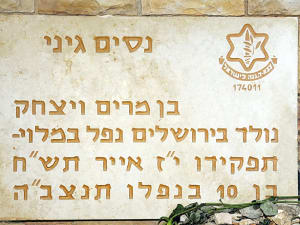
Nissim Ginni, 10 years old, the youngest fallen soldier of the IDF

THE WAR OF INDEPENDENCE
Yom haAtzmaut celebrates the Declaration of Independence of Israel on May 14, 1948. But that declaration was the beginning of a very painful war that cost the lives of 1% of the Jewish population of Israel … The day after the Independence day all the armies of the Arab countries began to attack the Jewish population of Israel, which at that time consisted of more or less 650,000 souls.
The story of Nissim has to do with the attack against the Jewish Quarter of the Old City of Yerushalayim, the Roba Yehudi, by the powerful Jordanian Legion.
Nissim Ginni was born in Jerusalem in 1937 or 1938. It is possible that he was born in Hanuka, because among Sepharadim it is common to name a baby born on that holiday “Nissim”. His father was Ytshaq Ginii, an observant Jew that came from Izmir, Turkey. His mother was Miryam Waqnin, from Morocco. Nissim had two brothers, Nathan and Meir z”l, and one sister, Chaya. Nissim studied in the Talmud Tora of the Old City. 1,600 Jews lived there at the time, in a constant state of tension with their Arab neighbors. Jewish children suffered the permanent bullying of Arab children, but they managed very well to defend themselves.
THE SIEGE OF JERUSALEM
On May 14, 1948, when Nissim was in the 4th grade, and 9 years old, hostilities began. The Old City was blocked and the Jews who lived there were totally isolated, with only 200 young soldiers left, and very little ammunition, to defend the population. The soldiers resisted as much as they could, but many died or were captured by the enemy. The siege intensified and there were fewer and fewer Jewish fighters left. The civilians, then, joined the efforts to defend the city. The situation of the Ginni family was not easy. The father, who had a bakery in Mahane Yehuda, was caught outside the Old City when the blockade began, and was not able to enter the Jewish quarter. Nissim’s mother, blind in both eyes by a terrible illness, was in charge of her four children. Chaya, the older sister, who was 14 years old, volunteered in Bate Mahase, an improvised infirmary where a few nurses and volunteers treated the wounded. Many children, such as Nathan, Nissim’s older brother, who was 12 years old, also volunteered to help. The children brought coffee or food to the soldiers and helped as much as they could.
THE MOST COURAGEOUS CHILD
Nissim, 9, also volunteered. Probably due to his skills in the game of “hide and seek”, Nissim knew perfectly well all the corners, the shortcuts and the secret passages of the Old City. Nissim, was very mature, awake and especially brave. Nissim helped the soldiers carrying weapons and ammunition from one to the other. But the most important thing that Nissim was doing was to slip away at night, avoiding the enemy sight, and identify and inform the Jewish forces of the movements of the Jordanian troops. Eyewitnesses tell that Nissim often ran under a rain of Jordanian bullets to fulfill his mission, risking his life to find the Jordanian snipers. The intelligence brought by this child resulted to be absolutely critical to the brave Jewish soldiers, and his actions saved many lives. On May 27, 1948, Iyar 19, after helping the Israeli soldiers for hours, Nissim went home to eat a hot meal. But before he could taste his mom’s food, a young man came looking for him: “Your replacement did not arrive”, he told him, “we need you at the observation post.”
SHALL I STAY HOME WHILE MY BROTHERS DIE?
When Nissim was about to leave, his mother, frightened by the sounds of the bullets that were increasingly closer, said: “Leave him here, outside is getting very dangerous.” Several witnesses remember what Nissim said to his mother at the time: “מה את רוצה אמא, שאני אשב בבית ואחרים ימותו”  “What do you want, mom, that I stay at home while others die?” And Nissim left.  Nissim arrived at the observation post, near the place where Yeshiba Porat Yosef stands today, next to the Kotel. In a tragic moment, Nissim raised his head and a Jordanian sniper shot him and mortally wounded him. Nissim was taken to the infirmary of Bate Mahase, where he was treated by his own sister Chaya, who desperately tried to stop the blood. But she did not have the appropriate medical equipment to help Nissim, and the next day Nissim Ginni died of his wounds .
THE FALLING OF THE OLD CITY
That day, after resisting heroically for 14 days, the Rabbi of the Old City of Yerushalayim, Ribbi Benzion Hazan, raised the white flag and the city surrendered to the Jordanians. The Jordanians took about 500 Jews prisoners, and the rest of the Jews were taken out of the city. The body of Nissim, along with other seven deceased soldiers, remained in the infirmary of Bate Mahase.
THE BURIAL of NISSIM GINNI
In June 1967 the Israeli Army, miraculously, reconquered Yerushalayim. An elderly Arab citizen asked to speak with the highest ranking officer. The elder took the officer to a corner of the city and said, “The bodies of a few Jews are buried here. I buried them myself in 1948. The Jordanians wanted to burn the bodies, but I did not allow them.”   The army removed the bodies, but the fighters could not be identified. Except for one: Nissim Ginni, because he still had his baby teeth …
The remains of Nissim were taken by order of Rabbi Shelomo Goren to the cemetery of the Mount of Olives, Har HaZetim. After a few years, the Israeli Army recognized Nissim Ginni as the youngest fallen soldier to have served in the Israel Defense Forces, and a plaque was erected in his memory in the Har Hertzel military cemetery. See HERE


The Role Played By The NY Times During The Holocaust (Part 2/2)

To see what we wrote yesterday, click here
We began to write about the role played by the prestigious newspaper The New York Times and the lack of information about the Holocaust in the American population.
It should be noted that the New York Times, especially in the 1940s, was not only the most important newspaper in the world, but also the “leading” newspaper, in the sense that thousands of other newspapers and newscasts in the US and around the world got their information from the Times and followed its leadership (this, obviously, is changing in the modern news-media-world).
We will see now some examples that illustrate the biased attitude of the New York Times in reporting the atrocities that were occurring in Europe.
A New York Times article of July 2, 1942 reports the killing of 700,000 Jews, “one fifth of the entire Jewish population of Poland.” It even mentions concentration camps and gas chambers. The article says: “Children in orphanages, elderly in hospices, sick in hospitals and women were killed in the streets. In many places Jews were detained and deported to undisclosed destinations or massacred in nearby forests. ” The article continues to list how many Jews had been killed in each province, and then says that “the massacre still continues in Lvov.”
This story is typical. The information is objective, detailed and even contemporary. However, the American public was largely unaware of the magnitude of what was happening. Then that generates two questions. The first question is, how did this happen? And then the second question is, why did this happen?
How? The answer is that these news were buried in the middle of the newspaper. The article of July 2, 1942 appeared on page 6 under a small subtitle reserved for unimportant material.
Another article of June 27, 1942 that describes the same massacre as “probably the biggest mass slaughter in history”, was on page 5 and had no title!
Why? This tendentious down-playment of the Shoah did not occur because the front page of the newspaper was full of momentous news. The day this horrific story appeared in the New York Times, the front page featured articles about tennis shoes and canned fruit.
Then we ask ourselves again why?
The answer is: Arthur Hays Sulzberger. Sulzberger was the owner and editor of the New York Times. And what makes it so amazing is that Sulzberger was Jewish.
Sulzberger felt no religious or emotional connection to the threatened mass of European Jews. Although hard to believe, it seemed that, on the contrary, he did the impossible to ignore them.
Sulzberger wrote the following:
“There is no common denominator between the poor and unfortunate Jew led [to death] in Poland and … .I. Certainly, in Poland, this Jew is part of a persecuted minority. … fortunately, I’m not in that category. “
According to Leslie Leff, the author of “Buried by the Times” who denounces Sulzberger’s silence and minimization of the information about the Shoah, Sulzberger’s lack of empathy and tendency towards European Jews was due to his reformist ideology. Sulzberger’s political grandfather, Isaac Wise, was the founder of the Jewish reform movement in the US. In those times reform Judaism promoted the idea that Jews are not a nation but simply followers of a creed.
Sulzberger was an assimilationist Jew: for him Jews are not a people, in the same way that Catholics or Protestants are not a people. In December 1942, in a note to the staff of the New York Times he wrote: “I have been trying to instruct the people of my newspaper on the subject of the word ‘Jews’; that they are not a race or a people, etc. “
Former New York Times journalist Ari Goldman, in his review of Leff’s book, writes:” There is no doubt that Sulzberger’s views on Judaism influenced what what he did in his newspaper. “
Again and again the views of Sulzberger are reflected in the editorials of the New York Times, in which the difficult situation of the Jews is not mentioned but is rather deliberately ignored.
On the German refugee children, almost all of them Jews, the New York Times generalized: “[those children] are of any race and faith.”
On the Hitler regime, the New York Times wrote: “It is decency and justice that are being persecuted [by Hitler], not a race, nor a nationality, nor a faith.”
On the millions of Jewish refugees, the New York Times said: “They have nothing to do with a specific race or creed. It is not a Jewish or a Gentile problem. “
And notably in an editorial on the Warsaw Ghetto uprising in 1943, the New York Times did not mention Jews at all!
Leff also examined the positions and actions of the editorial staff of the Times. Leff concludes: Sulzberger’s bias was shared by other Jewish staffers who decided to minimize, bury and downplay the news about the killings of Jews: “Between them and influential Catholics among the crucial night editors, who decided where to place news items, the imperiled Jews of Europe had no advocate in the NYT’s newsroom.”
For more information on this subject read:
BURIED BY THE TIMES, by Leslie Leff.
Watch “Reporting on the Times: The New York Times and the Holocaust”, a fascinating documentary by Emily Harrold.
And see a short paper by Anna Blech here (most of the information of this article was adapted from this paper).