NEW TRAINING PROGRAM FOR RABBIS

FIRST REBELLION AGAINST ROME
Previously, we wrote about the process that led Judea (Israel) to losing its independence and becoming a vassal state of the Roman Empire around 63 BCE. In 54 BCE, the Jews tried to rebel against the empire and regain their sovereignty. Alexander, the son of Yehuda Aristobulus, led a rebellion against the new Roman consul: Crassus. But he failed. 13,000 Jewish combatants were killed and 30,000 civilians were captured and sent to Rome as slaves. Many Jewish cities were destroyed and turned into Roman cities. To further weaken the Jews, the Romans invited pagans from across the empire to settle in the land of Israel, offering them reduced taxes with the purpose to outnumber the local Jewish population. Furthermore, the new kings or governors of Judea were appointed by the Roman emperor, and their allegiance was primarily to Rome and not to their Jewish brethren. The best known of these kings was undoubtedly Herod, who reigned from 37 BCE to 1 CE. Herod was born in Judea but was not a Jew but of Idumean or Edomite descent.
THE EDOMITES AND THE JEWS
The history of the Edomites and their relationship with Am Israel is quite complex. Edom descended from Esau, Ya’aqob’s brother. This would normally mean that Jews and Edomites should be close allies, distant “cousins.” However, for a long time, especially in the days of King David (1000 BCE), Israel and Edom were sworn enemies. The same thing happened at the time of the destruction of the first Bet haMiqdash (Jerusalem Temple, 586 BCE), the Edomites joined our enemies, the Babylonians, and their wickedness and unspeakable cruelty towards the Jews was explicitly recorded for posterity in the famous Psalm 137 of Tehilim ‘al neharot Babel (137:7). At the time of the Hashmonayim (150 BCE) the Edomites converted to Judaism and many of them fully integrated into the Jewish people and fought in its ranks like many Druzes in the Israeli army today. But Herod was different. His unconditional loyalty to the Romans was also the product of his hatred toward the Jews. Herod fully collaborated with the Romans, collecting very heavy taxes from the Jews, and establishing pagan temples in various cities in Israel, such as Caesarea and others. His greatest provocation was placing the Golden Eagle, the military banner, and a roman “object of religious worship” at the entrance gate of the Bet-haMiqdash.
JEWISH YOUTH vs ROMAN EAGLE
The rabbis encouraged a group of young Jews to physically remove the Roman idol from the Temple precinct. But the mission failed, the young men were seized and brought before Herod. Flavius Josephus records the dialogue that took place at that time. Herod said to them, “Who sent you to remove the eagle?” The young people answered: “The Laws of our fathers”. Herod asked them: “And why do you seem to be so excited and calm at this moment? Don’t you know that I am going to execute you? The young Jews responded: “We know! But we also know that eternal life awaits us in the world to come (‘olam haba).” Herod had these forty young Jews killed along with two of the greatest rabbis of Israel, burning them at a public stake.
FROM A VASSAL STATE TO A ROMAN PROVINCE
In the year 6 of the common era, a few years after Herod’s death, the situation got even worse for the Jews. Augustus, the first Roman emperor, abolished the “Jewish” monarchy and the relatively independent Jewish state was formally turned into a Roman province. In other words, from that moment on there would be no more local Jewish kings or governors: Judea would be “directly” under the jurisdiction of the Roman emperor. This also implied that the Roman religion became the official religion of Judea. The Romans, like the Greeks 200 years earlier, now expected the Jews to abandon their religion and adopt the Roman gods, “as the rest of the empire had happily done.” And unfortunately, as happened before in the days of the Greek Empire, many Jews, especially those belonging to the higher economic levels, betrayed their faith and their brothers in order to obtain tax exemptions and other benefits for collaborating with the Romans.
Once Judea became a Roman province, the Romans appointed the High Priest (Cohen Gadol) who would slowly begin to make changes to the Jewish Temple Laws, undermining the holiest place of Judaism. The Romans would also have unlimited access to the treasures of the Bet haMiqdash, whose religious objects (kele haqodesh) were made of gold and silver. The well-known Roman prefect Pontius Pilate (26-36 of the common era) stole part of the treasures of the Bet-haMiqdash and with those funds he ordered the construction of an aqueduct in Jerusalem.
This new scenario became increasingly intolerable for the Jews.
And a new idea (suicidal!) began to ferment in the minds and hearts of the Jews: “We must rebel against the Roman Empire and recover our political and religious autonomy, before Judaism disappears completely.” Echoes of an all-or-nothing Jewish rebellion against the invincible Roman army could be felt in the air of Jerusalem…
To be continued
APOSTOMUS BURNED A SEFER TORA
A Jewish commando attacked an expedition of Romans who brought weapons and supplies to the invading army. The Roman governor, Komanos, besieged the city of Bet-Horon from where this attack was organized, and ordered that the attackers be seized and brought to him. The Roman soldiers complied with the governor’s orders, but exceeded them. A Roman military man named Apostomus took a Sefer Tora and burned it publicly. This occurred on the 17th of Tammuz. The Yehudim heard this great tragedy –it was the first time this happened but unfortunately, not the last one– and started a great revolt, which was only appeased when the Romans executed the soldier who had committed this aberration.
A BREACH IN THE WALL
The Jews’ rebellion against the Romans did not prosper, and the Romans ended up destroying the Bet haMiqdash in 68 of the common era. The Jews living inside Yerushalayim defended themselves behind the walls, which were originally built in the days of King Solomon. The walls of the second Bet haMiqdash were built by Nehemiah, 5th century BCE. These walls were obviously there to keep the enemies out of the city and were especially strong. The people fought with bravery and ingenuity to defend the city and repel the powerful enemies. But the Romans, the most powerful world superpower at that time, had very advanced military technology. They used catapults to throw very heavy rocks that struck and broke the walls. They also built towers to climb the walls and weaken the Jewish defenses. The enemy soldiers carried in these towers a “battering ram’”, an enormous trunk with an iron ending with the image of a ram’s head, to strike and damage the walls and gates of the city.
On the 17th of Tammuz one of the walls of Yerushalayim –the fortress of Antonia, built by Herod 40 years before, in honor of the Emperor Marcus Antonius– yielded, and the Roman soldiers began to enter the city. This was the beginning of the end of Yerushalayim.
The Jews fought ferociously from within the walls, but they were not united, and were fighting with one another. And as our Sages explained, when this happens (sinat chinam), HaShem is not with us.
FIRST ALIYA
Forty years after leaving Egypt, and shortly before entering the land of Israel, the Jews have just conquered the Emorites and the people of Bashan, who were in what is today northern Jordan. The one who sees this with great concern is Balak, the king of the neighboring town of Moab. He fears that his nation will be targeted by the Jewish army. He knows that the power of Israel does not consist of his army, but of his God. Balak then looks for a non-conventional way of weakening Israel. He sends for Bil’am, a non-Jewish sorcerer, famous for the effectiveness of his predictions and curses. Balaq asks him to come to him and curse the Jews. But God appears to Bil’am and orders him not to go to Moab. “You shall not curse the people, for Israel is blessed [by Me]!”
SECOND ALIYA
At the behest of the Divine request, Bil’am declines the invitation and does not proceed to Moab. But King Balak insists and suggests that he will reward him handsomely for his services. God allows Bil’am to accept the invitation, but warns him that he should only speak the words that God will put in his mouth.
THIRD ALIYA
Bil’am leaves the land of Midian and goes to the kingdom of Balak. God sends an angel that Bil’am does not get to see. But Bil’am’s donkey registers the presence of the Divine angel, gets scared and refuses to go on. Bil’am hits his animal and miraculously —or in the form of a prophecy— the donkey communicates with Bil’am and reproaches him for hitting his animal. God then opens Bil’am’s eyes and allows him to see the angel. The angel questions Bil’am for his violence. And he once again exhorts him to only say what God tells him. Bil’am finally reaches Moab, where King Balak is waiting for him.
FOURTH ALIYA
Following Bil’am’s instructions, Balak builds seven altars and offers sacrifices to God. But God dictates to Bil’am in a poetic/prophetic way the exact words that he should address to Balak and his ministers: “From Aram, King Balak of Moab has brought me, from the mountains of the East and has asked me to curse Israel… But how could I curse those whom God has not cursed, and how would dare I invoke the wrath of God if He has not been angry with Israel?… “ And then he went on to pronounce blessings and praises to the Jewish people. Balak is angry at Bil’am’s blessings and reminds him to petition God only what he tells him.
FIFTH ALIYA
In an attempt to convince Bil’am to curse Israel, Balak takes him to another place, as if the change of location will inspire him to curse Israel. They build altars and offer sacrifices, but God again puts blessings for Israel into Bil’am’s mouth. “God [ loves Israel so much] that he ignores when they do not do the right thing, forgives them and sees no evil in Israel’s children.”
SIXTH ALIYA
Once again, Balak takes Bil’am to another place in the hope that he can curse the Jews from there. Despite the new altars and offerings, only beautiful blessings and praises come from the mouth of Bil’am: “How beautiful are your tents [the houses of the Jews], O Jacob, your dwellings, O Israel! … God, who brought them out of Egypt … will destroy the nations of the enemy… Those who bless them will be blessed, and those who curse Israel will be cursed. Balak loses his patience with Bil’am and asks him to leave empty handed.
SEVENTH ALIYA
Before leaving, Bil’am expresses a prophecy about the end of days: “I see it, but it would not be now; I contemplate it, but it won’t be soon. A star will come out of Jacob, and out of Israel will arise a staff that will defeat the princes of Moab and uproot the sons of Seth… ». He also speaks of the eventual destruction of Esav, Amalek and Assyria.
Bil’am’s plan to curse Israel, trying to get God to punish His people for their eventual sins, has failed. A new plan is then put into practice: the Moabite and Midianite women go to the camp of Israel to seduce the Jews and lure them into sexual activity and idolatry. This was the way to serve the pagan deity of Ba’al Peor. Many men fall into temptation and sinned. God then commands Moses to execute the guilty. A deadly plague breaks out among the Jews, causing the death of 24,000 men. Zimri, a Jewish leader who was part of this great sin, publicly cohabited with a Midyan princess. Pinechas, the grandson of Aharon haCohen, executes both of them and the plague ends.
“When HaShem your God brings you into the land he promised to your fathers, Abraham, Isaac and Jacob…a land with large, flourishing cities that you did not build, with houses filled with all kinds of good things, that you did not provide; with wells that you did not dig, and with vineyards and olive groves, that you did not plant – when you eat, and you are satisfied, do not forget HaShem, who brought you out of Egypt, out of the land of slavery.” Deut. 6:10-12
The people of Israel are ready to enter the Promised Land. They will have to fight for it. But HaShem already promised them that He will join them in the battlefield. No one doubts they will succeed in defeating the enemies and conquering the land. The Tora, therefore, is not concerned about war, fighting, military strategies, simply because the Almighty will be on our side. But the Tora is concerned about peace. About the potential side-effects of “inherited prosperity”. The Israelites will be coming to cities that are fully functional. They won’t even need to build the houses where they will live; the wells, are already filled with water, and the trees, vineyards and olive groves, are already planted and bearing fruits.
This scenario, which seems to be the greatest material dream for any mortal, is tricky. It might become a dangerous spiritual trap. The Tora warns the people of Israel against a a psychological phenomenon known as “affluenza”, that is, the negative side-effects or wealth. Affluenza might take place when one has what he or she needs, wants and wishes. And the most common strand of affluenza affects people who have not worked and made huge sacrifices for what they have; but rather, they have inherited their wealth from others. Those who worked hard for what they have, usually appreciate what they have. Moshe Rabbenu understands that AM ISRAEL is in a similar situation. They will inherit everything for free. With no effort. And Moshe rabenu teaches them this valuable lesson: Beware of inherited well. Do not forget WHO gave it to you, and what HE expects from you: appreciation and kindness.
Many parents wrongly believe that giving their children everything they want without demanding any effort from them, is a way of loving them and for our kids to experience everlasting happiness. But showering our kids with riches and asking them nothing in return, kids will be exuding gratitude and appreciation, and eventually they will imitate them and feel a tremendous need to give and share with others. Many times, however, parents discover that far from raising happy and thankful sons and daughters, they have raised spoiled children, who do not feel any need to express gratitude and far from become great philanthropist they are always asking for more, and instead of contributing in producing wealth, they feel entitled to freely receive everything they want.
GOOD RELATIONS
Something exceptional and unprecedented, which included the intervention of Doña Gracia Mendes-Nasí, occurred in the city of Ancona, an important commercial port on the east coast of Italy. This city was established as a “papal state” in 1429. The Popes Clement III and Paul III tried to develop Ancona as a center of international trade. And to achieve this goal, they granted the city’s Jews permission to open banks and offer credit. On February 21, 1547, the pope invited “any person… from the kingdoms of Portugal… including New Christians [=anusim] to settle in Ancona.” Due to this pro-Jewish attitude, many anusim Jews (forcibly converted to Christianity) from Portugal and Spain began to settle in Ancona, which thanks to its privileged geographical location became an ideal base for maritime trade with the Ottoman Empire. In 1550, the Jewish population of Ancona numbered about 2,700 people. In that year one of the largest Synagogues in Italy was built there.
THE POPE VS THE JEWS
But everything changed in 1555 when a new Pope, Gian Pietro Carafa (Paul IV), took office in the Vatican. This Pope, known for his undisguised anti-Semitic feelings, turned against the Jewish population of Ancona and ignored all the rights granted to Jews by the popes that preceded him. The Jews were humiliated, deprived of their commercial privileges, and locked up in a ghetto. The new pope also reinstated the inquisition in Ancona, confiscated the property of the Jews, and began to persecute and condemn the anusim. Nearly 100 anusim were imprisoned by the Inquisition and threatened with being burned or sold into slavery if they did not renounce their Jewish faith. Some chose a forced conversion to save their lives and the lives of their children. Others were deprived of their liberty to be sold on the Maltese slave market. 24 anusim, who openly lived as Jews, adamantly refused conversion (even a fictitious one) and were burned at stake in an auto de fe of the Inquisition.
FOR THE FIRST TIME IN HISTORY
The news of the execution of these anusim reached the ears of Doña Gracia Mendes in Constantinople. On March 9, 1556, at the behest of Doña Gracia, Sultan Suleiman wrote to the pope demanding the release of the imprisoned men, whom he called his subjects since he granted them Ottoman citizenship from afar. The Sultan also requested the release of the confiscated property. But despite all diplomatic efforts, this did not work, and Doña Gracia then planned a “Jewish” response that until then had been unprecedented in the history of the Jewish people: an economic boycott. In this case, against the city of Ancona. Very respectful of the rabbinical authorities, Doña Gracia sought Halachic support for her plan and instructed Rabbi Yehuda Faraj to explain the situation to the chief rabbis of Constantinople and Italy and enlist their support in establishing the boycott and persuade with their co-religionists to support her.
THE END OF ANCONA’S GLORY
Doña Gracia managed to declare a boycott of the port of Ancona. No ship of her company or of companies that had relations with her company could embark or disembark in Ancona. The port to use would be from now on Pesaro, or the already famous port of Venice. It must be remembered that Doña Gracia was the head of the wealthiest family in the Ottoman Empire and one of the most influential families in Europe. With her boycott, Doña Gracia managed to paralyze the port of Ancona, which remained closed and abandoned for a considerable time, and had a devastating effect on the city’s commerce. There is a document from the Ancona City Council addressed to the pope in which they beg him to stop the inquisitorial proceedings against the anusim because they were antagonizing Ottoman merchants and affecting the city’s trade. According to the historian Bernard Dov Cooperman, after this embargo, Ancona never recovered from this boycott and lost its importance as a commercial port for good. Although this was not the first economic boycott in the renaissance, it was the first organized by the Jews. Never before, until the days of Doña Gracia Mendes, Jews had the power to defend themselves, react and punish the abuses of the church and the inquisition. Doña Gracia Mendes, once again, demonstrated her courage, her leadership, and her passion for defending her Jewish brothers.
The book “Shalshelet HaQabalá” (p. 276-278) written by Rabbenu Gedalia Ibn Yajia (1526-1588) tells the story and mentions the names of the 24 Jewish martyrs who were executed in Piazza della Mostra AL QUIDDUSH HASHEM, that is, by maintaining their Jewish faith and refusing to convert to Christianity, knowing that they would pay their refusal with their lives.
These are their names
Simeon Ben Menachem
Yoseph Guascon
Samuel Guascon.
Abraham Falcon
Isac Nahmias
Salomon Alguadish
Moses Paggi
Salomon Pinto
Yoseph Moljo
Abraham Cerilia
David Nahas
Abraham di Spagna
Moses Barzilon
David Reubén
Salomon Iahia
David Sadicairo
Yoseph Verdai
Yoseph Pappo
Yacob Cohen
Yacob Montalban
Abraham Lobo
Yacob Mozzo
Abraham Cohen
And a woman, whose name is unknown.
זצוק”ל
The execution of these Yehudim in 1555 shook the Jewish communities of Europe and inspired elegies (qinot) that to this day are recited in some communities of Italy during Tish’a beA
FROM SPAIN TO TURKEY
In Turkey, the Jews lived very well, under the auspices and protection of Sultan Suleiman the Magnificent (1520-1566), who generously received Sephardic refugees, allowed them to freely exercise their religion, and facilitated their permanent residence in the empire. Suleiman was confident that the presence of the Jews benefited his kingdom economically and politically. And he is credited with the following phrase, making fun of King Ferdinand of Spain: “Do you call this an intelligent king, who impoverishes his states to enrich mine?” Turkey was the ideal refuge for Sephardic Jews. In fact, everyone dreamed of living in Turkey in total freedom and outside the horrible arm of the inquisition. The big problem was getting there, as explained below.
THE QUEEN OF CHESED
In the year 1553 Doña Gracia Mendes Nasí arrived from Ferrara, Italy, to Constantinople, the capital of the Ottoman Empire. She was accompanied by an entourage of 200 people and 40 guards. In Constantinople, she was received with the honors accorded to a queen. While her successful businesses in Europe were managed by her nephew Yosef Nasí, in Constantinople Doña Gracia dedicated herself exclusively to charitable works and especially to helping materially and spiritually to the reestablishment of the anusim, the Jewish refugees from Spain and Portugal. Cecil Roth writes something that surprised him. He recounts —and documents— that Doña Gracia lived in a very luxurious mansion… “and she had in her house every day 80 poor people, eating at her table.” (p.103). Taking the needy to eat at her table raised the prestige of the poor and their dignity. I heard from my uncle, Rabbi Yosef Faur z”l, that Doña Gracia deliberately brought the poor to her own table to set an example for other wealthy Jews, who always tried to imitate everything Gracia Mendes did. And as expected, the example of Doña Gracia multiplied. And there was no shortage of poor Jews… because more and more refugees, who did not have what to eat, were constantly arriving to Constantinople from Spain, Portugal, and other European countries.
SALONICA: THE CITY OF REFUGE
With the consent of the Sultan, Doña Gracia got the Sephardic refugees to settle in Salonica (Thessaloniki). This port-city was not developed at that time, but over time “it became the second most important metropolis of the Ottoman Empire, thanks, in good measure, to those Sephardim” (see here). Thessaloniki became the only city in the world with a majority Jewish population. The predominant language was Ladino, a language that continued to be used by the Jews of Salonica until modern times. . Doña Gracia worried that these exiles will not lack the means of life. In addition to hiring them in her own company for the port activity, the commercial expertise of the Mendes, Doña Gracia also established a textile company in the city to provide more jobs for the refugees. And in Salonica Doña Gracia also took care of a very important Mitzvah: redeeming captives.
PIDYON SHEBUYIM
At that time it was very common for pirates to attack ships, steal the cargo and capture the passengers to sell them as slaves. The Jewish prisoners were the favorites of the pirates. Why? Because the criminals knew that they would always find other Jews who would pay a good price to rescue their brothers. “There is no greater merit than rescuing captives.” אין לך מצווה גדולה כפדיון שבויים , said the Sages of the Talmud. Ships with Jewish human cargo constantly arrived at the port of Thessaloniki. And Doña Gracia was behind the efforts and negotiations to free the captives, even knowing that the kidnappers abused the price they demanded to free their captives. There is documentation that records the data of a ship that was hijacked by pirates from Malta and arrived in Salonica with 70 Jewish prisoners. It is said that Doña Gracia Mendes paid up to 500 ducats (a ducat was a 3.5-gram gold coin) per person for their ransom. Thanks to the efforts of this extraordinary woman, thousands of Sephardic captives were rescued and released from captivity.
JEWISH EDUCATION
In Salonica, Doña Gracia also founded a Talmud Tora –a Jewish school–that after a few years had 10,000 students and 200 teachers. She also founded and maintained a prestigious Yeshiba (higher rabbinical academy) headed by the famous Ribbi Shemuel of Medina. This was a very special Yeshiba. In addition to sponsoring the regular Tora schollars, every year Doña Gracia invited three Rabbis from other Jewish communities to study for a year with Ribbí Shemuel de Medina, the most brilliant Halakhic mind in the diaspora at the time. After a year these Rabbis would return to their communities with more knowledge and experience. Doña Gracia also founded a very special Synagogue in the city: Leviyat Chen (ח“ן, are the initials of her Hebrew name: Chaná Nasí). This Synagogue was like an “ulpan”: it was conceived exclusively for the anusim, that is, those Jews who had been forcibly converted to Christianity and knew nothing of Judaism. In this Synagogue, they were first taught the Hebrew language and the basics of the Tora and Tefilla, to facilitate their active integration into the Jewish community.
To be continued
JOURNEY TO DEATH
Sea travel from Spain or Portugal to Turkey was unaffordable for the vast majority of Jews since when they left Spain they were not allowed to take anything of value with them. Those Jews who somehow had the means to pay for transportation to Turkey exposed themselves to very high risks since there were no minimum guarantees for the safety of the passengers. Once on the high-sea, the helpless refugees were at the complete mercy of the ship’s captain and crew, who normally abused them, stole their belongings or sold them as slaves. Even in the rare event that the ship’s captain was honest and kept his promise to take the Jewish refugees to their destination, the ships could be attacked by pirates, who would seize the cargo, kidnap the passengers and sell them into slavery. But the worst threat on the ships, especially the less expensive ones, was disease and epidemics. Since the refugees traveled without the basic health or hygiene conditions. Thus, most of the passengers did not survive the journey. Take the case of Rabbi Isaac Caro, who wrote about his journey. He escaped from Portugal when King Manuel gave the order to forcefully baptize all Jewish children. He left with his wife and his children (at least 4 boys) and when he arrived, he only had one daughter left. Although he does not provide us with the details of all the dangers of his journey, Rabbi Caro says that on that journey “all my sons, young and old, died” (halechu lebet olamam kol banay hazecharim, gedolim uqtanim). He also hints that he wrote his book Toledot Ytschaq, as a consolation for his great loss. And he says that, despite the tragic ending, he was blessed to have escaped from Portugal, because otherwise he and his children would have been forced to be baptized.
All this should help us understand a little better two things:
1. That the expulsion of the Jews from Spain was virtually a death sentence for most Sephardic refugees.
2. The enormous importance of the humanitarian mission that Doña Gracia Mendes carried out to save the lives of Sephardic refugees by transporting them on the ships of her own commercial company from Europe to Turkey.
SUMMARY
We are briefly reviewing the life and work of Beatriz de Luna, later known as Doña Gracia Mendes. Let us remember that when the inquisition was established in Portugal it was impossible for the Jews to continue living there, and in the year 1538, when her husband Francisco Mendes died, Beatriz, together with her daughter Ana and her brother-in-law Diogo, moved to Flanders (today Antwerp, Belgium), the financial capital of Europe at the time. There she was in charge of the successful international trade company and the bank that her deceased husband had founded. Beatriz used her fortune and her influence to help her Jewish brothers escape from Portugal and reach Turkey.
IN THE NETHERLANDS
Flanders then belonged to the Empire of Carlos V of Spain. And therefore religious matters were under the authority of the inquisition. For that reason, and until she reached her final destination: Turkey, Beatriz was still hiding her Jewish status. With her high profile, any small mistake could cost her and her family their lives. And as we explained earlier, it was very tempting for the inquisition to accuse her of “judaizing” (practicing Judaism) since if she were found guilty the Church would be able to keep her immense fortune. While she was in Flanders, Beatriz continued to grow in fame and success. She dealt commercially with King Henry II of England; with Emperor Charles V; with the King of France and even with Popes Paul III and Paul IV. These relationships involved commercial activities, loans of huge sums of money to the monarchs, and bribes to the church so that the inquisition would not persecute the Jewish anusim (converts against their will) in Spain and Portugal. The whole story of Beatriz in Flanders is fascinating, but too long to be told in a few lines.
BEATRIZ IN VENICE
In 1544, after a political move against her trying to unmask her Jewish identity, Beatriz escaped from Flanders and settled in Venice. At that time Venice was a “republic” independent of the papacy and had territories in Croatia, Slovenia, Greece and even Cyprus. The Republic of Venice was known for its pragmatism and Beatriz was very well received there, as her trading company benefited this city immensely. At that time Venice had its own rules to deal with the Jews. On the one hand, Venice offered guarantees to the anusim so that they could discreetly lead their lives without being disturbed by the Inquisition. However, those who wanted to live openly as Jews had to settle in the city’s famous Ghetto. Let us remember that the first Jewish Ghetto in history was that of Venice, established in 1516. Beatriz continued in Venice until 1549.
THE IMPORTANCE OF CALLING YOURSELF “GRACIA”
From Venice, Beatriz moved to Ferrara, at that time an exceptional place for Jews. Ferrara was the only city-state in Europe in which Jews were allowed to freely and openly practice their religion (this good situation lasted only until 1597). By the end of the 15th century, Ferrara had accepted more than 20 Sephardic refugee families, granting them civil liberties unthinkable in other regions, such as the right to practice medicine. And it was there, in Ferrara, in the year 1549 where “Beatriz” finally left behind her gentile name fro good and call herself “Gracia” (the typical Sephardic translation of the name “Chaná”; “Chen” in Hebrew means “Grace”), “Nasí”, her Jewish maiden name. For the first time in her life she began to openly practice her beloved Jewish religion. In those days there was also an incipient but very important Jewish community, mostly Sephardic refugees, in Erets Israel, especially in Tsefat (Safed). There was, for example, Rabbi Yosef Caro (1488-1575), his teacher, Ribbí Ya’aqob Berab, and his students, such as Rabbi Moshe Alshekh haQadosh and other geniuses of Torah and Qabbala. Doña Gracia and the Jews of Ferrara financially supported these Jewish colonies and Rabbinical academies of Tsefat and Yerushalayim.
JEWISH EDUCATION FOR THOSE WHO NEEDED IT MOST
Doña Gracia continued to help the “conversos” of Portugal and Spain to escape the Inquisition. But her task was not limited to materially helping the anusim. One of the most important projects that Doña Gracia Mendes initiated was the sponsoring of Jewish books in Spanish. Why was this so important? Because there were tens of thousands of Jewish refugees from Spain and Portugal who could not read Hebrew – or did not understand it – and their only access to the Bible, for example, was through Christian translations into Latin, such as the Vulgate, which in the key texts presents an anti-Jewish version of the Book of Books. But the Bible was not the only book that she had to translate. A prayer book was needed so that the Jewish refugees would understand what they were saying when praying and thus strengthen their faith in God. In 1552 Doña Gracia financed the “Book of prayers for the whole year”, translated by Rabbi Yom Tob Atias (whose former name was “Jerónimo de Vargas”.) She also financed the publication of “The Consolation for the Tribulations of Israel”, a book of Jewish history and stories written by Rabbi Samuel de Usque, published in 1553. In that same year these two rabbis were in charge of the first “Jewish” translation of the Bible into Spanish: the famous “Bible of Ferrara ”. In the introduction, both Rabbis wrote him an emotional letter of dedication and gratitude that we can see below.
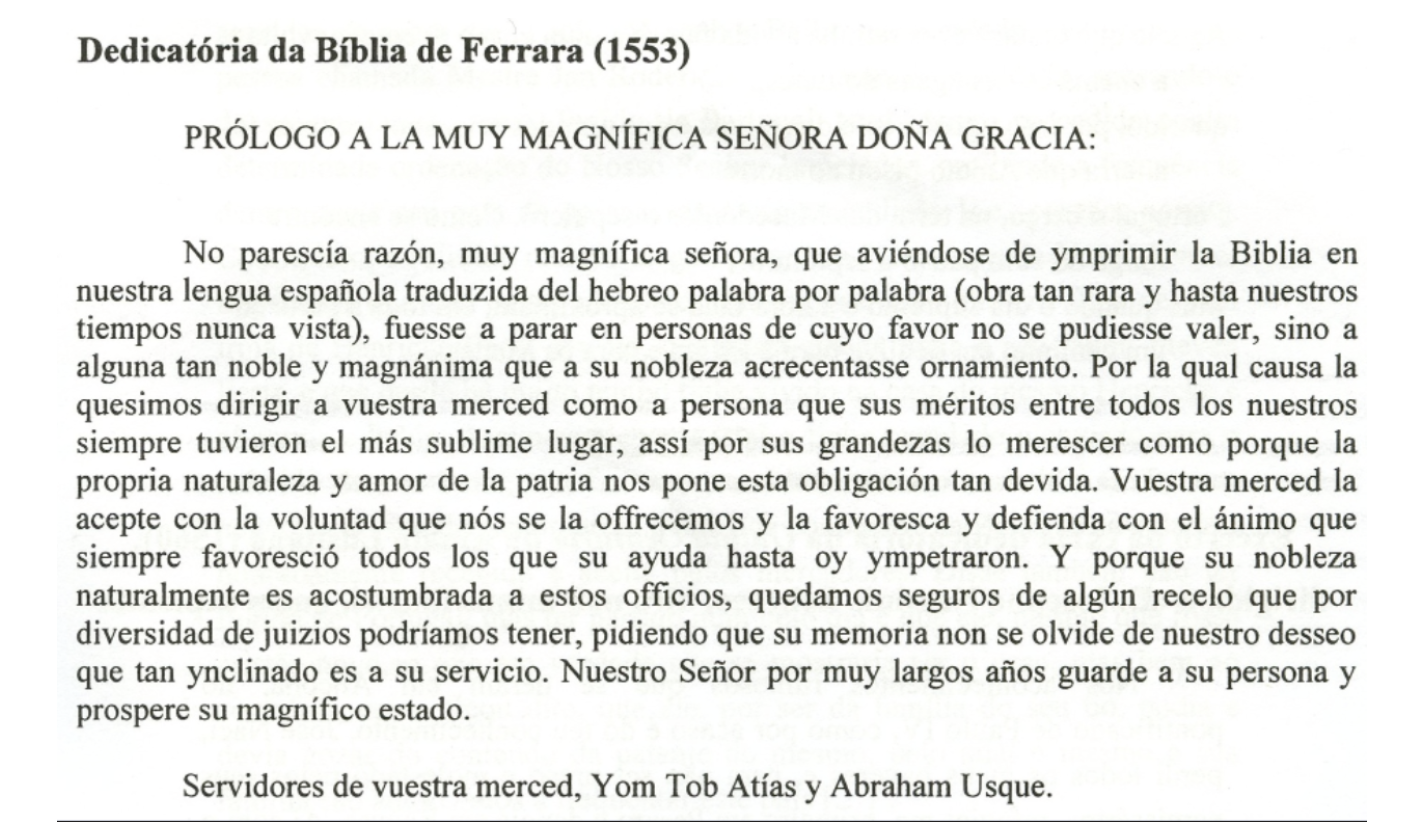
This is my own translation from old Spanish.
It did not seem right, very magnificent lady (Doña Gracia), that having the Bible printed in our Spanish language translated from Hebrew word for word (a work so rare and never seen until our times) would end up in people whose favor we did not could be used, but to someone so noble and magnanimous that her nobility did not increase ornament. For which cause we wanted to dedicate it to your grace, as to people whose merits among all of ours (= the Jews) always had the most sublime place, so for their greatness they deserve it as because nature itself and love for the homeland (= the nation of Israel) places on us this very due obligation. May your grace accept it with the will that we offer it to her and favor and defend her with the spirit that always favored all those who until today begged for her help. And because her nobility is naturally accustomed to these trades, we are sure of some suspicion that due to diversity of judgment we could have, asking that her memory not forget our desire that is so inclined to her service. May our Lord keep her person for many long years and prosper her magnificent state.
Your servants, Yom Tob Atias and Abraham Usque.
THE JEWS OF FERRARA
The Jewish community of Ferrara was made up entirely of Sephardim who had arrived from Spain a little before 1492, and who, living in total freedom, were progressing there in their spiritual life and flourishing materially. Prosperity attracted more Jews and before the end of the 16th century, more than 3,000 Jews lived there, representing approximately 10% of the total population. The privileged life dedicated to the Tora and philanthropy (Ma’asim Tobim ) of Ferrara Jews at that time, is described with sublime beauty by Cecil Roth in his book “Doña Gracia”. Let us briefly say that the most prestigious families in the city such as the Abarbanels (the sons of Rabbi Don Isaac Abarbanel), the Modenas and the Nasí were benefactors of any Jewish cause that arose. The houses of these patrons and philanthropists were always open to welcome Talmide Hakhamim (Rabbis and Tora scholars), supporting them financially and providing them access to something very precious and difficult to find at that time: libraries. Filled with Hebrew books and manuscripts, that these wealthy families owned in their homes. The freedom enjoyed by the Jews of Ferrara was relatively short-lived. In 1597 the last Prince died, leaving no male heir, and very quickly the Pope claimed and took the Kingdom after a brief resistance. Amid the shouts of joy from the people who greeted the Pope, a new and unusual cry was also heard in the city: “Down with the Jews!” Great anxiety gripped the community, especially the anusim who feared the rule of the Pope and the Inquisition. About half of Ferrara’s Jews emigrated to Modena, Venice, and Mantua.
To be continued….