Yom HaShoah: How I Became a Witness of the Holocaust

On Monday night, the eve of the 27th of Nisan, we will begin the commemoration of Yom haShoah, the day on which we remember the brutal extermination of 6 million Jews at the hands of the Nazi murderers and their collaborators.

My parents and grandparents were not born in Europe. I come from a typical Sephardic family. On my mother’s side, my ancestors come from Syria, and on my father’s side, from Morocco. None of my close relatives were sent to a concentration camp, nor died in a gas chamber. My parents, my sisters, and I were all born in Argentina. We did not directly experience the Shoah, nor do we have survivors in our families.

I learned about the Shoah at the school I attended in my hometown of Buenos Aires, the Talpiot school on Azcuénaga Street at 700. Every year they made us watch some horrible black-and-white documentaries. So, my classmates and I learned about death trains, corpses, crematoria, and gas chambers. I will never forget that documentary that showed a group of school-age children, accompanied by a teacher, innocently entering a German army truck, from which they never emerged alive, since to expedite their murder, the Nazis directed the carbon monoxide gases inward. I cried, and a lot… for the horror that our brothers suffered at the hands of the most inhuman humans that history has known, yemach shemam.

But what I remember most, and what made my experience of the Shoah something “personal,” happened the year our principal, Mr. Eliezer Shlomovitz, z”l, invited a Holocaust survivor to speak with us (it was probably the year 1977). It is worth noting that at that time, it was not common for Shoah survivors to speak in schools.

He was an elderly man. It was difficult for him to speak in Spanish, and you could tell he didn’t have a memorized speech. Although I vividly remember the experience of hearing him speak, I am ashamed to admit that I remember all the details of his personal story. Not his name or if he thought it necessary to mention it. After telling us about his personal holocaust, how he lost his parents, his little brothers, and practically all his loved ones, and how he managed to escape from Auschwitz, this elderly man told us something like this:

“You have not personally lived through the Shoah, thank God. I think I fear that perhaps for you, the Shoah may one day become just another chapter in modern Jewish history. A history that perhaps can be refuted, questioned, or denied by our enemies. And that is why I want you to understand that the effort of our enemies to deny history is the first step in trying to repeat it. And you can never allow that to happen. It is not enough to ‘learn’ about the Holocaust. You have to be witnesses to the Shoah. All of you. Why? Because history can be denied and documents can be questioned. The only ones who can protect the memory of the Shoah are the witnesses of the Shoah. Today, you have heard my story. And you have also seen me. And you have seen my eyes… Now you carry a new and tremendous responsibility on your young shoulders. Today, you have become eyewitnesses to the Shoah. How did this happen? I will explain it to you. My eyes saw the Shoah. But they didn’t see it in black and white. My eyes saw the dark green of the Nazi uniforms, the metallic gray of their rifles, and the red of the blood of our loved ones. My eyes saw death in all its horrible colors. My eyes saw the horror that my words cannot describe. And now I want you to look into my eyes. So that from today on, you can tell others, and someday tell your children: ‘I have not seen the Shoah. But my eyes have seen the eyes that saw the Shoah. And now, my children, look into my eyes and become witnesses too.’

When he finished speaking, he rolled up his sleeve and invited us to look at his prisoner number. It was the first time we had seen a number tattooed on human skin. I approached him a little closer and forced myself to look more closely into his eyes. They were small, gray, sad, tired, and dull. There was something empty and absent in that gaze. It lacked “life.” And that was when I realized that in the tired eyes of that old man, I had witnessed a reflection, or a dark shadow, of the horror of the Shoah. And since then, I became a witness. And the Shoah became part of my personal experience.

Let us not forget. Nor allow it to be forgotten.



A Powerful Lesson From the Maror

Rabban Gamliel indicates that “Maror” is one of the three central concepts we should pass on to our children in the Seder, along with Matsa and the Pesach sacrifice. The Maror, the bitter vegetables we eat in the Seder, reminds us of how the Egyptians demonized us, enslaved us, and made us suffer. But why is it so important to transmit this “painful” lesson to the next generation on the night of the Seder? Should we not focus exclusively on “celebrating” our freedom? There are several reasons why we should remember tonight the meaning of the Maror.

There are several reasons why we should remember the meaning of the Maror.

First, when debating the order in which the story of the exodus should be told, our Sages understood that we have to mention the bad things that happened to us and that these bad memories should be mentioned first. Why? Because in this way, we will better appreciate the good things that happened to us. The better we realize the horrors of slavery, the better we will appreciate the gift of freedom.

Second, hatred towards the Jewish people symbolized in the Maror, is not something of the past. Somehow our children must know that our destiny as a chosen people involves being exposed to demonization and persecution. It is an integral part of the package of belonging to the People of God.

And thirdly, I think there is an additional, very important reason to preserve the memory of our suffering. The Tora teaches us to positively channel the memories of the pain we suffered in Egypt. How? By doing everything possible to ensure other people do not suffer. To me, this idea and its timing represent a revolution in human thinking. Here’s why.

In the past, a particular pattern always repeated itself. Civilizations that were oppressed and enslaved fought for their freedom, and then, upon triumph, their first “need” was revenge: to make their persecutors endure what they had suffered. However, the story did not end there. Once the formerly oppressed people became stronger and more powerful, they dedicated themselves to capturing other peoples, enslaving them, and making them suffer as they had. This sadistic behavior is a well-known psychological phenomenon. Statistics show a very high rate of “abusive” people (in every sense) who have been abused in the past.

The Tora introduces a moral revolution—a 180-degree shift in perspective.

What is the Mitzva mentioned in the Tora more than any other commandment? “And you shall love [= care about, take care of] the stranger [= the poor, the needy, the people most exposed to abuse], because you were strangers in the land of Egypt.” In a counter-intuitive, almost supernatural way, the Tora teaches us to transform the memory of our suffering into virtue. Instead of nurturing or justifying a subconscious thirst for revenge and abuse, we, the people of God, should become extra kind to those in need. The Tora tells us: You know what suffering means; therefore, do not let other people suffer. Why? Because you are better qualified than those who did not suffer to understand what humiliation, poverty, and oppression mean.

We, Jews, teach our children from a young age to preserve the memory of our affliction and process it to do whatever we can to prevent others from suffering.

I know many very good and generous people. But, honestly, the most generous, kind, compassionate, and angelic people I have met are Holocaust survivors. Among them, for example, Rabbanit Esther Jungreis z”l, who dedicated her life to inspiring others to do kindness. Or Yehuda Lindenblatt, from Manhattan Beach, a first responder in Hatzalah, a man dedicated to saving lives. Over the years, I have met many Holocaust survivors and have been shocked by their kindness and altruism. These elders suffered the inconceivable. Their families were destroyed. Following the common pattern of “abused” becoming “abusers”, Shoah survivors should have become the most abusive people on the planet. But in fact, quite the opposite is true! And I think all the credit goes to our Tora. This incredible idea that the Tora instilled in our minds from an early age: TAKE CARE OF THOSE WHO SUFFER, BECAUSE YOU PERSONALLY KNOW WHAT SUFFERING MEANS. This idea, counter-intuitive in terms of human psychology, is nothing but Divine—one that, Seder after Seder, became part of our character and DNA.

רמב”ם הלכות עבדים א ו

ל עבד עברי אסור לעבוד בו בפרך ואיזו היא עבודת פרך זו עבודה שאין לה קצבה ועבודה שאינו צריך לה אלא תהיה מחשבתו להעבידו בלבד שלא יבטל מכאן אמרו חכמים שלא יאמר לו עדור תחת הגפנים עד שאבא שהרי לא נתן לו קצבה אלא יאמר לו עדור עד שעה פלונית או עד מקום פלוני וכן לא יאמר לו חפור מקום זה והוא אינו צריך לו ואפילו להחם לו כוס של חמין או להצן ואינו צריך לו אסור ועובר עליו בלא תעשה שנאמר לא תרדה בו בפרך הא אינו עושה לו אלא דבר קצוב שהוא צריך לו וכן העכו”ם שנמכר לו אם רדה בו בפרך הרי ישראל מצווין למנעו ואם הניחוהו עוברים בלא תעשה שנאמר לא ירדנו בפרך לעיניך ואין אנו נזקקין לכנוס לרשותו של עכו”ם ולבדוק אחריו שלא יעבידנו בפרך שנאמר לעיניך בזמן שאתה רואה.

Rambam (Maimonides), Laws of Slaves, Chapter 1, Law 6

It is forbidden to work a Hebrew slave with rigor. What is considered rigorous work? Work that has no set limit and work that is not necessary but is intended only to keep the slave busy so that he is not idle. From this, the Sages said that one should not say to the slave, “Tie up the vines until I come back,” for he has not given him a limit. Instead, he should say, “Tie up the vines until this specific time” or “Until this specific place.”

Similarly, he should not say to him, “Dig in this place,” when it is not needed. Even heating a cup of hot water or cooling it down when it is not needed is forbidden, and it is a violation of a negative commandment, as it says, “You shall not work him with rigor.” This means that he only does a defined task that is necessary for him. Also, for a non-Jew who bought a Hebrew slave, Israelites are commanded to prevent it if he works him with rigor. If they allow it, they transgress a negative commandment, as it says, “He shall not work with rigor in your sight.”

  NEVER SPEAK IN ANGER
by  Rabbanit Esther Jungreis z”l
Rebbetzin Esther Jungreis on Anger


PESACH: From Prosperity To Assimilation In Egypt

ובני ישראל פרו וישרצו וירבו ויעצמו במאוד מאוד ותמלא הארץ אותם

“And the children of Israel increased, and they multiplied profusely, they grew, and they became very, very powerful. And the land was filled with them ”.

I confess that I’ve always read this verse in a different way than I am reading this year. I understood this text like this: The Jews in Egypt had become a demographic threat to the Egyptians. “And the earth was filled with them”, means that the Egyptians noticed the Jewish presence everywhere. The text itself does not praise the Jews for their impressive economic achievements, but neither does it appear to criticize them. The text only mentions the facts and explains why Pharaoh decides to put an end to the growth of the Jews.
Let me now present an alternative reading of this text, especially the last words, and a slightly different conclusion.

LIVING OUTSIDE A COMMUNITY
The text begins by describing the demographic explosion and the success of the Jews (= they grew), and then it explains what the Jews did once they succeeded. When they arrived in Egypt, Jews were living secluded in the land of Goshen. They were a society of privileged foreigners. But now, probably 60 – 70 years, or two generations later, Egypt-born Jews no longer felt like foreigners but an integral part of the affluent Egyptian society. And the ghetto was now too small for them! The Tora tells us here that many Jews voluntarily left their territory – their Jewish quarter and their community– and began to scatter throughout the country (“And the land, Egypt, was filled with them”), looking for more real-state, more wealth, more power, and more influence. The ethnic or social barriers that living in a community provided, protecting them from assimilation, were now an obstacle to their progress and economic development. It was the first time — but not the last — that assimilation began to take shape as a result of prosperity and success on the part of Jews who felt that they belonged in the Gentile society.

FORGETTING GOD
While this negative reading of this text is a bit speculative, there are reasons to think that it may not be too wrong. In very different contexts, the Tora repeatedly warns the Jewish people about the “risks” of material abundance. In the book of Debarim (Chapter 8: 11-14)  the Tora describes the wealth that the Jews will enjoy in the Promised Land and then it says:  “Be careful lest you forget HaShem your God and abandon His commandments… when you have eaten your fill, and you have built beautiful houses to live in, and your cows and herds multiply, and your silver and gold have increased, and you have prospered in all that you possess … beware! Lest your heart grow arrogant and you forget HaShem your God, who delivered you from the land of Egypt…. ”.  How does assimilation begin? By forgetting God when you do not “need”Him because you already have all that you need and then more.  And when did Jews remember God? When they were poor or suffering the horrors of starvation or slavery.

FORGETTING ISRAEL
There is an additional element that might show the criticism of the Tora to the fact that Jews “filled the land of Egypt with their expansionist presence.” That is the remarkable silence of the Tora regarding the expected return of the people of Israel to their land. We all remember that Jacob’s children came to live temporarily (lagur) in Egypt: they were supposed to stay there until the situation improved and then return to the land of Abraham, Isaac, and Jacob!  In Egypt, God blessed them with progeny and prosperity. That should have motivated the children of Israel to return to Israel with their wealth and resettle in their ancestors’ land as consolidated people. But this verse seems to say that the Jews, once they started to enjoy a very high standard of living in Egypt, felt comfortable there and were looking to move not to Israel but even deeper to the south, into the land of the Nile.

Understood in this way, this verse seems to express the concern that the Jewish people were at risk of losing their identity and spirituality and forgoing their plans to return to Israel.

Ironically, but in a way that should not surprise us in our modern times, it seems that the one thing that “saved the Jews from complete assimilation” and finally got them to return to their land was Egyptian antisemitism.

This is the Hebrew text that inspired this interpretation of the biblical text.   

ההעמק דבר

ותמלא הארץ אתם. מהם מיבעי וכן ת״א מנהון. אבל לשון המקרא אותם. בא ללמד דלא ארץ גושן לבד שהי׳ מיוחד לישראל ומלאה מישראל לבד. אלא אפילו כל א״מ שהי׳ עיקר ישיבת עם מצרים מ״מ מלאה הארץ את ישראל. ומשמעות אותם עמם. כמש״כ בספר ויקרא י״ז ה׳ עה״פ וזבחו זבחי שלמים לה׳ אותם. והיה כל מקום פנוי שמצאו ישראל לקנות ולדור נתישבו שמה. והיינו דכתיב במכת בכורות ופסח ה׳ על הפתח הרי שהיו הרבה בתי ישראל בקרב בתי מצרים. ואע״ג שיבואר להלן ב׳ כ״ה וג׳ ז׳ שפרעה נגש לישראל ולחצם לדור במיצר כדי להשפיל דעתם. מ״מ הי׳ באופן שנשארו בקרב ערי מצרים בין בתיהם. ובא הכתוב להקדים בזה סיבת שנאת מצרים וגזרת המלכות. ומחשבת חשד מה שלא עלה ע״ד ישראל. כ״ז בא משום שבקשו לצאת מרצון יעקב אביהם שישבו דוקא בארץ גושן כדי שיהיו בדד ונבדל ממצרים כמש״כ בפ׳ ויגש. אבל הם לא רצו כן. ובש״ר איתא עוד שפסקו למול מזה הטעם שאמרו נהיה כמצרים. דאחר שקבעו דירתם בקרבם מצאו טוב להם להשתוות למצרים ולא יהיו ניכרים שהמה יהודים. ומשום זה ביאר המדרש שהפך ה׳ לבם לשנוא עמו. וכבר ביארנו בס׳ בראשית עה״פ כי גר יהיה זרעך וגו׳ אשר היא הסבה שבכל דור ודור עומדים עלינו לכלותנו בשביל שאין אנו רוצים להיות כגרים ונבדלים מן האומות

“And the land was filled with them”. What does it mean? …it comes to teach us that not only the area of Goshen, which was originally designated for Israel, was filled with them, but even all other Egyptian cities were also filled by them. This means wherever the Jews found an empty space in Egypt, they bought it and settled there. This is what is written in The Plague of the Firstborn God had to differentiate between the houses of the Israelites and the Egyptians because the Israelites [stopped living in their neighborhoods] to live among the Egyptians. Although the Pharaoh forced the Jews to live in narrow conditions to degrade their spirits, they resettled within the Egyptian cities, among their homes. This text, therefore, comes to anticipate the reason for Egypt’s hatred and decree against Israel: the suspicion that Israel harbored thoughts to betray them and take over Egypt! This was why their father Jacob wanted them to dwell specifically in the land of Goshen and be separated from Egyptians, as it says in Parshat Vayigash. But the Jews did not want that. And as a result [in order to assimilate], they even stopped circumcising themselves for this reason, saying that they want to become like the Egyptians… and not be recognized as Jews. And therefore, the Midrash explains that God turned the Egyptians’ hearts to hate the Jews.

As we have already explained in the book of Genesis, “your offspring shall be [=behave as] strangers in a land..” (Genesis 15:13): when the Jews do not behave as such, the nations stand against us to destroy us, because we do not want to be like strangers and live separated from them.


PESAH: Why Matza?

In just a few days, on Wednesday, April 5th, in the evening, we will begin the celebration of Pesach. As mentioned below, there are eight biblical precepts in Pesach. The first two are “Telling the story of our redemption from Egypt ” and “Consuming Matsa.” In the following lines, we will try to understand this second commandment a little better.

The most characteristic Mitsva of Pesach is the consumption of Matsa. The Matsa replaces the “bread,” and in fact, it is a “bread,” but flat and with no spongy crumb. It is made without waiting for the dough to rise through the normal fermentation process and without adding yeast. Now then, why do we eat Matsa on Pesach?

There are two reasons. One of them is explicitly mentioned in the Tora. The second reason, less known, is briefly mentioned at the beginning of the Haggada that we read at the Seder.

THE POOR MAN’S BREAD (לחם עוני)

Let’s start with what the Haggada says. For many years, when we lived enslaved in Egypt, we only ate Matsa: breakfast, lunch, and dinner. This low-cost “bread” – called at the beginning of the Haggada  ‘Lachmá aniyá or ‘poor man’s bread’ – has no yeast, salt, or additives. The Matsa was the food conceived by the cruel Egyptian masters as the ideal food for Jewish slaves. It was not a nutritious or balanced meal, but it was digested slowly and lasted longer in the stomachs of Jewish slaves, who thus complained less about hunger. Matsa was also the lowest-cost food that could be produced: all that was needed to prepare Matsa was flour and water, two of the cheapest and most abundant elements on the banks of the Nile.  In selecting the Matsot as the food for slaves, there was an additional purpose related to the psychological torture of the Jews: the time factor. Normally, to produce a common bread, the dough should rest for about 20 minutes, and only then, once the dough rises due to fermentation, it is placed in the oven. But the Egyptian masters did not want to give the Jews a twenty minutes lunchtime: the Hebrew slaves had to prepare the dough and bake it immediately, as it was, so no work time was going to waste. The improvised flat “bread” obtained thru this process was flavorless and did not have the smell of freshly baked bread, a luxury reserved for the masters.   We probably ate Matsot in this way for at least three or four generations. The Haggadah reminds us of this by indicating that the Matsa we eat at the Seder “is the bread of poverty that our ancestors ate in Egypt.” The experience of eating only Matsa for so many years, and its psychological effect, was engraved in our memory. When we eat the Matsa, we reexperience the flavor of captivity.

THE OTHER MATSA

The explicit reason that the Tora mentions regarding Matsa is different: at the time of our exodus from Egypt, “we also ate Matsa.” Why? Because the order to leave Egypt occurred ‘suddenly’ (bechipazón), on the night of the 15th of Nisan, after the last plague, when Pharaoh finally gave in after so many refusals and negotiations, practically expelling us from his territory. The exodus from Egypt was a “lightning operation” that lasted only a few hours. Let’s try to visualize it: we have to get ready to leave our homes for ever and leave behind all our possessions. We know we are going to the desert, but we don’t know for how long we are going to walk. The most urgent thing we need, apart from water, is food for the journey. And we have just a couple of hours to get ready. We need to prepare as much food as possible in no time: who can patiently wait twenty minutes for each dough to rise? And so, when we left Egypt, we did not take bread with us but carried the Matsot on our shoulders. This event created an emotional memory in our DNA that the Tora immortalized with the commandment to eating Matsot at the Pesach Seder. Many Sephardim Jews dramatize this unforgettable event repeating at the Seder  the words of the Tora משארותם צרורות.  Watch this video of a teacher in a Sephardic school in Mexico teaching his students to pretend taking the Matsot on their shoulder and say (in Arabic): Where do you come from? From Egipt. And where are you going? To Yerushalayim!

DID YOU KNOW THIS?

Some time ago, while teaching Masechet Rosh Hashanah, I noticed a detail that I hadn’t paid attention to it in previous years. The Sages say that our slavery did not end on Pesach, that is, in the month of Nisan: the forced labor was interrupted on Rosh haShana of that year, that is, 6 months before the departure from Egypt (this fact is also referenced in the psalm of Tehillim that we recite on Rosh haShanah הסירותי מסבל שכמו). If so, I suppose that once our slavery ended, we began to consume “normal egyptian bread”, that is, fermented bread. But now, that we had to prepare to leave Egypt in a hurry, ironically,  we were forced to bake the “poor man’s bread” again… But as we explained it, this time the Matsa had a different flavor: the taste of the freedom that was taking place hastily, in front of our eyes.

THE DOUBLE TASTE OF MATSA

The Matsa then represents both the bitterness of slavery and the sweet taste of our providential freedom. On the one hand, we remember the affliction we suffered as slaves in Egypt. When eating Matsa, we celebrate our redemption without forgetting our suffering. And on the other hand, our exodus from Egypt was not the result of a progressive “revolution” that fermented in the people over several years, and whose final outcome occurred after endless battles… We were rescued by the Creator in a Divine act of redemption, irrepetible in the history of humanity.


Handmade Matzot vs. Machine Made Matzot

ALL MATZOT ARE MADE EQUAL 

in terms of their composition (flour, water, and a process that takes less than 18 minutes) and for centuries all Matzot were made by hand. This changed in 1838 when Isaac Singer invented the first machine for making Matzot. By the middle of the 19th century there was a great debate among  European Rabbis. Some opposed the machine made Matzot arguing that it was impossible to clean the getting rid even of the slightest remaining of dough between one production and the other. This meant that for Rabbi Shlomo Kluger and others, machine-made Matzot were not be Kosher for Pesach! On the other hand, other rabbis argued that machine-made Matzot had a Kashrut standard higher than the handmade Matzot, machines would decrease the possibility of human errors, like leaving a portion of the dough unattended, that could lead to some accidental fermentation (Ketab Sofer and others).

This controversy lasted for a few years. But at the end most rabbis concluded that by establishing certain guidelines for cleaning thoroughly the machines, the Kashrut of machine-made Matzot was indisputable.

HUMAN VS ARTIFICIAL INTELLIGENCE 

There is another point of debate that continues to this day. It is the subject of “intentionality” or kavana. To explain this point, I’ll have to elaborate a little more widely.

When a religious article is manufactured this article, and its accessories, must be done with the specific intent to be used for this particular Mitzva. Example: we cannot use a piece of leather, originally manufactured to make shoes, belts, furniture, etc., for making a Tefillin or its straps. Why? Because Jewish law requires that the leather used to make Tefillin has to be processed “explicitly” for the purpose of being used for the Mitzva of Tefillin. For this reason, before beginning the production of the leather to be used for the Tefillin, the person in charge says: “leshem mitzvat tefillin” [ “I am processing this leather to be used …] for the Mitzva of Tefillin.”   Intentionality in the production of a religious article is a Halakhic requirement. The same principle applies, for example, for the threads of the Tzitzit (the fringes of the Talit). They must be made from the beginning for this specific purpose. If you have threads which were manufactured with a different purpose in mind, to produce curtains, or even without a specific purpose, these threads are not suitable to fulfill the Mitzva of Tzitzit. The same applies to the other Mitzvot.

Back to our subject: the Matzot that we consume during the first two nights of Pesach are “Matzot Mitzva” and must be made with the explicit purpose of fulfilling the Mitzva of eating Matza. And the question that arose when the machines to produce Matzot were invented was: can we assume that the “human intentionality” required for the production of any religious item is  transferred from the man who activates the machine saying “leshem matzot mitzva  to the machine itself? Or, should we assume that the intentionality is disrupted when a non-human factor gets involved in the process? This fascinating debate still remains. And it affects not only Matza production but many other areas of Jewish law, for example, many people would only use a Tzitzit with threads elaborated by hand.

FOR TWO NIGHTS ONLY

In the case of Matzot, we must clarify that this discussion applies only to the Matzot that are used during the Seder, when we say the Berakha ‘al akhilat Matza and we need to have Matzot Mitzva. Some rabbis would say that machine made Matzot (there is also machine made Matza Shemura!) can be used for the first two nights, while other rabbis including Rabbi Obadia Yosef z”l, would recommend, when possible, using handmade Matzot for the first two nights of Pesach. For the rest of Pesach any Matzot could be used.

Hasidim (Chabad and many other Hasidic groups) are very strict on this issue, and they would use exclusively handmade Matzot throughout Pesach.

Sometimes, there might be an economic issue involved in this matter. Handmade Matzot are more expensive than machine-made Matzot. Thus, in the case of a family that cannot afford the cost of the handmade Matzot, many rabbis would approve the use of machine made Matzot even for the two night of the Seder, relying on the less stringent views. 

How to differentiate between handmade Matzot and machine made Matzot?

1. Handmade Matzot are significantly more expensive. 🙂

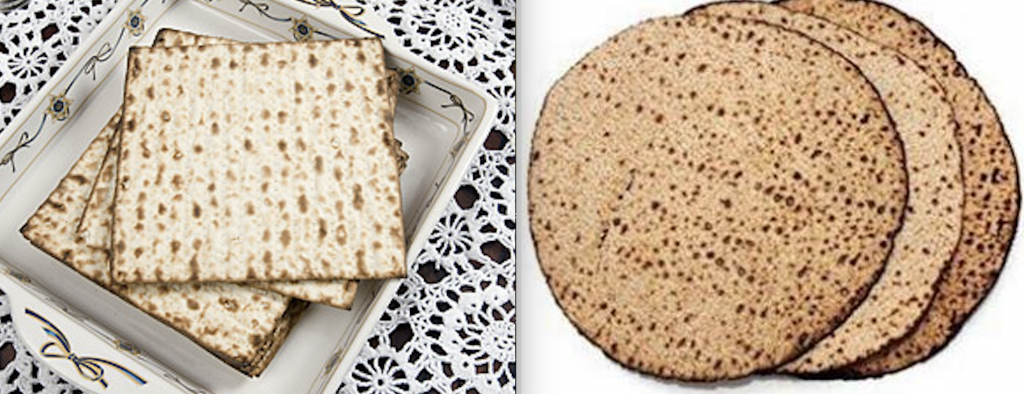
2. Machine made Matzot are square and of a standard size. Handmade matzot are circled, and with a more rustic look

Machine Matzot Handmade Matzot


PSYCHOLOGICAL CHAMETS

In just a few more days, on the night of Wednesday, April 5th, we will begin the celebration of Pesach. As mentioned below, there are eight biblical precepts associated with Pesach: the first two are “to tell the story of the Haggadah on the night of the Seder” and “to consume Matza”. All the other commandments are related to the prohibition of consuming or even possessing Chametz during Pesach. In the following lines, we will better understand the reason for the precepts associated with Chametz.
“More knowledge, less ego. Less knowledge, more ego.”
Albert Einstein

AIRS OF GRANDEUR
During Pesach, it is prohibited to eat or possess any food that is or contains Chametz. Why? Beyond the well-known historical reasons – our redemption was so rushed that there was no time for the bread dough to rise – our Rabbis saw in Chametz, the fermentation process that raises the dough, a very significant representation. They compared Chametz to arrogance. The dough that inflates itself, with the individual who allows their ego to expand and enlarge. Arrogance and Chametz are air: an illusory inflation of the self.

FREEDOM AND CONSUMPTION
But why do we specifically think about arrogance and humility during Pesach? Because not all people are exposed to the risk of becoming arrogant individuals. A Jewish slave in Egypt, for example, could not afford to be vain. The risk of excessive vanity is only relevant to a free, wealthy, self-possessed man. And on Pesach, when we commemorate our freedom, we have in mind that as sovereign individuals, we could easily fall into a different kind of self-slavery. Mental slavery. An addiction to the inflatable aspects of our ego: arrogance. Modern society, in its tireless efforts to make us slaves of consumption, more selfish, more narcissistic, and more hedonistic, pushes us to convince ourselves that we need everything we want and desire. This immense ambition, when satisfied, can easily lead to arrogance: feeling that I AM more than others because I HAVE more than others.

HUMILITY AND SELF-ESTEEM
Matza, a flat, unleavened bread with no frills, represents humility. To be humble does not mean to degrade or humiliate ourselves. It means to assume the true dimension of human life, become aware of our inevitable mortality, and recognize our dependence on God. Humility, on a psychological level, is also the essence of self-esteem. Love oneself and fundamentally accepting oneself is a prerequisite for being at peace with oneself. The arrogant individual is insecure. They need public flattery and the constant applause of others to survive emotionally. They seek the approval of the other, sometimes desperately, to compensate for what they lack or because they are incapable of facing their faults and errors. Only the humble, the person who does not need the applause of others to feel better, is genuinely free and independent. The humble person can admit their mistakes, change, and improve.
On the other hand, the arrogant person cannot admit mistakes and is, therefore, unable to change. And by being unable to correct themselves, they adapt to their own defects and enslave themselves. Arrogance is a tyrannical Pharaoh that condemns our personality to stagnation.

WHO IS IN THE CENTER?
Arrogance, this mental Chametz, is the main barrier between man and his neighbor. And also between man and God. The arrogant person does not conceive of “serving God”, but rather “using” God for their benefit. Our Rabbis explain that from the perspective of the arrogant person, “there is no place in this world for him and for God.” What does this mean? If reality were a circle, someone (or Someone) must be at the center of that circle. And at the center, there is no room for two. The arrogant person places himself in the center, displacing God to the periphery. In that relationship, they do not serve God but try to use Him.

The most critical goal in the life of a Jewish individual is to attain a level of humility that recognizes that God is at the center of reality. This mission is impossible for the arrogant individual, who is enslaved by his own pride.
Just as we eliminate every crumb of Chamets from our homes, we must erase every trace of vanity and arrogance from our hearts.


A New Pharaoh, Yosef and Abraham Lincoln

וַיָּ֥קָם מֶֽלֶךְ־חָדָ֖שׁ עַל־מִצְרָ֑יִם אֲשֶׁ֥ר לֹֽא־יָדַ֖ע אֶת־יוֹסֵֽף
A new king arose over Egypt, who did not recognize Joseph.
Shemot, Exodus, 1:8
We have already explained (Exodus 1: 7) that after two or three generations of arriving in Egypt, the Jews born there began to feel at home: the first thing they did was to leave their community, Goshen, and venture into Egyptian territory looking for new economic opportunities (see here). The next verse tells us how the situation of the Jews began to get worse.
Exodus 1: 8 says, “And then a new king arose in Egypt, who did not recognize Yosef.”
A NEW DYNASTY
There were two ways to become a new Pharaoh in Egypt: inheriting the throne from the father (or grandfather), or leading a coup against the monarch on duty. Everything seems to indicate that in this case it was the latter, a military revolt that produced a new dynasty, something not uncommon in Egypt. As usual in these cases, the allies of the previous government are now the enemies of the government in power. The Jews enjoyed a privileged position with the Pharaoh of Yosef’s time. This new King, however, “did not recognize” Yosef. This is not to say that he had never heard of him: Yosef was extremely famous. He saved Egypt’s economy with his prophetic predictions of the famine years and served Egypt loyally. The Egyptians deeply thanked Yosef for saving their lives and giving them food and seeds to plant. Yosef was a national hero. But now the new Pharaoh decides to rewrite history and sentence Yosef not to oblivion but to disgrace. Why?
THE NEED FOR AN ENEMY
The Italian philosopher Umberto Eco explained in his essay “Building an enemy” that for many rulers, especially dictators, an enemy, real or imagined, is an essential necessity. It serves the dictator to consolidate his power by creating a feeling of national unity based on hatred for a common foe. The enemy will be blamed for all the ills of the state. Which will serve the tyrant as a perfect distraction from internal problems that he cannot solve. For centuries, humanity’s favorite enemy has been the Jewish people. And this phenomenon, which still persists — for example, in the United Nations’ obsession against Israel — was born in Egypt. The new Pharaoh redefined Yosef and his descendants as “enemies of the people.” And for a long time I asked myself how did it happen? Was it possible to rewrite history, erase the national memory of a people and turn heroes into villains?
NOTHING NEW UNDER THE SUN
I’ve seen some similarities between what happened with Yosef and some events that took place in America during recent months. There are some extremist groups in the United States who are dedicated, among other things, to erasing the historical memory of this country, by demonizing “national heroes.” Take, for example, Thomas Jefferson (1743-1826), one of the Founding Fathers of the United States; who served as the third president of this country, and was, among other things, the main author of the Declaration of Independence and a defender of democracy and individual rights. But since he was a slave owner, which in those days was the accepted norm, he is criticized and demonized as if he “would own slaves today, in 2021”. Or Abraham Lincoln (1809-1865), the president who put an end to slavery in the United States! The statues of these heroes have been destroyed or vandalized. Schools that bear their names will be renamed. And the same is happening with Christopher Columbus, George Washington, Benjamin Franklin, or in England with Captain James Cook and others. These radical revisionist are trying to rewrite history in an anachronistic way, based on a political agenda, turning the heroes of the past into the new villains of the present.
A MIDRASH AND CURRENT EVENTS
Despite the obvious differences what one sees today sheds light on what happened then. It gets clearer for me to understand what transpired in Egypt, and what were the tactics Pharaoh used to “demonize” Yosef and make believe the Egyptians that all their problems were caused by him. And that now his descendants will have to pay for it! The Midrash Tanchuma presents an opinion that seems surreal for its unbelievable contemporaneity. It says the new Pharaoh “had Yosef’s remains unearthed from his luxurious tomb and thrown into the Nile, as a show of contempt on the part of the new Egyptian ruler for the great Jewish leader.” The Tora is not a collection of ancient myths or stories. Some times the present helps us to better understand the Tora; and the Tora allows us to better analyze and grasp present events, showing us patterns of behavior from the past that we can identify even today.


Medication and non-edible products

 Products that are not edible, such as cosmetics, glues, shampoos, deodorants, soaps, detergents, and other cleaning products, may be kept in possession or used during Pesach, even if they contain Chamets. Therefore, it is unnecessary to verify the absence of Chamets or obtain a special rabbinical seal or certification for these products (Rabbi Obadia Yosef, Yalqut Yosef, 360: 31, 361: 68).

For Sefaradim, medications that come in the form of non-chewable capsules or hard pills can be used during Pesach, as they are considered “inedible.” This includes medication that may contain Chamets elements. However, nowadays, it is highly unlikely (Yalqut Yosef Mo’adim, 362: 40). Rabbi Eliezer Melamed, a prominent rabbinic authority, notes that many Ashkenazi rabbis follow a similar Halakhic criterion and that most medical hard pills are made with potato or corn starch, which is permitted for Pesach consumption (see Penine Halakha Pesach 102, 103).

If possible, asking doctors to prescribe non-chewable pill medication for Pesach is advisable (obviously, in the case of a serious medical condition, any necessary medication should be taken).

Some Ashkenazi rabbis hold stricter opinions regarding consuming non-edible Chamets for Pesach, with some Ashkenazi rabbis stating that only non-chewable medication should be allowed. Vitamins, even in the form of non-chewable capsules or pills, cannot be used during Pesach unless it has been verified that they do not contain Chamets (many Sephardic rabbis agree with this criterion). Additionally, some Ashkenazi rabbis adopt a stricter stance on using non-edible Chamets for Pesach, such as cleaning products or perfumes made from wheat alcohol.

Both Sephardic and Ashkenazi rabbis agree that liquid or chewable medicines, syrups, powdered vitamins and/or medications, or vitamins with a pleasant flavor that is drinkable and/or chewable should be certified as “Kasher for Pesach” or verified not to contain any Chamets ingredients. Many dietary supplements and vitamins are made with elements that are 100% Chamets (e.g., grain fibers, wheat germ, etc.), so it is important to be cautious. Similarly, oral perfumery or personal hygiene products with a pleasant taste, such as toothpaste or flavored lipsticks, should also be checked for any Chamets elements.

We recommend the advanced level reader who wants to understand the relevant Halakhic details of the issue of medications in Pesach to see the following links:

Rabbi Melamed (Hebrew)

Star-K (English)

As the reader can appreciate, in all these Halakhot, there are diverse customs and traditions. For a final verdict, consult with the Rabbi of your community.


ZAKHOR. Antisemitism does not stop: it must be stopped

The Shabbat that precedes Purim is called Shabbat zakhor (= Remember!). This Shabbat we take out two Sefarim, one for the weekly Parasha,  this year 2022: Vayqra, and the other Sefer for a special Maftir in Debarim 25:17, zakhor. “Remember… what Amaleq did to you when you left Egypt … Amaleq attacked the defenseless … and did not fear God … do not forget !!!”.
 
THE STORY OF AMALEQ
When we left Egypt, escaping a 140 years period of slavery, Amaleq attacked us. It was an unprovoked attack, without reason or motive. Israel was not a threat to Amaleq’s possessions or territory.  The reasons for Amaleq to attack the Jews were not “logical” but rather, using a modern term “ideological”. Moreover, we were superior in number to Amaleq. But Amaleq still –irrationally—attacked us.  To be more effective and cause maximum damage, Amaleq attacked the weak, the infirm, the old.
 
There was nothing specific about the Jews that triggered Amaleq’s hatred.  It was not the power of the Jews, or the money of the Jews. The Jews had just escaped from a lengthy captivity. What power or money would slaves have?  It was not a territorial issue either: we were in the desert, not even in the Promised Land. Amaleq territory was not in our plans!
What characterizes Amaleq is a radical irrational hatred for Jews. 
 
I think the best way to identify Amaleq  (and anti-Semitism in general) is that Amaleq hates Jews “unconditionally”. Is not because of  what we Jews “have” or what we Jews “do” but because of what we Jews “are”: the people of God.  It is an existential hatred. What the Jew has or does is something Amaleq might use as an excuse to justify his hatred. To  disguise hatred as a politically correct fight against this who wish to dominate the world, etc.  
 
Amaleq and his “ideological” descendants (known as ”zekher Amaleq”) can be clearly identified by the following characteristics:
 
1. UNCONDITIONAL HATRED
Amaleq’s hatred towards Jews is not motivated by territorial disputes, revenge or by feeling threatened. It is an obsessive hatred toward the Jewish people . Look for example at Iran. Iran threatens to wipe Israel off the map although it has no common borders with Israel. There are not disputed territories between the two countries. 
 
2. CIVILIANS
Amaleq would attack and would try to kill Jews, whether they are civilians, women, elder or children. Remember Ma’alot in 1974?  22 little children were massacred by Arafat and the PLO. The murder of the Fogel family in Itamar, including a woman, her children and a baby.  The synagogue of Har Nof in Jerusalem. And many more. In the last years, representatives of Amaleq have killed Jews in Israel and have stabbed to death Jews also outside Israel. In Paris, Milan, London, Brussels, Miami, California, Buenos Aires, New York, Pittsburg, and unfortunately there are no signs that this will stop.  
 
3. SUICIDAL
Amaleq’s hatred for Israel is suicidal. Amaleq is willing to practice martyrdom (self-immolation, suicide attacks, etc.) if as a consequence he would kill a Jew. Amaleq’s hatred towards Jews is greater than Amaleq’s love for their own lives or even the lives of their own children.
 
4. SINGLE OBSESION
Amaleq may hate other people temporarily, but his endless obsession is against Israel. Amaleq does not hate the Jews for what happens in Israel. On the contrary, Amaleq hates Israel because is a Jewish state.  Anti-Zionism is Amaleq’s way to disguise its anti-Semitism.
 
5. EXISTENTIAL HATRED
The most important and practical point to consider in our confrontation with Amaleq is that it is not possible to negotiate with Amaleq. Because Amaleq will never be satisfied with land, money, or even with us changing our religion. Think of the Shoa. The Nazis killed also those Jews who were willing to renounced their religion. Amaleq wants the Jewish People to disappear, period. Israeli politicians and Jews around the world are divided precisely on this point: Everyone Jew wishes to live in peace. But some believe that peace with our enemies can be achieved through negotiations. Others believe that, like Amaleq, our enemies (Iran, Palestinians, Hizbollah, BDS, etc.)  will NEVER stop attacking us, even if Jews or Israel concede their demands.  The greatest internal conflict of the modern Israeli politics has to do with identifying or not identifying our modern enemies with the Amaleq the Tora warned us about.
 
6. SELF HATRED
For many Jews, especially for those who are unfamiliar with or unwilling to accept the Biblical concept of Amaleq, it is extremely difficult to recognize and acknowledge the true nature of Amaleq. And since the behavior of Amaleq is beyond rationality, intelligent and educated but extremely naive Jews, believe that something “rational” must be triggering Amaleq’s hatred toward us. And instead of accepting the irrational nature of Amaleq’s hatred, they blame it on ourselves!. They assume, for example, that terrorist attacks or Amaleq killing of Jewish civilians, or the BDS movement that aims to delegitimize Israel  is the consequences of a new settlement. Or that hatred to Jews has to do with some Jews being wealthy or powerful. When a Jews accepts Amaleq’s narrative he or she might end up hating their own people instead of holding Amaleq accountable.  
 
7. DENIAL
Foreseeing the danger of the well-meaning but naive Jew, the Tora warned us not only to “zakhor” (remember) Amaleq. In the same text, with an exceptional tautology, the Tora exhorts us to not forget Amaleq’s suicidal obsession and irrationality (“Lo Tishkakh”).
 
Our Hakhamim prescribed  to publicly read the text where the Tora mentions Amaleq the Shabbat before Purim. Why? Because Haman was the first descendant of Amaleq who was about to succeed in erasing the entire people of Israel off the map.
 
The Tora assures us that HaShem will not let Amaleq destroy us. But it exhorts us not to be naive about the true nature and intentions of Amaleq.  Forgetting, can be tremendously costly for us.
 
Parashat Zakhor has the special status of being a biblical text whose reading is a direct commandment of the Tora. Women are also expected to fulfill this obligation and attend Synagogue to hear Parashat Zakhor.


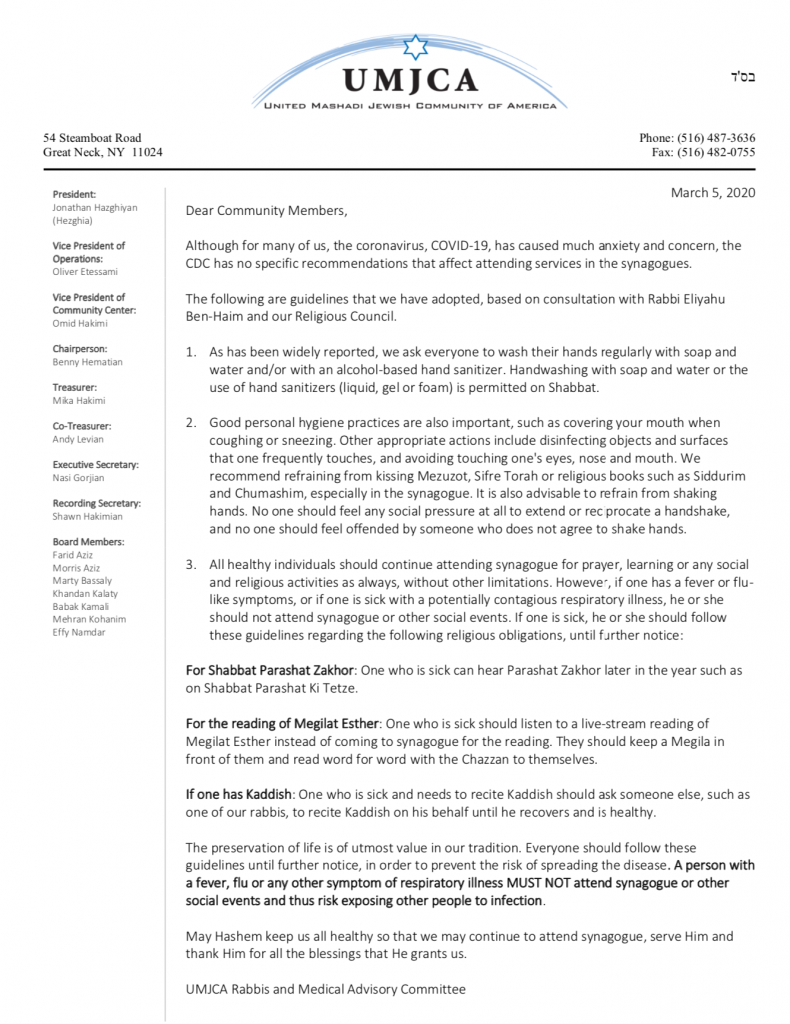
UMJCA Community Notice on COVID-19


Shabbat And Cellphones

Great minds discuss ideas; average minds discuss events; small minds discuss people.

Addiction to electronic devices is a growing concern in our modern society because we never part with them. Even when we finish our work and come home to relax, we still connect to our computers, cables, and Wi-Fi. Cell phones are particularly problematic, especially for children and adolescents. Teachers don’t know what to do to control their use. And many parents have already given up, until one day they realize that their little children would rather have an iPhone in their hands than hold hands with them. The syndrome of “separation anxiety,” which in the recent past referred to the fear of being separated from their parents, has become the panic adolescents feel when their cell phones are not within reach.

Being able to disconnect from this addiction is extremely important, but it seems that no one knows how to do it. Except for the Jewish people. In the first part of this Parasha, the Tora tells us about the “Sabbath rest.”  Shabbat is a Divine gift whose relevance is not for modernity but for eternity. Miraculously — I have no other way of explaining it– the meaning of Shabbat has always been transforming, adapting to what we most need in those moments. In the times of slavery, when we left Egypt, Shabbat helped us feel free and experience physical rest, which we did not have for generations. In difficult times, in our long exile,  Shabbat was an emotional refuge, a family space, a community identity, and an island of peace. In times of poverty, the Shabbat table, with its mandatory “two” loaves, helped us regain a sense of dignity.

In modern times, Shabbat once again surprises us, revealing its magical renewed significance to the point that it makes me think that Shabbat was NEVER more necessary than in 2023. From Friday afternoon to Saturday night, all contact with the electronic world is suspended. On Shabbat, we relearn to enjoy the true pleasures of the real world. We sit down to talk, not chat, with our beloved families. We don’t listen to digital music; we sing along with our children. We talk about Tora without the intromission of Alexa or Siri, and our children do not listen to a podcast but to words that come from human lungs and vocal cords.

The images of our family around the Shabbat table will not be shared in family chats, nor will they end up in a virtual cloud. They will be stored in the hearts of our children and will create memories that will become their identity and the feelings that will unite parents and children for generations. Shabbat invites us to disconnect from a fake virtual world to build a real family.

It has never been so necessary.