Our Perasha Behar Sinai contains 24 commandments or Mitzvot. We will briefly look at some of them.
SEVENTH YEAR
God orders Moshe the Mitzvah of the Shemitah or sabbatical year: “When you arrive in the land that I am giving you, the land will observe a year of rest. For six years you will be able to sow your field, prune your vineyard and reap the harvest. But in the seventh year the land will have a year of rest… you shall not sow your field, nor prune your vineyard…”. God promises that if the people of Israel faithfully observe His laws, they will not lack food. I will “ordain My blessing for you in the sixth year so that the land may produce a harvest sufficient for three years.” That is, the sixth year will produce enough food for that year, and the next two years (during the eighth year, the land is plowed and sown, but it is not harvested until the end of the year. Which is why it is necessary that the sixth year would produce for three).
JUBILEE
The Torah also mentions the year of Jubilee or Yobel: Every 50 years the land is returned to its original owners. The land then was never sold in perpetuity but up to a maximum term of 50 years. Debts were also canceled in a similar way. All of this prevented some people from becoming too poor and others too rich in the long year. In the Jubilee year, all the slaves were freed, who at that time were the people who, given their poverty, were employed as servants to survive or to pay for their debts.
INTEGRITY
The laws of buying and selling objects and property must be followed with absolute integrity. It is forbidden to deceive or harm others financially. The Tora also indicates that one must avoid harming others with words that would damage them emotionally.
SOCIAL JUSTICE
When one of your Jewish brothers is in financial trouble and is forced to sell part of his property to support himself, the closest relative who can redeem that land must do it. If a man has no one to redeem it or if he lacks sufficient means to recover it, what he sold will remain with the buyer just until the year of jubilee. The Parasha also refers to compassion and social justice: helping a fellow Jew who is in financial difficulty. It is necessary to prevent someone from falling into poverty, by offering them a loan that can sustain them financially. The Tora reminds us, however, of the prohibition against charging interest on a loan to a Jewish brother and the imperative to treat servants in a dignified and respectful manner. “For the children of Israel are My servants, whom I rescued from the land of Egypt. I am HaShem Your God.” The Parasha concludes with a final exhortation to observe the Shabbat day and to show the utmost respect for our Temples and Sanctuaries.
BEHAR: Colombian Universities and the Sabatical Year
In this week’s Parasha we find a very interesting Mitsva, Shemita, or in English Sabbatical year. This means that the in the land of Israel the cultivation fields should rest during the seventh year. In the seventh year the land is not plowed; neither sown nor harvested. The reason for this Mitsva was explained in different ways. The first thing that might come to mind is that letting the soil rest for a year contributes to the conservation of the soil and allows to improve its fertility.
GROWTH
I think the best way to understand “Shemita” is comparing this Mitsva with “Shabbat”. During Shabbat we also “rest” and one of the benefits of rest is that it allows us to renew our physical strength for the next working week.
However, the meaning of the Shabbat goes beyond material rest. Actually, physical rest is not the purpose of Shabbat, but just an incidental consequence of the Shabbat. If I live on the 12th floor I have to go up and down the stairs every time I come to or I leave my house. Something that does not really add a lot with to my physical rest …
The meaning of the Shabbat and Shemita must be sought in the effect it leaves in the worker, the “human”, not the ground or the body. Once every seven years / days the Jewish worker stops working, plowing and harvesting to engage in another completely different activity. In Yerushalayim, for example, the year of Shemita coincided with the Mitsva of Haqhel, where all the people gathered to hear and study the Tora from the Kings and Priests of Israel. We do the same every Shabbat. Since we do not work, we can leave our mundane occupations and dedicate ourselves to pray, listen to and study the Tora with our family and our congregation.
In this sense, Shabbat and Shemita present an identical scenario: on Shabbat we stop working and we stop “growing economically”. Not to dedicate ourselves to physical rest but to “growing spirituality”. Increasing not our financial gains but our Tora knowledge, wisdom and our closeness to HaShem. In the year of Shemita we stop dedicating ourselves to “the growth of the plants and the fruits” of the land and we occupy ourselves “in our own growth.”
This concept of intellectual growth and mental renewal is recognized today throughout the world. The most prestigious universities in the world grant their faculty “a Sabbatical year”, one year of rest every seven years of work. The university pays the professor his or her full salary so that she can spend twelve months studying, researching and writing. Thus, without the burden of the teaching work, the professor can exponentially renew his knowledge, grow intellectually and then bestow all his new intellectual wealth into his students.
The academic sabbatical year is perhaps the best illustration of the nature and benefits of the Shabbat and the year of the Shemita. I received a great article from one of my readers in Bogota, Colombia. This article clearly explains and defends the adoption of the Sabbatical year for Colombian Universities teachers in a very pragmatic way. The suggestive title says: “The Sabbatical year has nothing to do with resting. Colombian universities see in this strategy [implementing a Sabbatical year for their faculties] the ideal opportunity to improve the quality of their teachers’ education and to increase the number of their articles, research and academic books. “ See the full article HERE (Spanish)
EMUNA
There is one more element, very deep, that Shabbat and Shemita have in common. Emuna, our faith that our sustenance ultimately comes from HaShem. Let’s start with Shabbat. We all know of the anti-Semitic prejudice that accuses the Jews of being able to sell his soul for money. In fact, the best argument to unmask this malicious accusation is by understanding what Shabbat is. When a Jew observes Shabbat he is sacrificing a very significant part of his income. How many times have I heard that in retail, for example, ”Saturdays are a very important day for business”. When a Jew observes Shabbat, he demonstrates that for him economic benefit lies on a secondary plane. And that he believes in God’s intervention in our livelihood.
In the year of Shemita there is similar, but almost miraculous, scenario, and on a larger scale phenomena. The Tora assures the Jewish farmer that if he observes Shemita, he has nothing to fear. This is what the Tora says in Vaiqra, chapter 25: “(20) And if you ask yourself, What shall we eat in the seventh year, if we neither sow nor reap our produce? ” (21) [Therefore, you must know that] in the sixth year I will send you a blessing so great that the earth will produce [enough] for three years. (22) When you sow during the eighth year, you will still be eating from the previous harvest, and you will continue to eat of it until the harvest of the following year. ”
When the earth rests during the seventh year, it must be worked during the eighth year to begin producing fruits only in the ninth year. The Jewish farmer must “have faith” that the agricultural production of the sixth year, will be enough for the sixth, for the seventh, and for the eighth year.
The observance of Shabbat and the observance of the Shemita are a testimony of our Emunah: when we observe the “Sabbatical rest”, we testify with our actions (with our rest and with our economic sacrifice) that Hashem, the Creator of the World, is the ultimate responsible for our livelihood.
Honoring Parents as Heroes, a Biblical revolution
We all know the importance of the Mitsva of honoring and respecting our parents. What is perhaps less known is the historical context in which this commandment was established. Learning more about it will help us appreciate more how extraordinary this commandment is.
At first, sight, honoring our parents seems to be something obvious and natural today.
Especially because, as with many other values, Jewish biblical ideas have been integrated over the centuries into the mental and social heritage of a large part of humanity. We live in a civilization that the Bible has transformed, and as such, we take the duty to honor our parents for granted. However, this obligation is a Biblical Jewish innovation.
Let’s see.
WHAT IS A HERO?
Family and family hierarchies were not always as we know them today. To the point that parricide and incest, as can be seen from the stories and myths of the Hittites, the Sumerians, and many other peoples of ancient Mesopotamia, were not uncommon.In our specific case, the duty of honoring parents in the Tora goes far beyond mere respect for the authority of our parents. Honoring them means giving them a special category of respect. Consider, for example, the obligation of a son or daughter to stand up in honor of the mere presence of their parents. In modern society, this is reserved for individuals with certain positions associated with power, for example, the president, a judge, a governor, etc. Also, in ancient times, in societies contemporary to the time of the giving of the Tora, this type of honor was reserved not for the progenitors but almost exclusively for the warriors and the “heroes” of the battlefield. For men (never for women!), powerful and physically strong, distinguished by their military prowess or by defeating monsters with multiple heads.
The call to honor “parents” is a radical innovation of the Tora, a profound disengagement with other cultures and with the human tendency to elevate to the level of heroes those who obtained the glory in the battle. The Biblical revolution solidifies the image of parents by demanding to honor them as if they were our heroes, and reinforcing thus the child-parent bond, facilitating the process of education and transmission.
WHAT IS A WOMAN?
Another element that perhaps is not valued enough is that societies of antiquity were strictly patriarchal, and in many civilizations, women were considered as possessions, and they enjoyed practically no rights. As explained by the Sages, the Biblical text establishes that a child should honor his father and mother equally. The mother is not seen as a paternal appendix but as an equal partner in the family society. This is a cultural revolution with long-term effects. Because by raising the position of both parents equally, a Jewish child is trained from a tender age to appreciate women. Among other things, this will influence, in the future, the way a man will see his own wife since there is a direct relationship between the respect that a son has for his mother as a boy and the respect he will have for his wife when he gets married. A Jewish daughter also grows up with an enhanced self-esteem as a woman, seeing the unconditional honor and deference given to her mom by her male siblings.
Showing Honor and Providing Care for Our Aging Parents
The rabbis of the Talmud examined the matter of honoring our parents in special circumstances. We will now explore one of these cases.
MENTAL HEALTH
The rabbis presented the case of Rab Ase, who lived with his elderly mother, who exhibited symptoms of senile dementia. Rab Ase took excellent care of her, doing whatever he could to please, honor, and avoid contradicting her. The Talmud illustrates the mother’s erratic behavior and Rab Ase’s reaction: first, she asked him to buy her jewelry, and he brought her some. Then she asked him to find her a husband. Trying to appease her, he told her he would look into it… Eventually, the situation reached a point where the elderly mother’s orders became increasingly eccentric, and her behavior grew even more erratic. Rab Ase then decided not to care for his mother “personally.” Firstly, for some reason, Rab Ase’s mother’s behavior was very dysfunctional in her son’s presence, but with other people, she behaved more calmly. Secondly, Rab Ase understood that if this situation with his mother continued or worsened, he might be forced to restrict his mother physically, something he was unwilling to do because it would be disrespectful to her. Rab Ase then hired a capable helper to care for his mother. Based on this precedent, the rabbis concluded that, in certain circumstances, a son or daughter might have their elderly parents under the care of other people.
Obviously, these are very sensitive and complex issues, and each case is entirely different from the other. It is recommended in these circumstances to consult with a rabbinical authority and a mental health professional to find the best and most effective solution for both parents and children.
It is worth noting that the fact that a son or daughter is not taking care of their parents in person does not exempt them from continuing to address their parents’ needs, visiting them, speaking to them frequently over the phone, and using all modern means of communication to maintain a strong emotional relationship with their parents.
DISOBEYING PARENTS FOR THEIR OWN GOOD
Honoring our parents includes, as much as possible, pleasing them and fulfilling their wishes. But what should be done when parents ask their children to do something harmful to them? For example: What should a son or daughter do if their father asks them to bring him an alcoholic beverage, and the child knows that the father will end up drunk? Should a child obey their father and bring him liquor, following his “wishes,” or should they refuse to please their father in this case?
The rabbis explain that in these types of circumstances, children must refuse to obey their parents for their own good. However, they must do so while maintaining the utmost respect, trying to dissuade their parents while keeping their dignity intact and maintaining a positive attitude without offending them.
Contemporary rabbis provide some other common examples. If a father or mother has diabetes and asks their child to bring them a very sweet food, or if a father asks his son or daughter to bring him cigarettes, in all cases where parents ask their children for something that may cause them significant harm to their health or well-being, children should not fulfill these requests. Once again, even in these cases where children disobey their parents for their parents’ benefit, it is crucial to maintain a respectful attitude and avoid offending, yelling at, or humiliating the parents (Yalqut Yosef, Kibbud Ab va-Em, 2, 46-60).
This is a very symbolic week, a week that represents the transition between two completely opposite historical milestones that affected the Jewish people more than any other historical event. On the one hand, this past Tuesday we cried and mourned on Yom HaShoah, the Holocaust Remembrance Day. On the other hand, this coming Tuesday night, we will celebrate Yom ha’Atzmaut, the day of Independence of the State of Israel. Jews have suffered countless persecutions, massacres, and pogroms everywhere and at all times. However, we have never suffered as in the Shoah. Both in absolute and relative terms, there has never been such a devastating massacre as the Shoah. The Jewish people were never so close to being exterminated. At one point in 1944 or 1945, when the Nazis murdered half a million Hungarian Jews in just six months, when no one dared to oppose the Third Reich, or when Rommel was preparing the gas chambers in Tunisia to transport and gas there, the Jews of North Africa, Palestine, Syria, Iran, and Iraq. At such times we lost all our hopes. We felt we were doomed to die or we were already dead. We were buried. It was the end.
But then the greatest miracle, promised so long ago by our prophets, happened. In a span of just three years, which in the context of the history of our people is less than the blink of an eye, the Kibbuts Galuyot, the return to our land, began. HaShem took us out of our graves, lifted us, and brought us back to Israel. And from the ashes, we, the Jewish people, began to revive. More than 2500 years ago, Ezekiel (Yehezqel) had a very special prophetic vision (nebua). In this vision (Chapter 37), HaShem transported him to a valley. In that valley, there were bones. Many bones. Human bones. Probably millions of bones. Dry bones. There is nothing more dead than a dry bone. Ezekiel saw it and said nothing. And then HaShem told Ezekiel: “Son of man: Do you believe that these bones will ever come alive? And Ezekiel, in a combination of humility and surprise, replied: “HaShem, God, You would know that.”
And then, there was a deafening noise. The bones began to move, came together and formed skeletons. Veins and nerves covered the skeletons and, finally, flesh and skin. Now, they were no longer bones but bodies; dead human bodies, corpses. Then, HaShem said to Ezekiel, “Prophesy to these bodies to insufflate into them a breath of life, and let the spirit of life enter into these bodies and let them live again.” And so it was. A breath of life entered the bodies, and they stood up. It was a great army, very large. HaShem told the prophet Ezekiel, “Son of man, these bones are the house of Israel. They say, ‘Our bones dried up, we lost our hope, we have been sentenced to disappear.’ So, I prophesy and say to them [Israel]: Thus said HaShem, God: behold, I will open your graves, and I will raise up from your graves, and I will bring you to the land of Israel. And it will be known that I am HaShem when I open your graves and bring you from them, My people. I will grant you a spirit of life, and you will live again. And I will lead you into your land. And you will know that I am HaShem. I have promised, and I delivered.”
It is impossible not to connect this prophecy with 1945 and 1948. In 1945, we were doomed to disappear. We were dry bones or, perhaps worse: ashes. And then, when so many Goyim thought that we had disappeared, that we would never again become a people, that all those promising prophecies would never be fulfilled, the greatest miracle occurred, just like Ezekiel saw in the valley of the dry bones. HaShem opened our graves, lifted us, and brought us back to Israel. HaShem promised, and He delivered.
The first Jewish Spies of the State of Israel
יעקב בוקאי ז”ל
Tonight and tomorrow, we commemorate “Yom haZikaron”, Israel’s Memorial Day. We remember the heroes of Israel: soldiers, spies, and martyrs who sacrificed their lives for the establishment and continued existence of Medinat Israel.
A few years ago, I read a very interesting magazine given to me by Mr. Nathan Hasson from Manhattan Beach, Brooklyn. This monthly magazine, “MIKAN UMISHAM” writes about the Jews of Damascus (Sham) Syria, their stories, traditions, etc. One of these magazines is dedicated to the “mustaarabim comando” (or mista’arabim), a special unit of the Israeli army that was officially formed in 1943. Before Israel’s independence in 1948 and the IDF’s establishment, Jews living in Israel formed a clandestine army called the Hagana. The Hagana was organized to defend the Jewish colonies from the constant attacks and looting coming from the Arab population. Within the Hagana there was a military unit, Palmach, whose mission was to attack the enemy in a preventive manner and disrupt their military plans. In 1943 the Palmach organized a special elite group of espionage and counterterrorism called “The Arab Commando” or, in Hebrew, the Mustaarabim (“pseudo-Arabs”). This unit was formed by a handful of young agents and spies of Jews born in Arab countries. These young people spoke Arabic perfectly, knew the culture, and could dress and look like Arabs. In this way, they could go behind enemy lines, blend with the local population and gather intelligence information or perform special missions.
The most famous of the “mustaarabim” spies was undoubtedly Eli Cohen z “l (1924 -1965), whose espionage operations for Israel in Syria were crucial and determinant for the victory of Israel in the Six-Day War.
Today, Yom Hazikaron, I would like to share with you the stories of other younger “mustaarabim” to honor their heroism and memory.
YOSEF COSTICA
Yosef Costica was born in Damascus, Syria, in 1921. At the age of 13, he emigrated to Israel.
In 1936, the year of the great Arab rebellion, Yosef volunteered in the Hagana. In 1940 he was recruited for a special mission in Tripoli, Lebanon. Costica changed his identity and his name. He was now “Abu Nuri”, a Lebanese Maronite businessman. Costica’s mission was to report the possible coming of Nazi troops into Lebanon. Why Nazis? Lebanon was “a French colony”, and at that time, France was under the control of Vichy, who supported Adolf Hitler י”ש. It was expected that at any moment the Nazis would arrive in Lebanon and cross over to Israel, to deport and kill the Jews. Costica had to watch and report on these movements to his superiors and eventually sabotage the arrival of the Nazis into Israel by any necessary means: destroying bridges and roads, bombing ships or vehicles, etc.
Costica was later reassigned to reporting on the location of the city’s refineries, for which he reinvented his identity and posed as an athlete who ran several kilometers each day around the refinery facilities. He returned to Israel on foot to bring his superiors all the information and maps they needed.
The information collected by Yosef Costica was a great service to the future Medinat Israel in the most vulnerable time of our history.
YAAQOB BUCAY
The story of this young man is quite tragic. Yaaqob was born in Damascus in 1930, in a family of 10 children. At the age of 15, he made Aliyá, and at 16, he volunteered at the Hagana. Bucay stood out as much for his physical condition as for his great motivation to fight and defend Israel. His name reached the Palmah commanders, who recruited him for the “Mustaarabim unit” for his knowledge of the Arabic language. Yaaqob was assigned to a very risky mission: establishing an espionage network in Amman, Jordan. He received intensive training for 6 months. The plan was the following: in 1948, a truce had been signed between Jordan and Israel, and part of the agreement was that Israel would deliver to Jordan 450 Jordanian citizens who had crossed into Israel illegally. Yaaqob Bucay was going to infiltrate that group and pose as a Jordanian citizen, and once in Aman, he would begin to organize an intelligence and espionage unit there. The transference of Jordanian citizens took place in March 1949. But something failed, and the young Jewish spy was discovered. Some say that his blue eyes gave him away, or his Jewish appearance, that he wasn’t able to disguise … Despite all the diplomatic efforts and the dispatch of several agents to rescue him, his whereabouts could not be found, and he could not be saved. It is thought that in the Jordanian prison Bucay, who was just 19 years old, was tortured to extract information from him. Yaaqob Bucay was sentenced to death and hanged in August 1949.
Two months after his execution, a letter written in his own handwriting arrived in Israel, in which he wrote to his superiors that he did not confess his identity or mission. “I have not betrayed [Israel]; my conscience and my heart are and will always remain faithful to you as long as I am alive.”
It is unknown where he was buried, but a monument was erected in his honor in the military cemetery of Israel, “Har Hertzel”.
יהי זכרם ברוך
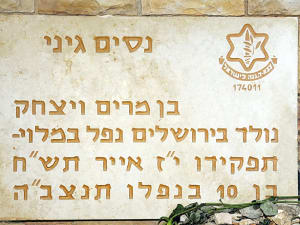
Nissim Ginni, 10 years old, the youngest fallen soldier of the IDF
THE WAR OF INDEPENDENCE
Yom haAtzmaut celebrates the Declaration of Independence of Israel on May 14, 1948. But that declaration of Independence was the beginning of a very painful war that cost the lives of 1% of the Jewish population of Israel … The day after Independence day, all the armies of the Arab countries began to attack the Jewish population of Israel, which at that time consisted of more or less 650,000 souls. The story of Nissim has to do with the attack against the Jewish Quarter of the Old City of Yerushalayim, the Roba Yehudi, by the powerful Jordanian Legion. Nissim Ginni was born in Jerusalem in 1937 or 1938. It is possible that he was born in Hanuka, because among Sepharadim it is common to name a baby born on that holiday “Nissim” (miracles, alluding to the miracles of Hanuka). His father was Ytshaq Ginii, an observant Jew that came from Izmir, Turkey. His mother was Miryam Waqnin, from Morocco. Nissim had two brothers, Nathan and Meir z”l, and one sister, Chaya. Nissim studied in the Talmud Tora of the Old City. 1,600 Jews lived there at the time, in constant tension with their Arab neighbors. Jewish children suffered the permanent bullying of Arab children, but they managed very well to defend themselves.
THE SIEGE OF JERUSALEM
On May 14, 1948, when Nissim was in the 4th grade, hostilities began. The Old City was blocked, and the Jews living there were isolated, with only 200 young soldiers left and very little ammunition to defend the population. The soldiers resisted as much as they could, but many died or were captured by the enemy. The siege intensified, and there were fewer and fewer Jewish fighters left. The civilians, then, joined the efforts to defend the city. The situation of the Ginni family was not easy. The father, who had a bakery in Mahane Yehuda, was caught outside the Old City when the blockade began and was not able to enter the Jewish quarter. Nissim’s mother, blind in both eyes by a terrible illness, was in charge of her four children. Chaya, the older sister, who was 14 years old, volunteered in Bate Mahase, an improvised infirmary where a few nurses and volunteers treated the wounded. Many children, such as Nathan, Nissim’s older brother, who was 12 years old, also volunteered to help. The children brought coffee or food to the soldiers and helped as much as they could.
THE MOST COURAGEOUS CHILD
Nissim, nine or ten years old, also volunteered. Probably due to his skills in the game of “hide and seek”, Nissim knew perfectly well all the corners, the shortcuts, and the secret passages of the Old City. Nissim was very mature, awake, and especially brave. Nissim helped the soldiers carrying weapons and ammunition from one to the other. But the most important thing that Nissim was doing was to slip away at night, avoid the enemy sight, and identify and inform the Jewish forces of the movements of the Jordanian troops. Eyewitnesses tell that Nissim often ran under a rain of Jordanian bullets to fulfill his mission, risking his life to find the Jordanian snipers. The intelligence brought by this child resulted in them being absolutely critical of the brave Jewish soldiers, and his actions saved many lives. On May 27, 1948, Iyar 19, after helping the Israeli soldiers for hours, Nissim went home to eat a hot meal. But before he could taste his mom’s food, a young man came looking for him: “Your replacement did not arrive”, he told him, “we need you at the observation post.”
SHALL I STAY HOME WHILE MY BROTHERS DIE?
When Nissim was about to leave, his mother, frightened by the sounds of the increasingly closer bullets, said: “Leave him here; outside is getting very dangerous.” Several witnesses remember what Nissim said to his mother at the time: “מה את רוצה אמא, שאני אשב בבית ואחרים ימותו” “What do you want, mom, that I stay at home while others die?” And Nissim left. Nissim arrived at the observation post, near the place where Yeshiba Porat Yosef stands today, next to the Kotel. In a tragic moment, Nissim raised his head, and a Jordanian sniper shot him and mortally wounded him. Nissim was taken to the infirmary of Bate Mahase, where he was treated by his own sister Chaya, who desperately tried to stop the blood. But she did not have the appropriate medical equipment to help Nissim, and the next day Nissim Ginni died of his wounds.
THE FALLING OF THE OLD CITY
That day, after resisting heroically for 14 days, the Rabbi of the Old City of Yerushalayim, Ribbi Benzion Hazan, raised the white flag, and the city surrendered to the Jordanians. The Jordanians took about 500 Jews prisoners, and the rest of the Jews were taken out of the city. The body of Nissim and seven other deceased soldiers remained in the infirmary of Bate Mahase.
THE BURIAL of NISSIM GINNI
In June 1967, the Israeli Army B”H reconquered Yerushalayim. An elderly Arab citizen asked to speak with the highest-ranking officer. The elder took the officer to a corner of the city and said, “The bodies of a few Jews are buried here. I buried them myself in 1948. The Jordanians wanted to burn the bodies, but I did not allow them.” The army removed the bodies, but the fighters could not be identified. Except for one: Nissim Ginni, because he still had his baby teeth … The remains of Nissim were taken by order of Rabbi Shelomo Goren to the cemetery of the Mount of Olives, Har HaZetim. After a few years, the Israeli Army recognized Nissim Ginni as the youngest fallen soldier to have served in the Israel Defense Forces, and a plaque was erected in his memory in the Har Herzl military cemetery. See HERE
TAZRIA-METSORA: How to improve your quality of life
This Shabbat, we will read two sections of the Torah: Tazria and Metzora. One of the most discussed topics in these two sections is tzara’at, which is a disease or condition (neg’a) generally associated with leprosy. Once diagnosed with this disease, the individual was isolated and quarantined until their cure. The Sages learned from the case of Miriam, Moses’ sister, who contracted tzara’at, that there is surely a relationship between tzara’at and speaking ill of others, which is known as Lashon Hara, i.e., speaking badly about others. Since those who engage in the addiction of gossip and destructive speech must be “isolated” so that their behavior does not “spread” and their example does not become “normalized” in Jewish society.
We present here a brief reflection on one of the ways to avoid Lashon Hara, according to the teachings of Pirkei Avot.
“And judge every person favorably.” – “Yehoshua ben Perachyah used to say: Make yourself a mentor, acquire a friend, and judge every person favorably.”
Judging others favorably is a commandment of the Torah. Where does this commandment appear? In the book of Leviticus 19:15 it says: “You shall judge your neighbor with righteousness.” The Sages explained this important precept as follows:
There are three categories of people: the righteous person (tsadiq), the wicked person (resha’im), and the average person. The righteous person has an impeccable record of good deeds. These individuals, who are more like angels than humans, are not the majority. They will be between 1% and 5% of the total. At the other extreme, we have the true wicked people, the resha’im, those selfish individuals with bad intentions and a record that condemns them. I estimate that this is also a maximum of 5% of the total population (the book “The Sociopath Next Door” claims that sociopaths are 4% of the population). And then we have the ordinary people: all of us, who generally have noble intentions, do good things, but also have our flaws – sometimes we behave altruistically and sometimes selfishly. People with average morality will make up 90% of the population.
The Torah says:
To the righteous person, you must judge them with indulgence. Even if you are not sure if they acted well or badly, or when you perceive a suspicious situation but do not have all the evidence in front of you: do not condemn them in your heart. Judge them generously. Positively. Give them the benefit of the doubt.
To the wicked person, who already has a record of deliberately acting with evil, you cannot give the benefit of the doubt until they repent because their behavior can affect you. You must be suspicious of a truly wicked person, even when it seems they want to do something noble (we will talk more about this later).
And what about the average person? With most of our friends, family, acquaintances, etc., the Torah indicates that with the average person, you should judge them as if they were a “righteous person” and give them the benefit of the doubt unless you have clear evidence to the contrary. In other words, this commandment, “You shall judge your neighbor with righteousness,” should be read more or less as follows: “You shall judge your neighbor (the average person) just as you judge the righteous person (the tsadiq).” Thus, according to the Torah, we must give the benefit of the doubt to the vast majority of people!
Judging others in this way brings enormous benefits for society and individuals in material, spiritual, and emotional terms.
Firstly, because “with the same measure that you measure, it will be measured to you.” How do we want to be judged by God after 120 years? Do we expect Him to judge us severely or indulgently? Surely we want the Supreme Judge always to find an extenuating circumstance, a justification for our mistakes… The Sages explain that God will judge us with the same measure we use to judge others. If we learn to judge others with the benefit of the doubt, that’s how we will be judged by Him. And something else: not only will God judge us as we judge others, but our gestures and attitudes are usually reflected and imitated by the people around us. If you want other people to judge you indulgently, not to rush to suspect you or condemn you before having all the information at hand, then learn to judge others with the benefit of the doubt. When you give others the benefit of the doubt, you also receive it from others.
Finally, judging with the benefit of the doubt is the best antidote to avoid Lashon Hara. When we speak badly of others, it’s because we think badly of those people. Often we hear a destructive comment about another individual, and we “believe it” and repeat it, even though we may not have evidence or know the complete story and all versions of the story. If we learn this great commandment of giving others the benefit of the doubt in our hearts, we will be much more careful not to listen, not to believe, and especially not to repeat negative comments about others. This way, we will avoid Lashon Hara, and our quality of life will improve immensely.
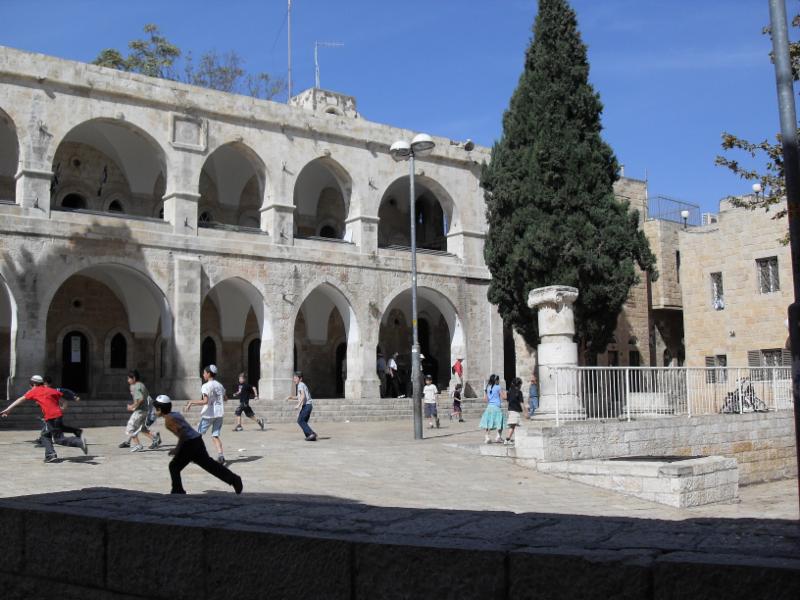
Look closely at this picture. Do you see anything special? Just children playing in a square. Right? Well, not so fast…
This is the Old City of Jerusalem. Some children are playing in a square (and a street) called Bate-Mahase. This is a very important place in the Old city. The two-story building with arches that you see was built in 1871 with funds provided by Baron Wolf Rothschild of Frankfurt to house poor families. The Rothschild family coat of arms is still at the top of the building. Today, it houses the offices of the Jewish Quarter Municipality. In this courtyard, you see a very familiar scene: children running and playing. This happens every day because there are two schools close to this courtyard: The No’am Talmud Tora and the Sylberstein Yeshiva.
What you don’t see in the picture is another familiar view: elders, old men, and women sitting on the benches of the square. Elders love the sight of children, and many times after school hours, grandparents would come to this square to play with their grandchildren.
There is something else in this place. Look at the following picture.
There is a scripture carved in stone. It’s a quote from the prophet Zekhariah, 8:4-5. Zekhariah was a child when the Jews lived in the Babylonian exile 2500 years ago. Without their own land and without the Bet HaMiqdash, the future of the Jewish people looked very grim. They were hopeless. In normal circumstances, Jews would have naturally integrated (assimilated) into the Babylonian population and disappeared. But a miracle happened. Cyrus, the Persian emperor, was moved by HaShem (as he explicitly declared) and encouraged the Jews to come back to Israel and rebuild Jerusalem. Although the majority of the Jews chose to remain in Babel (the first but not last “voluntary exile”), thousands came back.
Zekhariah was among them. They found a completely destroyed city. Everything was ruins, ashes, and desolation. There was not even a wall to protect the city, which made living in the city a mission impossible (imagine living in a house without one of its outside walls).
But from the midst of this desolation, Zekhariah had a prophetic vision, a very unlikely scenario to happen, given the terrible conditions of Yerushalayim in his days.
This prophecy, engraved on that stone, is in Chapter 8, verses 4-5:
“And now, HaShem says: I will return to Mount Zion, and I will dwell in Yerushalayim…. And once again, old men and women will walk Jerusalem’s streets with their canes and will sit together in the city squares. And the streets of the city will be filled with boys and girls playing in it.”
Let us now see the whole picture: you are in Bate Mahase, reading this extraordinary verse engraved on the stone in front of you. On any given day, elders sit on a bench and children play in the street. Then you realize that you have the incredible merit of being a living witness to the fulfillment of Zekhariah’s prophetic words. You also understand that you are not just a witness of Zekhariah’s prophecy but rather the embodiment of that prophecy. You get the feeling that 2500 years ago, in his incredible vision, Zekhariah saw you.
AMIDA Elokai Netsor, praying for your own good behavior
The ‘Amida technically ends with the nineteenth and final blessing, Sim Shalom. However, before concluding the ‘Amida, we recite the “Elo-hay, netsor…” prayer, which is different from every other prayer. First, unlike every other berakha in the ‘Amida, this prayer is written in the first person singular. Why? Because this berakha, “Elo-hay, netsor…” was not originally part of the ‘Amida, but a personal prayer composed by Mor bareh deRabina, a Rabbi from around 500 of the common era. Since then, it has been adopted by all the Jewish people to conclude the ‘Amida.
The content of this prayer is also unique. In it, Mor bareh deRabina asked God to save his tongue from evil and his lips from falsehood. He recognized the huge challenge of keeping our mouths under control and asked for God’s assistance in preventing him from speaking lashon hara (negative speech) and deception, which are often the sources of conflicts between people.
In this prayer, the Rabbi also requested God’s help in behaving with humbleness, patience, composure, and calm, especially in moments of tension when one is provoked by others or hurt by others and instinctively wants to respond and hurt the aggressor back. We ask for God’s assistance to grant us the patience and restraint we need to react appropriately in these difficult situations.
This prayer is unique because it requests God’s help in refining our character and improving our behavior, unlike the other berakhot in the ‘Amida, in which we request material things such as health and a good livelihood. In this last prayer, we ask God to inspire us to do good and help us to keep away from doing evil, but we should also recognize that our behavior depends on our freedom of choice and our responsibility to make moral decisions. When we recite this prayer, we must remember that we are not asking God to control our lives and decisions but to help and inspire us to reach our potential and behave with integrity.