Shemini Atseret & Simchat Tora

ושמחת בחגך אתה ובנך ובתך ועבדך ואמתך

והגר והיתום והאלמנה אשר בשעריך

דב’ 16:13-15

“And you shall rejoice in your celebration, you, and your sons, and your servants, and the stranger, and the orphan, and the widow that dwell in your people”
During the festival of Sukkot, we reside in the Sukka for seven days and we take the four species of plants (etrog, lulab, hadas, ‘araba). Also during Sukkot, we have another Mitsva called “simcha”, which means “to celebrate” or to be happy. This is the only one of the three Mitsvot of Sukkot that also continues for the next festival: Shemini Atseret, this coming Shabbat Oct 6th and 7th and Simchat Tora, Sat night Oct 7th and Sunday, Oct 8th.
What is Simchat Tora?
Outside Erets Israel, as on any other festival (= Yom Tob), the holiday is celebrated for two days in a row. In this case, the second day of Shemini Atseret is also known as Simchat Tora, in which we celebrate the completion of the annual cycle of Tora reading and the uninterrupted beginning of the new cycle of reading from Bereshit.
The Tora tells us to be happy and to manifest our joy during these holidays. We sing and dance around the Tora, expressing our joy at being a part of the people chosen by God to study and observe His Law.
Material joy is also part of the celebration. During Yom Tob we share several festive meals with our loved ones. We eat, drink, honor the day of Yom Tob, and make it as pleasurable as the Shabbat (Shulhan ‘Arukh OH 529: 1).
In honor of Yom Tob we also dress well, as we do when we go to a wedding. According to the Shulhan ‘Arukh we must dress in Yom Tob “better” than in Shabbat. (Idem).
The Rabbis also explained that each individual enjoys material happiness in a different way. They said that before Yom Tob begins, the parents will give their children “… nuts [to eat] and nuts [to play]. The equivalent today would be “candies and small toys [not electronics!]”. The husband must give his wife clothes and/or jewelry, always according to his possibilities (and the husband is happy seeing his wife happy).. On the other hand, the woman of the house prepares a good meal for her husband and her family. Wine and meat are “mandatory” on the menu of Yom Tob. Meals are prepared with care and in abundance, but still within each person’s budget.
Although we are accustomed to the idea that happiness is the result of success and that success consists of having more, gaining more, showing more, etc., the Jewish view of happiness is a little different. In Yom Tob, we learn to rejoice with what we have, regardless of “how much” we have. In our materialistic society, it is considered that success is having what one wants; we must learn that happiness consists in wanting what one has and sharing with others what one has.
By offering others–those who do not have enough to eat, or those who do not have a family, especially orphans and widows– to participate of our family meals (SH ‘A 529: 2).
Maimonides said about this last point: “The person who closes the doors of his house [to the needy], eats and drinks [by himself] together with his wife and children and does not feed and drink the poor, is not practicing the joy of this Mitsva, but the joy of his own stomach … “(MT Yom Tob 6:18)
Finally, material joy also requires moderation:
“During Yom Tob [and this includes Simhat Torah, YB] a person should not drink too much [alcohol] … because drunkenness and frivolity are not part of the Mitsva to be happy. [drunkenness is rather] part of vulgarity and ignorance … and [the Tora commanded us] to attain a level of happiness that is compatible with our service to HaShem … a person can not serve HaShem from frivolity, lightheadedness or drunkenness “(6:19). “The highest way to serve HaShem is to feel happy that we are able to fulfill [His will by observing] His commandments …” (Maimonides, MT H. Sukka veLulab, 8:15).


Thank You, HaShem, For The Rain!

The Mishna explains that in Rosh haShana God Almighty examines our deeds and determines, based on our merits, if we deserve another year of life. We have a window of opportunity from Rosh haShana to Yom Kippur to admit our mistakes and appeal an eventual negative decree, confessing, asking for forgiveness, etc. At the time of the Neila, the decree is sealed and our fate in that specific area, determined.

In Sukkot, our rabbis said, our livelihood is determined bachag nidonim al hamaim . In other words, assuming we were granted good health to make it to the next year (notice that we ask God to grant us ‘one year at a time’) the question remains: will we be granted the means to maintain a life of dignity?

The key concept that represent our request for a dignified livelihood is the word ‘rain’.

Why?

Because in biblical and Talmudic times, the Jewish farmer would plow the land, saw the seeds,  and take care of his field protecting the crops from animals, sickness, strong winds etc.  But it is “rain” what will ultimately determine the success of his harvest.  Rain is needed for a successful harvest and having then what to eat and rain is essential for our livelihoods and the life of our animals. Drought would kill humans and animals and it was considered one of the worst and most damaging natural tragedies …Rain is the most important requirement for the livelihood (parnasa) of the  farmer.

At the end of Sukkot, from the Musaf prayer of Shemini Atzeret this coming Shabbat morning we change the words Morid haTal “You make the dew descend” for “Mashib haRuach uMorid haGeshem“,  “You make the wind blow, and the rain descend.” to praise HaShem for the Creation of rain (see also this article) . This text is introduced in the second blessing of the Amida.

It is important to notice that at this specific point we are not actually “asking” God for rain. As we know, during the first three blessing of the Amida we don’t ask God for our needs, rather we praise Him for His power and kindness. When saying Mashib haRuach thus, we are acknowledging (not asking) God that it is by His will that the mechanism of rain is activated, and we are implicitly recognizing that our livelihood depends on Him.

מי ששכח להזכיר “משיב הרוח ומוריד הגשם”, ונזכר לאחר שסיים את ברכת  מחיה המתים ,  אם אמר “מוריד הטל” במקום “משיב הרוח ומוריד הגשם” ,כפי מנהג הספרדים בימות הקיץ , אינו חוזר לראש התפלה כיון שאמר מוריד הטל


Where is the Etrog Originally From?

Although it is not mentioned in the Tora as one of the seven typical fruits of Israel (wheat, barley, grapes, figs, pomegranates, olives, and dates), the etrog is a fruit indigenous to the land of Israel. Maimonides has already suggested this fact in his “Guide for the Perplexed,” where he explained that the Tora instructed us to use four specific plants, etrog, palm branches, myrtle, and willows, which were easily obtainable in the land of Israel.
 
The etrog was such a predominant Jewish symbol that it could be found in many mosaics and coins of ancient Israel. For example, in the coins of the year 66 CE, before the destruction of our Second Temple, and especially in coins minted in the years of the of Bar Kokhba revolt, 130- 135 of the Common Era.
 
Back then, supported by Rabbi Aqiba, Bar Kokhba led an army that tried to rebel against the Roman empire and rebuild an independent Jewish state, but the rebellion failed.
 
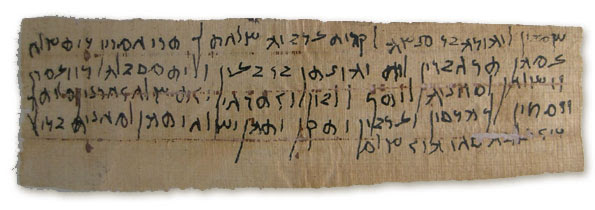
The use of etrogim in the coins of the Bar Kokhba rebellion is even more meaningful when we remember the great discovery of the Israeli archaeologist Yigal Yadin, who found a perfectly preserved letter in the caves of the Yehuda Desert, written by Bar Kokhba himself, in which he describes the difficulties of his troops with some unique supplies.
 
This is the text of the letter.
 
“Shimon [bar Kokhba] to Yehudah: …. I’m sending two donkeys and two men. I sent them to Yehonatan bar Masabla … you must ask them to carry donkeys and bring them back loaded with palm branches [lulabim] and etrogim. And also send other [men] to bring to our camp branches of myrtle [hadasim] and willow branches [‘arabot]. Make sure tithing (ma’aser) is already separated. Send all to my camp. Our army is very large. Shalom“.
 
And this is the original letter of Bar Kokhba in ancient Hebrew
 
 
While originally from Israel, the etrog is also found on the coasts of the Mediterranean. Some areas are famous for the extraordinary quality of their etrogim. Calabria (Italy), the island of Corsica (France) or the island of Corfu (Greece). One can find etrogim also in Lebanon, Libya, Morocco, etc.
But, how did the etrog come to those parts of the world?
 
The most accepted hypothesis today is that the etrog was brought from Israel to other areas of the Mediterranean with the dispersion of the Jews throughout the world, with a very specific mission in mind: to be used during the holiday of Sukkot.
 
Why do researchers believe that?
 
Because unlike the lemon or other citric fruits, the etrog tree is relatively fragile, very sensitive to diseases that can affect its root, and lives for relatively few years (12-15, unlike the lemon, which can live 25 to 30 years). In addition, the etrog demands much more water than other citric trees; and the fruit has almost no pulp. For what other reasons have etrogim been planted in orchards along the Mediterranean Sea?
 
For a long time, etrogim were not grown in the land of Israel, and these “foreign” etrogim supplanted the etrogim from Israel. Only in the mid-19th century, on the initiative of Sir Moses Montefiore z”l, that etrogim were grown again in Israel.
 
Many Jews in the diaspora use etrogim from Morocco, Italy, Yemen, etc. But it is good to remember that those etrogim also have solid Jewish roots…

See this interesting article about Calabria and the Etrogim https://www.calabriatheotheritaly.com/santa-maria-del-cedro-diamante-citron/


What is the Secret of the Four Plants?

“And, you shall take on the first day [of Sukkot] a fruit of a citric tree (etrog), branches of palm-trees (lulab), a branch of myrtle (hadas) and willows of the brook (‘araba), and you shall rejoice before HaShem, your God, for seven days”. (Lev. 23).
What is special about these plants that we take in Sukkot?The Tora does not explain why we should take specifically these four species during Sukkot. One possible explanation for this omission, in line with the thinking of Maimonides, is that at the time the Tora was given the reason for this commandment was so obvious that it needed no further explanation.The Hakhamim (the Rabbis of the Talmud) offered some interpretations, focusing on what these plants visually represent (four organs of the body -spine, heart, eyes, mouth- all united to serve HaShem); or their perfume and taste ( four individuals of the Jewish people, their study and their virtuous deeds).

PERENNIAL PLANTS My teacher, Rabbi Sa’adia Benzaquén, z “l, used to say that what these four plants represent the “vegetable kingdom” because all of them are perennial plants, i.e., they do not die or lose their leaves in the winter. This is particularly characteristic of the etrog, a fruit, that as the Gemara explains “remains in its tree throughout the whole year (haddar beilano mishana leshana). These four plants also grow in four completely different habitats. The etrog grows in the valleys, the lulab in the desert, the myrtle (hadas) in the mountains, and the ‘araba (willows) on the shores of lakes and rivers.

Their need for water is very different.

THE LIFESPAN OF A PLANT I also noticed a few years ago that these plants get dry at a completely different pace. The plant that dries faster than all other plants is the ‘araba. Willow branches, once cut from their tree, would dry up within a few days. Sometimes, the branches of ‘araba might not survive even the seven days of Sukkot. Then we have the myrtle leaves, hadasim, which would dry up completely in a few weeks. The lulab, the palm branch, dries very slowly, it takes months not weeks to dry up. And finally, we have the etrog. There are several elements that make the etrog a special fruit. But perhaps the most characteristic aspect of the etrog is that it does not decompose, and might last for years. If one leaves, for example, a lemon or any other citric fruit for a few days outdoors, or even in a refrigerator, it will inevitably turn white or green and moldy . The etrog, however, never decays. The etrog will shrink and dries up and it would loss its color, but it would not decompose, and it would preserve its aroma, not for months but for years!

BY DESIGN? Are these characteristics by chance? Although I’m not quite sure how to interpret the meaning or symbolism of these features –and perhaps at the time the Tora was given the reason was absolutely obvious — I do not think that it is just a coincidence that the Tora mentions these specific plants. Why? First, because a fundamental element of the festival of Sukkot is water / rain. During Sukkot we start thanking HaShem for rain (mashib haruah, morid hageshem) , and we also pray and ask HaShem to have a year of generous rainfall, at its due time, knowing that at this time God decides the fate of our crops and produces (בחג נדונים על המים). And these plants seem to represent four different levels of “dependence” on water, and the humidity they contain and preserve. The etrog and the ‘araba seem to be at opposite ends in terms of how long the moisture they keep inside lasts. The main reason why I do not think this interpretation is a coincidence is the order in which these four plants are presented in the Tora. The Tora mentions these four species in a specific order: first, the Tora mentions the fruit that lasts the longer, the etrog. Then, the lulab (palm branch), then the hadasim (myrtle), and at the end the ‘araba (willow): the longer the plant last, the earlier it is mentioned in the pasuq.

MY GARDEN OF EMUNA

This year I planted in my backyard a few tomatoes plants. And I noticed that the tomatoes don’t grow all at the same time: they produce their fruits, one or two at a time, thus, allowing us to have tomatoes for the entire season. I was so amazed and grateful to HASHEM when I noticed that! Then, this year as I was reviewing what I wrote about the reason for these plants I thought of a similar idea: the main reason why the Tora tells us to take these plants and being grateful and “rejoice before HaShem, your God” is because Sukkot happens at the end of the harvest. It should be noted that in ancient times there were no refrigerators or food preservation methods like we have today. And of course it was always necessary for farmers to have food reserves that could last until the next harvest. There are perishable foods that, just like the “‘araba”, won’t last for a long time once they are harvested and they must be eaten while they are fresh. There are also foods that like “hadasim” and “lulab” can last for a few weeks. And there are other foods that can be left to dry like the “etrog”, like figs, dates, and most grains. In His infinite wisdom and goodness the Creator designed perishable foods that need to be eaten fresh, and foods with no expiration date. Perhaps the arba’at haminim, four plants with very different expiration date, represent these characteristics and they give us one additional reason to thank HaShem for his Awesome Creation.


Holding and Waving the Four Plants

This year, 2023/5784, the first time that we will fulfill the Mitsva of Lulab will be on the second day of Yom Tob: Sunday, October 1st, in the morning.  
(מוליך ומביא – למי שהארבע רוחות שלו, מעלה ומוריד – למי שהשמים והארץ שלו” (סוכה לז, ב
 
“And, you shall take on the first day [of Sukkot] a fruit of a citric tree (etrog), branches of palm trees (lulab), a branch of myrtle (hadas) and willows of the brook (‘araba), and you shall rejoice before HaShem, your God, for seven days”. (Lev. 23).
 
THE MITSVA
We are commanded to take the above-mentioned four species of plants during the festival of Sukkot. We take three branches and one fruit. One lulab, two ‘arabot, three hadasim, and one etrog are taken together each time. This Mitsva is called “the four species” (ארבעת המינים) or,, the Mitsva of lulab. We should hold the lulab, the hadasim, and the ‘arabot in the right hand and the etrog in the left hand. Then, we perform the Mitsva of netilat lulab, which means “lifting” the lulab. The four species must be held in the direction that they grow. On the first day of Sukkot, we must carefully perform the Mitsva with our lulab and etrog. During the other days, the four species may be borrowed from somebody else. The Mitzva of the four species is not performed on Shabbat.  This year, 2023/5784, the first time that we will fulfill the Mitsva of Lulab will be on the second day of Yom Tob: Sunday, October 1st, in the morning.  
 
BLESSING: Two blessings are said the first day of Sukkot, ‘al netilat lulab and shehecheyanu. The berakha,  ‘al netilat lulab, is also said during the other days of Sukkot. Since every Mitsva has to be performed after we say the blessing, some people hold the etrog upside down and turn it back after the blessing, otherwise, the berakha would be said unnecessarily (berakha lebatala). Others would hold the etrog in their hand only after the berakha is said. Women are formally exempted from the Mitsva of lulab. However, the tradition in most communities is that women perform the Mitsva of lifting the lulab, which is meritorious. The Sephardic tradition indicates that women should not say the berakha for the performance of this Mitsva, while the Ashkenazi tradition indicates that women could say the berakha.
 
THE NA’ANU’IM: Once we say the berakha we move the Lulab in four directions (lena’anea’). And each time, we rattle the Lulab for a few seconds.
 
See in this video the na’anu’im, the movements of the Lulab, according to Maimonides, and the ancient Jewish tradition. 


WHAT IS THE MEANING OF THESE MOVEMENTS? 

אמר רבי יוחנן: מוליך ומביאלמי שהארבע רוחות שלו, מעלה ומורידלמי שהשמים והארץ שלו. במערבא מתנו הכי, אמר רבי חמא בר עוקבא אמר רבי יוסי ברבי חנינא: מוליך ומביאכדי לעצור רוחות רעות, מעלה ומורידכדי לעצור טללים רעים.  מסכת סוכה ל“ז:    

כל זה רומז שהכוונה לבקש מהיתברך על העתיד ולהודות לו על העבר.       מנורת המאור שע“ט

In his book, Menorat haMaor, Rabbi Isaac Abohab explains why we do these movements with the Lulab, quoting a text from the Gemara.
Ribbi Yochanan explains that we move the Lulab forward and backward (towards one’s own body) and then up and down to thank HaShem “who is the owner of the four winds,” and to express our gratitude for those winds that brought the rain in due time during the past harvest. Why do we thank God in Sukkot for the good winds? Because on Sukkot the Jewish farmer had already harvested all of his fruits and produce for the year. Being grateful to God is essential, explains Rabbi Abohab, because when we have all the food we need around us, we are inclined to forget God (זמן בעיטה).

Ribbi Yose Bar Ribbi Chanina provides a different explanation: these movements with the Lulab, symbolizing the winds, represent our prayer asking God to protect future harvests, to prevent damaging winds —which bring drought or locusts— and destructive rains that can ruin all the products of the earth.

Which opinion do we follow? To thank God for the past or to ask God for a promising future? Our tradition is to do both during the famous Hallel prayer.
In order to thank and acknowledge God for what he gave us, we move and wave the Lulab as if it were a qorban, an offering to God, saying as we move, “HODU LASHEM KI TOB KI LEOLAM HASDO” Let us give thanks to God when it is good [=when we have abundance], [saying that] ‘His kindness is infinite’, ” .
And to beg HaShem for a promising material future, we move the Lulab while saying ANNA HASHEM HOSHIA NA, “Please, God, save us.” That is, “save us from the destructive winds, from inclement weather that could leave us without food and at risk of dying.

If these prayers about wind, rain, and dew are not very familiar to us, it is because, in our days of superabundance, we have so much food B”H that it is difficult for us to understand the terrible challenges of a year without harvest.

 
The Sephardic custom today is to move the Lulab, without shaking it, in six different directions:  south, north, east, up, down and west. This order was established by Hakhme haQabbala. In this video, we see Rabbi Mordechai Eliyahu z”l doing the na’anu’im, as the Sephardic tradition holds.


The Fragility of the ‘araba

If you look at the four plants we take on Sukkot; you will see that one of the differences between them is the length of time they last until they dry out or decay.

The Etrog lasts the longest; it shrinks but can last for years without decomposing. Then, we have the Lulab, the palm branch, which takes a few months to dry (which is why, when the Matsot were baked at home, it was customary to use the dry branches of the Lulab, adding them to the oven where the Matsot were made). And then there are myrtle or hadasim, which can last a few weeks without decomposing. Of the four species, the most fragile and the one that decomposes the fastest is the ‘araba. Willow leaves last only a few days off their trees, hopefully, a week…

Our rabbis explain that at the end of Sukkot, the Heavenly Court issues the verdict on the rain that will fall this coming year (bachag niddonim ‘al hamayim). This is the main reason why, following a kabbalistic custom, it is customary to stay awake all night on Hoshanah Rabbah studying Tora).

“Rain” is the most critical element for our livelihood. And immediately after the end of Sukkot, the rainy season begins.

It is possible that the ‘araba also reminds us of our vulnerability and dependence on the rain that HaShem sends us. Furthermore, we internalize our fragility by hitting the ‘araba’s branches against the ground and seeing how the ‘araba is defoliating with each blow. Thus, we realize that we entirely depend on HaShem for sustenance and prosperity.


Moving Into A Roofless Home

This coming Friday night, September 29th, 2023, we will begin the celebration of the holiday of Sukkot.
The Tora says:
‘In Sukkot you shall dwell for seven days… so that your generations will know that I hosted [protected] the children of Israel in Sukkot, when I brought them forth from the land of Egypt…(Leviticus 23).
For seven days, we abandon our homes and sit in the Sukka. The Sukka is a ‘hut’ consisting of four walls and a fragile covering or ‘sekhakh’. We eat, study, and, weather permitting, sleep in the Sukka. We bring our furniture into the Sukka and make it as comfortable and beautiful as possible. Sukkot commemorates the forty years of our journey from Egypt en route to the Promised Land. During those years in the desert, HaShem provided us with food and water and satisfied all our needs. God also granted us special Divine Protection against desert weather inclemencies, wild animals, and other dangers.

By moving into the Sukka and leaving the safety and security of our solid homes, we are reenacting those glorious days when we were under His “direct protection”, which is ultimately the protection that matters the most.

There are many details and specifications as to how to build the Sukka.

The basic principles are:

WALLS: The walls, usually 3 or 4, must be built first before we place the sekhakh (covering). We could make the walls of any material capable of withstanding an average wind. This is why rabbi Obadia Yosef z”l recommends avoiding fabric for the walls and instructs to use wood or panels instead. See below.

SEKHAKH: We place the ‘sekhakh’ on top of the walls. For the sekhakh we can use all kinds of branches: bamboo branches, leafy branches, palm branches, etc. Special curtains made of reeds or bamboo can also be used for this purpose.

SHADOW vs. RAIN: The sekhakh /covering should be dense enough to provide a shadow that would cover most of the area of the Sukka at noon, but it has to be fragile enough to allow rain to come into the Sukka. An impermeable “hut” is not considered a temporary dwelling and therefore is not a valid Sukka (=pesula).

Most of the Halakhot of building a Sukka are identical for Sephardim and Ashkenazim. See this for a specific rule about the walls, by R. Obadia Yosef z”l.

LIVING IN THE SUKKA

The rabbis explained that to fulfill the Mitsva of dwelling in the Sukka we should leave our primary residence and settle in the Sukka. They said: “For the seven days of the festival, each person should turn the Sukka into his permanent residence and his house into the temporary one”. Living in the Sukka means that all regular activities we do at home should take place in the Sukka.

Some examples:

MEALS: Except when raining, we should have all our meals in the Sukka. According to Jewish Law, all formal meals -which are defined by the recitation of hamotzi and birkat hamazon– must take place in the sukka. That is why when having a formal meal, with bread, we recite the berakha: ….asher kiddeshanu bemitzvotav vetztivanu leesheb basukka.

MEZONOT: Pastries, cakes, cookies, etc. (mezonot) should also be eaten inside the sukka.

SNACKS: A light snack (a fruit, a salad, coffee) might be consumed outside the sukka. The rabbis praised those who, during the festival of Sukkot, would not eat or drink anything outside the Sukka.

SLEEPING: Sleeping in the sukka is part of the Mitsva of “settling” in the sukka. However, the fulfillment of this Mitsva depends on a few factors: weather conditions (cold temperatures and obviously rain); one’s physical condition (health, sensitivity to cold, age, etc.). In some areas, we should also be aware of safety concerns, like the possible presence of animals (raccoons, foxes, mosquitos, or other insects), etc. this could also be considered a factor to be excused from sleeping in the Sukka.

All regular activities we usually do at home, like studying, reading, napping, relaxing, etc., should also be done in the Sukka.

EDUCATIONAL VIDEOS 

1. Building a Solid Sukka (Hebrew)
2. Building a simple Sukka 

!בברכת שנה טובה ומבורכת


SUMMARY OF HAAZINU

The Tora portion we read this week, Ha-azinu, consists of a poem by Moshe. This poem is of a prophetic order since it anticipates the good and the bad that will happen to the Jews in their history.
Moshe invokes the heavens and the earth as eternal witnesses of this prophecy. In this poem, the heavens and the earth begin by praising God, declaring He is righteous and just and that His children, the Jewish people, cause their own misery by forgetting and abandoning God. And especially for not being thankful and deliberately ignoring that God is the source of all blessings.
Moses pleads with the Israelites to contemplate history and see how God protected Israel in the desert as an eagle cares for her young. God will establish them in the promised land where they will lack nothing. But as sometimes happens with a spoiled child who receives everything from his parents, the people of Israel will ignore God, rebel against Him, and abandon Him. Ironically, this will happen because they now have so much blessing and abundance that they feel they do not “need” God. They will be searching now for false gods from pagan peoples.
God will be indignant at this lack of gratitude on the part of His children and as a consequence o will then “hide His Face,” that is, suspend His special protection over the Jews. The pagan peoples will then invade the land, and the people will be exiled and on the verge of extinction. And at that moment, the Jewish people will wrongly think that all this happens to them because “God does not exist”. That is why this poem represents a testimony: to know that when Israel is not protected, the reason is that they have abandoned their Protector and moved away from Him.
However, the time will come when God will redeem Israel and would punish the nations that made His beloved people suffer. Israel will then sing praises to the Creator.
In the last part of this short but very profound Parasha, Moshe teaches this poem to the Jews. He implores them to pay close attention to it since the Tora is not a superficial text but a Guide that gives meaning to our lives. And only when we cling to it will we strengthen ourselves and B”H have the merit to live uninterruptedly in our land.
God tells Moshe to go up Mount Nebo. From there, the great leader of Israel will see the promised land before he dies.


VIDEO: Yom Kippur for Kids (part 2)

Fasting in Yom Kippur.

Tefila of Yom Kippur.

Who should fast and who should not?

Children and fasting.

Wearing non-leather shoes.

VIP: What should we learn from the story of Yona?


VIDEO: Yom Kippur for Kids (Part 1)

What is Teshuba and what are the steps that we should follow?

Learning to apologize.

There is nothing wrong with saying, “I was wrong”.

The power of forgiving others.

What should we do every night before we go to sleep?