VAYISHLACH: What is the meaning of the name Israel?
In Parashat VAYISHLACH we read that Ya’akob fought with an angel and the angel blessed him, and changed his name from Ya’akob to Israel. ‘Israel’ became the alternative name of Ya’akob but also the name of the Jewish nation. But is it fair? That we the Jewish people are named ‘exclusively’ after Yaakob? Why aren’t we called the people of Abraham, the founder of the Jewish people? How about Itschack? The middle generation is always the most challenging! Wait a minute: the Jewish status of a person goes after the mother! Whatever religion the mother is, that is also the child’s. So why aren’t we called the people of Sarah or Ribkah or Rachel or Lea? Why are we named AM ISRAEL exclusively after Ya’akob?
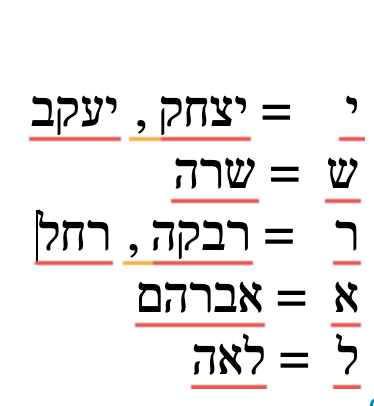
NOW, take a closer look at the spelling of the word ISRAEL (in Hebrew!) and you will find ALL the names of our three patriarchs and our four matriarchs: ‘Yod’ for Itzchack and Yaakob, ‘Shin’ for Sarah. ‘Resh’ for Ribkah and Rachel. ‘Alef’ for Abraham and ‘Lamed’ for Lea.
They are all there!
Israel is indeed the perfect name for us.
What does the word Hanukka mean?
The word Hanukka means “dedication,” and it is used in this sense in Hebrew in phrases like Hanukat-haBayit (dedication of one’s new home).
So, what dedication are we referring to in our holiday of Hanukka?
During the second century BCE, the Jews in Israel lived under the oppressive rule of the Syrian-Greek army led by Antiochus Epiphanes. They were forbidden to practice their religion, and at one point, the Bet haMiqdash (the Holy Temple of Jerusalem) was captured and defiled by the Greeks. The Greeks desecrated the Temple by introducing an image of their pagan god, Zeus, and offering sacrifices of impure animals, such as pigs.
In 165 BCE, the Jews, led by Yehuda Makabi, rebelled against the powerful armies of Antiochus. With God’s help, they defeated the Greeks and regained control of the Bet haMiqdash. To purify and re-dedicate the Temple to God Almighty, they needed to light the Menora, symbolizing that the Temple had fully returned to the service of God.
They found only a small jar containing a limited amount of pure oil, enough to last for just one night. Nevertheless, they lit the Menora and joyfully dedicated the Bet haMiqdash back to God. The Makabim anticipated they would need to interrupt the dedication until new pure oil could be produced. However, a miracle occurred—the oil lasted for eight days, precisely the time required to prepare new pure olive oil.
Hanukka thus celebrates the dedication (or re-dedication) of the Bet haMiqdash to HaShem after years of defilement.
The holiday is observed by kindling candles each night for eight nights, commemorating the miracle of the oil.
This week’s Perasha begins with the exile of Ya’aqob Abinu, our third patriarch. Ya’aqob flees the land of Israel when his brother Esav declares her intention to assassinate him. Ya’aqob then heads to Haran, a town near the Syrian border. Abraham’s relatives live there: Laban, Ya’aqob’s uncle, and his family. Ya’aqob does not arrive at Haran in a caravan of camels with guards and servants, as it happened when Eli’ezer, Abraham’s servant, visited town. Ya’aqob comes by himself with nothing in his pockets. And also, unlike Eli’ezer, Ya’aqob is not coming for a few days. Ya’aqob goes for an indefinite time (which ended up being 20 years). On the first night of his trip, when he had not yet crossed the border of Erets Israel, Ya’aqob had a dream. He dreams of a ladder resting on the ground but reaching up to the sky. And he sees angels. Angels go up to heaven and come down from heaven. And here, we are faced with a challenge that the text of the Tora presents us with. Angels are supposed to “be in heaven,” so they should descend and then ascend. Why, even in a dream, is the order reversed? Let’s look at the most famous interpretation of this point, provided by Rashi.
WHAT ARE ANGELS?
First, we must know that angels in the Tora are not like angels in other religions: winged beings with haloes on their heads. To explain what angels are, let’s remember that the Creator does not act “directly” on His world (there were only two exceptions to this rule: 1. The first act of Creation and 2. The Exodus from Egypt); God acts thru His “angels”. That is, natural forces or instances that seem “fortuitous” to us or individuals who, knowingly or not, fulfill a Divine mission. In Tehillim (104: 4) the wind, for example, is considered an angel of the Creator since HaShem used the wind to create rain and other events in Creation. The angels that visited Abraham and Lot were (or, according to other interpretations: looked like) human beings. What “the wind” and these human or human-like “angels” have in common is that they both “strictly carry out the will of God,” the mission for which they were conceived and created. In Hebrew, the word “angel” (mal-akh) actually means emissary, proxy, representative, an agent of HaShem who, unlike human beings, does not have freedom of choice (that is, “freedom to disobey”).
One more thing: angels are mentioned in the Tora in a particular context: Divine Protection. Again, “angels” are not independent beings, in Judaism, we do not worship “angels,” nor do we pray to “angels.” We speak of angels when we refer to Divine intervention through natural or human, miraculous events. And especially in the context of “protection”. In Ya’aqob’s case, the angels that he saw in his dream came to assure him that HaShem’s protection would continue even outside of Israel.
LIVING WITH LABAN
Once we understand that “angels” refers to Divine Protection, we can address the second question: Why do angels go up first and then come down in our patriarch’s dream? Shouldn’t it be the other way around? Rashi says the following, based on a beautiful Midrash: what Ya’aqob contemplated in his dream was “a changing of the guard” between the angels who protect Ya’aqob in the land of Israel and the angels who will protect Ya’aqob outside the land of Israel, in Haran, the territory of Laban. But why is a changing of guard necessary? At Buckingham Palace, the change of guard is done because soldiers must rest, eat, etc. But for what reason does jab need new angles? The dangers that threaten Ya’aqob in these two places are very different. In the land of Israel, Ya’aqob was threatened with death by Esav. Now in his next destination, the land of Laban, no physical threat awaits Ya’aqob. However, Ya’aqob’s values and beliefs will be in jeopardy… Ya’aqob is going to live with an idolatrous family; he intends to marry one of Laban’s daughters and be part of that pagan family. The possibility that Ya’aqob will forget everything he learned from his father Isaac and his grandfather Abraham and ultimately transform himself into a full member of Laban’s family is very real! This new situation, assimilation, requires a new type of Divine protection, which had not been necessary until that moment. In this dream, according to our Midrash, God shows Ya’aqob that He protected him from Esav and He will continue to protect him in terms of his physical integrity. But He is also warning Ya’aqob that unknown dangers await him in his new destiny and that he, Jacob, will have to take the threat of assimilation very seriously.
ISRAEL AND THE DIASPORA
It is incredibly similar to what happens today. The dangers to which the Jews of Israel and the Jews of the diaspora are exposed to are very different. In Israel, the fundamental threat – although it is not the only one – is physical integrity: permanent wars, intifadas, suicide attacks, etc. This was also the kind of danger that haunted Jacob in the land of Israel at the hands of Esav. On the other hand, the most harmful threat facing Jews in the diaspora today is similar to the one Ya’aqob was going to face in his new destiny: assimilation to the values of Laban and to the pagan society of Haran. This is a much more subtle challenge and much more difficult to overcome, especially since it is less visible … and sometimes it happens without us noticing.
Like Ya’aqob we Jews of the diaspora must become aware of the dangers we face and must do everything possible to educate the next generation so that the Tora remains relevant to them and they see it as the most beautiful source of inspiration and the guide of their lives.
VAYETSE: Why We Dream What We Dream
Our Parasha covers twenty years of the life of Ya’aqob Abinu. These years elapsed between two dreams. The first dream took place when Ya’aqob was leaving the land of Israel and heading towards Haran, in northern Syria. In his dream, Ya’aqob saw angels descending from heaven to earth and ascending from earth to heaven. Beyond the different interpretations of the amazing dream, the point I would like to focus on is that upon leaving Israel, our patriarch Jacob dreamed with angels. Dreams don’t come out of nowhere. And dreams don’t lie.
WHAT ARE DREAMS MADE OF?
First, let’s understand a little better what dreams are. We are what we dream. And we dream what we are. The content of our dreams reflects our lives. Desires, traumas and fears that we experience in our daily routine. If one dreams that he or she is flying, it is likely that he is aspiring to advance in his life, to have a better job, etc. but he feels that he is chained and trapped. Dreaming that one “flies” frees the dreamer for a few moments from those chains that limits him: the dream expresses his deep desire to progress. If you dream that you are driving a car and the brakes do not work, you probably feel, even if you don’t realize this consciously, that you are not in control of your life, and you want to be in control before it is too late. When you dream that you are in public without appropriate clothes, it is probably a reflection of your fear that people will discover something embarrassing that you do not want to be known. Dreams say a lot about us, our fears and desires that live in our subconscious mind.
THE DREAMS OF A PATRIARCH
Ya’aqob’s dream is deeply spiritual. Ya’aqob Abinu saw angels in his dream because that was his daily reality. He lived among them: his mother, his father, his grandfather Abraham, Shem, and Eber. Ya’aqob runs away from the land of his parents for fear that his brother Esav will kill him. He flees to the house of his uncle Laban. And there he has to work very hard. Laban, for a long time takes advantage of him. Until one day, after many years, Jacob tells Laban Gen. 31: 38-40 «These twenty years that I have been working for you, your sheep and your goats have not been injured, I have never taken from the animals of your flock [to my personal benefit], I never brought you an animal torn to pieces by wild beasts [I always took great care of them], and if they ever suffered an accident, I have taken the losses, since you always demanded that from my hand [even if it was not my guilt], and I did the same when an animal was stolen … day or night … [I worked non-stop]: during the day the heat consumed me and at night the frost, and so sleep fled from my eyes. »
METAMORPHOSIS
At the end of those twenty years, Ya’aqob dreams again. But this time he has a very different dream. There are no angels climbing a ladder, but animals mating, climbing one on top of the other. “Males climbed into herds, producing striped, dotted, and spotted animals” (Gen. 31: 10-11). This second dream is not a “spiritual” dream but a very material one! Animals represent material goods: there is no greater opposition than: “angels” vs “animals.” In his second dream, an angel indeed speaks to Ya’aqob, but only to teach him how to outsmart the shrewd Laban in business. This is a 100% materialistic dream, unbecoming the Ya’aqob we previously knew.… But in that same dream, Ya’aqob receives a direct order from HaShem, and this order comes with an explanation: (31; 11) «ki raiti et asher laban‘ ose imakh. Because I’ve seen what Laban has done to you. It’s as if HaShem is saying to Ya’aqob: “I see that working twenty years for Laban has affected you deeply. You have changed, and it can be seen in your dreams: twenty years ago you dreamed of angels and a ladder that linked earth to heaven. Now your dreams have been transformed: they are horizontal, ‘superficial.’ The angels were replaced by sheep and the stairs by stables. These dreams are worthy of Laban, not Ya’aqob!”
THE WAY BACK HOME
Ya’aqob then receives a direct order from HaShem, without ambiguity. It is time to go back home (31:11): “Now you must leave that land [Haran] and return to your homeland, [Israel].” You have to go back so that your dreams change, so that you dream of angels and ladders. And you will achieve that by living a life that constantly promotes that connection between earth and heaven. Your destiny is to be one of those human “angels” who ascend to heaven and bring the Tora to earth. So it was. In the last pasuq of this Parasha 32: 1, as soon as Ya’aqob arrives in Eretz Israel, he again visualizes “the angels” coming to meet him at Machanayim.
Ya’aqob, and us, his descendants, learned this great lesson. We must live our lives dealing with whatever we need to live with dignity and comfort, but with enough spirituality to dream of angels and ladders between heavens and earth.
Jews and Candles
We are celebrating the holiday of Hanukka. And whenever this festival approaches, I reflect on one important question: what does it mean to be a Jew? There are many answers to this question—technical, spiritual, and political. However, the answer I want to share with you today transcends these definitions. Let’s explore it together and see what you think.
BEING A JEW AND BEING A CANDLE
Each Jewish person is like a candle. Judaism, the Tora, is the flame of that candle. This metaphor is neither arbitrary nor capricious. The Tora has always been compared to “light.” In fact, the Hebrew word Tora originates from the root or, meaning “light.” Our mission as a nation is to be, as the prophet Yesha’ayahu said (Isaiah 42:6) “or lagoyim,” a light to the nations. Remarkably, we fulfill this mission without acts of proselytism or missionarism. To illuminate, we only need to be lit. The word Tora shares the same root and is nearly identical to the word morá, which means “teacher.” For Jews, the process of learning is one of intellectual and spiritual enlightenment. The Tora is “our teacher”; it educates, illuminates, and guides us. Through its teachings, it dispels darkness from our lives, shows us how to live, and grants us clarity.
CANDLES: LIT OR UNLIT?
Now that we understand why the Tora can be compared to light or a flame, let’s return to the candles, the receptacles of the flame: the Jewish individual. If a Jew (Yehudi) does not learn Tora, does not study it, and does not observe its commandments, is he still Jewish? The answer is an unequivocal “yes.” A Jew never loses his or her Jewish status (Yisrael af al pi she’chata, Yisrael hu). A Jew without Judaism is like a candle without a flame. A flameless candle is still a candle. And while it is not yet fulfilling the purpose for which it was created, it remains a candle nonetheless. Importantly, it can always be “lit.” Often, all this candle needs is another candle, already burning with a strong flame, to approach it, offer its light, and help it ignite.
THE CANDLE The metaphor of the candle and the flame is particularly fitting for Hanukka. It helps us understand why we celebrate a great military victory by lighting candles. Let’s delve into this.
Throughout history, our enemies have often sought to destroy the candles. In such cases, their aim was our extermination. They didn’t care whether the candles were lit or not. For example, during the Shoa (Holocaust), a Jew who said, “I don’t believe in God. I’m not observant. Let me go,” would still be taken to the concentration camps. The anti-Semitic enemy, as in the days of Haman and Ahashverosh, didn’t care about the flame; their hatred was directed at the candles themselves. Their goal was to destroy the Jewish people entirely. By destroying the candles, they also sought to extinguish the flames.
THE FLAME Hanukka, however, tells a different story. During this time, as in the era of the Inquisition, the enemy’s objective was not to destroy the candles but to extinguish the flames. They sought to replace the flames of Judaism with a cross or a Greek deity. The Hashmonayim, our heroic ancestors who triumphed during Hanukka, did not fight to save their physical lives. Their lives were not under immediate threat. Rather, they fought—and were willing to sacrifice their lives—to preserve the flames of Judaism. Lighting candles is the most fitting way to commemorate their victory.
THE MIRACLE Finally, the miracle of Hanukka, when a small amount of oil burned for eight days, has much to teach us. When we follow the example of the Hashmonayim and work to strengthen and multiply our flames—sharing the light of the Tora with others—we can be assured that HaShem is on our side. Even when we feel that our efforts or abilities are enough to light only one candle, HaShem will grant us the inspiration and strength to light many more.
This Hanukka, may we all strive to keep our candles burning brightly and help others rekindle their flames.
Sephardic vs. Ashkenazi traditions in Hanukka
HANUKKA: DIFFERENCES BETWEEN SEPHARDIM AND ASHKENAZIM
There are no significant differences between the traditions of Sephardic and Ashkenazi Jews regarding Hanukka. There are only some minor variations.
Examples:
THE FUNCTION OF THE SHAMASH
According to the Ashkenazi custom, the auxiliary candle or shamash is lit first. Thus, after saying the berakha, one uses the shamash to light the rest of the candles, and after lighting all the candles, the shamash is placed in its designated spot. In the Sephardic tradition, however, all the candles are lit using a match or a separate candle, and only at the end is the shamash lit.
For the Ashkenazi tradition, the shamash serves a dual function: it provides additional light and is used to ignite the other candles. In contrast, the Sephardic tradition does not use the shamash for lighting the other candles. The primary reason for lighting the shamash in the Sephardic tradition is to ensure that if one inadvertently benefits from the light of the Hanukka candles, it is the shamash’s light providing that benefit. In other words, whereas Ashkenazim use the flame of the shamash to light the other candles, Sephardim use the shamash solely for its light.
WHERE SHOULD YOU PLACE YOUR HANUKIA?
Many Sephardic families, especially in Israel, maintain the original custom of lighting the candles outside the house, on the opposite side of the mezuza (as seen in historical depictions). The Ashkenazi tradition, however, is to light the hanukia (also known as a menora) inside the house, near a window, so that the light can be seen from the outside.
HOW MANY HANUKIOT DO WE LIGHT?
In many Ashkenazi communities, the custom is for each family member to light their own hanukia, including young children who are older than six years. In Sephardic families, however, the custom is to light only one hanukia per family (mitsvat ish u-beto). This practice parallels the lighting of Shabbat candles. In Sephardic tradition, only the mother lights the Shabbat candles. In Ashkenazi tradition, each daughter in the family lights her own set of Shabbat candles.
LEHADLIQ NER HANUKKA OR NER SHEL HANUKKA?
In the berakha, the Ashkenazi tradition uses the phrase: lehadliq ner SHEL Hanukka (“to light the Hanukka candle”). Sephardim, following the wording of the Shulchan Arukh, say: lehadliq ner Hanukka, omitting the word “SHEL.” There is no grammatical or semantic difference between these two versions, and one cannot claim that one is correct while the other is not.
Interestingly, the original version of this berakha as found in Maimonides’ Mishne Tora (Hilchot Hanukka 3:4) includes the word “SHEL,” similar to lehadliq ner SHEL Shabbat (“to light the Shabbat candle”). Although Sephardic tradition generally follows Maimonides, in this instance, it adheres to the opinion of the mekubalim (Kabbalists). However, some Sephardim, such as the members of the Spanish-Portuguese community of England (who distanced themselves from mystical-based traditions after the events of Shabbetai Zevi), retain Maimonides’ original version. This version, which includes the word “SHEL,” is also found in older Sephardic siddurim like Tefilat haHodesh and Bene Tsion and was the practice in Iran, as recorded by Mr. Nassim Bassalian.
TRADITIONS
Playing with the sebibon (dreidel) is an Ashkenazi custom that Sephardim traditionally did not adopt. Similarly, the practice of giving Hanukka gelt (coins or gifts for children) is an Ashkenazi tradition not typically observed by Sephardim.
TOLEDOT: The difference between GPS and a Google car
Last week we saw how Abraham Abinu sent his servant to find a good wife for his son Isaac (Itshaq). The rabbis always insisted that the woman is the key to a good Jewish family. And Abraham knew that, although Isaac was a great tsadiq (righteous man), if his wife did not accompany him, the mission of Isaac, transmitting the legacy of Abraham, would have failed. Abraham knew this from personal experience. His first son, Ishmael, did not follow him. Ishmael imitated his mother Hagar, and ended up becoming a hunter, as his maternal ancestors.
Abraham wanted for Isaac someone exactly like Ribqa. A woman who would care about practicing hesed (generosity) which is manifested when, upon being asked, one does more than expected. In this sense Ribqá was a clone of Abraham, the man who represented the epitome of Hesed.
We also see another very important element in Ribqa’s personality. Ribqá has a a natural modesty (seniut). Hakhamim indicated this by the way she sat on the camel, or when she covered herself with the veil upon hearing that Isaac was approaching, etc. But as we see in the dialogue she had with Eliezer and with her own parents, her modesty did not prevent Ribqa from having her own character, and a firm personality. Ribqa knew exactly what she wanted. She knew what she had to do and she did it! Exactly like Abraham, who did what he had to do, despite having the rest of the world against him. Ribqa firmness became crucial for the fate of Abraham’s legacy, and the destiny of the Jewish people.
When speaking of marriage, the modern Greeks compare the husband to the head and the wife to the neck. I propose a slightly more sophisticated model: the Jewish marriage as an automobile. Who drives the car in this model? Who is holding the wheel? That is, the husband. And the wife? The wife is the GPS.
A few days ago I was on the Belt Parkway, close to exit 17, and I had to get off at exit 31. Suddenly, my GPS (Waze) tells me: “Take Exit 18”. And I, of course, thought that the GPS was wrong, and I ignored Waze’s recommendation. When I was closer to Exit 18, my Waze kept insisting “In a quarter of a mile tale exit 18, to your right”. I did not move from the left lane. Belt Parkway looked beautiful ahead of me. Just before passing through Exit 18, almost as if realizing I was going to ignore it, I think my GPS screamed at me: “Take Exit 18. Exit 18!!!” . I went ahead and told to myself: Why listening to the GPS when I know this highway much better than Waze? Then, the most predictable thing happened. Close to exit 20 I hit a terrible traffic. A total standstill. I lost about 40 minutes, because as you all know, once you passed Exit 18, there are no alternative routes ….
At that moment I remembered once again the difference between my wife and I: I, the driver, posses just human vision, my limited sight ends where my eyes stop seeing. But my wife, like Waze, has satellite vision. Somehow our wives (or is it just MY wife?) see much further than us. And sometimes, if we ignore them, we suffer the consequences ….
Most probably, Ribqa first did what a GPS would do, telling Isaac: “Esav is not the right candidate to continue the legacy of Abraham”. “Esau is too busy with success”. “Esav lives to pursuing his material appetites”. “We have to choose Ya’aqob”. But Isaac did not see the flaws of Esav… and ignoring the advice of his GPS, he decided to name Esav as his spiritual heir.
Now we have to understand the difference between a car with a GPS and Google car. The GPS tells the driver: “Exit 18, Exit 18”. The Google car, however, does not give instructions to the driver. The Google car leads the car directly to Exist 18, and saves the driver from a standstill, without consulting the driver…
In the most crucial moment, when the fate of the legacy of Abraham Abinu was at stake, Ribqa acted as a Google Car. Ribqa was chosen by Abraham for that specific mission. To save Isaac from a limited vision, from making a terrible and irreparable bad decision. Ribqa, who was so similar to Abraham, was there “instead” of Abraham. Protecting Abraham’s legacy. Acting as Abraham would have acted.
By having led Isaac to assign Ya’aqob as his spiritual heir, Ribqa saved the legacy of Abraham, and in a sense, she guaranteed the existence of the Jewish people.
From Meah Shearim to the IDF
THE WAR CONTINUES
I began writing these lines in Yerushalayim. In Israel’s capital, the war is not immediately evident, except in the reduced number of tourists visible on the streets or in restaurants. However, the pain of families losing loved ones is felt across Israel. Friends, acquaintances, or acquaintances of acquaintances. Israel is one big family, and the pain of one is the pain of all.
The army is currently fighting on two fronts: first, Gaza. The plan is for Israel to fully clear the northern part of Gaza and relocate Palestinians to a humanitarian camp in the south. The northern zone, which includes Gaza City, J’abalia, Bet Lahia, and Bet Hanun, would come under strict Israeli control. This would prevent, among other things, terrorists from attacking or invading Israeli territory as they did on October 7, 2023. To achieve this, some towns and cities still need to be conquered. So far, Israel has had much success in the war, B”H. In the northern region, only about 200,000 Gazans remain, and the plan is for the humanitarian aid entering Gaza daily—about 350 trucks per day—to be distributed exclusively in the south, encouraging all who need it to move there.
The second active military front is in Lebanon, which currently demands the majority of the Israeli army’s attention. Hezbollah’s weapons are much more advanced than those of Hamas. Hezbollah has massive tunnels in southern Lebanon, some reaching depths of 80 meters, designed to infiltrate Israel and carry out mass killings of thousands of Israelis. The war in Lebanon has only just begun, and we must continue praying for God to protect our brave and heroic young soldiers.
MORE SOLDIERS NEEDED
One of Israel’s most pressing challenges is a lack of human resources in the army. More soldiers are urgently needed, and one possible solution is recruiting Haredi soldiers—those Jews who study Tora full-time and are legally exempt from military service. I remember in my youth, for instance, that Argentina’s law exempted Christian or Jewish seminarians from the mandatory military service. The original Israeli law, established by Ben Gurion, was implemented when Medinat Israel had a negligible Haredi population. Today, however, B”H, the Haredi population numbers approximately 1 million people, representing 15% of the total Jewish population, and it continues to grow. In these critical times, Israel urgently needs more soldiers to fight and protect its borders.
ARMY AND RELIGION
Until now, there was only one combat unit for Haredim, Netzach Yehuda, which has existed for some time. The good news is that the Jewish army is organizing a new brigade to accommodate Haredi soldiers, called “Hashmonayim,” which strictly aligns with the Haredi lifestyle. Hundreds or even thousands of young Jaredim are enlisting voluntarily, and this trend will only grow. The integration of Jaredi soldiers will give the Israeli army a much stronger Jewish identity.
Consider the case of the Zionist religious Jews, Dati Leumi, who have always served in the army and are known for their high combat spirit and sense of responsibility. Their service reflects the Tora’s mitzvot regarding assisting, saving, and being ready to sacrifice for another Jew. All these mitzvot come to life when a Jewish soldier is on the battlefield. Jaredi soldiers will contribute not only as human resources but also spiritually, with Boré Olam, the Creator, as the commander-in-chief of the Israeli army.
MENDEL AND NAHSHON BEN AMINADAV
This is a very important and historic video. The protagonist is a 33-year-old Jaredi man, Mendel Roth, a direct descendant of the Baal Shem Tov from Mea Shearim, who is set to begin his service in the army in one month.
The message speaks volumes: the idea that Haredim do not serve in the army seems like something from a past generation. Now, in this new unit he will join, Hashmonayim, it is possible to combine these two worlds—his commitment to the Tora and his responsibility toward Am Israel.
Roth hopes to be an example and inspiration for others, showing that there is no contradiction between religious devotion and serving the nation.
Mendel explains that this decision not only brings him personally closer to God and the redemption of the Jewish people but also represents an act of unity aimed at healing one of the main fractures within the people of Israel. In his words, his example will change the perception of those who believe there are Jews who do not contribute enough to the country, making this a great Kiddush HaShem.
In the army, Mendel will not settle for an administrative or desk role; he has decided to join KRAVI service, meaning he will fight and risk his life for his people. Mendel speaks about how this decision marks a historic change in the country.
He emphasizes that the most critical factor for him was that this new brigade, Hashmonayim, is fully adapted to the Haredi lifestyle, maintaining a religious environment that ensures soldiers can complete their service without compromising their commitment to Judaism—something that was previously difficult to guarantee within the military context.
Mendel is paving the way for a trend destined to grow. His courage and decision serve as an inspiring example for all young people who, like him, wish to serve Israel without giving up their religious identity.
It is crucial to listen to his words in full, as his message represents a significant group of young Haredim eager to participate in the army and assist in defending Israel.
This article was published a few days ago in the Israeli newspaper Israel Hayom, with more details about the Hashmonayim Brigade.
המהפכה החרדית של צה”ל: כך תיראה חטיבת חשמונאיםבתי מדרש בכל פלוגה, לימוד גמרא כתנאי להכשרת לוחם, וחליפה ומגבעת בשבת • הגיוס הראשון יתקיים בנר ראשון של חנוכה • עשרות מיליוני שקלים הושקעו בבא”ח מכבים, שם יעברו החיילים את כל ההכשרות – מטירונות ועד קורס מ”כים • בצה”ל מבהירים: “אין כוונה להפוך אותם לציונים – רק להגן על המדינה”
The Haredi Revolution in the Israeli Defense Forces: This Is How the Hasmonean Brigade Will LookA Bet Midrash in every company. Talmud study as a prerequisite for combat training. Suits and hats for Shabbat. The first recruitment in this unit will take place on the first night of Chanukah. Tens of millions of shekels have been invested in the Makabim Training Base, where Jaredi soldiers will receive all their training, from basic training to the commanders’ course.
Lot and Abraham lived in the same area. But when the shepherds of Abraham and Lot quarreled, Abraham suggested to Lot that each one should take separate ways. “Look at the land that is in front of you,” said Abraham to his nephew, “and choose where you want to settle in. If you want to go north, I will go south. If you go south, I will go north”. Lot does not doubt and chooses to settle in Sedom. Why? Because Sedom was a city of wealth and economic stability. At that time, the area had abundant rivers, and those who lived there did not depend on the rain, and droughts did not affect them. Surely Lot imagined that there, in Sedom, he would build a beautiful house , he would have the best car , and he and his descendants would marry people of great wealth. What a successful life awaited Lot in Sedom!
But the Tora also warns that the people of Sedom were evil ואנשי סדם רעים וחטאים ליהוה מאד. They did not let anyone share their wealth. And instead of assisting, they oppressed and exploited the weak and the poor. Our Hakhamim said that in Sedom a law was established “those who help a poor person, an orphan or a foreigner would be executed”. (Sedom’s ideology always remind me of Nietzsche, whose philosophy was later adopted by the Third Reich. For them the weak or the sick should NOT be assisted or helped, as this represents a “waste” of the totalitarian state resources. Every resource should be devoted exclusively to the progress of the healthy and superior– Arian men and women– following the most basic law of nature, learned from Nietzsche’s contemporary Charles Darwin: the survival of the fittest).
Lot came from an environment that could not be more different from Sedom. Lot had been raised in the home of Abraham Abinu. An open house where all those in need are welcomed. Lot must have absorbed these lessons from Abraham. And I imagine that when Lot realizes the nature of the inhabitants of that city, he will have asked himself: “And now what should I do? Do I stay in this city, or I leave?” Lot decided to stay. Maybe he thought that he would have enough emotional strength not to let himself and specially his children to be influenced by others. But Lot failed. And while it is true that he retained some characteristics of Abraham, for example, he received foreigners (malakhim) risking his life, we see that he did everything by himself. Unlike Abraham, who together with his wife Sara prepared the banquet for their visitors, Lot’s wife does not appear in that scene… Lot had to prepare the food for his guests all by himself. When Abraham asked HaShem not to destroy the city of Sedom if ten righteous people were in the city, Abraham was thinking of Lot and his family. Lot, his wife, his two married daughters, their husbands, his two single daughters and their fiancees. a total of 10 people. HaShem, in the end, destroyed the city, which shows us that Lot was not able to influence even his family. What is more. When Lot offered his daughters instead of the strangers that people wanted to kill (I imagine that helping a foreigner in Sedom was as dangerous as helping a Jew –protecting him and giving him shelter– in World War II). Lot was actually influenced by others. He was culturally and morally transformed, inadvertently, into a citizen of Sedom.
One of the most important lessons I heard in my life has to do with the frog. How do you cook a frog? (I do not know if this story is true or it is an urban legend. In any case, please do not try it at home, since apart from being tremendously cruel, it is not Kosher :). In France, and in the far East cooked frogs are an exquisite delicacy. The problem is that the frog must be cooked while he is alive. So, how do you cook a frog? If you place the frog in boiling water, the frog will immediately jump out of the pot. But if the live frog is placed in a pot with water at room temperature and at a low heat, the frog would not jump out of the pot and will be slowly cooked. And this is why: The body of the frog detects drastic temperature changes. Therefore, if we move the frog from a temperature of 70 degrees and expose it to 212 degrees of boiling water, the frog will jump out. However, and very unfortunately for the frog, its body “tolerates “small” changes in temperature. Its body “adapts” the small temperature changes and is unable to “sum up” those small changes and realize that “a big change” has taken place . When the slow fire brings the water temperature from 70 to 75 degrees, the body of the frog feels that: “5 degrees is nothing. There is no danger.” And the body adapts to 75 degrees. When the water reaches 80, the frog –that already got used to 75 feels that: “5 more degrees, it is nothing”. And when it reaches 85, the frog experiences the same thing: “5 degrees, do not affect me”. The frog tolerates and adapts to those small changes, and is unable to add up those changes and realize that: “…that there are 15 degrees difference between 70 and 85 and this can end badly”. Finally, when it reaches 210 degrees, it’s too late for the frog…
Something very similar happens with most people in terms of “influences”. When we live around individuals with questionable values, we begin to absorb those values very gradually. So gradually, that those changes become almost imperceptible. Over time, it happens to us what happened to the frog. We do not realize that those small changes are adding up. And when we want to realize it, it’s already too late ….
The lesson we learn from Lot is that we have to choose very carefully the environment where we live, and where we educate and raise our children. So it does not happen to us what happens to the poor frog.
VAYERA: Sodom and Gomorrah and the Bible as History
THE DISCOVERY OF THE CENTURY
As a teenager, I remember reading an exciting book called “The Bible as History” (I read it in Spanish “Y la Biblia tenia razón”), which first introduced me to the fascinating world of Biblical archaeology. The book, written by a German author who fought against the Nazis, Werner Keller (1908 -1980) was published in 1955. With the limited information available to him in those days, the author did an excellent service to Biblical studies since he first demonstrated that no archaeological discovery contradicts the Tora narrative. And secondly, despite the thousands of years that have passed, solid evidence of Biblical stories and accounts continues to appear. But Keller predicted something about two Biblical cities, and fortunately, he was wrong. I quote: “Today we can affirm, with complete certainty, that any search for Sodom and Gomorrah that is intended to be carried out in the future will be completely useless since the enigma of the ruin and disappearance of both cities cannot be clarified.” (Page 47, Spanish edition).
Very recently, in 2018, a group of modern archaeologists discovered the remains of Sodom near the Dead Sea. Moreover, they have also been able to verify, in an extraordinary way, the nature of the catastrophic event that led to its destruction. The story is exciting, but I will need the reader’s patience to explain it in detail.
THE WEALTH OF SEDOM
The Torah mentions Sedom (en English Sodom) in the Perashiyot that we have read these last weeks, Lekh-Lekh and Vayera. Abraham and Lot had a lot of cattle. So much so that both shepherds fought over territory, to avoid escalating the conflict, Abraham proposed to Lot to separate from each other: Abraham would go east if Lot wanted to go the west, and vice versa. The Tora then describes what led Lot to decide where to move: “Genesis chapter 13: 10: “Then Lot looked up and saw the entire Jordan Valley, as far as Tzohar, which was a fertile land, like a garden [blessed by ] God, like the land of Egypt. This is how [this area] was before God destroyed Sodom and Gomorrah… Lot established himself in the plains and spread his tents as far as Sedom.” The first thing we learn from this text is that this area was very fertile, which is in complete contrast to the extreme aridity and salinity of the surroundings of the Dead Sea. The second reference says that Sedom was like Egypt. What is this referring to?
SEDOM AND THE NILE
Two particular points characterize Egypt. 1. First, unlike all the other countries in the Middle East, Egypt does not depend on rain; it depends on the Nile. And droughts, therefore, do not affect it. For this reason, Egypt was the favorite destination for those who fled other regions, escaping droughts and hunger. The Tora alludes to the migrations of our patriarchs to Egypt several times. 2. There is an area in the North of Egypt known as the Nile Delta. There, the Nile divides into channels, transforming the entire area into an extraordinary, fertile, prosperous natural garden. This is probably the Goshen area (archaeologists call this place Avaris), where the Jews lived when they came in the times of Yosef. Before the destruction of Sedom and its surroundings, the Jordan River might have had similar water channels that formed a delta around the city and fertilized the region. This area must have been prosperous and independent of rain on both sides of the Jordan River. And it is, therefore, logical to expect travelers, or refugees, to seek shelter in Sedom, as the Tora tells us that happened with the foreigners that Lot welcomed into his house.
FOR RICH GUYS ONLY
The Tora then relates the terrible habits of the inhabitants of the city of Sodom: 13:13: “The men of Sodom were wicked and committed grave sins against God.” These “sins against God,” as we see in the story of Lot, were more like “crimes against humanity,” the abuse of foreigners—murder, robbery, sexual violence, etc. — that it was “normalized” because, as the Tora says: everyone participated in attacking the foreigners to “from the young to the elderly .”On the one hand, the population was very prosperous. On the other hand, they were ruthless, selfish, and infamous for their immorality (hence the famous word “sodomy”). God punished Sedom and its surroundings with extinction. God destroyed the city, its surroundings, and “all the vegetation of the land” and disappeared. The question that has not yet been resolved is how God destroyed this city.
ARCHEOLOGY
For many years, archeologists believed that the cities of Sodom and Gomorrah were located south of the Dead Sea. And they supposed that the ruins of these civilizations were not found because the Dead Sea swallowed the cities. That’s why Keller said no one would ever discover these cities. He also assumed incorrectly that an earthquake had destroyed these civilizations. However, when describing the destruction of Sedom, the Tora mentions that “fire fell from heaven”, which does not happen as a consequence of an earthquake. Was then a meteorite that destroyed these cities? Well, a meteorite would have left an enormous crater. None was found. Another interesting fact is that Abraham saw the aftermath of the Sedom cataclysm from his place, Hebron. Abraham saw “smoke as from a furnace” rising from that area. Did Abraham see something similar to a mushroom cloud produced after a nuclear explosion? If so, what could have caused that?
So, where was the city of Sedom located, and what was the nature of the cataclysm with which God punished these cities?