Shabbat Sheqalim

In the time of the Bet haMiqdash, the Temple of Jerusalem, communal sacrifices (qorbanot) were offered daily on behalf of the entire Jewish people. This representation was not merely theoretical, nor did it depend solely on the proper intent of those responsible for performing the sacrifices: the Kohanim. The participation of the people was established in a very practical way: every year, in the month of Adar, a special tax was collected—machatsit hasheqel, or “half-sheqel”—which had a fixed amount, the same for both the poor and the wealthy. The money collected in this national fundraising effort was used to purchase the animals for the qorbanot. The daily communal sacrifices and the additional sacrifices (musafim) for Shabbat, Rosh Chodesh, and the festivals were all bought with the funds from these sheqalim. In this way, every Jew had an equal share in the offering of the sacrifices.

The machatsit hasheqel was collected during the month of Adar because the Temple’s fiscal year began the following month: Nisan.

The money collected from the sheqalim was also used for the maintenance and general expenses of the Temple, but not for its construction. As we read in Parashat Terumah, the funds to build the Mishkan (the Sanctuary in the desert) and later, to construct the Bet haMiqdash, came from voluntary donations. In other words, the Temple’s finances depended on a system that combined donations with a fixed tax (a kind of membership fee) collected in the month of Adar.

Since every individual contributed the same amount, the collection of the sheqalim (plural of sheqel) also served as an annual demographic census.

Today, to remember the collection of the sheqalim:

We read Parashat Sheqalim on the Shabbat before Rosh Chodesh Adar (or on Shabbat Rosh Chodesh when they coincide).
We give a fixed, flat donation as a symbolic act to commemorate the machatsit hasheqel.

In our community it is suggested that every adult male donate $10. This money can be allocated to any charitable cause, including synagogue maintenance, Jewish education, or other acts of tzedakah.

In many communities, it is customary to collect these donations on the Fast of Esther .

It is important to emphasize that we are not donating the actual “half-sheqel,” something that, God willing, we will be able to do once we have the Bet haMiqdash again. Instead, this is a ZEKHER LEMACHATSIT HASEQEL, a commemoration of the half-sheqel.

Image of the Half-Sheqel Coin from the Second Temple Era

(Approximately 50-60 CE)
On the left side, in ancient Hebrew script, it reads: Sheqel Yisrael (“Sheqel of Israel”).
On the right side, it reads: Yerushalayim HaQedoshah (“Jerusalem, the Holy”).



Great News About Hamas!


TERUMA: Are Jews generous?

FORCED LABOR

In this week’s Parasha, Teruma, we begin reading about the Mishkan or Tabernacle, which was the Temple built by the people of Israel in the desert. The Mishkan contained several sacred artifacts (כלים), including the Ark of the Covenant, which housed the two Tablets of the Law; the Menora and a special Table (shulchan hapanim); and the incense altar. All these objects were made of pure gold. Additionally, there were other artifacts and vessels in the Tabernacle made of silver or copper, beams of a special acacia wood, and curtains crafted with very fine fabrics.

The question that arises is: where did Moshe acquire these precious metals and other materials necessary for constructing the Mishkan? When pagan kings constructed temples, often dedicated to themselves, they would tax or confiscate the people’s wealth to do so. Moreover, labor was imposed upon them: slaves, prisoners of war, or the families of the kingdom would send their children to work for the crown for several months or years. The Jewish people experienced this for several generations in Egypt. One might have expected, therefore, that following this example, Moses would have forced the people to pay high taxes and recruit labor by force to construct the tabernacle.

VOLUNTARY WORK

However, in the desert, things were quite different. Moshe did not have to resort to taxation or force people to work, as the Jewish laborers came “voluntarily.” They “donated” the woods, fabrics, precious metals, and other necessary materials. Moshe merely had to make a request for these donations, and the people responded with generosity that came straight from the heart. The Torah (Shemot chapter 25) attests to this by stating, “HaShem spoke to Moshe saying: Tell the children of Israel to take/donate an offering for Me; you will take the donation of everyone whose heart moves him to do it.” But how did the Jewish people react to Moshe’s call? We find the answer ten chapters later in the Torah, which devotes a significant amount of space to detailing every aspect of the Bet haMiqdash’s construction (as well as recounting the unfortunate episode of the golden calf, but that is a separate matter). In Shemot chapter 35, the Torah states, “the children of Israel, all the men and all the women whose hearts moved them to donate something for the construction that HaShem asked the children of Israel to do through Moshe, who brought a voluntary offering.”


THE OPPOSITE OF DEFICIT

The Torah recounts an extraordinary event, likely unique in the history of philanthropy. Not only was nothing missing, but in the end, there was a surplus of donations. This is described in the 36th chapter of Shemot, where it says that the people brought their freewill offerings every morning, and the men in charge of the sanctuary work reported to Moshe that the people were bringing more than was needed. Moshe then declared that no further donations were necessary, as the materials were already abundant.

The word “surplus” is not often used when it comes to non-profit donations, but the people of Israel were so generous that there was excess. One must also consider where the Jewish slaves obtained such valuables. The Torah tells us that before leaving Egypt, the Jews claimed compensation from the Egyptians for their years of work, and were given objects of great value. This was the first time that the Hebrew slaves owned such items, and it is not typical for someone to part with something of value when they have it for the first time.

The generosity shown by the Jewish people is incredible and unparalleled in ancient history, and perhaps even in modern times. It is also noteworthy that the Jewish leaders declared the surplus and did not keep it, as a king or ruler might have done. This reflects the honesty of the Jewish leaders, as described in Perashat Pequde.

The history of generosity and altruism that began in the Mishkan is repeated every day by the Jewish people around the world. While we may not hear much about these acts of kindness, they are often done anonymously, without recognition or fanfare.


ANONYMOUS CHARITY

Beyond the kindness represented by giving in abundance, the epitome of altruism and generosity is anonymity. Nobody in the Mishkan wanted their name to be mentioned on a special plaque or something similar. The Mishkan was consecrated to Bore Olam, the Creator, and the offerings were completely anonymous. This reminds me of a true story that I witnessed in Israel. It involves a way of practicing Tsedaqa that I consider admirable since it includes three elements: generosity, anonymity, and surplus.

A generous man, let’s call him Mr. Cohen, travels to Israel every year to give Tsedaqa, among other things. As we know, the highest way to practice Tsedaqa is to help the poor people of Israel. Throughout the year, Mr. Cohen “sets aside” some of his income for this generous purpose. Once in Israel, Mr. Cohen visits cities and neighborhoods where there are poor or needy Abrejim or people without many resources. He goes to the neighborhood store (every year he tries to visit a different neighborhood) and asks the storekeeper if he gives credit to his customers, which is very common in Israel. The grocer shows him a notebook with the debts of dozens of families, usually with many children, who have significant debts with the grocer on account of the food they buy for their children: bread, milk, sugar, spreadable cheese, tomatoes, and cucumbers – the staple diet of a low-income family in Israel.

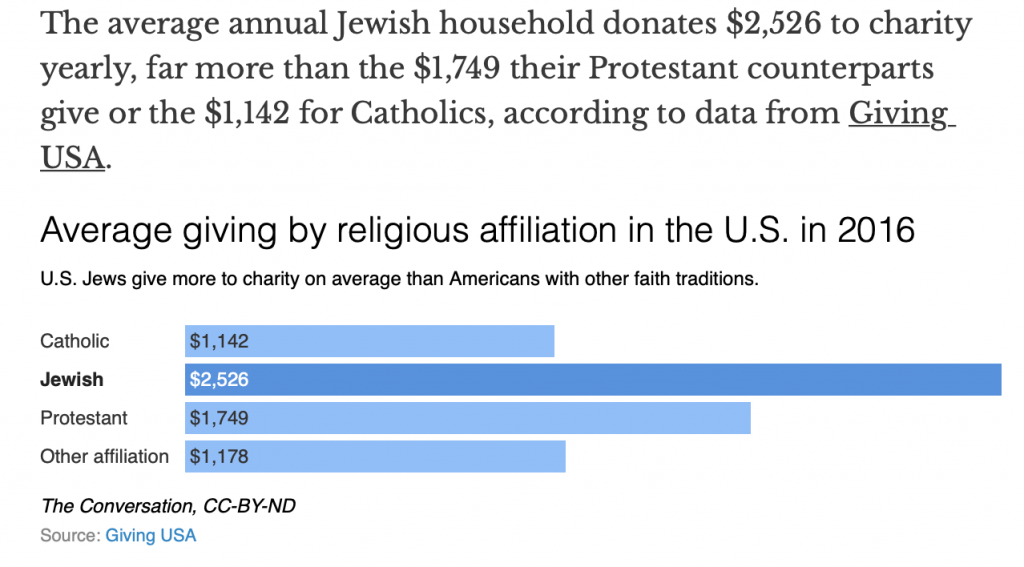
Mr. Cohen writes the grocer a check for the value of the debt and then leaves another 5,000 Shequels for the expenses of the most needy families. This story of generosity and altruism that began in the Mishkan repeats itself permanently. Far from the anti-Semitic prejudice that Jews are greedy, statistics show that our co-religionists outperform members of other religions in acts of philanthropy. If we do not hear more about these acts of kindness, it is because the most important acts of philanthropy are carried out anonymously, without any interest in appearing, just as in the Mishkan.


MISHPATIM: Who wrote the Tora?

This week’s Parasha contains a large number of Mitsvot: 53. Almost all of these precepts are categorized as mishpatim, or civil laws. This code of laws, which complements the Ten Commandments, begins unexpectedly by establishing the rights of slaves. The Tora states that a slave must be treated with respect, cannot be humiliated or subjected to degrading labor, and if their master physically harms them, they must be set free. Above all, their period of servitude is limited to six years, and when it ends, they do not leave empty-handed—the master must compensate them.

The Tora also addresses the rights of a young woman working as a servant, explaining that she must be treated with dignity. If the master decides to marry her to his son—something that was not uncommon—her husband cannot discriminate against her or treat her with fewer rights than a regular wife.

If we review the oldest legal codes, such as the Code of Hammurabi or the Hittite laws, contemporaries of Abraham Abinu, we notice a clear element. These laws focus on the rights of masters, the owners of slaves: in the Code of Hammurabi, law 282, for example, states that “if a slave says to his master: ‘You are not my master,’ his ear shall be cut off.” In the Hittite laws, if someone harmed a slave, they had to pay compensation. But to whom? Not to the slave but to the owner, as if it were a broken object. In both cases, the most vulnerable had neither voice nor rights.

Why did the laws of ancient peoples not mention the rights of slaves? Because laws were always written to benefit and protect the interests of the most powerful: kings, rulers, and aristocrats, who were often the owners of slaves. Slaves, who at that time made up more than two-thirds of the world’s population, had no voice or power to influence legislation.

Legal codes were written by the powerful to protect their interests: to maintain their authority as masters and deter any attempt at rebellion.

But who, then, could have written laws that protect slaves? Whose interests were being protected, and why?

It is also surprising that the Tora began the code of mishpatim with the rights of slaves. The Code of Justinian in imperial Rome, for example, begins by proclaiming the supremacy of the emperor and demanding that his authority be respected, ensuring that anyone who violates this law will be punished with death. The priority is to protect the ruler’s power, maintain the empire’s order, and punish rebels. No code begins with the rights of ordinary citizens—and even less so with the rights of slaves.

We can determine who wrote a law with a simple question: Who benefits from it? Laws always benefit those who draft them. And those who write them are usually the most powerful, those in power. They need rules that help them preserve their authority—not to benefit the most vulnerable.

However, the Tora completely breaks this pattern. Its laws are not written from the perspective of the master but from that of the slave. They do not seek to preserve the authority of the powerful but to guarantee the dignity and rights of those without power. The Tora protects slaves, widows, and orphans—the most vulnerable, who had no one to defend them.

Let’s see, for example, the severity with which the Tora condemns abuses against the defenseless:

“You shall not mistreat any widow or orphan. If you mistreat them and they cry out to Me, I will surely hear their cry. My anger will be aroused, and I will kill you with the sword; your wives will become widows and your children orphans.” (Shemot 22:21-24)

Who could have written these laws? Slaves? Widows? Orphans who were in power? The rulers? For what purpose would rulers and masters limit their own authority?

The obvious conclusion is that the only author of the Tora is God, the Creator of the world and humanity—the only King and Ruler who cares, first and foremost, about protecting the most vulnerable.


TERUMA: Parasha Summary

This Parasha describes God’s instructions to Moses to invite the people to contribute whatever they can or want to contribute to the construction of the Tabernacle. The necessary materials included precious metals, fabrics, skins, linen, wood, spices, precious stones, etc. God gave detailed instructions to Moses about the construction and dimensions of the Tabernacle and its artifacts. First, the text describes the Ark that would contain the tablets of the Law. The Ark was to be made of acacia wood and covered in gold, with rings at its corners where poles could be inserted for transportation. The Ark would be covered with a pure gold lid, and two gold cherubim would be made from this cover.

Next, instructions were given for constructing the Table for the Bread of the Presence, which was also made of acacia wood and covered in gold. Then, the construction of the Menorah, the seven-branched candlestick that was to be made from a single block of pure gold with decorative terminations, was described.

The Torah then describes the construction of the Tabernacle’s sanctuary. The cover of the Sanctuary would consist of several tapestries: the first would be a combination of colorful wool and linen, and the second layer would be made of goat’s hair. These two large covers would also cover the exterior walls of the Tabernacle. The top of the Tabernacle would then be covered with dyed ram skins and skins of “tachash” (an animal whose identification is subject to discussion). The walls of the Tabernacle were to be made with acacia wood beams covered in gold. The bottom of each beam had to be inserted into two silver bases. The east side of the Tabernacle would be open, and its north and south sides would have 20 beams, while the west wall would have eight. The beams were joined by several crossbars.

The Tabernacle’s sanctuary consisted of two sections: the innermost chamber was the most sacred space where the Ark would be placed. The outer chamber, Hejal or Qodesh, would house the Menorah, the Golden Table, and the Altar of Incense.

Moses was then given instructions for the construction of the Altar. This altar was to be made of acacia wood covered in bronze and was to have four vertical projections at its corners. The altar was also to be made with rings and transportation poles.

The Tabernacle’s courtyard was to be 100 cubits (approximately 50 meters) by 50 cubits and was enclosed by linen curtains. The entrance to the courtyard was to be on its east side, covered by a woven wool and linen curtain.


TERUMA: Respect For What You Were

This week’s Parasha describes among other things the Ark of the Covenant, or aron haberit. The Ark was inside the Qodesh HaQodashim, the most sacred area of ​​the Mishkan or tabernacle.

What was inside the Ark of the Covenant? Among other things: a scroll of the Tora, a sample of the man and the rod of Aron haKohen. The Ark also contained the two Tablets with the Ten Commandments. But what happened with the first set of tablets  that Moshe broke when he saw the People of Israel worshiping the golden calf? 

What happened with the remains or pieces of the broken first Tablets? Our Rabbis assert that the fragments of the first tablets were also placed inside the Ark, next to the second Tablets (לוחות ושברי לוחות מונחים בארון).

And what can we learn from the fact that both the new Tablets and the remains of the first Tablets were in the same sacred place, same category?

1. We learn that an element that had qedusha (holiness) cannot be discarded in a dishonorable way.  This is why religious objects that carry the name of HaShem – say a Sefer Tora, Tefilin, a Mezuza – when can no longer be used they cannot be thrown away. We keep them until they can be buried. That is why in every synagogue there is a Geniza, usually a large box, where these and other religious objects or books that are no longer used are placed. And eventually all these elements will be taken to a cemetery where they are buried. According to Shulhan Arukh, a sefer Tora that has some unfixable imperfection (pasul) should be buried next to a Talmid Hakham.

2. The Hakhamim also learned  a great lesson from the fact that the remains of the old Tablets were kept next to the new tablets. If a respected Tora scholar is affected  by Alzheimer or senility, and loses his knowledge and wisdom he should still be treated with the same respect.  This individual is like the old broken Tablets. The content is gone and the  wisdom completely shattered. And still we should not stop honoring him!  

We learn from the fact that the Ark contained in the same place the new and the old “broken” tablets that we owe this person the same respect and honor that we gave him before. 

“Am Israel” is a leading example in terms of how much values honor parents, scholars and elders, regardless of their present mental condition. It is important to keep this in mind because we live in a society that appreciates and honors people, only when they are useful. 

Our Tora teaches us to honor not just what a person is but also what a person was.


MISHPATIM: Human Law vs Divine Law

ואלה המשפטים אשר תשים לפניהם
   כי תקנה עבד עברי
 
This week’s Parasha contains many Mitsvot, almost all of them belonging to the category of “Mishpatim”, Civil Law.
 
It is worth analyzing the first letter of this Parasha, the VAV, which in Hebrew fulfills the function of “and …”, a conjunction. The Sages always pay attention to the presence of this word and explain what might be the association between the text before the ”and” and the text that follows “and.” The Sages of the Midrash indicate that this Parasha is the thematic continuation of the previous Parasha. The conjunction “and” indicates the Divine origin of these Mitsvot: just as the precepts of the previous Parasha, the Ten Commandments, were promulgated by HaShem on Mount Sinai, the laws of this Parasha are also of Divine origin. Before the Tora was given, Moses judged the people according to his own criteria, which, while (undoubtedly) of impeccable morals, it was ultimately a human criterion. At the beginning of this Parasha, God tells Moshe that these new laws, God’s laws, will now be the laws “that you shall teach and through which you shall judge the Jewish people.” First lesson: Human criteria, no matter how honest they may be, are not sufficient. Not only because these laws can be subjective but also because they are “relative.” That is, they change according to time, fashions, cultures, and many other psychological, sociological, etc. factors. Only a Divine law can be eternal, universal, and with values that never go out of style.

But there is something even more fascinating. This a great example to show why human beings “need” Divine laws. The laws presented here in Mishpatim constitute the first biblical legal code. A pre-constitution with 53 articles. I would like to compare just one aspect – which could easily go unnoticed – between the code of laws presented in Mishpatim and other modern codes of laws. The American Constitution, for example, and I estimate that it is the case for most constitutions of civilized countries, begins with government-related issues: the formation of Congress, the authority of the Senate, and everything related to the President and the Government. In the Tora, there are also laws of the state, of the court, of the priests, of the king, etc. But, very significantly, the first code Mishpatim begins with the laws of the most vulnerable individual: the Hebrew slave, in English, the “indentured servant”. A man or a woman who, due to their poverty or debts, works as servants until they pay off what they owe. This form of slavery was extremely common in the past. In any case, because of their debts,  these individuals were poorer than the poor. And in terms of their status, they were the “least important” people in society and, therefore, the most exposed to abuse by their masters or employers.

And incredibly, the first topic, the first law presented in the Mishpatim code, is not that of the powerful individuals or rulers, but the laws of the slaves! This law speaks about the rights of the slave: the maximum term of servitude, that the salve should be treated without violence or abuse, he (especially “she”) shall not be discriminated against or forced to do humiliating work; the slave shall be compensated at the end of his work and indemnified if the boss injures him, etc.  THIS IS ABSOLUTELY UNPRECEDENTED IN THE HISTORY OF MANKIND.  AND UNIQUE. Especially in the ancient societies contemporary to the Tora, 3500 years ago.  Let’s take, for example, the famous Code of Hammurabi, which speaks about slaves, not their rights, but their obligations to serve their masters with loyalty and the severe punishments for disobedience. For instance, the last article of the Code of Hammurabi, number 282, says: “If a slave is found guilty of saying to his master, ‘You are not my master,’ his ear shall be cut off” (see other similar examples here).

Why does the Tora begin with the rights of the weakest? Simply because it was not written by the “sovereign” or “tyrant” of the time but by God. And the God of Israel focuses first and mainly on the rights of the weakest! As we see in this case and also a little further on in this same Parasha: the Tora severely emphasizes the prohibition of abuse or exploitation of the most unprotected, the widows and orphans. Exodus 22:21-23 states, “Do not abuse the widow or the orphan. Because if you do, when they cry out to me, I will certainly hear their cry… and my anger will be aroused against you…”

Only the Tora, a Divine Law, is concerned more and primarily with the rights of the most vulnerable, of those who have less.


MISHPATIM: The Rights Of A Jewish Wife

The Ketuba, which is the Jewish marriage document, outlines the husband’s obligations to his wife. During the wedding ceremony, the groom declares that he is taking his bride as his wife “according to the law of Moses and Israel,” implying that he accepts all the responsibilities of a Jewish husband.

In this week’s Parasha Mishpatim, the Tora establishes the three primary duties of a husband towards his wife:

  1. She-erah: providing his wife with sustenance.
  2. Kesutah: supplying her with clothing and lodging.
  3. ‘Onatah: being intimate with her.


  1. She-erah

Theprimary responsibility of the husband is to provide financial support for his wife. This is the first of the three duties stated in the Torah (Exodus 21:10), which the rabbis refer to as “mezonot” (food, i.e., alimony/aliment = food).

Maimonides provides a few examples based on ancient traditions brought by the Talmud:

According to MT, Ishut 12:10-11, the husband must provide food for his wife and children according to his financial means. If the husband is poor, he should provide only two basic meals a day, whereas a wealthy husband should ensure that his wife and children have nutritious food (meat, fish, or whatever is customary) daily.

According to MT, Ishut 12:16-17, if a husband goes on a business trip overseas (in ancient times, people would travel overseas for months or years with virtually no possibility of communication), and his wife is left with no means of obtaining food, the rabbinical court may confiscate and sell the husband’s assets to provide for his wife and children, provided that at least three months have passed since the husband’s departure. It was assumed that thoughtful husbands would leave sustenance for their families for at least 90 days.

  1. Kesutah, which literally means “her clothing,” is an obligation of a Jewish husband to provide his wife with appropriate clothing, bedding, furniture, and a place of residence.

Clothing: The husband is required to provide his wife’s social needs, that is: suitable clothing for every season of the year. The quality of clothing provided must be in accordance with the husband’s financial ability and the local custom and fashion. For instance, the social needs of a woman residing on a farm differ from those living in a city (Maimonides, MT Ishut 13:2). Additionally, the husband is responsible for providing non-essential items such as jewelry and cosmetics at a level that aligns with the balance between his financial capability and the wife’s social needs.

Place of residence: The place of residence is often agreed upon and written in the Ketuba. In the event that the husband wishes to change the usual place of residence, the wife is expected to move with him. However, there are exceptions, such as when the neighborhood is disreputable, in which case the wife can refuse to move to a more violent or corrupt place. Moreover, if the couple lives in Israel, the wife can decline to move out of Israel or leave Jerusalem if they live in Jerusalem (13:15, 13:19-20) even to move to a more comfortable place.

  1. ‘Onatah: The Tora explicitly grants conjugal rights to the wife.  Exodus 21:10 states that the husband “must not deprive his wife of her food, clothing, and marital rights.” Maimonides states that a husband’s consistent refusal to engage in sexual relations deliberately or maliciously is a transgression of a Biblical prohibition. In such a case, the woman has legal grounds to ask for a divorce, claiming the total amount of the financial compensation established in the Ketubah. However, this rule does not apply when the husband’s abstinence is health-related (Maimonides MT, Ishut 14:7). The Talmud discusses the expected frequency of the husband’s marital duties based on his occupation (14:1).

Although not explicitly based on a Biblical statement, the wife is also expected to fulfill her conjugal duties. If a wife permanently denies her husband his conjugal rights without a justified reason or maliciously (kede letsa’aro), she is considered a rebellious wife (moredet) and in the event of divorce, she is not entitled to any compensation (14:9).

The primary purpose of Mitsvat ‘Onatah is to strengthen the loving bond between husband and wife. The Tora commands the couple to have children (peru urbu) in a separate Mitsva. This Mitsva, ‘Onatah, is independent of the intention of procreation. Even when conception is impossible, such as during pregnancy, when the woman is under a permissible form of birth control, or when the wife is no longer able to bear children, the couple is still expected to have an active married life.


TU BISHBAT, understanding why you need a new year for trees

Tu Bishbat is the “new year of the trees.” This “new year or cycle” is an halakhic concept relevant to some commandments of the Tora related to agriculture. These precepts linked to land are called mitsvot hateluyot ba-arets  “commandments that apply to the products of the land (vegetables, trees, grains),” and almost all of them belong exclusively in the land of Israel. For example: teruma (offerings to the Cohanim), ma’aser (tithes) shebi’it (resting of the land every seven years) etc.

Tu Bishbat is essential to know how old the trees are and determine thereby, for example, to which tithing cycle their fruits belong, as we will see below.
MAASER (מעשר):
This tithe is like a “tax” of 10% from the harvest. There are two types of tithes. First, the ma’aser rishon, which was a tenth of the produce of the land giving to the Levites. The Levites did not own land to work, their function was to serve, along with the Cohanim, in the Bet haMiqdash and teaching Tora to the people. The Cohanim and Levites were the teachers and the rabbis of Am Israel, in the days of Bet haMiqdash.
Apart from this first tithe, for the first, second, fourth and fifth years of the seven-year cycle there was a second tithe or ma’aser sheni which was to be consumed by their owners in Yerushalayim. It could also de redeemed and exchange by other products to be eaten in Yerushalayim.
In the third and sixth years, the ma’aser ‘ani was given, this is the tithe for the poor.  As we know there were many other gifts or tsedaqa given constantly to the poor besides ma’aser ‘ani. (See  Maimonides MT matenot ‘aniim)
Now we can better understand the role of Tu Bishbat. Tu Bishbat is the cut off day that determines the age of trees and serves to determine to which cycle these fruits belong.
ORLA (ערלה):
Another practical example of the application of Tu Bishbat is the commandment of ‘orla, the biblical prohibition to eat a fruit from the trees during the first three years after the tree is planted (Vayiqra 19:23). Tu Bihsbat is also the cutoff day for determining the end of these three years.
And why was Tu Bishbat  established as the cutoff day for the trees? Our Rabbis explain that by Tu Bishbat most of the year’s rains have already fallen, the trees have absorbed the rain and now they exude resin with a new vitality, which represents the end of a cycle and the beginning of another.
One more thing about the mitsva of ‘orla. Unlike the tithes and other agricultural commandments that we have mentioned, the mitsva of ‘orla also applies outside of Israel. That is, when a Yehudi plants a tree, no matter the country he or she is in, the fruits of that tree cannot be eaten during the first three years (Shulhan Arukh, YD, 294: 8).

.


My Most Favorite Ashkenazi Tradition 

TAX SEASON

Tu Bishbat is not a religious holiday and is not mentioned in the Tora. The rabbis chose this date 2,000 years ago for purely technical reasons related to the computation of tree years. It is a technical Halakhic date, a cutoff used for commandments such as “ma’aser,” or tithing, and “orla,” the prohibition of eating the fruits of the trees during the first three years. On the 15th of Shebat, the trees are simply one year older. The Tora or the rabbis in the Talmud never mentioned any other spiritual or religious meaning on this day. And obviously, Tu Bishbat was relevant exclusively for trees growing in the land of Israel, and to know, for example, when to bring certain fruits to Jerusalem or the Bet HaMiqdash, the Temple of Jerusalem. Therefore, once we Jews lost our Bet HaMiqdash and were exiled from Israel, Tu Bishbat was forgotten.

THE RENEWAL OF THE LAND

In the 16th century, thousands of Jews escaping the Spanish Inquisition arrived in Turkey. Then they moved to Eretz Israel, establishing a Jewish colony in the city of Safed (Tzefat). This city soon became the most important Halakhic center in the world. Rabbi Yosef Caro (1488-1575) wrote the Shulchan Arukh, the halakhic code still accepted by all Jews in the world, in Safed.  Mystic literature, or Kabbalah, also flourished in Safed through Ari HaQadosh (1534-1572) and his disciples. For these Jewish sages who lived in Israel, the 15th of Shebat now had special significance. Kabbalistic rabbis formulated a “Seder” or Tu Bishbat ceremony, like the one we do on the night of Rosh Hashanah, to praise HaShem for the land of Israel that He granted us, and which we were now miraculously inhabiting again. This new Tu Bishbat ceremony consisted of eating a variety of fruits. In addition, following the model of the Pesach Seder, they also drank four cups of wine, from lighter to darker colors: white; pink; Cabernet, and Syrah to represent the four seasons of the year.

FROM ISRAEL TO THE REST OF THE WORLD

Since then, the tradition of having some type of “se’uda” or fruit meal spread throughout the Jewish world. The most prized are those fruits that the Tora mentions when it praises the land of Israel: “a land of wheat and barley, grapes and figs, pomegranates, olives, and honey (dates)” Deuteronomy 8:8. For the Jewish world, Tu Bishbat now represented a new concept. Through these fruits, Jews reconnected with our beloved land. Today we would say that Tu Bishbat is a “Zionist” commemoration.

Sephardic Jews in Turkey, Morocco, Syria, Iran, etc. celebrate this date by eating figs, dates, grapes, olives, and pomegranates: fruits that could be found in those geographic areas. In Ashkenazi communities, Tu Bishbat was also celebrated. But, unlike the Mediterranean coastal areas, neither figs nor dates grew in the cold north of Europe. And it was impossible to import these fruits from the Holy Land. But the Jews of Europe did not give up. How would they remember Erets Israel if they couldn’t taste one of these fruits? And then, someone came up with the idea of the carob tree! Although the Tora doesn’t mention carob as a fruit of Israel, the Talmud tells us the famous story of Rabbi Shimon Bar Yohai, who survived for 12 years in Meron, an area near Safed, eating carob. In some way, the Jews of Europe managed to import dried carob pods from the land of Israel: “in the times before fast transportation and refrigeration, the hard and dry texture of the carob made it one of the few fruits grown in the land of Israel that could withstand the long-distance journey [to Europe] without deteriorating”. (See here)

ROCKS WITH THE TASTE OF HONEY

When I first heard this story, I was moved to tears! Although Rabbi Shimon Bar Yohai survived thanks to this tree,  the Gemara classifies carob as “food for animal consumption” (מאכל בהמה). Carob seeds are hard as rocks, and difficult to bite, and if you haven’t broken all your teeth trying to bite, you’ll discover that these seeds produce a floury substance that smells like spoiled cheese. However, for European Jews, these tough seeds were exquisite because they came from the land of Abraham, Isaac, and Jacob, the land of the Temple, the promised land. Love and passion for Israel transformed the inedible carob seed into the most delicious fruit in the world!

The custom of eating fruits on the 15th of Shebat continues to this day. Many of us, who still live outside of Israel, have the incredible privilege of going to a local supermarket and buying Israeli wine, honey, cheese, cookies made with Israeli flour, and fruits that come directly from our beloved land. The beautiful Ashkenazi custom of eating carob on TU BISHBAT continues to this day!

Wherever you are this TU BISHBAT,  eat fruits that remind you of Israel, feeling the beautiful taste of our beloved land. Or visualize yourself as a 17th-century European Jew savoring in the bitter carob seeds, the milk, and honey of our beautiful land.