The Meanings of Matsa

The most characteristic Mitsva of Pesach is to consume Matsa (in English: matzah”). Matsa replaces ordinary “bread.” And it is, in fact, a type of “bread,” flat, with no salt, and without the soft, inner part of the bread (=crumb). It is made without waiting for the dough to rise through the normal fermentation process and without adding yeast.

So, why do we eat Matsa on Pesach?

There are two reasons. The Tora explicitly mentions the first reason, and the second, lesser-known reason is briefly mentioned at the beginning of the Haggada, the text we read at the Seder.

BREAD FOR SLAVES (לחם עוני)

Let’s start with what the Haggada says. For many years, when we lived enslaved in Egypt, we ate exclusively Matsa for breakfast, lunch, and dinner. This inexpensive “bread“, called by the Haggada Lachman Aniya,  “the poor bread” or “the poor’s bread,”  had no yeast, no salt, and no additives. The Egyptians conceived Matsa as the ideal food for the working Jews: Matsa is digested slowly and lasts longer in the slaves’ stomachs, who complained less about hunger. Matsa was also the lowest-cost food that could be produced: flour and water were two of the cheapest and most abundant elements on the Nile’s banks. In addition, there was an element of deprivation and a virtual mental torture of the Jewish slaves. Eating Matsa meant that there was no lunch break.  Typically, the dough is left to rest for about 20 minutes to produce ordinary bread. Once the dough rises through fermentation, it is placed in the oven and turned into delicious bread. However, the Egyptian slave masters did not grant the Jewish slaves those 20 minutes of rest.  The Hebrew slaves had to prepare the dough, bake it on the spot, and return to work immediately (or perhaps, they were forced to eat Matsa “while” they were working…).  The Haggada reminds us of this by pointing out that the Matsa we eat at the Seder “is the bread of affliction that our ancestors ate in Egypt.” The experience of eating only Matsa for so many years, and its psychological effect, was engraved in our memory, and when we tried it, we relived the taste of captivity.

THE SECOND TIME WE ATE MATSA

The explicit reason that the Tora mentions regarding Matsa is different: at the time of our departure from Egypt, we ate Matsa. Why? The final order to leave Egypt occurred “at the last moment” (bechipazon) between Nisan 14 and 15, after the last plague when Pharaoh and the Egyptians felt forced to expel us from their territory.  Leaving Egypt was an operation that lasted hours, not days. Let’s try to visualize it: we must take the essentials with us and leave all our belongings behind.  We need food to travel the desert. The journey will take several weeks or months, and we must prepare as much food as possible. Who knows when we will have time, and whatever is needed, to make food again!  When we are about to leave and pack just our essentials, do we have time to wait twenty minutes between bread and bread until the dough rises? Probably not. We had to make as much bread as possible for the journey, as fast as possible, so we just made the dough flat. 

WHEN DID SLAVERY END?

Masechet Rosh HaShanah mentions a detail that sheds light on the two reasons for the Matsa that I just explained. I always wondered “why was the bread of the exodus different from the bread the Jews ate all other days because Jews ate Matsa uninterruptedly.     The Sages explained that our slavery did not end on Passover, that is, in the month of Nisan: forced labor was interrupted on Rosh haShana of that year!  That is, 6 months before leaving Egypt. This event is referenced in the Tehillim Psalm 81, which we recite on the night of Rosh Hashanah (הסירותי מסבל שכמו). If so, once slavery ended, our ancestors consumed fermented or ordinary “Egyptian bread”! But ironically, when we had to leave Egypt in a hurry, we were ordered to consume again “poor people’s bread” or “Jewish bread.”  But this time, we ate Matsa for a different reason. This time, the Matsa did not have the bitter flavor of slavery but the taste of freedom that was taking place swiftly and miraculously in front of our eyes.

THE DOUBLE TASTE OF MATSA

The Matsa represents both the bitterness of slavery and the sweet taste of our providential freedom. By eating the Matsa, we celebrate our redemption without forgetting our suffering. On the one hand, we remember the affliction we suffered as slaves in Egypt. And on the other hand, we recall our departure from Egypt. Which was not the consequence of a progressive “revolution” that fermented in the Jewish people over several years, and whose outcome occurred after endless battles…. Bore Olam rescued us in a swift act of redemption, unrepeatable in human history.


What Is and What Is Not Chamets?

We cannot eat, benefit from, or even own Chamets during Pesach. Today, we will explain what is and what is NOT Chamets.

THE FIVE GRAINS Chamets (also written hametz or chametz) is any fermented substance, solid or liquid, from one of the following five grains: wheat, rye, spelt, barley, and oats. These are also the five grains that are generally used to make bread. Our sages established that only bread made from one of these five grains is considered for the berakha “HaMotzi” and “Birkat Hamazon.” For example, bread made from soy flour, rice flour, or corn is not considered real “bread.”

LIQUID CHAMETS The fermentation process only affects “flour” that comes from these grains. For example, beer is made from barley grains, which are soaked and then fermented. Beer (like whiskey and other alcoholic beverages made from one of these grains) is considered Chamets, although the grain was never converted into flour.

OTHER FERMENTED FOODS On the other hand, a fermented food that does not come from or does not contain any of these five grains cannot become Chamets, even if it undergoes a fermentation process. For example, wine is fermented, but it is made from grapes. The same applies to other alcoholic beverages, such as sake (known in Japan as “rice wine”), made from fermented rice.

Finally, only some things that come from these five grains are Chamets. Matsa to be used for Pesach can only be made from one of these five grains. Matsa is also a kind of “bread.” In Hebrew, it is called the bread of poverty or “lechem oni,” and in English is called “unleavened bread.”

THE DIFFERENCE BETWEEN CHAMETS & MATSA

  1. TIME The fundamental difference between bread and Matsa is time. Bread and Matsa are made with the same essential ingredients: flour and water. The difference is that when preparing Matsa, you cannot leave the dough to rest once the flour is mixed with water. The dough must be kneaded and baked in less than 18 minutes. If left idle for 18 minutes or more, from the time the flour gets in contact with water, that dough “ferments.” This fermentation is called “Himuts” in Hebrew, and the product of this fermentation is called “Chamets.” Regular bread is made with flour and water (and yeast, as we will later see), but the dough is deliberately left to rest. When fermented, the dough enlarges, and the bread-crumb, i.e., the soft, inner part of the bread, is formed.

  2. WATER If the flour made from one of the five grains is mixed “exclusively” with fruit juice, honey, or eggs without water, the fermentation or Himuts will not occur. Technically, if a dough is made by mixing wheat flour with pure fruit juice, with no water, and baked after resting for 18 minutes or more, this food will be called Matsa Ashira, and it is not considered Chamets.

  3. SE-OR Yeast (in Hebrew se-or שאור) is similar to Chamets. The biblical prohibition of Chamets, consumption and possession also includes the banning of yeast, though yeast is not an edible food by itself but an additive. Until a century ago, yeast was usually produced at home. Flour and water are mixed and kept for four days to prepare yeast. That sourdough, which smells like alcohol, is known as “natural yeast,” and it is used as a catalyst for fermentation in the preparation of homemade bread. In other words, when preparing bread, once flour and water are mixed, introducing some yeast into the dough will accelerate the fermentation process, and the dough will grow bigger, producing soft and tasty bread. All Chamets restrictions (use, possession, benefit) also apply to se-or, that is, natural or commercial yeast.


PARASHAT HACHODESH: Why do we call this coming month “Nisan”?

חזרנו  לקרוא החודשים בשם שנקראים בארץ בבל, להזכיר כי שם עמדנו ומשם העלנו ה’ רמב”ן שמות י”ב , 2

This Saturday, March 29th,  we will begin the month of Nisan at night. We will read this Shabbat, the Perasha of the week, Pequde. We will take a second Sefer Tora to read ha Chodesh haze lakhem, that is, a text from the book of Shemot (Exodus) chapter 12 announcing the coming of the month of Nisan: “This month will be for you the first month … of the months of the year “. In the Hebrew calendar, there are 12 months (or 13 when there is a leap year, and a second month of Adar is added every 3 years or so). In the Tora the names of the months are designed with ordinal numbers: first month, second month, third month, and so on. The month of Nisan is the first of the 12 months of the year. For those familiar with the ordinary Gregorian calendar, there is something unusual here: January is the first month of the year, and it is also the first month of the year; that is, January, the new year begins. In the Hebrew calendar, however, the year starts in the seventh month of the year, the month of Tishri, and the first month of the month is Nisan.

The month we call today “Nisan” was designated by the Tora as the first month of the year because it is the month of Pesach. When we count the months, we remember the great miracle of our redemption. So when we say:  “the third month,” we are saying “the third month, counting from Nisan, the month of our redemption.”  Something similar, although in the opposite sense, happens with the days of the week. We count the days of the week in Hebrew, as in Portuguese, with ordinal numbers: the first day (יום ראשון), Sunday, the second day (יום שני), Monday, etc. And every time we count the days, we do it in reference to Shabbat. When we say in Hebrew “Monday,” we are saying, “Today is the second day, counting toward Shabbat” (שני בשבת). So every time we mention a day of the week, we remember Shabbat.

Today, although we continue counting the days of the week with ordinal numbers, we no longer count the months with their ordinal names, but we say Nisan, Iyar, Tishri, etc. Why? These names are not Hebrew names! In fact, these were the names of the months in ancient Babylon (and then in Persia, as they appear in Megillat Esther).

The big question is: why did we Jews abandon the Biblical names of the months and adopt the non-Jewish names of the months of Babylon?

Ramban (12, 2) explains that this has to do with a prophecy of Yirmiyahu (Jeremiah). Yirmiyahu had the difficult task of announcing that if the people of Israel persisted in their abandonment of the Tora, the Bet haMiqdash and Yerushalayim would be destroyed, and the survivors would be taken prisoners to Babylon. But Yirmiyahu also comforted the people, announcing that HaShem would miraculously bring them again from Babylon to the land of Israel. This great miracle occurred in 538 BCE, when, as the last Pesuquim of the Tanakh says, the Persian emperor Cyrus Koresh announced that HaShem revealed to him and ordered him to rebuild the Bet haMiqdash in Yerushalayim. Miraculously, Koresh also invited all the Yehudim who wanted to return to Israel under his protection.

Yirmiyahu prophesied the destruction and exile of Israel (chapter 16: 9-13) and also the return of the Jewish people to their land. And he said (16: 14-15) that when this happens, when HaShem would bring the Jewish people back from Babel to the land of Israel: “… it will no longer be remembered [only] that HaShem took us out of the land of Egypt, but it will be said that HaShem brought back the children of Israel [to their land] from the land of the north (= Babel) and from all the countries where I [HaShem] exiled them.”

Our sages understood that the memory of the redemption of Babel would completely replace the memory of the redemption of Egypt. In fact, no event in Jewish history is mentioned and remembered as many times as our deliverance from Egypt. There are dozens of Mitzvot, not only Pesah but also Shabbat, Tefillin, Shema, etc., that remind us of Egypt’s departure. But surviving the Babylonian exile was a miracle of Biblical proportions. So, what do we do then with the Prophet Yirmiyahu’s indication: to remember the great miracle of the redemption of Babel? Ramban explains that to follow Yirmiyahu’s words, we count the months of the year with the Babylonian non-Jewish names. Thus, whenever we mention the Babylonian name of one of our calendar months, we automatically remember our exile in Babel and “YETSIYAT BABEL,” our miraculous redemption from that captivity.


The Fifth Cup, and Eliyahu haNabi

והוצאתי והצלתי וגאלתי ולקחתי      והבאתי

BLESSINGS OVER A CUP OF WINE

Reciting a blessing over a cup of wine is an ancient Jewish tradition going back to the Bet haMiqdash, where wine libations were offered at the time that the Leviim (Levites) recited and chanted Psalms (Shira). In this way, the songs and blessings of praise and gratitude were always connected with wine. When a blessing (such as Qiddush, Sheba Berakhot, Habdala, post-Birkat haMazon, etc.) is recited over the wine, the cup of wine is called: “a cup of blessing” (in Hebrew: כוס של ברכה).

We have four cups of blessing because in the Seder, as previously explained, there are three blessings and one song of praise, Hallel (Psalms 113-118).

Now, there is an ancient tradition, mentioned by the Talmud and Maimonides, of reciting a fifth prayer, a famous Psalm of Tehillim, Mizmor 136. The Sages called this Psalm “Hallel haGadol”, the great [song of] praise [to HaShem]. It contains 26 verses describing all the acts of kindness that HaShem did for humanity and His people, Israel, and how we show our gratitude to Him. It begins with the creation of the world; it includes our words of appreciation for our freedom from Egypt and the establishment of the Jewish people in the land of Israel. This Psalm, according to Maimonides, is recited in the Seder after the Hallel over a fifth cup of wine! Maimonides clarifies that this fifth glass of wine is NOT mandatory but optional. And that, unlike the first four glasses, it was consumed only by the person who recited the prayer and not by the other diners.

Yemenite Jews maintain the custom of drinking a fifth cup of wine until today. In all Halakhic instances, they strictly follow Maimonides’s opinion. As for other communities, the custom is to pour a glass of wine but without drinking it.

WHY ELIYAHU HANABI?

This fifth cup of wine is said to be “for Eliyahu haNabi.” Let’s clarify this. The Sages debated for centuries whether or not one should drink the fifth cup of wine. While there are several explanations for this debate, I will present just one of those explanations.

The four cups of wine remind us of the four expressions of redemption mentioned in the Tora during our Exodus from Egypt:

In Shemot (Exodus, chapter 6), HaShem says to Moshe:

(6) … go and tell the Israelites: “I am HaShem, and I will rescue you from the oppression of the Egyptians. I will free you from their bondage and redeem you with a great display of [My] power and incredible acts of justice. (7) And I will take you as My people; and be your God.

Thus, with the first cup, the Qiddush, we remember that HaShem put an end to our oppression by ending our slavery. The second cup reminds us that HaShem brought us out of Egypt. The third cup reminds us that in doing so, HaShem displayed all His power: the ten plagues, the opening of the sea, etc. And the fourth cup reminds us that HaShem chose us and took us among all peoples to be His chosen people.

But, the following verse expresses a fifth idea: (8) And I will bring you to the land of Israel, a concept mentioned by Psalm 136 as well!   

For centuries, and before 1948, there was a discussion among the Rabbis regarding this fifth concept: although we are free, and we are the chosen people, we do not have the land of Israel. What is the point then to recite the fifth blessing and praise God for something we lost, i.e., our sovereignty in our land, Israel? The Rabbis did not settle this debate, and as a compromise between the two opinions, we serve the fifth cup, but we don’t drink it. Now, whenever there is an unsolved debate among the Rabbis, it is said that when Eliyahu haNabi would come [announcing the arrival of Mashiach], then we will have our Sanhedrin (or National Supreme Court), and those Judges would then solve every Halakhic doubts …. and this is how the fifth cup become popularly known as the cup of Eliyahu haNabi.

ISRAEL

It is worth mentioning that in our times when we B”H have our sovereign State of Israel, many Rabbis, Sepharadim, and Ashkenazim ( such as Rabbi Hayim David haLevi z’l or Rabbi Shelomo Goren, z” l and others) hold that we should return to the custom of “drinking” the fifth glass of wine because B” H we have the gift of the land of Israel back! 

For this reason, many Jews who live in Israel tend to serve and drink the fifth cup of wine in honor of Erets Israel.

MAY HASHEM SEND US VERY SOON (PERHAPS EVEN BEFORE THIS COMING PESACH) ELIYAHU HANABI, ANNOUNCING THE ARRIVAL OF OUR MASHIACH TSIDQUENU. THEN WE WILL HAVE THE MERIT OF CELEBRATING ALL TOGETHER IN ISRAEL OUR DEFINITIVE REDEMPTION.

AMEN!

For more information on the fifth cup, see this interesting article in Hebrew by Rabbi Moshe Tsuriel


Pesach, through Haroset

“And [the Egyptians] embittered the lives [of the children and Israel, forcing them to do] the hardest works, [such as the extraction of] mud and [the manufacture of] bricks…”
Exodus 1:14
 
 
POLITICAL FREEFALL 
For several decades Jews had a privileged life in Egypt. They lived in a safe and fertile area: Goshen. They did not lack anything. They enjoyed prosperity and good health. This material well-being gave the Jews power and influence. But when a new Pharaoh came to the throne, founding a new dynasty (18th?), he sought to curb the power of the Jews and their demographic growth. First, he imposed excessive taxes on them to impoverish and weaken them. But he was not successful. Pharaoh then proceeded to the second stage of his plan: direct confrontation. The Egyptian ruler officially declared the Jews to be the “enemies of the people” and deprived them of their freedom.
 
SLAVES OF THE PEOPLE
Visualizing a scenario where Jews are denigrated and brought from the top of society to the bottom in a very fast change of events, is very difficult and it can only become more real – and terrifying – if we think of the Shoah. Elie Wiesel, in his book “Job: Ou Dieu dans la tempête” (French) was one of the first to compare Egyptian captivity with the Holocaust. According to Wiesel the properties and assets of the Jews were confiscated by the government. Men and women were forcibly removed from their homes and taken into labor camps (Pitom , Ramses), where they were forced to work for the government. According to Rabbi Wisser, better known as the Malbim (Russia, 1809 – 1879), many Jews were given to Egyptian citizens as free labor, and as “reparations” for all the money “the Jews made in the good old days.”. These are the words of the Malbim: “Jews were taken as permanent slaves, but they no longer worked for the monarch [the government], but for the general population. The Jews were now the slaves of [Pharaoh’s] slaves and were forced to do whatever work any Egyptian asked of them.”
 
THE REVENGE OF THE EGYPTIANS
The Torah describes how Egyptian citizens treated their Jewish slaves. “And the Egyptians embittered their lives with hard work.” There was something “personal” in this mistreatment of the Jews. Animosity. Resentment. Why? Because the new Pharaoh—a calculating revisionist—changed the narrative of history and demonized Yosef and his descendants. From being the hero who saved Egypt from famine, Yosef was now portrayed as the villain who took advantage of the Egyptian famine to favor his own family. Consequently, and in what appears to be the first manifestation of antisemitism, the Egyptians looked now at the Jews not as saviors of Egypt’s economy but as abusers and si loyal, and this resentment was translated into the most terrible revenge: the “rich” Jews were now the people’s slaves. Free labor for the resentful Egyptians, who got a lot of enjoyment from having the former nobles, under their feet.
 
WORK, UNTIL YOU DIE
The jobs assigned to the Jews were, of course, the most unhealthy and the riskiest jobs that no one else was willing to do. What do we know about these jobs? Little children draw pictures of Jewish slaves dragging stones, but this is not what the Tora says. The first reference in the Torah is “chomer ulbenim”, mud and bricks: not stones. Incidentally, in the south of Egypt, the stone was used for construction, but in the north, in the Nile delta, where the Jews resided, mud bricks were used. Apparently, of all the hard work that had to be done in Egypt, the most humiliating, exhausting, and deadly was producing these bricks. What did this job consist of? Egyptian bricks were made from two materials: 1. clay or mud, and 2. straw. These mud bricks, also known as “adobe” are used in rural areas almost everywhere on the planet, also on the banks of the Nile (see video at the end of this article) to this day. The Jewish slaves had to extract the mud from the Nile —which was rich in minerals, but harmful to the skin—, transport it, mix it with animal manure, and stir it with feet and hands for four or five days until the brick reaches the point of fermentation. Then, the straw was introduced into that mix to make it strong, solid, and durable. Finally, it was poured into the brick molds. All this work was done in the swamps of the Nile, a river infested with crocodiles, hippos, and mosquitoes, and under the scorching desert sun that burned the skin.
 
HAROSET AND NATIONAL MEMORY
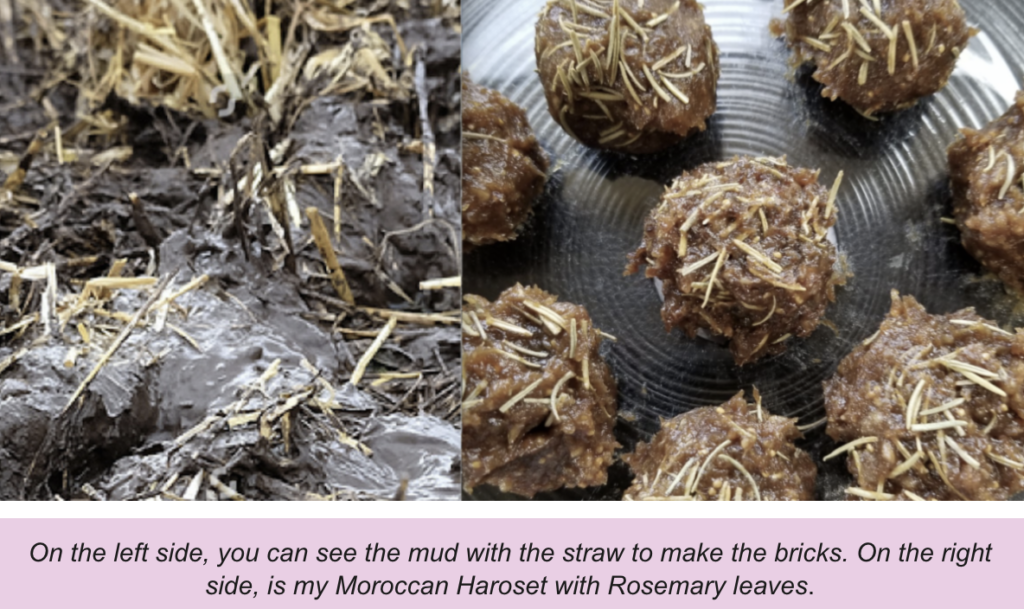
There are two foods that the Tora instructs us to eat at the Pesach Seder: Matsa, which reminds us that it was God – and not Moses or any other political leader – who delivered us from Egypt. And Maror, a bitter vegetable that reminds us of the taste of slavery. The Sages added two more foods to help us experience slavery and freedom as physically as possible. On one side they introduced the four cups of wine, to celebrate our freedom. And on the other hand, they told us to prepare the Haroset, which according to Maimonides is a Mitsva established by the Rabbis, particularly when combined with the Maror, , to remember slavery. The Haroset is a paste made with fresh fruit, dried fruit, and wine (or vinegar, according to Maimonides) which reminds us of the color and texture of clay. The image of the mud in our hands has been engraved in the collective memory of our people as a national trauma, the symbol of slavery and oppression. And the Haroset reminds us of this at the Seder.
 
MAIMONIDES RECIPE
There is something else in the Haroset. Following strictly what the Talmud says, Maimonides indicates that “pieces of herbs” (tebalin) must be added to the Haroset, which visually represents the straw. We do not know what those herbs were, but we do know that they are not to flavor the Haroset but to create that special “visual effects”. That’s why Maimonides indicates that the herbs should not be ground but cut into small pieces so that it looks like straw (teben) and thus the Haroset looks like “mud with straws” (טיט ותבן). The presence of this ingredient, the herbs or tebalin, was considered essential in the times of the Talmud. The Gemara in Pesachim recounts that the general custom in Jerusalem was that when people arrived at the markets to do their Pesach purchases, the merchants announced: “Come and take [for free] the herbs to fulfill the mitzvah [the precept of Haroset]. ”
 
THE FUNCTION OF HERBS
Since the effect of these herbs should be visual, there is no limitation on the type of herbs or vegetables that should be used for this purpose. Some rabbis mentioned cinnamon, ginger, or sprigs of hyssop, clarifying that they should not be ground but cut. The Maharil (1366-1427) was the most explicit, saying to cut the herbs into long, fine pieces (מחותכין ארוכין) to give them the appearance of “straws”. Today – for some reason that I have not yet been able to understand – almost all the recipes of the Haroset include spices or aromatic herbs, but no one mentions the herbs that give the Haroset the special visual effect that should awaken the memory of the mud and straw…. For some reason, this very important element has fallen into disuse… and this is when I decided to do my own Haroset…

MY HAROSET RECIPE

I am not allowed into the kitchen two days before Pesach… But this year (this article was written in 2019 Y.B.) I wanted to prepare a Haroset that was more like the recipe I learned from Maimonides.
According to Maimonides, the Haroset is made with dried fruits (figs, dates or raisins), wine vinegar and tebalin or herbs. The fruits give it the color and texture of clay; the vinegar its bittersweet flavor, and the tebalín, the look of the material that our ancestors used in the slavery of Egypt to make the “adobe”, that is, the mud-brick with straw.
Following Maimonides’ recipe, I easily prepared a paste with dried dates, dried figs and vinegar (no fresh fruits).
But since no one seems to give importance to the tebalin, I had to start looking on my own for something to put into the Haroset that would visually resemble the “teben” or straw.
I went shopping. First, I went to a supermarket and I saw alfalfa sprouts, which were long and thin… but I needed something dry, not fresh. I kept looking and then, “Eureka,” I found the straws! “Japanese Enoki mushrooms” with Kosher certification. They were long, white, thin and dry. Perfect for the desired visual effects. I bought a small bag to try. But my wife Coty wasn’t too happy about having Japanese mushrooms at the Seder. At that time I had to make a choice between my wife and Maimonides… and as everyone will understand, I discarded the “Enokis”…
Next, I went to “Everfresh,” the local kosher store, to find a more Jewish alternative. I saw cinnamon sticks, which could be the perfect shape, but they were too dark: too similar to the color of Haroset, and I needed the special color effects that would highlight the contrast between the mud and the straw. I found a bag of dried orange peels, but they seemed too short. Then I saw “Frozen Zucchini Spirals” in the freezer, but they were too similar to spaghetti… not exactly for the “spirit of Pesach”. The lavender branches looked perfect. I called my wife and she reminded me that I should use something edible. I ended up purchasing a little of everything: groceries, some non-food items, some frozen. I was undecided about what I could use… and this when a little miracle happened! Coty brought me a small packet of Rosemary Leaves and asked me to check if they were kosher for Pesach. 
When I saw those leaves I had an epiphany! These dried leaves were a perfect option. The color: light, between white and yellow. They were herbs as Maimonides required, and edible, as my wife required. But there was a problem. The leaves were too short. They would be lost inside the Haroset… and the visual effects would be lost … While I was looking at the leaves, and thinking about how to mix them with the Haroset, I had a second epiphany: I remembered the Moroccan Haroset, prepared in the form of balls, similar to falafel or meatballs. And I suddenly visualized that the Rosemary leaves had the perfect size to be mixed within the Haroset balls. I saw in my mind the mud with the straws, which for decades traumatized our ancestors! The rest was easy. And the result is right here below….


Regular Matsa vs. Matsa Shemura

The Matsa is a special bread made of a flat dough. The dough is prepared exclusively with flour and water and without yeast. The flour usually comes from wheat, but technically, the Matsa could also be made from barley, oats, rye or spelt flour. The most sensitive issue in the preparation of the Matsa is time. To avoid the fermentation of the dough, the entire process of processing from the moment the flour is brought into contact with the water until the Matsa is removed from the oven, takes less than 18 minutes.

There are different types of Matzot. For example, we have regular Matsa and Matsa Shemura. The difference between these two Matzot has to do with the level of supervision (shemira). Specifically, from what point of the elaboration process the supervision begins.

REGULAR MATSA  

Supervision of the normal Matsa begins from the moment the flour is produced. To ensure, for example, that the flour is kept in a dry place because moisture causes the flour to be fermented and turn into Chamets . In addition, it must be verified that the water to be used to make the dough is at room temperature level, because if the water is warmer, for example, it would accelerate the fermentation process. Once the dough is made for the Matsa, it cannot be left to rest. Any piece of dough that has been left unattended for over 18 minutes is Hamets, and if that piece of dough gets mixed with the dough for the next Matsot, it might affect the Kashrut of all of Matsot’s production! After a batch of Matsot is produced, and before producing the next batch, the machines are thoroughly inspected and cleaned. These are some examples of the supervision to which regular Matsa production is subjected.

MATSA SHEMURA  

In addition to observing the same rules for the supervision  of the regular Matsa, in the elaboration of the Matsa Shemura supervision begins from the time the grains of wheat are harvested in the fields. The grains, which are harvested when they are still fresh, are examined carefully to ensure, for example, that there are no broken grains, something that would lead to premature fermentation. The supervision includes also making sure that there are no sprouted grains, which would also accelerate the fermentation process. In the case of Matsa Shemura the grain is selected and monitored when is harvested, at the time of transportation and when is finally stored, to ensure that it is safe from moisture.  All this additional supervision implies more labor, and that is why the Matsa Shemura is substantially more expensive than the regular Matsa.

Obviously, both the regular Matsa and the Matsa Shemura, are Kasher for Pesach. However, the Halakha indicates that we have to use of Matsa Shemura during the first two nights of Pesach (in Israel, only the first night), when we say the Berakha al akhilat Matsa. Why? Because during the two nights of the Seder eating Matsa is a Mitzvah. As it is written in the Tora (Exodus 12:17) ושמרתם את המצות, “and you should watch (= strictly supervise) the Matzot.” During the other days of Pesach, there is no obligation to consume Matsa Shemura, because during the rest of Pesach there is no formal commandment to eat Matsa, only to refrain from eating Chametz.


The Land of Israel or the State of Israel?

THE LAND OF ISRAEL

Jerusalem was not always the vibrant capital of the Jewish state that we know today. For centuries, the few Yehudim who managed to reach the Land of Israel were merely a defenseless minority, without sovereignty, living under the rule of foreign powers. Visiting Jerusalem was an act of faith, and seeing the ruins of the city, not only the Temple (Bet HaMiqdash), caused such profound pain that our Sages decreed that one must tear their garments as a sign of mourning.

I think of Yehuda HaLevi, the great 12th-century poet and philosopher who tragically died at the gates of Jerusalem while reciting his poem Tzion Halo Tishali. Or Maimonides, who, upon arriving in Israel in the 12th century, visited Hebron but could not even step foot in Jerusalem due to the bloody Crusades between Christians and Muslims. For more than 1,800 years, the Jewish presence in Jerusalem was insignificant and constantly threatened. We had no army, no government, no authority. We were either persecuted or, at best, tolerated, depending on the whims of the ruling powers.

RELIGION OR NATION?

In his reasoning about tearing garments in contemporary times (something that we Sephardim still do), Rabbi Tzvi Yehuda Kook z”l explains his argument based on an interpretation of the Bet Yosef. He asserts that mourning is not solely dependent on the existence or non-existence of the Temple but also on who governs Israel and Jerusalem. If the city is under foreign rule, then yes, we must mourn our loss. But since 1967, Jerusalem has been in our hands, rebuilt day by day. Jerusalem is no longer just part of the Land of Israel; it is the capital of the State of Israel.

This distinction between “Land” and “State” is fundamental to understanding Purim. In the time of Mordechai and Esther, about 50,000 Jews lived in Jerusalem and its surroundings, and the Bet HaMiqdash was built and functioning! This was thanks to a decree by the Persian emperor Cyrus in 516 BCE, which declared religious freedom for the Jews and allowed the construction of the Temple. But the Jews were subjects of the Persian Empire. They had no sovereignty or army of their own, and after the death of Cyrus, they were not even able to obtain imperial permission to build the protective walls of the Temple—something that Nehemiah achieved with the son of Ahasuerus, Artaxerxes. Without sovereignty, any imperial decree could seal the fate of the Jewish people, as would have happened with Haman’s decree, which would have led to the extermination of the Jews in the “Land” of Israel as well.

WE DON’T REALIZE HOW GOOD WE HAVE IT

Today, thanks to God, Land and State coincide. We no longer depend on the favor of foreign kings or rulers. We protect ourselves heroically with the help of Bore Olam and with our own army. We build and rebuild our cities, ensuring that no modern-day Haman can determine our fate. God performed miracles on Purim through Mordechai and Esther. Today, His Providence is manifested through the soldiers who protect the existence of Medinat Israel.

To better understand the contemporary significance of this concept, we only need to briefly explore the Muslim perspective on the State vs. the Land of Israel. The more moderate Arabs—those who are not jihadists—insist that Jews may live in the Land of Israel, but they must not have a State! According to them, Jews could reside in the Holy Land as a protected minority, paying a special tax (jizya), but without sovereignty or their own army. In other words, depending on the goodwill of those in power. Essentially, they would be willing to grant us the right to exist and even to practice our religion and perhaps have our Bet HaMiqdash—in a location to be determined—but not the right to self-determination. That is, it would repeat the same scenario we experienced during the Persian Empire and for centuries in Muslim countries: we would be at the mercy of the rulers of the time.

THE TRAP OF INGRATITUDE

This is why, every time a Jew speaks of the “Land of Israel” and omits mentioning the “State of Israel,” they are unintentionally reinforcing this Arab narrative. Some may not be satisfied with the Jewish state because it is not yet religious enough, etc. But by denying the idea of the Jewish State and repeating this exilic mindset, one would be acting—perhaps unknowingly—in a disgraceful way toward Bore Olam, who has granted us this immense privilege.

In the Messianic era, according to Maimonides, the first step will be the restoration of Jewish sovereignty over the Land of Israel, under the leadership of the Melekh HaMashiach, a sovereign King (Melekh) whom the Jewish people anoint (Mashiach), and who has not been appointed by non-Jews. Every time we affirm that we have a State of Israel, we also declare that our Messianic aspirations are drawing ever closer.

The lesson of Purim is clear: without our own State, without our own defense, Jews will always be in danger. It doesn’t matter how free we are to practice our religion, and it doesn’t even matter if we are in Israel or in the diaspora—if we don’t have a State, there will always be a Haman ready to find us defenseless.

Today, all Yehudim around the world are, virtually, citizens of Israel. The miracle of Medinat Israel is happening before our very eyes. We only need to open them to see it.


MEGILLAT ESTER -CHAPTER THREE

VERSES 1-7

After some time, King Achashverosh appointed a new prime minister: Haman, son of Hamedata, the Agagite. Agag was from the nation of Amalek, infamous for attacking the Jews without provocation when they left Egypt. Haman was granted the highest powers in the kingdom.

From what we see in the rest of Megillat Esther and what we know from Herodotus’ historical account, once Achashverosh returned defeated from his failed military expedition to Greece, he no longer wanted to engage in politics. He now wished only to enjoy the pleasures of ruling and focus on grand construction projects like those he built in Persepolis. To achieve this, he needed someone to handle his empire’s political and administrative affairs. Haman was that man: he was strong-willed and authoritarian, which helped the king consolidate his rule and, most importantly, prevent any conspiracies against him.

To invest Haman with the highest authority, the king ordered that everyone revere him in a religious way. All the citizens of the empire, the ministers, and the members of the royal court were not only required to bow before Haman—hishtachavayah in Hebrew, an act of respect widely accepted at the time—but also to kneel before him.

“Kneeling and then bowing” (kri’ah ve-hishtachavayah כריעה והשתחוויה) was not merely a sign of respect but an act of worship and religious devotion, a gesture in the Hebrew Bible reserved only for God. The Sages add that Haman carried an idol with him, from which he derived his supposed divinity, similar to pagan priests. Once we understand this, we realize that kneeling and bowing before Haman constituted an act of idolatry. This is why Mordechai, a member of the royal court (sha’ar hamelech), refused to show reverence to Haman.

A lesser-known rabbinic opinion states that King Achashverosh, aware of this issue, personally exempted Mordechai from kneeling before Haman out of respect for his religious principles ( כי כן צוה לו המלך).  

Other opinions, however, criticize Mordechai for not being more cautious and suggest that he could have resigned from the royal court to avoid facing the dilemma of bowing or not bowing before Haman.

In my opinion, Mordechai was following the example of Hananiah, Mishael, and Azariah, who, 120 years earlier in Daniel’s time, had done something similar during the ceremony of the inauguration of an idol in Babylon (Daniel, chapter 3). When everyone else bowed, they were willing to risk their lives to publicly set an example for other Jews that they must not bow before an idol.

In any case, Mordechai assumed that, at worst, Haman would order his execution. Still, he never imagined that Haman would seek revenge by plotting the genocide of the entire Jewish people.

Mordechai did not deliberately approach Haman provocatively to demonstrate his refusal to bow, as otherwise, Haman would have seen him directly. Instead, Mordechai did so discreetly. And just as had happened with Daniel’s friends, his enemies reported him to Haman.

Upon learning of this affront, Haman was furious. Instead of reporting it to King Achashverosh, he handled the matter personally. His first thought was that killing Mordechai or even his family was not enough. To satisfy his thirst for vengeance, he had to take extreme measures against the people who hold Mordechai’s values.  Haman then decided to eliminate “all the Jews in the Persian Empire,” which at that time meant “all the Jews in the world,” including the colony of 50,000 Jews living in Jerusalem, a province of the Persian Empire. This was the “final solution,” conceived by none other than a descendant of Amaleq.

The first thing Haman did was choose a date astrologically favorable for this massacre. The Persians frequently consulted astrologers and oracles to determine the most auspicious days for their plans. According to some historians, their astrological oracle consisted of a board with the names of the months and another board with the numbers of the days. Haman cast a small stone or a special gem—called pur (“lucky stone”) in ancient Persian—onto a board with the names of the months, and it landed on the month of Adar. Then he cast another stone, which landed on the number 13. Thus, two stones (purim, the plural of pur) determined the date, the 13th of Adar, and the fate of the Jewish people.  It was the 12th year of King Achashverosh’s reign. All Haman needed was to convince Achashverosh to sign the decree to execute the “final solution.”

VERSES 8-9

From the text of the Megillah—what it states and, more importantly, what it omits—we can deduce that Haman’s strategy to convince King Achashverosh consisted of four key points.

First, he minimized the event and avoided discussing it openly in a formal meeting. That is why Haman did not request an official audience with the king to present his plan, as Esther did when she wanted to speak with him. I think that Haman seized a casual and informal moment—perhaps after a long and exhausting meeting when the king was already standing, tired, or in a rush to attend his next event—to secure a quick and careless “yes” from him.

Second, Haman never explicitly mentioned that he wanted to eliminate the Jews. He proposed sanctions against “a certain people,” describing them as scattered throughout the empire, disobedient of the king’s laws, and followers of their own weird rules. According to Malbim and many other commentators, King Achashverosh did not realize that Haman’s decree referred to the Jews.

Third, Haman avoided stating outright that he wanted to “kill” these people, as that might have alerted the king. Instead, he used an ambiguous term: le-abedam, meaning “to destitute them.” This could imply extermination, but in the Tanakh, it usually means depriving form freedom (enslaving them) or affecting them economically by confiscating their property or exiling them (as in the Shema Yisrael, where va-avadtem meherah means “exile”).

The fourth point was about the money. The king did not need to think twice. Not only did Haman refrain from requesting funds from the Crown for his project, but he also offered to raise money:  10,000 silver talents, which would be confiscated in the operation and added to the royal treasury.

VERSES 10-15

To Haman’s surprise—and delight—King Achashverosh did not ask to read the decree and did not pose any questions. With complete indifference and gross negligence, the king removed his signet ring, handed it to Haman, and said, “Do as you please with this people and keep the money for you.”

Haman’s plan had worked even better than he had expected.

With the king’s ring in his hands, Haman summoned the royal scribes and dictated what they were to write. Rabbi Moshe Almosnino highlights a crucial point: Haman drafted the decree with two separate texts. The first, Ketav Hadat, only stated that all the citizens of the empire should prepare for an important event on the 13th of Adar (Save the Date להיות עתידים ליום הזה) without giving any details.

The second document, Patshegen haKetav, contained the fine print explaining Haman’s true intentions: “On the 13th of Adar, the Jews of the Persian Empire will be destroyed and murdered, and their possessions will be confiscated. The young, the elderly, children, and women of the Jewish people will be killed on the 13th day of the month of Adar.”

The decree was signed on the 13th of Nisan and urgently sent to the 127 provinces of the empire via the royal postal couriers. It was also translated into all the empire’s languages.

In Shushan, to prevent the king from learning of Haman’s entire decree, only the first document, Ketav Hadat, was circulated, which did not mention genocide.

This chapter concludes by telling us that Haman and King Achashverosh sat down to enjoy a banquet, while the citizens of Shushan—both Jews and non-Jews—were left confused and perplexed upon hearing the mysterious proclamation to “save the date for the 13th of Adar.


Singing the Hallel in Yerushalayim

Pesach was celebrated with great joy in the times of the Bet haMiqdash (the Temple of Jerusalem, destroyed in the year 68 of the Common Era). Hundreds of thousands of Jews came to Yerushalayim from all corners of Israel to sacrifice the Qorban Pesach (a sheep or goat) on the 14th of Nisan. They stayed with relatives, acquaintances, or often wherever there was room. The houses in Yerushalayim were open to all who needed a place to stay. Only when there was no more room available would a red cloth be hung above the door to announce it.

Today, we remember this beautiful act of hospitality when we say at the beginning of the Haggadah: “Let all who are hungry come and eat; let all who need come and celebrate Pesach with us.”
In the homes of Yerushalayim, people gathered in groups of families, friends, and guests called Haburot (singular: Habura). Each Habura, which could consist of 50, 60, or even up to 100 people, would partake of the same Qorban.

The lamb was brought on the afternoon of the 14th of Nisan to the Bet haMiqdash by one or two representatives of each Habura, and it was sacrificed while the Hallel was recited.

There is a beautiful custom, still practiced today in a few communities, that was observed for centuries in remembrance of this Hallel on the eve of Pesach. Do you know when people used to bake the Matsot used for the Pesach Seder? On the 14th of Nisan! That is, in the afternoon of the eve of Pesach, at the very time the Qorban was sacrificed. This is in fact the ideal time to prepare Matsot—just as we prepare Halot on a regular Friday afternoon. And while preparing the Matsot, the family would sing the Hallel!

Let’s return to Yerushalayim. After being slaughtered, the animal was roasted whole and brought back home. That night, already the 15th of Nisan, the Seder was conducted—very much like we do today. The Haggadah was read, the Ma Nishtana questions were asked, and a large meal was served, including other offerings such as the Korban Hagiga, and all accompanied, of course, by Matsa, Maror, and Haroset. People reclined on couches or cushions and ate like nobles. They drank four cups of tempered wine, toasting to our salvation, redemption, freedom, and our assignment as the chosen people.

At the end of the meal, before midnight, the Qorban Pesach was distributed as the Afiqoman (the final course or “dessert”) among all members of the Habura. Everyone had to eat at least a portion the size of an olive (Kazait).

Today, we remember the Qorban Pesach by placing a shank bone on the Pesach tray (or a chicken leg among Ashkenazim). At the end of the Seder, we also eat an additional portion of Matsa, the Afiqoman, saying: “We eat this Matsa in memory of the Qorban Pesach, which was eaten when one was already satisfied.”

After eating the Qorban Pesach, we recited the Birkat haMazon, the blessing of gratitude to HaShem for our food.

Towards midnight, once the Pesach meal was complete, something truly “magical” happened. People would go up to the terraces of their homes and from there, looking toward the Bet haMiqdash—illuminated by the full moon—they would sing the Hallel, the Psalms of Tehillim recited to thank HaShem for freeing us from Egypt.

I believe this was the most beautiful moment of the night: the voices of hundreds of thousands of Yehudim, the entire Jewish People, coming together to sing the Hallel, all at once, with one melody, filling the holy city with that extraordinary song. The Gemara says that the voices of this multitudinous chorus were so powerful that the city literally “trembled.”

To preserve the memory of that beautiful Hallel and make it part of our national memory, we all sing the Hallel together in the synagogue before the Seder begins.

May HaShem grant us the merit to sing the Hallel next year, all together, in Yerushalayim, with one voice before our Bet haMiqdash. AMEN.

יהי רצון שנזכה לחגוג את חג הפסח בבנין בית תפארתינו במב”י, אמן


Understanding the Never-Ending Palestinian Conflict

WRITTEN FEBRUARY 2024

RELIGION AND TERRITORY

Today, I am going to address a topic related to Islam, which must be known to more appropriately understand whether the creation of a Palestinian state that US President Joe Biden has proposed in recent days will promote peace in Israel and the Middle East.

What meaning does territory have in different religions?

In Christianity, religious issues are separated from political issues. Let us remember the famous phrase: “Give to Caesar what is Caesar’s,” which imposes the division between church and state as two separate entities. In Christianity, there is also no idea of national territory or the religious obligation that all Christians must live in a specific country in the future. Christians do not have territorial ambitions or territories that they aspire to conquer or liberate for religious purposes (ironically, the only exception I can think of is “Jerusalem,” but I think that was in the times of the Crusaders.) Although Christianity embraces the ideal of evangelizing humanity, it does not intend to militarily conquer all the countries in the world to achieve that goal.

Judaism is different: we are a political religion. And we have territorial ambitions. Our millennial aspiration is to have our own sovereign state in the land of Israel. However, beyond the land of Israel, we Jews do not embrace the goal of conquering other lands or imposing our Torah on any other people. Not even in messianic times. When the Messiah arrives, we do not intend to conquer the world (as the anti-Semitic tract “The Protocols of the Elders of Zion” falsely alleges) but rather to live in our land, Israel, guided by our Tora, to serve our God in the Bet HaMiqdash—the Holy Temple of Jerusalem—and living in peace with our non-Jewish neighbors.

Islam is a different story. And it is essential for Israel and for the Jews of the world to know what their actual “territorial ideals” are. We need to understand who we are dealing with and not repeat the mistakes made in the past, for example, in the Oslo agreements.

ISLAM AND OCCUPIED TERRITORIES

For Islam, there are two types of territories:

1. “Dar Al-Islam” defines the lands that are ruled or “were ever ruled by Muslims.”

2. Dar Al-Harb is a land that is not yet under Muslim sovereignty but that one day, eventually, will be. This theoretically includes the entire planet Earth. Because, unlike the Jews, Islam has the “messianic,” “utopian” aspiration that everyone converts to Islam. This explains a little better one of the most serious problems of the West: that Muslim immigrants who arrive in Europe, for example, not only have no intention of “integrating” into the culture of the countries that offer them refuge but also, on the contrary, in the long term, they have the aspiration of imposing Sharia, Islamic law, on the countries they arrive.

(There is also a third category, less known, which is Dar Al-Salam: the land of peace. That is, the planet Earth will enjoy peace when the entire world finally accepts Islam and follows Sharia. Only at that moment will there be definitive and lasting peace. And until then, Muslims must do everything possible to achieve this religious and political vision. For more information, see this phenomenal article in Hebrew ).

WHAT ABOUT ISRAEL?

For Muslims, the land of Israel falls into the first category: “Dar Al-Islam, a territory that Islam once ruled, that is, “occupied territories.” Israel was indeed conquered and ruled by Caliph Omar in the 7th century. And once this occurs, the land becomes sacred, and no matter how much time has passed, according to Islam, it can no longer be ruled by non-Muslim infidels. Suppose non-Muslims want to live in the lands of Dar Al-Islam. In that case, according to Islam, they can do so only if they submit to Muslim sovereignty and accept the supremacy of Islam (dhimmis).

But if non-Muslim infidels rule and inhabit these lands, they are considered an illegal occupying force. For Islamist states like Iran, or those that identify with the Muslim Brotherhood, Qatar, or Turkey, it is a religious duty to recover those lands. And for the most extreme Muslims, jihadists, such as Hamas, Hezbollah, or the Huties of Yemen, recovering those occupied lands and attacking the invader “is an act of legitimate defense” (sic.), and they must resort to “jihad”, the holy war –which calls for the genocide of the enemy–to achieve it.

AND THERE WAS LIGHT!!!

When this point is understood, it becomes clearer what is seemingly meaningless in the claims and actions of Palestinians and other Arab Islamist and jihadist groups towards Israel.

Let’s look at some examples:

1. The concept of occupation is not a political concept. In reality, as everyone knows, there was never a previous Palestinian state, which Israel is now occupying. In the context of Dar Al-Islam, “occupation” is a religious, Islamic term that refers to the sovereignty of infidels, in this case “Jewish” over a Muslim territory.

2. Therefore, the “occupied territories” claimed by jihadists are not limited to Judea and Samaria or Gaza but to the entire land of Israel, including Jerusalem, Haifa, and Tel Aviv. It is for this reason that one will never hear in pro-Palestinian demonstrations a call for the creation of two states, one Israeli and one Palestinian, living in peace with each other. What the pro-Palestinians demand is “one state,” the Palestinian one, from the river to the sea (from the Jordan River to the Mediterranean Sea).

3. This also explains why Hamas justifies its massacre with the excuse of the Israeli “occupation” when we all know that Israel withdrew from Gaza in 2005 and has NOT had any soldiers in Gaza since that year. But for the Palestinians, Gaza or Judea and Samaria are not enough. They have to expel the Jews from all “Palestinian” territory.

4. It is then demonstrated that the conflict with the Palestinians is not territorial in the conventional sense. A classic territorial problem between two countries is resolved through war or negotiating territory. After wars or negotiations, countries established stable and peaceful relations, though this was not always immediate. For instance, despite the annexation of Texas and the Mexican-American War in the 19th century, the U.S. and Mexico eventually became neighbors with strong diplomatic and amicable ties. However, since the Palestinian conflict with Israel is not merely territorial but rather a religious conflict, there is little room for negotiations or concessions. And it is for this reason that Islamists WILL NEVER RECOGNIZE A JEWISH STATE IN A TERRITORY OF THE “GIVEN TO ISLAM” CATEGORY, no matter how small this state may be.

5. This also explains why Hezbollah attacks Israel. Israel does not “occupy” Lebanon, and Hezbollah cannot have territorial claims against Israel. Still, as a jihadist religious group, it fights against non-Muslim sovereignty in Dar Al-Islam.

6. This is why Iran, an Islamic state, fights for the destruction of Israel, even though it has no border with Israel. And why the Islamist Huties of Yemen have written on their flag as part of their existential mission: “Death to Israel” even though the Jewish State is 5,000 kilometers away from Yemen.

7. The religious obligation to liberate territories occupied by non-Muslims in Dar Al-Islam explains why Hamas or Hezbollah or the Palestinians of Judea and Samaria use their mosques as military bases and hide weapons and ammunition, soldiers, etc. there. After all, the war they are fighting is not for military but religious purposes. It is logical, then, that religious institutions are at the service of jihad. Only in this last incursion into Gaza after October 7 did the Israeli army attack and destroy mosques and expose the hypocrisy of the United Nations, which always demanded immunity for religious institutions, knowing that Palestinians in Gaza and Judea, and Samaria use these facilities for military purposes. Something similar happens with hospitals, schools, and facilities of the infamous UNRWA.

8. The idea of Dar Al Islam also explains why confiscating territory from the Palestinians in Gaza is the most effective measure to punish the October 7 massacre and other terrorist acts and will be the only thing that can deter them when they try in the future. to repeat a similar attack: if they mess with Israel, they will lose territory of Dar Al-Islam (nakba). This will be the worst defeat for them, politically and religiously.

9. The jihadists practice a double discourse: on the one hand, the religious one, the internal dialogue from the mosques, where they tell the truth about their final objective with inexplicable impunity: destroying Israel is the first step, and starting the jihad against the West.


On the other hand, there is propaganda for the ears of Hamas accomplices: the United Nations, the media, the Red Cross, Amnesty International, and the International Commission on Human Rights, to name just a few examples. In all these forums, there is a pact of silence by which they will never mention the religious aspect of this conflict. On the contrary, and knowingly, they will describe Israel as the aggressor; they will disguise the problem of jihad as Israeli “colonialism.” And there are also the useful idiots, the atheist leftists, who, in their insane psychopathic deviation from good to evil, end up supporting the most fundamentalist theological doctrine: Jihad.

10. Only once we understand the concept of “Dar Al-Islam” do we know the supreme naivety of the statements of the American Secretary of State Anthony Blinken about declaring a Palestinian state “attentive to the legitimate aspirations of the Palestinians.” The final aspiration of the Palestinians – and in this sense, there is no difference between Hamas and the Palestinian Authority – is for Israel to disappear from the map, to vacate ALL of its territories, from the Jordan River to the Mediterranean Sea. But the most immediate “strategic” aspiration of the Palestinians is to create a state that borders Israel. Have Israel at a zero distance from there to produce more and more massacres in the style of October 7, and thus, one day destroy the infidel Jews who occupy “Dar Al-Islam”.

And despite all this, Israel B”H will prevail, free itself from its enemies, and triumph.

How do I know?


וְהִיא שֶׁעָמְדָה לַאֲבוֹתֵינוּ וְלָנוּ

שֶׁלֹּא אֶחָד בִּלְבָד עָמַד עָלֵינוּ לְכַלּוֹתֵנוּ

אֶלָּא שֶׁבְּכָל דּוֹר וָדוֹר עוֹמְדִים עָלֵינוּ לְכַלּוֹתֵנוּ

וְהַקָּדוֹשׁ בָּרוּךְ הוּא מַצִּילֵנוּ מִיָּדָם

And that promise of protection that God made to our ancestors, which protected them, will protect us, too. Because it was not a single time that our enemies wanted to destroy us; in reality, new enemies that seek our destruction emerge in each generation. But again and again, the Holy One, saves us from their hands.

Rabbi Yosef Bitton

Israel is facing an enemy that does not intend to stop with the destruction of Israel ח”ו, but instead wants to continue fighting against Western civilization.

Israel is at the forefront of this battle of civilizations or religions. And although Israel inexplicably has the world against it, little by little, some countries and world leaders, such as the future Prime Minister of Holland Geert Wilders, are seeing it.

¿AFTER ISRAEL? Spain & Portugal

This phenomenal article from BBC 2016 (Spanish) explains the concept of Dar Al Islam in a little more depth and mentions which countries are in this category: Israel is the first because it is in the Middle East, but it is not the last.

For jihadist … there is a sacralization of the land. Any territory that has been part of Islam at some point will always be part of Islam. It does not matter that control was lost centuries ago, that Muslims do not exist or are a minority in that territory. That is Islamic land and those who occupy it are invaders….

Al Andalus was the territory that remained under Islamic rule in the Iberian Peninsula from the arrival of the Muslims, in 711, until the fall of the Kingdom of Granada, in 1492 into the hands of Castile.

At its maximum extent, in the 8th century, Andalus covered practically the entire peninsula…

The territory that “must be recovered” extends from Southeast Asia in the East to the Iberian Peninsula in the West.

That doctrine – as Azzam wrote in 1987 – proclaims that “jihad or holy war will remain an individual obligation until all the other lands that were Muslim return to us and Islam reigns in them again before us are Palestine, Lebanon, Chad, Eritrea, Somalia, Philippines, Burma, southern Yemen, Tashkent and Andalus [that is: Spain and Portugal .Y.B].