ON VICTORY AND DEFEAT On the day that the Jewish leaders declared the establishment of the new State of Israel, on May 14, 1948 (5 Iyar 5718), the neighboring Arab countries declared war on the Jewish State and began an invasion on all fronts, confident of their victory. Israel had many disadvantages, but the most notable was the lack of weapons. Let us remember that the five Arab countries that launched an attack against Israel – Egypt, Iraq, Syria, Lebanon, and Jordan – had become independent a few years earlier. Both England and France equipped them with weapons and trained their armies. The Arab countries had, for example, 50 tanks, while Israel only had one tank. The Arabs had 200 artillery vehicles, and Israel had just two. The Arabs had 140 guns, and Israel only had five. The most significant disadvantage was that the Arabs had more than 70 warplanes. At the start of hostilities, Israel had none. The Arab countries had warned that if Israel declared its independence, they would attack. They were waiting for this to happen since the chances of winning the war and having everything in their favor were 100%. So confident were in their triumph that they called on the Arab radio for all Palestinians living in Israel to leave for a while the country, assuring them that they would return very soon when the short battle would be over, and all the Jews would be thrown into the sea (a euphemism for: “being brutally murdered”). Hundreds of thousands of Palestinians left the territory of Israel. In this way, the Arab countries created the “Palestinian refugee problem,” for which they never took charge, and instead, to this day, they continue to blame Israel.
OBJECTIVE: TEL-AVIV Immediately after the declaration of independence, Egyptian warplanes appeared in the skies over Tel Aviv, began to bombard the city, and met no resistance. These nonstop attacks from the air left hundreds dead — including women and children — and thousands wounded. The Egyptians advanced significantly and reached Ashdod, remaining only 30 kilometers from Tel Aviv. The powerful Jordanian legion, trained by the British and commanded by British generals (sic.), managed to besiege Jerusalem, and the invasion of the Holy City was imminent. The Jordanians also captured the city of Lod and what is now Ben Gurion International Airport and approached Tel Aviv from the east. Iraqi forces that came from the northeast were also closing in on Petah Tikva and Hadera on their way to Tel Aviv. The Syrians were surrounding the city of Tiberia and, together with the Lebanese military forces, had isolated the Galil, the north of the country, from the rest of Israel. The final destination of the Arab armies was Tel-Aviv, which at that time was the seat of Israel’s Government and the military High Command.
UNITED AGAINST ISRAEL Israel had no way to defend herself and could not get weapons. Why? Because the United States was leading an international embargo that prohibited any country from selling weapons to Israel, with full awareness and knowledge that Israel could not possibly survive the attack of the Arab armies on her own. It was only a matter of time before a new Shoah was repeated, and the world, for the second time, acted as a silent accomplice. All efforts by Israel’s newly created Israeli Army to defend itself failed. The forecasts that predicted the brutal defeat of Israel were coming true. The military superiority of the Arab armies was insurmountable. There was no way the Israelis could withstand the attacks even for a few more days…. the end was imminent. The Arabs, very confident in their victory, announced that “what Hitler had done was nothing in the second war, compared to what they would do with the Jews” once they conquered Tel Aviv. The world, as in a horrible dejavú of the Holocaust, watched and remained silent. And then a great miracle happened. It was June 11, Sivan 4, 1948.
THE CEASEFIRE The Swedish Count Folke Bernadotte, appointed by the United Nations as a mediator between Israelis and Arabs, proposed a ceasefire, that is, an interruption of the military activity of the armies for four weeks, offering that each one remains in control of the positions they had conquered up to that moment. Israel, which was losing on all fronts, obviously agreed. The inexplicable thing—the miraculous thing!—was that the Arab countries also accepted this ceasefire, even though they were one day away from conquering Tel Aviv! I quote Professor Ben Artzi, a historian at Bar Ilan University. He writes this in his (Hebrew) book Megillat Hatequma VehaAtzmaut: “But why did the Arabs accept the ceasefire…? In reality, all their military objectives had already been achieved: Jerusalem was surrounded and besieged; Tel Aviv, a very short distance [from falling into their power]; the south of Israel [the Negeb] disconnected from the rest of the country, and the Galil, the north, had already been conquered. A little more effort on the part of the Arabs, and they were already in the heart of Jerusalem, Petah Tikva, Netania, Hadera, Afula, and Tel-Aviv”. Ben Artzi does not try to hide his conviction that this ceasefire was a miracle of Biblical proportions.
CELEBRATING AHEAD OF TIME The truce began on June 11. The five Arab armies, who considered that they had already won the war, started negotiations among themselves about how Israel’s territory and the spoils of war were going to be divided once the Jews had formally surrendered, something they hoped to happen in the next few days. But Israel took advantage of the ceasefire and, with the support and generous donations of Jews in the United States and the diaspora, bought from Czechoslovakia, the only country that dared to break the international embargo, all the weapons they could, including 15 military planes. It also changed its strategy: even though the military balance was still in favor of the Arabs—at least 10 to 1— Israel decided that now it was not only going to defend itself but would start attacking the Arabs! Once the war resumed, the Arab armies were so confident in their victory that they practically stopped fighting. According to Igal Alon, the famous Palmach commander, when the ceasefire expired: “The Arab armies that had a great advantage stopped advancing, something that is inexplicable.”
BIBLICAL FEAR And then the third miracle happened. Israel’s courageous and unexpected decision to go on the offensive caught the Arabs entirely by surprise. They went from passivity to panic, imagining that Israel had more power than it did. At the end of May, four unassembled “Messerschmidt” military planes secretly arrived in Israel from Czechoslovakia inside a commercial aircraft. The planes were assembled in record time, and on May 30, before they could test them, they went out on their first mission: trying to stop the Egyptian forces who were only 30 kilometers from Tel Aviv. The planes made a surprise attack on the Egyptians. Still, they did not cause severe damage since the attacking equipment did not work well. However, the Egyptian commander in charge of that force sent an urgent message to his superiors, telling them that “his army could advance no further because they were being bombarded by a force far superior to them.” All this panic was more imaginary than real. The Tora first mentions the “fear” that Israel’s enemies felt in the Yaaqob Abinu story. When the inhabitants of Canaan, obviously stronger and more numerous than Jacob and his sons, “wanted but did not dare” to attack Jacob. The Torah says (Genesis 35:5) that the inhabitants of those cities “were taken by a Divine fear, which dissuaded them from persecuting the children of Israel. ויהי חתת אלקים על־הערים אשר סביבתיהם.” This is the way HaShem intervened to save our ancestors from their numerous enemies. The Tora tells the same thing in the famous song that the children of Israel recited when crossing the sea. תפל עליהם אימתה ופחד בגדל זרועך ידמו כאבן עה. In the book of Shemot, it appears to be an explicit promise from God to Israel. Our Torah says (Exodus 23: 27) that when Israel prepares to conquer the peoples of Canaan, God will intervene. How? “And I will strike fear and terror into your enemies, and confuse them…and cause all your enemies to turn their backs on you and flee.” We see this “Divine Modus Operandi” dozens of times in the Tanakh: Hashem defends His people, infusing an irrational psychological fear in the hearts of Israel’s enemies.
BIBLICAL AUDACITY Israel took an Egyptian officer who had participated in the War of Independence prisoner in the 1956 war. He was asked why the Egyptians accepted the ceasefire and did not continue to advance toward Tel Aviv in 1948 when the road was completely open to them. The officer said: “When we attacked the Israelis, we saw something that scared us: even after taking direct fire and heavy casualties, the Israeli soldiers kept advancing as if they were “crazy” (mej’nunin). And then we said to ourselves: “These crazy people cannot be beaten. It is better to [accept the ceasefire] and settle for what we have already achieved.HaShem did not just infuse fear in the enemy; He also inspired extraordinary courage in the hearts of His people.
MY INTERPRETATION I want to end this incomplete history of the most crucial war in the history of the State of Israel with a final reflection. The most inconceivable fact of this story is that knowing about their incomparable military inferiority, the leaders of Israel have decided to declare the Independence of Medinat Israel, knowing that the Arab’s attack would be imminent. This decision did not make any sense, neither from a military point of view nor from a logical point of view. Looking at the numbers, one can only think that it was an act of madness. However, there is another possibility. David Ben Gurion and the Israeli leaders of that time were not just acting on their own. A kind of Divine audacity moved them: God intervened in their minds and hearts in a way opposite to the way He intervenes when He spreads irrational fear into the hearts of our enemies. The Almighty inspired their souls with incredible irrational courage and bravery, which led them to act like Nachshon Ben Aminadab, going into the water until literally it covered their nose, knowing that HaShem would eventually intervene by opening the sea. This was the first miracle of Yom HaAtzmaut. Perhaps the greatest of them all
Lag LaOmer and the Study of Mysticism
In the Sephardic tradition, the 33rd day of the Omer, or Lag LaOmer (sic), is known as the day of the Hillula of Rabbi Shimon Bar Yochai.
Who was Rabbi Shimon Bar Yochai?
Rabbi Shimon lived during the second century of the Common Era. The collections of Midrashei Halacha, Sifre, and Mekhilta are primarily attributed to his authorship. He is the fourth most frequently mentioned Rabbi in the entire Mishna and was one of the five disciples who carried on the legacy of Rabbi Akiva.
However, Rabbi Shimon Bar Yochai is best known as the author of the Sefer HaZohar (the Book of Splendor), which contains the Sitre Tora—the mystical and secret aspects of the Tora.
The Talmud in Shabbat 33 recounts the extraordinary story that led Rabbi Shimon Bar Yochai to attain such profound levels of knowledge. Rabbi Shimon was sentenced to death by the Romans for daring to criticize their government. He fled to a cave with his son, Rabbi Elazar. They remained there for twelve years, surviving on a carob tree and a spring of water. During these years of isolation—studying Tora, detached from all social distractions, and with their material needs minimally met—Rabbi Shimon and his son reached an unprecedented level of Tora understanding.
And because Rabbi Shimon Bar Yochai reached an unparalleled spiritual level, his death is seen as a “graduation”—having achieved the highest possible level of accomplishment in this life. The 33rd day of the Omer commemorates this “graduation.”
The sages of Qabbala referred to this celebration as a Hillula, which means “wedding”—a metaphor used to describe the highest level of spirituality. The Qabbalists explain that in this world, the highest possible level of closeness to God is that of irusin, or engagement—when a couple decides to marry and commits to one another. In the state of irusin, a man and woman who love each other declare their mutual affection and their desire to spend their lives together. This is the closest level of connection with God one can achieve in this world: a level of loyalty, devotion, and unconditional love for Hashem.
The next level—marriage—is a far more intimate relationship. But it lies beyond earthly and human reach. That is why this metaphor, marriage, was chosen to describe the level that Rabbi Shimon Bar Yochai could only reach after departing from this world: a non-corporeal dimension, free from material needs and physical limitations. A state in which the soul can stand before the Divine Presence and fully enjoy His splendor.
As the reader can see, these mystical concepts are very profound, and even mentioning them is a subject of debate within the Jewish people.
Let me explain further.
There are two primary views regarding the dissemination of Qabbala. The first view, mainly found in Hasidic circles, holds that Qabbala should be taught to anyone willing to listen, regardless of their level of knowledge or religious observance. They also believe that spreading this mystical knowledge will hasten the coming of the Mashiach, since they interpret the prophetic verse that in the Messianic era “the knowledge of Hashem will fill the world as the waters cover the sea” as referring to mystical knowledge.
The other opinion, typical of the Sephardic rabbis, holds that Qabbala is extremely difficult to understand and very easy to misunderstand—or even be misused by charlatans and impostors. We have had more than one false messiah, such as Shabetay Tsevi, who used their knowledge of Qabbala to gain credibility and attract ignorant and superstitious followers.
Today, there are groups that supposedly study a form of popular “Qabbala”—an enormous oxymoron. In these circles, Qabbala is not seen or studied as a path to draw closer to God by renouncing material aspirations, but rather as a form of esoteric knowledge mixed with astrology, self-help, numerology, and even Zen philosophy to achieve greater material wealth or success—which is exactly the opposite of what real Qabbala is all about.
In the Sephardic tradition, the study and transmission of Qabbala is reserved for individuals who meet the following criteria:
A high level of Tora knowledge. To begin with, one must have already studied the entire Talmud, with commentaries, and be an expert in Halacha.
Exceptional religious and moral conduct, characterized by absolute integrity and humility.
Perhaps the most essential condition: disdain for materialism.
Only such an individual may be taught Qabbala in a private setting.
According to this philosophy, as I learned from my teacher Rabbi Saadia Ben Zaquen z”l, there is an infallible golden rule to identify a true Qabbalist:
“Those who know it do not speak of it, and those who speak of it do not know it.”
YOM HAATZMAUT: From Tikvatenu to Hatikva
A young man from Galitzia (hoy en Ucrania), named Naphtali Herz Imber, inspired by the founding of Petah Tikvah in 1878, wrote a poem expressing his hopes for the Jewish people’s return to their land.
The song, originally called “Tikvatenu” (Our Hope), later became “Hatikvah,” the national anthem of the State of Israel. One of the central themes of the poem/song “Hatikva” draws from the words of the prophet Ezekiel. In the renowned chapter 37, where Ezekiel describes the prophetic vision of the valley of the dry bones, he prophesies that the people of Israel, in their despair, will proclaim: “We are doomed to disappear, we are dead, buried, ‘our hope is lost'” (in Hebrew: abda tikvatenu). In response, “Hatikva” asserts, now with the establishment of Medinat Israel, “‘od lo abda tikvatenu”—our hope is definitely NOT lost.
Imber was born in 1856 into a Hasidic family. He received a traditional education and left home early to wander the world. He arrived in Palestine in 1882 and spent six years there, writing essays, poetry, and articles for Hebrew periodicals.
“Tikvatenu” was first published in 1886, though it had already been publicly read as early as 1882 to a group of farmers in Rishon LeZion, who received it enthusiastically.
Among them was Samuel Cohen, who so enjoyed the poem that he immediately set it to music.
“Hatikvah” was sung after the Sixth Zionist Congress in Basle in 1903, the last congress presided over by Theodor Herzl, who died tragically the following year. The anthem was performed at all subsequent Zionist Congresses, and at the 18th Congress, held in Prague in 1933, it was officially confirmed as the Zionist anthem.
“Tikvatenu” became the unofficial anthem of Jewish Palestine under the British mandate. At the Declaration of the State of Israel on May 14, 1948, the assembly performed “Hatikvah” at its opening ceremony.
The original text of haTikva, pre-Medinat Israel, differed from the one we have today. It was five times longer and included the Jewish aspiration of “coming back to the land of our forefathers, and to the city founded by King David (=Jerusalem)” od lo and tikvatenu, hatikva hanoshana, lashub leEretz Abotenu, leir bah David chana.”
Once the State of Israel was established and the People of Israel were settled in the land of our forefathers, the last eight words were changed and adapted to the new reality.
The Holocaust In Sephardic Communities
WHAT CAN WE LEARN FROM OUR ENEMIES?
I would like to briefly refer to the Holocaust in Sephardic communities, a topic that is not often discussed. In Holland, France, Bulgaria, Yugoslavia, and Italy, the Sephardic Jews suffered the same fate as the Ashkenazi Jews of Europe. Probably the most shocking case was that of the community of Thessaloniki in Greece, where nearly 54,000 Jews, 95% of its population, were exterminated in Auschwitz (see here). My first reflection is that we must learn a great lesson from our enemies: that we are ONE people and we must stay united. That there are no, and should not be, differences between Sephardim, Ashkenazim, more religious or less religious, etc. We must do the impossible to feel that we are members of the same family.
.
THE JEWS OF MOROCCO AND ALGERIA
Let’s briefly look at the impact of the Shoah on the Jewish communities in North Africa: Morocco, which had a population of 200,000 Jews in 1940. Algeria, 120,000 Jews. Tunisia had 80,000 Jews, and Libya, had 30,000 Jews. The first three states were under the French protectorate, while Libya was under the Italian protectorate. France was occupied by the Nazis in 1940, which is known as “Vichy France.” The Germans ruled France, its colonies, and its protectorates. And this included: Morocco, Algeria, and Tunisia. In Morocco and Algeria, the infamous “Statut de Juifs” was established, which allowed the German authorities to confiscate the property of Jews, severely restrict their activities, and prohibit their access to education, etc. They also established about 30 labor camps to build the trans-Sahara road, and for that, the Germans recruited about 4,000 Jews from Morocco and about 1,000 Jews from Algeria. It should be noted that there was a big difference between these labor camps and, for example, Auschwitz or Bergen-Belsen. In the North African “labor camps,” only adult and able-bodied men arrived at first. Dozens of them died due to unsanitary working conditions, scorching heat, disease. But the vast majority survived. The camps in Europe, on the other hand, were “extermination camps.” Children, the elderly, women, and men who could not work were immediately exterminated in gas chambers. And for the men and women fit for work, they were made to work but ultimately to be killed. This horrible strategy, not so well known, has a “name” in the German language. The expression is: Vernichtung durch Arbeit, “killing Jews through forced labor.” Returning to North Africa on November 8, 1942, and B”H before the Nazis could carry out the process of deportation and extermination of the Jews, Allied forces led by General Montgomery arrived on the coasts of Morocco and Algeria and were able to defeat the Nazis-led by General Rommel in a military operation called “Operation Torch.” (see map above).
THE OLDEST JEWISH COMMUNITY OUTSIDE OF ISRAEL
Tunisia is a separate story. Tunisia was the only country in North Africa directly occupied by the Nazis. To begin, the Jewish population of this country, the smallest in the region, constituted 15% of the total population. Jews lived in the capital (of the same name) and on the famous island of Djerba. According to tradition, a group of Cohanim (priests) who served in the Temple of King Solomon escaped to Djerba when the Great Temple of Jerusalem was destroyed in 586 BCE. They brought some stones from the Bet HaMiqdash which they used to build their synagogue there. To this day, the majority of Jews in Djerba – more than 60% – are Cohanim, something that has recently been confirmed in DNA tests that detect the Cohanim gene. Djerba is one of the few surviving Jewish communities in the Arab world. One day after the “Torch” operation began on November 9, 1942, the Germans occupied Tunisia. Rommel’s idea was to regroup in that country and repel the Allied forces from Morocco and Algeria and the British forces from Egypt. Within days of arriving, and despite being occupied with fighting the Allied forces, the Germans ordered the leaders of the Jewish community to provide them with all the data about the community. Thousands of Jews were taken to labor camps to build military roads (the vast majority survived). More than 200 Jews from that country were transported directly to Europe, where they were exterminated in concentration camps. B”H in May 1943, the Allies defeated and expelled the Germans from Tunisia, and the loss of Jewish lives was not higher.
I refer to the history of the Libyan Jews during the Holocaust in a separate article (see here)
WHO WAS NOT INCLUDED IN THE FINAL SOLUTION?
A final reflection on something horrifying. On January 20, 1942, the infamous Wannsee Conference took place, which is a small town near Berlin. At that conference (see here), the Nazi leaders gathered with the purpose of evaluating and strategizing “the final solution” to the Jewish problem. Among other things, they mentioned the number of Jews that had to be eliminated in France. This list indicated 700,000 Jews. But in France, there were only 350,000 Jews! Historians say that the only way to understand this difference in numbers is that the Nazis planned to exterminate all Jews from the countries under French protection: that is, Morocco, Algeria, and Tunisia…
I have always defined myself as “a Holocaust survivor.” The simple reason is that, as with North Africa, the intention of the Nazis’ final solution did not end in Europe. God forbid, if the Nazis had triumphed in Europe, then the Jews of North Africa, the Middle East, and perhaps even the Americas would also have faced the executors of the final solution.
We all are Shoah Survivors
IZKOR
Tips to avoid a boring Seder
The night of the Seder is different from all other nights—not just because we eat Matsa and bitter herbs, but mainly because on this night, we educate ourselves and our sons and daughters about our history: how the children of Israel came to Egypt, thrived, were enslaved by Pharaoh, and were ultimately rescued by our God.
The Seder night is dedicated to all the guests, family, and friends who partake in the Seder with us, particularly our children. “Seder” means “order,” which refers to the program of 15 steps established for this special night. But it’s not enough to have a script; you also need an MC to run the Seder, keep the children awake, and prevent the adults from getting bored. The person leading the Seder should take their role seriously and feel responsible for the success of this event.
At the Seder, we fulfill one of the most important and beautiful Mitsvot of the entire Tora: Sippur Yetsi’at Mitsrayim, recounting the story of the Exodus from Egypt.
I will now give five brief tips about what the MC must do to make the Seder as successful as possible.
1. DIVIDE AND CONQUER
It’s essential to divide and assign the texts of the Haggada among the participants—who will read what part, and whether they will read it in Hebrew or English. Everyone participating is expected to read a paragraph, so the MC should communicate to the guests which parts they are responsible for, so they can prepare to read them well.
Young people and adults can participate by sharing explanations and comments about the symbols and foods of the Seder. For example: What is Matsa? What is the process to make Matsa? Why do we eat Matsa? Or why do we eat charoset, drink four cups on this night, or eat reclining on our left side? It would be great if the MC sent all participants the subjects they are to explain, along with links to ensure that their explanations are informative rather than opinion-based.
Here are some helpful links:
WHY CHAROSET?
WHY MATSA?
WHY FOUR CUPS?
WHY DO WE EAT RECLINING ON OUR LEFT SIDE?
The MC should also tell the “speakers” to limit their time to no more than two or three minutes—especially if these explanations are presented before dinner.
2. BE RELEVANT!
On that note, the MC should save deeper or potentially debatable subjects for after dinner.
Presenting a subject and then briefly discussing it makes the Seder more exciting and participatory. Let me share some ideas about slavery, for example, that can be discussed and compared with contemporary situations or events:
DEMONIZATION OF JEWS
One of the biblical paragraphs most highlighted in the Haggada is from Parashat Ki Tabo (Deuteronomy 26:6). It says that the Egyptians “demonized” us (vayare’u otanu) as part of their effort to turn public opinion against the Jews, portraying them as enemies of the nation and justifying their enslavement. Question: In our days, are Jews, the State of Israel, or the Israel Defense Forces still being demonized? Are lies spread or used against Israel or its army to harm its image?
CHANGE OF GOVERNMENT
Slavery began with a change of government in Egypt. According to some commentaries, it was not just a new king but a different dynasty, one that hated the previous regime—which had been friendly to the Jews—and sought to cancel the Jewish people. Question: Does a change in government—especially when a new political party comes to power—still affect Israel and the Jews today, in 2024? For instance, consider Brazil and Argentina and their relationship with Israel over the last two years.
SLAVERY
Is forced labor the only form of slavery you know? Does “mental slavery” exist in modern times—for example, when certain ideas or values are promoted or suppressed by media or governments to serve political agendas? Question: Is it easier or harder to think freely for ourselves today than it was 50 years ago?
3. CHILDREN
All I’ve mentioned so far applies more to adults or teenagers. It is important that the adults are motivated to participate, learn, and engage in discussions. But we must also consider the children—”the main protagonists of this night.” The MC should ask parents to help their children prepare readings, explanations, or words of Tora they learned in school.
It would also be extremely nice to encourage the children to show and explain the drawings and art pieces they created at school to all the participants. Again, the more we prepare in advance, the better the results.
Children should also be encouraged to sing the primary songs of the Seder and, if possible, prepare a short play about the encounters between Pharaoh, Moshe, Aharon, the Ten Plagues, etc.
PESACH: The Seder and a Broadway Show
We will celebrate the first night of the Seder B”H Saturday night, April 12th, 2025
מקימי מעפר דל מאשפת ירים אביון להושיבי עם נדיבים עם נדיבי עמו
“From the dust, God raises the poor to sit with the nobles of his people.” Psalms (113:7-8)
ACTING FOR THE LITTLE ONES One of Pesach’s most important mitzvot is the Seder’s celebration. At this very special festive dinner, we celebrate our departure from Egypt and the end of our slavery and thank God for rescuing us. During this dinner, we read the story of the exit from Egypt and we perform certain rituals to recreate and reenact the experience of slavery and freedom. We do this following the indication of the Sages who said that during that night, “one should ‘show himself’ (i.e., בכל דור ודור חייב אדם להראות את עצמו, “act” ) as if he had come out of Egypt.” The Pesach Seder, for this reason, requires a stage decor designed to “dramatize” slavery and freedom and thus entertain our children, that is, educate them without boring them in the process! This is why it is obligatory to serve during the Seder maror –bitter herbs–and charoset –a brown paste made with dried fruits, which looks like the mud used to make the bricks when we were in captivity. And on the other hand, during the Seder we drink four cups of wine to celebrate our freedom. Another “theatrical” gesture we do that represents freedom (cherut), is known in Hebrew as hasiba, reclining on our left side.
In the next lines, we will try to understand it better.
THE ROMAN TRICLINIUM What is the origin and history of this custom? In ancient times, people usually sat down to eat on the ground, or slaves, who in Athens or Rome, for example, made up a large part of the population, ate standing up. But on celebratory occasions, nobles and aristocrats ate in “triclinium”, a set of three or six couches, arranged in a «U» shape– “… wide enough to accommodate three diners on each sofa, who reclined on their left side on cushions” (see here ). The small tables with trays (in Hebrew qe’arot) where the food was served were semi-individual, and as can be seen below in the illustration of an ancient Roman mosaic, they were placed inside the U. What is also seen in this mosaic is that the diners did not eat sitting on the couches but reclining on their left side. Why did they recline on the left side? The Sages explained that reclining on the left side decreases the risk of choking, but it seems that the more practical reason for this custom, as seen in the mosaic, is that most diners used their right hand to eat, and that is why they reclined on their left arm.
PRETENDING TO BE NOBLES
Now we can understand a little better the symbolism of the hasiba. The Sages of the Talmud established that to “act” as free men on the night of the Seder we must imitate the nobility and the aristocracy by eating while reclining on our left side. That night, all Jews, from the poorest to the wealthiest, sit and eat as free and noble people do, imitating not only the etiquette but also the status of the nobility. For this, I believe, the Sages found their inspiration in the verse of Tehillim that we recite in the Hallel on the night of Pesach, which states that God “raises the poor out of the ground and makes him ‘sit/ recline’, ‘next to/ like’ the nobles.
TIME FLIES Over time the universal custom of eating on the triclinium fell into disuse. And some European rabbis, such as Ra-aban (Abraham ben Nathan de Provence, France, 1155-1215), proposed to interrupt this custom, since in Europe the nobles already sat on chairs around a table, and reclining would be an anachronism. But the vast majority of the rabbis insisted that we should preserve this ancient custom. They even asserted that if we do not recline when eating the Matsa or drinking the cups of wine, we are not obligated to behave like nobles (derekh cherut). Interestingly, other rabbis justified the re-adoption of this ancient tradition by reassigning it to a different but very important category in the Seder: shinui, that is, the parent’s obligation to dramatize unusual gestures during that night in order to attract the attention of the main audience of this theatrical work: our children, stimulating their curiosity and provoking their questions.
THE BEGINNING OF FEMINISM? Another issue that has been discussed for centuries is whether women also had to recline during the Seder. The Talmud says ‘no’. And this is better understood when we consider that at that time, it was not part of the protocol for women to participate in the triclinium (in the Roman mosaic shown above, we can only see men). However, sometimes the Talmud mentions isháchashuba, important women, nobles, or close to the emperor’s family who belonged to this privileged elite. They were known in Latin as “matrons”, see here , (matronitá in the Gemara). Based on this, some rabbis from the Middle Ages, especially from Europe (Tosafot, Rama, etc.) said that women should also recline at the Seder, since all “Jewish wives should be considered important women.” And who can oppose to that? Today it is expected that both men and women equally participate in the custom of the hasiba.
Having, keeping and owning Hamets during Pesah
One of the elements that makes the Biblical prohibition of Hamets so unique is that, unlike any other forbidden foods, it includes the ban of its possession. There are three Mitsvot in the Tora related to this prohibition:
1. בל יראה “Your Hamets shall not be seen in your property” (Ex. 13:7);
2. בל ימצא. “Your Hamets shall not be found in your premises” (Ex. 12:19).
3. השבתת חמץ “You shall end [ownership of] your Hamets Pesah eve” (Ex. 12:15).
The Tora sheBe’al pe, the authoritative (halakhic) Jewish tradition, explains that the first two verses, the two prohibitions, are considered one single restriction, that is: “having” or “owning” Hamets during Pesah (emphasis on “your”, “you”,). It is forbidden to own Hamets, even when that Hamets is not physically IN your house. Maimonides explains this concept: In Halakha 4:2 saying: ” ….Hamets [food] belonging to a Jew …, even though it is buried, or located in another city, or is entrusted to a gentile, causes him to violate [the commandments]: “[hamets] shall not be seen” and “[hamets] shall not be found.”
We also have a third Mitsva called “tashbitu” which is explained by the Tora shebe’al pe as: you shall end the possession of your Hamets before Pesah begins.
In sum, there are two identical prohibitions (a unique case in the Tora) and one affirmative commandment, virtually for the same matter: the prohibition of owning Hamets during Pesah.
Strictly speaking, (and following Maimonides opinion) these three mitsvot could be fulfilled at once just by performing one single act: the ‘bitul Hamets’, that is, renouncing wholeheartedly to the ownership of any Hamets that belongs to us, regardless of where that Hamets is located.
By declaring the Hamets ownerless, a person 1. Fulfills the Mitsva of “ending the possession of his or her Hamets” and, 2. Avoids the two prohibitions of the Tora, even though there might still be some Hamets within his premises.
But this is not what we presently do for Pesah. Why? The Rabbis explained that there might be some practical complications with just “declaring” our Hamets ownerless, while keeping it at home, and that is why they instructed us to remove all Hamets food from our houses.
What are those potential complications? First, we might declare that we do not own our Hamets anymore, but, if we posses something valuable, a bottle of an expensive whiskey for example, will we really mean wholeheartedly that we renounce to the possession of that Hamets? Second, they said, Hamets is the most common food (think about bread, crackers, pasta, cereals, etc.), so even if we declare our Hamets ownerless while keeping it at home, we might end up eating Hamets accidentally…
This is why our Rabbis in the Mishna instructed us to actually remove, get rid (“be’ur hamets”, commonly translated as “elimination of Hamets”) all our Hamets before Pesah begins, and to renounce to the ownership of any Hamets we might still have and have not found (“bitul Hamets”).
Following the Rabbis instructions this is what we actually do:
(1) We clean our home, cars, offices and any other properties before Pesah begins to identify and remove all Hamets from them.
(2) We run a final search of all our properties to make sure that we have removed everything Hamets from them (Bediqat Hamets).
(3) We physically dispose of or get rid of any Hamets found in our properties before and during the search (Be-ur Hamets). There are many ways to dispose of our hamets: We can give our Hamets as a gift or charity to a non-Jew; or if we have bread leftovers, for example, we can throw it to the birds or to fish, or burn it or dispose of it in a garbage outside our premises.
(4) Then, after we get rid of our Hamets, we do the recite the kal hamira —that is the Bitul Hamets- saying: ”whatever Hamets we may still own anywhere, which was not detected during the bediqa and/or was not removed by us, does not belong to us anymore, and from now on it should be considered ownerless (hefqer) as the dust of the earth.
In this way, we fulfill all the Biblical and rabbinical requirements: 1. Searching and getting rid of all Hames from our properties. 2. Renouncing to the ownership of any unidentified and unfound Hamets that we might still have in our premises.
TALKING POINTS FOR THE SEDER
How was assimilation prevented in Egypt?
When our patriarch Ya’aqob was getting ready to descend to Egypt and reunite with his son Yosef —Egypt’s second most powerful man— he feared and hesitated. HaShem them revealed to Ya’aqob and said: “Do not be afraid to descend to Egypt, Ya’aqob, there I will make you a great nation”.
What was Ya’aqob afraid of?
AVOIDING THE INEVITABLE
Our last patriarch feared that his grandchildren and his great-grandchildren would assimilate into the prestigious Egyptian culture, and end up becoming “Egyptians of Semitic origin”. The assimilation of immigrants to the land that welcomes them is not only common, but normal and in a certain way, desirable. In the United States there are grandchildren and great-grandchildren of Italian, Irish or Polish immigrants, who arrived here at the beginning of the 20th century (or before!). Today, they consider themselves 100% American. They do not have, to my knowledge, any “existential” connection with the ancient land of their ancestors, and their ancient traditions, except perhaps in culinary matters. This was Ya’aqob’s fear. That his descendants would assimilate.
Ya’aqob did two things to prevent assimilation. Firstly, according to our Sages, Ya’aqob sent Yehuda before the family arrived and entrusted him with the organization of a sort of a Hebrew school or Talmud Tora. In this way, they could continue to instill in their children the values of Abraham Abinu.
Second, Ya’aqob asked (demanded!) Yosef to take his body and bury it in the land of Israel. In this way, his grandchildren and great grandchildren would always keep in mind that their place is in Israel.
YOSEF JOINS FORCES
Yosef, on the other hand, also took several measures to avoid assimilation.
First, he established his family in the land of Goshen, a separated land. And he make it clear to Pharaoh, and to his own family, that they would continue to dedicate themselves to cattle raising, a job that was taboo for Egyptians, because of their religious belief (they believed, like many hindus today, that some animals embodied the spirit of gods or dead people, and need to be left alone). In this way, Yosef wanted his family to maintain a limited social relationship with the Egyptians. And finally, Yosef, as his father did, made his descendants swear that his body will also be taken out of Egypt to the land of Israel.
CLOTHING, NAMES AND LANGUAGE
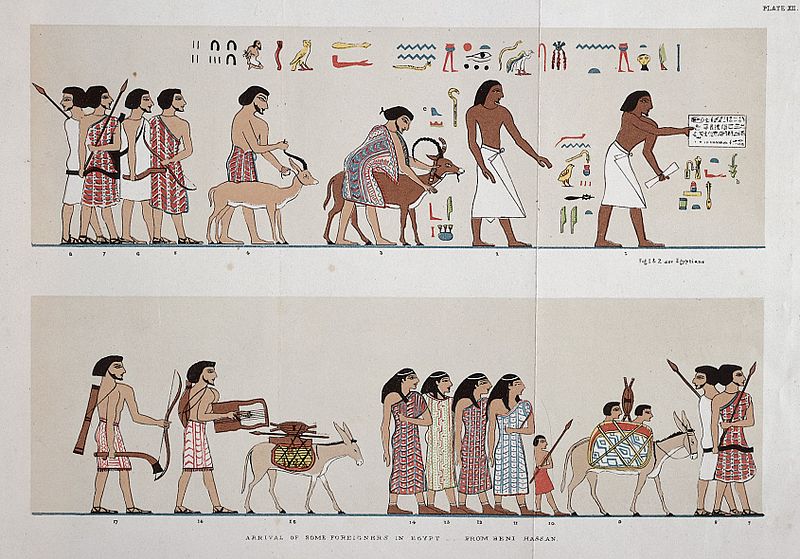
And then, there is more. At the cultural side, Jews refused to adopt certain elements of Egyptian society. The children and descendants of Israel kept the traditional Semitic dress, and did not adopt the Egyptian dress code. Most likely Jewish men would have a short beard and special colored tunics The image we see below shows a Semitic family (the Egyptians were not Semites) that came from Canaan and we can clearly see the beards and tunics, as opposed to the shaven (or beardless) Egyptians with white tunics or skirts . The dress code of the descendants of Ya’aqob was significant enough to be visually distinguished from the non-Jews.
Our Sages also explained that Jews did not change their Hebrew names for Egyptian names. Thus, even when a Jew was not present or seen, if someone mentioned “Levi” or “Shimon” they knew that they were referring to a Jewish individual.
Finally, they did not change their language. This means that parents spoke Hebrew at their house and teachers probably spoke Hebrew in the schools. And perhaps, if the Jews mother language was Hebrew, when they spoke Egyptian they spoke it with a “Hebrew accent”.
EGYPT, SEEN FROM CHINA
Regarding the origin of these thee elements, my son David, who was a Rabbi in the Sepharadic synagogue in Shanghai (China), shared with me his Chiddush. He told me that these three elements were mentioned by the Tora in the story of Yosef, when forcibly he had to become part of Egyptian society. The very first thing that Egyptians did to Yosef when he was taking out of prison was shaving him and dress him like an Egyptian. Then, the Egyptians changed his Hebrew name”Yosef” for an Egyptian name, “Tsafenat Pa’aneah” (the decipherer of the occult). And finally, we also witness that Yosef embraces the Egyptian language as his first language, since when he communicated with his brothers, before revealing his true identity, he did so through an interpreter. I do not think it is coincidence that these same three elements have been identified by our Sages (or perhaps by Yosef hismlef!) as key elements that lead to or accelerate the process of assimilation of a human group into its new home.
LEARNING FROM THE PAST
Summarizing and thinking about our present reality, we learn that 3500 years ago our ancestors did every possible effort to avoid assimilation by having their own Jewish education system; maintaining a very strong connection with the land of Israel; living in community; working in jobs with limited interaction with Egyptians; wearing something that indicated that they were Jewish (similar, for example, to a Kippa today); maintaining their Hebrew names and learning and speaking Hebrew: the language of Abraham, Yitshaq and Ya’aqob. .
A new king arose over Egypt, who did not recognize Joseph. Shemot, Exodus, 1:8
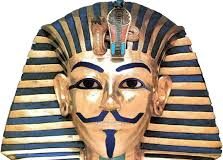
We have already explained (Exodus 1: 7) that after two or three generations of arriving in Egypt, the Jews born there began to feel at home: the first thing they did was to leave their community, Goshen, and venture into Egyptian territory looking for new economic opportunities (see here). The next verse tells us how the situation of the Jews began to get worse. Exodus 1: 8 says, “And then a new king arose in Egypt, who did not recognize Yosef.” A NEW DYNASTY There were two ways to become a new Pharaoh in Egypt: inheriting the throne from the father (or grandfather), or leading a coup against the monarch on duty. Everything seems to indicate that in this case it was the latter, a military revolt that produced a new dynasty, something not uncommon in Egypt. As usual in these cases, the allies of the previous government are now the enemies of the government in power. The Jews enjoyed a privileged position with the Pharaoh of Yosef’s time. This new King, however, “did not recognize” Yosef. This is not to say that he had never heard of him: Yosef was extremely famous. He saved Egypt’s economy with his prophetic predictions of the famine years and served Egypt loyally. The Egyptians deeply thanked Yosef for saving their lives and giving them food and seeds to plant. Yosef was a national hero. But now the new Pharaoh decides to rewrite history and sentence Yosef not to oblivion but to disgrace. Why? THE NEED FOR AN ENEMY The Italian philosopher Umberto Eco explained in his essay “Building an enemy” that for many rulers, especially dictators, an enemy, real or imagined, is an essential necessity. It serves the dictator to consolidate his power by creating a feeling of national unity based on hatred for a common foe. The enemy will be blamed for all the ills of the state. Which will serve the tyrant as a perfect distraction from internal problems that he cannot solve. For centuries, humanity’s favorite enemy has been the Jewish people. And this phenomenon, which still persists — for example, in the United Nations’ obsession against Israel — was born in Egypt. The new Pharaoh redefined Yosef and his descendants as “enemies of the people.” And for a long time I asked myself how did it happen? Was it possible to rewrite history, erase the national memory of a people and turn heroes into villains? NOTHING NEW UNDER THE SUN I’ve seen some similarities between what happened with Yosef and some events that took place in America during recent months. There are some extremist groups in the United States who are dedicated, among other things, to erasing the historical memory of this country, by demonizing “national heroes.” Take, for example, Thomas Jefferson (1743-1826), one of the Founding Fathers of the United States; who served as the third president of this country, and was, among other things, the main author of the Declaration of Independence and a defender of democracy and individual rights. But since he was a slave owner, which in those days was the accepted norm, he is criticized and demonized as if he “would own slaves today, in 2021”. Or Abraham Lincoln (1809-1865), the president who put an end to slavery in the United States! The statues of these heroes have been destroyed or vandalized. Schools that bear their names will be renamed. And the same is happening with Christopher Columbus, George Washington, Benjamin Franklin, or in England with Captain James Cook and others. These radical revisionist are trying to rewrite history in an anachronistic way, based on a political agenda, turning the heroes of the past into the new villains of the present. A MIDRASH AND CURRENT EVENTS Despite the obvious differences what one sees today sheds light on what happened then. It gets clearer for me to understand what transpired in Egypt, and what were the tactics Pharaoh used to “demonize” Yosef and make believe the Egyptians that all their problems were caused by him. And that now his descendants will have to pay for it! The Midrash Tanchuma presents an opinion that seems surreal for its unbelievable contemporaneity. It says the new Pharaoh “had Yosef’s remains unearthed from his luxurious tomb and thrown into the Nile, as a show of contempt on the part of the new Egyptian ruler for the great Jewish leader.” The Tora is not a collection of ancient myths or stories. Some times the present helps us to better understand the Tora; and the Tora allows us to better analyze and grasp present events, showing us patterns of behavior from the past that we can identify even today.
In this picture you can see Semites, probably Hebrews, arriving to Egypt. The difference between their clothing and the Egyptian clothing is very clear and very visual
Antisemitism Began In Egypt
ויאמר אל עמו הנה עם בני ישראל רב ועצום ממנו הבה נתחכמה לו פן ירבה והיה כי תקראנה מלחמה ונוסף גם הוא על שנאינו ונלחם בנו ועלה מן הארץ In two fundamental and extremely condensed passages, the Tora describes Pharaoh’s idea of the final solution: to exterminate the Jews. Pharaoh had in mind a four-steps plan: (וירעו אותנו המצרים ויענונו) 1. Demonization and defamation of the Jews. 2. Debilitating the Jews. Taken their assets. Imposing on them taxes as foreigners. 3. Enslavement of the Jews. 4. Extermination of the Jews We will refer now to the first part of Pharaoh’s plan: anti-Semitic defamation.
CHANGE OF GOVERNMENT
Some time after Yosef’s death, there was a change of government in Egypt, a coup d’état. A new dynasty of Pharaohs, who took over the government by force. As it commonly happens in politics, the new Pharaoh was antagonistic to the friends of the previous Pharaoh, his enemy. And that included the people of Israel, friends of the former Pharaoh, because they were always faithful to the Pharaoh in government. To justify his animosity toward the Jews and enlist the people against the Jews, Pharaoh rewrote Egyptian history and presented Yosef as a tyrant, that enslaved the people and benefitted his own family, giving them the best lands of Egypt. The attitude of this new Pharaoh, blaming the past administration for the present crisis, or creating imaginary enemy as a political distraction, is not the exception but the most common law of the land in politics, ancient and modern. Pharaoh must have to have invested a lot of resources in his revisionist endeavor, because Yosef, the most prominent member of the Jewish people in Egypt, was a national hero who saved Egypt from a tremendous famine. In the end Pharaoh succeeded in his campaign of hatred and in characterizing Jews as abusers, xenophobes and traitors. Very briefly, but with chilling precision, the Tora records Pharaoh’s speech. What is terrifying about this speech is that, in some incredible way, its arguments are still the usual repertoire of modern anti-Semites
Let’s see: ויאמר אל עמו הנה עם בני ישראל רב ועצום ממנו Exodus 1:9 “and [Pharaoh] said to his people: “There is a people [among us], the children of Israel, who are more numerous and stronger than us”.DEMAGOGYAnd [Pharaoh] said to his people.
Note that Pharaoh does NOT address his advisers or his cabinet, as a normal King usually does, or as he himself did on other occasions, for example, during the plagues. In this speech Pharaoh speaks directly to the people, something really uncommon. Why did he do that? Because he needed all possible leverage to change the Egyptians’ opinion of the Jews. The effect of this direct speech seemed to have been highly beneficial for his propaganda.
A SEPARATE PEOLE”And [Pharaoh] said to his people: There is a people [among us]: the children of Israel”. Although Jews lived in Goshen and followed their own traditions, they were not disloyal to Egypt. Pharaoh cynically mentions the isolation of the Jews (probably hinting to endogamy) to claim that Jews did NOT consider themselves part of the Egyptian society. These are the first seed he plants in people’s mind about Jews being xenophobic and elitist.
TOO MANY JEWS Then Pharaoh says that the Jews were too many. “They are more than us”. Pharaoh lies here, in the same way that modern anti-Semites systematically exaggerate the number of Jews in positions of power, political or finical, to show the world that Jews are a threat. Ironically, the only time the number of Jews is minimized by anti-Semites is when Jews are the victims. “In the Shoah only 1 million Jews died, the other 5 million is Jewish propaganda,” a modern anti-Semite would contend.
JEWS ARE RICH Pharaoh characterizes Jews as powerful and rich. And he repeats the anti-Semitic mantra: Jews are way richer than we are. In addition, if we see this Hebrew word more deeply but without twisting Hebrew semantics, Pharaoh is not only saying that Jews are richer than us , but is also hinting “the Jews got rich from us” (ממנו), that is to say: Jews became rich because they took our money! . Let’s see now the next verse
Pharaoh continues his hate speech: הבה נתחכמה לו פן ירבה והיה כי תקראנה מלחמה ונוסף גם הוא על שונאינו ונלחם בנו ועלה מן הארץ
EXODUS 1:10 “Let us be more clever than them, lest they keep multiplying and in case of war, they would join our enemies, fight against us, and we will have to leave the land. “JEWS ARE ASTUTELet us be more clever than them: Pharaoh indirectly suggest that the Jews are evilly intelligent, “cunning”. Insinuating that thru their shrewdness they exploited the Egyptians and took their money. The only way to deal with Jews is to be more cunning than them. Then he explains that now is payback time A time to recover form the Jews what is legitimately ours.
JEWS ARE DISLOYAL They will join our enemies.
And then comes Pharaohs punch line. The best known anti-Semitic accusation. “In the event of a war, Jews will betray us. They will join our enemies and fight against us”. This horrific demonization campaign, which the Tora exquisitely summarizes in only two verses, reached its goal. Two verses later, Exodus 1:12 we see the results. vayaqutsu “… the Egyptians felt contempt / hatred for the children of Israel.” Once the mind’s soil is sown with anti-Semitic propaganda the Egyptians are ready to accept the final solution. A few verses later Pharaoh discloses his endgame and orders a genocide. Exodus 1:16: “Kill the newborn males…but leave the female”. Eliminate the Jews, and at the same time, take their women. The hatred and defamation that we suffered (and continue to suffer) at the hands of Antisemites began in Egypt. Pharaoh’s speech and these false accusations, directly or indirectly, inspired the “The protocols of the sages of Zion” and all the anti-Jewish conspiracy theories until our own days . HaShem helped us and He rescued us from the hands of Pharaoh and his diabolical propaganda.
May HaShem continue to protect us from all those who rise up to defame, demonize and harm our people and our State of Israel.
DID ANTISEMITISM SAVE US FROM ASSIMILATION?
ובני ישראל פרו וישרצו וירבו ויעצמו במאוד מאוד ותמלא הארץ אותם
“And the children of Israel increased, and they multiplied profusely, they grew, and they became very, very powerful. And the land was filled with them ”.
I confess that I’ve always read this verse in a different way than I am reading this year. I understood this text like this: The Jews in Egypt had grown to the point of becoming a demographic threat to the Egyptians. “And the earth was filled with them”, means that the Egyptians noticed the Jewish presence everywhere. The text itself does not praise the Jews for their impressive economic achievements, but neither does it appear to criticize them. The text only mentions the facts and explains why Pharaoh decides to put an end to the growth of the Jews. Let me now present an alternative reading of this text, especially the last words, and a slightly different conclusion.
LIVING OUTSIDE A COMMUNITY The text begins by describing the demographic explosion and the success of the Jews (= they grew) and then it explains what the Jews did once they succeeded. When they arrived in Egypt, Jews were living voluntarily secluded in the land of Goshen. They were a society of privileged foreigners. But now, probably 60 , 70 years or two or three generations later, Egypt-born Jews no longer felt like foreigners, but as an integral part of the Egyptian people. And the ghetto was now too small for them! What the Tora tells us here is that the Jews left their territory, their community, their Jewish quarter and began to scatter throughout the country (“And the land, Egypt, was filled with them”), looking for more wealth, more power and more influence. The ethnic or social barriers that living in a community provides, protecting them from assimilation, were now an obstacle to their progress and economic development. It was the first time — but not the last — that assimilation began to take shape as a result of prosperity and success on the part of Jews who felt that they belonged into the Gentile society.
FORGETTING GOD While my (negative) reading of this text is a bit speculative, there are reasons to think that it may not be too wrong. Although in very different contexts, the Tora warns the Jewish people several times about the “risks” of material abundance. In the book of Debarim (Chapter 8: 11-14) when the Tora describes the abundance and wealth that the Jews will enjoy in the Promised Land, it says: “Be careful lest you forget HaShem your God and abandon His commandments… when you have eaten your fill and you have built beautiful houses to live in, and your cows and herds multiply and your silver and gold have increased, and when you have prospered in all that you possess … beware lest your heart grow arrogant and you forget HaShem your God, who delivered you from the land of Egypt…. ”. How does assimilation begin? First, by forgetting God. And when did they remember God? When they were suffering the horrors of slavery.
FORGETTING ISRAEL There is an additional element that might show the likelihood of this reading. That is, the remarkable silence of the Tora regarding the return of the people of Israel to their land. We all remember that Jacob’s children came to live temporarily (lagur) in Egypt: they were supposed to stay there until the situation improved, and then return to the land of Abraham Isaac and Jacob. In Egypt God blessed them with progeny and prosperity, and that should have motivated the children of Israel to return to Israel, reestablish themselves in their ancestor’s land as a consolidated people. But this verse seems to say that the Jews, who enjoyed a very high standard of living in Egypt, were very comfortable there and were looking to moving, not to Israel, but even deeper into the land of the Nile.
Understood in this way, this verse seems to express the concern that the Jewish people were at risk of losing their identity, their spirituality, and their willingness to return to Israel.
Ironically, but in a way that should not surprise us in 2021, it seems that the one thing that “saved the Jews from complete assimilation” was Egyptian antisemitism.
To be continued
ההעמק דבר
ותמלא הארץ אתם. מהם מיבעי וכן ת״א מנהון. אבל לשון המקרא אותם. בא ללמד דלא ארץ גושן לבד שהי׳ מיוחד לישראל ומלאה מישראל לבד. אלא אפילו כל א״מ שהי׳ עיקר ישיבת עם מצרים מ״מ מלאה הארץ את ישראל. ומשמעות אותם עמם. כמש״כ בספר ויקרא י״ז ה׳ עה״פ וזבחו זבחי שלמים לה׳ אותם. והיה כל מקום פנוי שמצאו ישראל לקנות ולדור נתישבו שמה. והיינו דכתיב במכת בכורות ופסח ה׳ על הפתח הרי שהיו הרבה בתי ישראל בקרב בתי מצרים. ואע״ג שיבואר להלן ב׳ כ״ה וג׳ ז׳ שפרעה נגש לישראל ולחצם לדור במיצר כדי להשפיל דעתם. מ״מ הי׳ באופן שנשארו בקרב ערי מצרים בין בתיהם. ובא הכתוב להקדים בזה סיבת שנאת מצרים וגזרת המלכות. ומחשבת חשד מה שלא עלה ע״ד ישראל. כ״ז בא משום שבקשו לצאת מרצון יעקב אביהם שישבו דוקא בארץ גושן כדי שיהיו בדד ונבדל ממצרים כמש״כ בפ׳ ויגש. אבל הם לא רצו כן. ובש״ר איתא עוד שפסקו למול מזה הטעם שאמרו נהיה כמצרים. דאחר שקבעו דירתם בקרבם מצאו טוב להם להשתוות למצרים ולא יהיו ניכרים שהמה יהודים. ומשום זה ביאר המדרש שהפך ה׳ לבם לשנוא עמו. וכבר ביארנו בס׳ בראשית עה״פ כי גר יהיה זרעך וגו׳ אשר היא הסבה שבכל דור ודור עומדים עלינו לכלותנו בשביל שאין אנו רוצים להיות כגרים ונבדלים מן האומות:
From Prosperity to Slavery
PHASE 1: Forced labor
EXODUS 1:11 Then the Egyptians assigned over them taskmasters to weaken them with hard work. And the Jews built for Pharaoh the fortified cities of Pitom and Ramses.
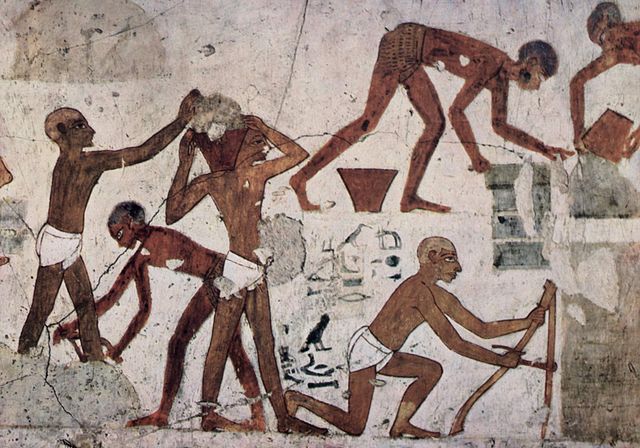
In the first phase of Pharaoh’s “final solution”, the people of Israel were not yet technically enslaved by Pharaoh. In fact, in Exodus Chapter 1:11-12, the word “slavery” or “enslavement” is not mentioned in the text. However, the text emphasizes the word “taxes”. The Israelites indeed worked for Pharaoh, building Pitom and Ramses. But at this point, this form of forced labor was a legal and legitimate procedure. The Egyptian monarch– ironically since the time of Yosef– was the Lord and Master of all Egyptians, Jews included. Pharaoh, therefore, had the absolute right to demand from his subjects any kind of service: joining the army to defend his territories, or working on the construction projects that the sovereign deemed necessary. As we saw in Pharaoh’s speech, Jews were foreigners, and were not trusted by the Egyptians; therefore they had to contribute with labor in lieu of, for example, serving in the Egyptian army. In this first phase, the work of the Jews consisted in building the cities of Pitom and Ramses, which according to the most accepted interpretation, were fortifications for military use- garrison cities. These fortifications were not built with common mud-bricks as houses or temples were, rather they were built with carved stones. We could asume that Jews worked in the quarries extracting the rocks, carving them, carrying the heavy stones, and mounting them on top of each-other.
We also need to keep in mind that, although taxing the Jews was seemingly a completely legal act, the true ultimate purpose behind this forced labor was not the building of the garrison cities. When Pharaoh delivered his infamous speech (Exodus 1: 9-10) warning his people about the threat that Jews represented to Egypt due to their increasing growth and wealth, he proposed a strategic plan to outsmart (הבה נתחכמה לו) and weaken the Jews both physically and financially. Forcing them to work in construction and abandon their own jobs; as well as forcing them to sleep in the fields far from home, would do the job. In this sophisticated, non-violent way, the power and the birth-rate of the Jews would be significantly reduced.
However, as the Tora explicitly says in the following verse, Pharaoh’s plan did not produce the expected results.
EXODUS 1:12. But the more they oppressed [the Jews] the more the Jews multiplied and grew. And the Egyptians felt threatened by the children of Israel.
Pharaoh’s plan failed. The people of Israel did not become weaker, rather they grew stronger, and continued to reproduce. It is at this point that Pharaoh decides to start Phase 2 of his plan: slavery.
EXODUS 1:13 And then the Egyptians enslaved the children of Israel with chattel (parekh).
CHATTEL SLAVERY
Here for the first time our text mentions “enslavement”, vaya’abidu, redefined with a crucial word: “parekh”, meaning “chattel slavery”. That is, unconditional and indefinite submission of the slave to the master.
To better understand this phase let us remember that in the first phase, “forced labor”, Jews had to fulfill an assigned mission: building Pharaoh’s projects. I believe that at this point Jews did not necessarily have to work directly for Pharaoh. Surely, they had to pay for the building material, but perhaps they were allowed to hire workers to do these constructions for them. And more importantly, once the building project was finished, they could return to their lives and routine.
However, in the second stage, “parekh” the Israelites were not assigned a specific job. We see that the Egyptians were intimidated by the Jews, therefore it would not have been difficult for Pharaoh to declare them as “the enemies” of Egypt. Jews were probably captured and taken as war prisoners —probably chained— and forced to work endlessly for the Egyptians- 24 hours a day. They were now at the complete mercy of their masters, who controlled their lives.
Visualizing this scenario is very difficult to do in our comfortable lives nowadays. I was only able to think more realistically about this by remembering what I know from the Shoah. The first time I read a comparison between Egyptian slavery and the Holocaust was in Elie Wiesel’s book, “Job: Ou Dieu dans la tempête” (French). Following Wiesels line of thought, I imagine that at this second phase; the houses, property and assets of the Jews were confiscated by the government, and handed over to Pharaoh or to the common Egyptian man. Jewish men, women and children, must have been forcibly captured and removed from their homes and taken into “ghettos” or fortifications. Similar to the European Jews in 1940. But instead of being taken into labor camps, many of them were probably given over to the Egyptian civilians as free laborers. This fact- not very well known- that the Jews were handed over to the Egyptians, was mentioned by Rabbi Wisser, the Malbim (Russia, 1809 – 1879). He explains the word “Egypt”, Mitzrayim, mentioned in this verse: “And the Egyptians enslaved the children of Israel.” In other words, similar to how Daniel Goldhagen describers in his book “Hitler’s Willing Executioners”, ordinary Egyptian civilians were accomplices of Pharaoh’s regime. The Malbim writes: “ Jews were taken as chattel slaves, but they no longer worked for the monarch [the government], but for the population in general. The Israelites were now the slaves of the slaves [of Pharaoh] and were obligated to do any work that any Egyptian asked of them“.
Exodus 1:14: “And [the Egyptians] embittered the life [of the children and Israel, forcing them to do] the hardest works, [such as the extraction of the] mud and [the making of] the bricks …
This verse describes the special and brutal way which the Egyptians treated their Jewish slaves. The biblical text mentions here the word vayimareru, “and they embittered their lives”. From this Hebrew word comes the word “maror” the bitter herbs that we eat the night of the Pesach Seder to remember the bitterness of Egyptian slavery. But what was the source of this animosity? A Master usually takes care of his or her slave. For the sake of comparison, think about the African slaves taken into America in the 18th and 19th centuries. These slaves were traded at a high price. The masters, indeed, exploited them in the cotton or tobacco plantations but they also took care of them. This was not done out of compassion for the slaves, rather out of the master’s convenience. Taking care of the slaves was similar to taking care of one’s assets . In some sense, the masters treated these slaves as well as they treated their animals.
But our text describes bitterness… there seem to be something personal about this mistreatment. One possible explanation is this: For several decades, from the time of Yosef until the new Egyptian dynasty that ruled over Egypt, Jews had a privileged life. They lived in a safe and fertile area, Goshen, where they enjoyed wealth and prosperity. And it is very possible that many wealthy Hebrews had Egyptian servants working for them! And remember that Pharaoh’s speech included the accusation that Jews gained their wealth from exploiting ordinary Egyptians! Now, Pharaoh is gifting the common Egyptians with Jewish slaves, their wealthy former masters. The resentment is now unleashed into the most terrible revenge: the “rich” Jews were now absolutely vulnerable, free laborers beneath their feet of resentful Egyptians.
THE HARDEST JOBS
The enslavement of the Jews in Egypt was not the classic type of slavery in which the master buys and sells slaves in the market. Jews were treated like enemies, and potential traitors who would be willing to join the enemy in the event of a war. The Egyptians must have felt therefore that their job was not only to take revenge. Jews, ultimately, had to be eliminated. How could they do that? Our text briefly mentions that the Egyptians assigned the Jews to the most unhealthy and risky jobs. Tasks that nobody else in Egypt was willing to do. The example mentioned in the Tora is “chomer ulbenim”, mud and bricks. Probably the most exhausting and lethal job in Egypt. These mud-bricks were made by mixing the mud with the Nile’s silt, and perhaps with manure, stirring it with their hands and feet for 4 or 5 days, until the it reaches the point of fermentation. Then, the straw is mixed into this mud to make the bricks stronger, more solid and durable. All this work was done in the swamps of the Nile, a river infested with crocodiles, hippos, mosquitoes; and under a scorching desert sun that burned the skin.
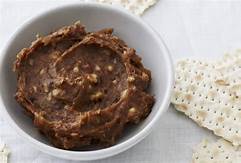
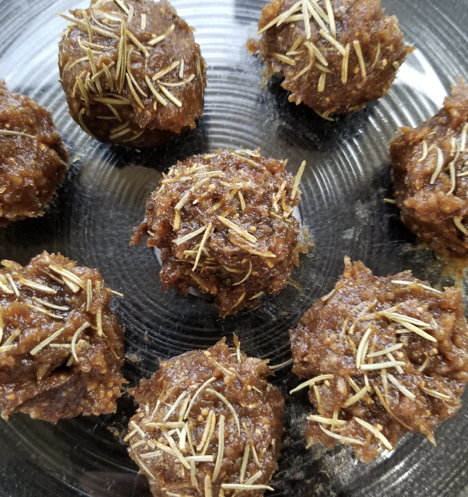
Maimonides explains that the Sages introduced the Mitsva of Charoset to bring to memory these terrible times. The brown paste recalls the color and texture of the mud. The vinegar the bitterness or tears. And the tebalin, edible herbs or spices , cut in thin and long pieces, which were part of Maimonides’ Charoset recipe, remind us visually of the straw mixed in the mud, a national memory of a slavery that we can not forget.
GENOCIDE
Understanding the nature of what the Charoset represents (the mud-bricks) is key to comprehend the ultimate goal of our slavery in Egypt. Same as in the Europe of the Shoah, in Egypt, we were treated as enemies. A Jewish life in Egypt, like in Europe, had no value. Not even labor value. Jewish slavery in Egypt can only be understood when thinking about concentration camps. Those who were not killed upon arrival had to work endlessly. In those camps there were no infirmaries to care of the sick or wounded laborers. If they got sick they were executed, or left to die. And were then replaced by the next prisoner. In Egypt and in Germany, there was an endless supply of Jewish workers. Jews were absolutely disposable.
The prisoners were “used” as free laborers until they died of hunger, disease or exhaustion. Jewish prisoners were deliberately subjected to the most dangerous and unhealthy jobs, such as the extraction of slit from the Nile or coal from the Mauthausen mines. Because for Germans as well as for Egyptians, the aim was not the product of the Jew’s labor. The ultimate goal was the final solution. This type of labor with purpose to kill has a unique name in Hebrew: “abodat parekh”, and it has a unique name in German: Vernichtung durch Arbeit, “extermination through work”, an expression that to the best of my knowledge, was used exclusively to describe the practice of the Nazi’s in concentration camps, killing the Jewish prisoners by means of forced labor.
Pesach Through The Haroset
The multiple symbols of the Haroset
תחת התפוח עוררתיך. דרש רב עוירא, בשכר נשים צדקניות שהיו באותו הדור נגאל ישראל ממצרים
Sota 11a
One of the foods that we serve in the Pesah Seder is the Haroset. A paste typically made with a mixture of fresh fruits, nuts and wine.
Unlike other foods that are served during the Seder, such as the Maror or the Matza, the Haroset is not mentioned in the Tora. The Mishna — the work that records the oral tradition of the Jewish people, written around the year 200 of the common era — indicates that the Haroset should be served at the Seder table, but it does not indicate what the function of the Haroset is.
This is not uncommon: many times a tradition, or even a Mitzva from the Rabbis (midibre soferim), was widely practiced, while the reason for that Mitzva was lost or forgotten, and the rabbis of the Talmud attempted to rediscover the original reason again.
HAROSET AS AN ACCESSORY
The Rabbis debated the reason of the Haroset. According to some opinions the Haroset is not a Mitsva per se but an accessory to the bitter herbs or Maror. The Talmud records five different herbs, like lettuce, that could be consumed as Maror to remember the bitter flavor of slavery. Some of these plants contained an acid that could be harmful for digestion (geonim). Some Sages explained that the Maror was dipped in the Haroset in order to neutralize the harmful effects of the acid. According to another opinion, one of the herbs that can be used for Maror (chazeret) contained a worm, that the Haroset was able to eliminate.
A TRIBUTE TO JEWISH WIVES
According to Ribbi Eliezer bar Ribbi Tsadoq the Haroset, although eaten with the Maror, is not a mere accessory to alleviate the effects of the Maror but a mandatory food (mitsva) to have at the Seder. And as such, the Haroset has “a meaning in its own”. The Haroset, Ribbi Elazar said, usually prepared with apples, reminds us of a very significant event. Pharaoh decreed the death of all newborn Jewish children. But this did not discourage the heroic women of Israel to be with their husbands and become pregnant. At the time of delivery, the Jewish mothers would go to the apple fields and give birth hidden “under the apple trees”. Miraculously, the Midrash explains, God mitigated their pain at the time of giving birth and the Egyptians guards did not hear the crying babies. According to this opinion, the Haroset is a tribute and a reminder to the women of Israel who acted with bravery and heroism. Thanks to their wisdom and sacrifice, the Jewish people grew stronger instead of “disappearing” for lack of procreation, as Pharaoh intended.
HAROSET and the BRIKCS
Another opinion, the best known and the most accepted, is that the Haroset represents the mud (טיט) that every day Jewish slaves had to gather with their hands to produce the bricks, used for the construction’s projects of Pharaoh. This was a very arduous and humiliating. The images of our hands and feet soaked in the mud, are part of the collective memories of our people. A reminder of the slavery and oppression we suffered for more than a century. Maimonides echoes this last opinion. And thus, in his recipe for Haroset he does not include “apples” as one of the required ingredients. What Maimonides does say is that the Haroset paste should be made with tebalin, herbs, to visually represent the straws that were added into the mud in the process of building the mud-bricks.
JEWISH BLOOD
There is also an opinion in the Talmud of Yerushalayim that says that the Haroset symbolize the blood of Jewish children killed by Pharaoh and his proxies. This idea was mentioned by Rabbi Moshe Isserles (Ram”a, 1530-1572) as the reason for the Ashkenazi custom of adding red wine to the Haroset. It is possible to connect all these above mentioned reasons (procreation; the making of bricks, and the killing of Jewish children) recalling a tragic Midrash (which in a post-Shoa time, I see no reason for not to taking it in its literal sense) that says that when a Jewish slave did not produce his due quota of bricks, the Egyptians would take one of his children and replaced the missing bricks with his or her little body.
THE VISUAL EFFECT OF THE HAROSET
To understand the original meaning of the Haroset, and its profound educational value, we will have to forget for a few moments the recipe of our own Haroset, and focus our attention on the three basic ingredients indicated by the Sages.
When Maimonides mentions the Haroset he says first that we prepare a paste with figs, dates, raisins or similar fruits. These soft fruits (or softened with cooking) are mushed, and then mixed with vinegar. And to this paste we then add the tebalín, or herbs.
Now that we know what the three ingredients of the Haroset are – fruits, vinegar and herbs – we will try to understand the reason of each one of them.
FRUITS, FOR THE TEXTURE OF MUD
Maimonides says (see text below) that the Haroset should remind us of the mud with which (or “in” which, as we shall see later) our fathers worked day and night, in the horrific Egyptian slavery. When you mush these fruits, part of that paste will surely remain in your hands. In a a similar way, the hands, feet and probably the entire body of the Hebrew slaves was never clean of mud. It always remain in their body. The fruits we use for the Haroset, dates, figs, etc. are soft and easy to mush, because the mission is to recreate a meal representing the mud (חרוסת זכר לטיט).
VINEGAR, FOR THE FLAVOR OF SLAVERY
The Sages also indicated that sourness should be perceived in the flavor of Haroset. That’s why in the original recipe vinegar, and not wine, is added to the Haroset. The sour taste of vinegar, obviously, is reminiscent of the bitter taste of our slavery, something that is explicitly mentioned in the Tora (וימררו את חייהם “And the Egyptians made the life of the Jewish slaves bitter…”. It is interesting to notice that originally, in the Talmud, the sweet taste of Haroset is not emphasized, although it is recognized as the expected flavor of a paste made from the mentioned fruits, which are sweet. Actually the rabbis emphasized that we should not be used too much Haroset to dip the Maror, the bitter herb, in it so that the sweetness of the Haroset does not neutralize its flavor.
HERBS (TEBALIN) FOR THE VISUAL MEMORIES OF SLAVERY
The least known ingredient of the Haroset is the one that Maimonides calls tebalin, that is, herbs. Herbs are generally used as aromatic additives or flavorings, sometimes they are mentioned as tablinín, spices. But in the specific case of the Haroset, Maimonides indicates that the herbs should not be ground or cut into small pieces, as is usually done when one uses spices for cooking. The best Kept secret of the Haroset is to introduce in it pieces of herbs that would resemble the “straw” (in Hebrew teben) that was used with the mud to produce there mud-bricks. The purpose of the tebalín, then, is not to add flavor or aroma to the Haroset, but to recreate a visual effect: “mud with straw” (טיט ותבן). The presence of the herbs / tebalin, is then essential to recreate the symbolic meaning of the Haroset. On this point the Talmud does not register any debate. To the extent that the Gemara in Pesahim relates (see text above) that when people came to the markets to shop for Pesah, the traders of Jerusalem announced: “Come and take (for free) the herbs to fulfill the mitzva [rabbinic commandment of Haroset]”
THE FUNCTION OF THE TEBALIN
Since the effect of these herbs must be visual, there is no specific indication as to what type of herbs or vegetables to be used. Some rabbis mentioned cinnamon, ginger, or hyssop twigs, but making it clear that they should not be powdered but cut into pieces. The Maharil (136-1427) was perhaps the most explicit, saying that herbs or spices should be cut into long, thin pieces (מחותכין ארוכין) to represent the “straw”.
Nowadays, for some reason (that I still ignore) almost all recipes of Haroset include ground spices an/or aromatic herbs and the visual effect that the Haroset must awake in our memory has fallen into oblivion.
HOW DID MAIMONIDES USE HAROSET IN THE SEDER?
Imagine a formal dinner in an upscale restaurant. The table will include the customary condiments: salt, pepper, and perhaps some olive oil. Now imagine Maimonides’ table for the Pesah Seder. On his table, there is ONE element that literally replaces “all” other condiments and dressings that night: Haroset, the exclusive dip meant to accompany all the symbolic foods that we consume on the Seder night. The Haroset is “bittersweet” condiment or dressing. And “bittersweet” is also what best defines the general flavor of the Seder. On the one hand, we remember and reenact the bitter memories of the slavery, oppression and genocide that we suffered in Egypt. And on the other hand, we also celebrate our freedom. Each of the elements of the Seder meal represents either a gesture of joy and freedom or a gesture of pain. The bittersweet Haroset is special in that it simultaneously represents the two.
Let us examine how and when the Haroset is consumed at the Pesah Seder according to Maimonides:
KARPAS WITH HAROSET
After inaugurating the Pesah Seder with the Kiddush, the first thing we eat is a piece of Karpas, or celery. In ancient times, it was common for a festive dinner to begin with an aperitif (celery or other fresh vegetables) before serving the main dish in order to stimulate the appetite. Now, the general custom in the Seder is to dip the karpas in vinegar (or water with salt) to remind us of the bitter tears that we shed in our Egyptian captivity. According to Maimonides, however, the karpas should be dipped in the Haroset! Anyways, remember that for Maimonides’ Haroset recipe included a significant amount of vinegar, which gave his Haroset an acidic flavor.
MATSA WITH HAROSET
The second time Haroset is used, as per Maimonides, is when we recite the blessing for the Matsa (Motsi-Matsa). We dip the Matsa in the Haroset instead of using salt as we usually do when we say haMotsi for bread. This gesture reminds me of a beautiful custom that is practiced in some families during Rosh haShana: to express our wishes for a good and sweet year, when saying haMotsi, the bread is dipped in honey or sugar instead of salt. However, while dipping the bread in honey or sugar in Rosh haShana is a popular tradition or folklore, the dipping of the Matsa in the Haroset, for Maimonides, is a formal, practically an “halakhic”, requirement.
MAROR WITH (A LITTLE BIT OF) HAROSET
Nowadays, the Haroset is used firstly to dip the Maror, the bitter herb. In this case, the rabbis indicate that the amount of the Haroset should be minimal, so that the flavor of the Haroset does not deprive us of experiencing the bitter taste of the Maror. Some rabbis wrote that after dipping the Maror in the Haroset, the Haroset must be removed from the Maror so that only a superficial layer remains on it. Maimonides clarifies that in this case, when spreading the Maror with Haroset, we are fulfilling a rabbinic precept, although we do not say a specific blessing for it. According to some opinions, this is because of the rulings of iqar and tafel, which determine that we say blessings on the main food -in this case, the Maror (‘al akhilat maror) as opposed to its accessories– in this case, the Haroset.
MATSA AND MAROR WITH HAROSET
Finally the Haroset is also added to the Korekh, the sandwich of Matsa and Maror that reminds us of the qorban pesah, the lamb that was consumed during the Seder of Pesah with Matsa and Maror in the times of the Bet haMiqdash. As in the case of the Maror, the use of the Haroset in the Korekh is also practiced by all the Jewish communities. As we already explained, the Haroset is not mentioned in the Tora, and is rather a ritual food related to the Pesah Seder which was established by the rabbis. The Haroset carries a tremendous meaning in its taste, its texture and its looks, and it conveys a very tangible representation of the slavery we want to remember in the Seder.
MY MAIMONIDEAN HAROSET
Dedicated to my Monday Night class students
Usually, I’m not allowed into the kitchen a few days before Pesach… But this year (2019) I wanted to prepare a Haroset that would resemble the new recipe I learned from reading Maimonides a little more seriously than previous years.
According to Maimonides, the Haroset is made with dry fruits (figs, dates, or raisins) and wine vinegar and tebalin. The color and texture of mud, a sour flavor , and “tebalin”, an herb or a spice that looks like straw.
Following Maimonides I prepared without any difficulties a paste with dry dates, dry figs, and vinegar.
Then, the most challenging element to figure out was the tebalin. Something to be put into the Haroset that would visually resemble the “teben” or straw.
I went shopping. Looking for something long that would resemble straws. Following the advise of my wife, Coty, I went to a Chinese supermarket. I checked alfalfa and other exotic sprouts. Then, I thought “eureka” , I found the “straws”: Kosher certified “Japanese Enoki Mushrooms”: long, white and thin. Perfect for the visual effects. I bought a small bag. But my wife wasn’t happy with Japanese mushrooms in the Seder. I had to pick a side between my wife and Maimonides…
And then, I went to “Everfresh” to look for an alternative. Cinnamon sticks, perfect shape , but too dark, too similar to the color of the Charoset. And we need the special effects of the contrasting colors of mud and straw. I looked into other staff like orange dry peels, but they were too short. “Frozen Zucchini Spirals”, but they too much like spaghetti. Lemon-grass was my next choice. Or lavender branches. They looked cute but not perfect. It should be something edible, she reminded me.
I came home with a few items: edible, non edible, frozen and i was still, undecided what I could use. Then, a small miracle happened! Coty brought me a small package of Rosemary Leaves to check if they were Kosher for Pesach. And when I was looking at them, I had a “vision”. Rosemary leaves are short, that’s why i would not have considered them in the first place. But their color is perfect. Light, between white and yellow. They were herbs like Maimonides required, and not Japanese mushrooms, and they were edible, like my wife required. As I’m looking as these leaves and how not to get them inside the Haroset I had an epiphany: I visualize the Moroccan Charoset, prepared with the shape of small balls, the size of falafel or meatballs. In my vision, I saw the rosemary leaves mixed with the Haroset balls. And I saw the mud with the straws!
And this is what I got.
This year, BH, I will do my best not just to remember but to “feel” the hardship of our captivity in Egypt, with the help of my experimental Maimonides’ Haroset.
In this image you can on the left side a picture of mud mixed with straw, used for mud-bricks, and on the right side a picture of the Charoset I made following Maimonides recipe to visually represent our slavery in Egypt (I used Rosemary’s leaves).
PESACH: Egyptian Slavery and Europe’s Concentration Camps
EXODUS 1:11
Then the Egyptians imposed [forced labor on the Jews] and taskmasters to [force them to work] and weaken them with hard labor. And the Jews built for Pharaoh the fortified cities of Pithom and Ramses.
TAXES
In the first phase of Pharaoh’s “final solution,” the people of Israel were not technically enslaved by Pharaoh. In fact, in Exodus 1:11–12, the word “slavery” or “captivity” is not mentioned. However, the Hebrew text emphasizes the word “taxes” (missim). Indeed, the Israelites worked for Pharaoh in the construction of Pithom and Ramses. But this form of forced labor was a legitimate legal procedure: it was a form of paying taxes to the government. Pharaoh, as sovereign, had the full right to demand from his subjects any service: joining the army to defend his territories or working on construction projects he deemed necessary. As we saw in Pharaoh’s speech, the Jews were considered foreigners; therefore, they had to contribute with labor instead of serving in the Egyptian army. In this first phase, the labor of the Jews consisted of building the cities of Pithom and Ramses, which, according to the most accepted interpretation, were military fortifications or garrison cities. These fortifications were not built with mud bricks but with hewn stones. We could assume that at this time, the Jews worked in the quarries extracting the rocks, carving them, and transporting the heavy stones for these fortifications. But although these taxes on foreigners were common, the purpose behind this forced labor aimed at the Jews was not lucrative: it was a genocidal plan, as we will analyze below.
GENOCIDE
When Pharaoh delivered his infamous speech (Exodus 1:9–10), warning his people about the seeming threat the Jews posed to Egypt, he proposed a strategic plan to (haba nitchakema lo) and weaken the Jews economically and demographically, forcing them to work in the construction of Pithom and Ramses and thereby making them abandon their jobs and sleep in the fields, far from their wives. In this sophisticated and non-violent way, the power and birth rate of the Jews would be significantly reduced. However, as the Torah explicitly states in the following verse, the Jews somehow managed to make Pharaoh’s plan not yield the expected results.
EXODUS 1:12
But the more [Pharaoh] oppressed them, [the Jews] the more they multiplied and grew. And the Egyptians felt threatened by the children of Israel.
Pharaoh’s plan failed. The people of Israel were not weakened but rather strengthened and continued reproducing and growing. At this point, Pharaoh decides to initiate Phase 2 of his plan: slavery.
EXODUS 1:13
And then the Egyptians enslaved the children of Israel with parekh.
For the first time, our text mentions “slavery,” vaya’abidu, followed by a crucial word: Parekh, which means “total slavery”, that is, the unconditional and indefinite submission of the slave to the master.
To better understand this phase, let us recall the previous phase: “taxes.” The Jews had to fulfill an assigned mission: building Pharaoh’s projects. Surely, they had to pay for the construction materials out of their own pockets, but they were probably allowed to hire workers to carry out these constructions for them. And more importantly, once the construction project was completed, they could return to their lives and routines.
However, in the second stage, parekh, the Israelites were not assigned a specific job, a construction project for Pharaoh. Now, they had to work as servants of the Egyptians! Pharaoh declared them “enemies of the people.” The Jews were captured, chained, and assigned to the Egyptians to work for them 24 hours a day. They were now completely at the mercy of their new Egyptian masters, who had total control over their lives.
PHARAOH’S WILLING EXECUTIONERS
Visualizing this scenario is very difficult from the comfort of our modern and prosperous lives. I could only think more realistically about this type of slavery by recalling the Shoah. The first time I read a comparison between Egyptian slavery and the Holocaust was in Elie Wiesel’s book, Job: Ou Dieu dans la tempête. Following Wiesel’s line of thought, in this second phase, the homes, properties, and goods of the Jews were confiscated by the government and handed over to Pharaoh. The Jewish men, women, and children were forcibly captured, taken from their homes, humiliated, and brought to “ghettos,” similar to European Jews in 1940. But then, instead of being taken to concentration camps, they were handed over to Egyptian civilians to be used as free labor. This little-known idea — that in this stage, the Jews did not work for the government but were handed over by the government to common Egyptians — was mentioned by Rabbi Meir Wisser, the Malbim (Russia, 1809–1879). He explains the word ”Mitzrayim,” mentioned in verse, not as “Egypt”, i.e., the Egyptian government, but as the genitive “Egyptians”: “And the ordinary Egyptians enslaved the children of Israel.” In other words, similar to what Daniel Goldhagen describes in his book Hitler’s Willing Executioners, ordinary Egyptian civilians were complicit in Pharaoh’s regime. The Malbim writes: “The Jews were taken as slaves, but no longer worked for the monarch [the government], but for the general population. The Israelites were now the slaves of the slaves [of Pharaoh] and were obliged to do any work that any Egyptian requested.”
EXODUS 1:14
“And [the Egyptians] embittered the lives [of the children of Israel, forcing them to do] the hardest labor, [like extracting] mud and [making] bricks…”
This verse describes the sadistic and brutal way the Egyptians treated their Jewish slaves. The biblical text mentions here the word vayimareru, “and they embittered their lives.” From this Hebrew word comes the word maror, the bitter herbs we eat on the night of the Pesach Seder to remember the bitterness of Egyptian slavery. But what was the source of this animosity against Jews? A master usually takes good care of his slave. The African slaves brought to America in the 18th and 19th centuries, for example, were traded at a high price. And the masters, although they exploited them in the cotton and tobacco plantations, also took good care of them. If not out of compassion, they did it out of convenience. Caring for slaves was like caring for one’s own assets: masters treated their slaves at least with the same care they treated their animals.
WORK TO DEATH!
However, the Jews in Egypt were treated differently, with “bitterness,”“resentment,” and “hatred.” There was something counterintuitive and personal in this mistreatment. One possible explanation is this: for several decades, from the time of Yosef until the new dynasty that ruled Egypt, the Jews lived a privileged life. They lived in a safe and fertile area, Goshen, where they enjoyed wealth and prosperity. And it’s even possible that many Jews had Egyptian servants working for them. Now, Jews were accused by the Pharaoh of having obtained their wealth by exploiting the ordinary Egyptians (ran veatsum mimenu). Now, Pharaoh gives the Egyptians Jewish slaves —perhaps their former prosperous masters! For the Egyptians, it seems, it was a moment of payback and revenge: the Jews were now absolutely at the mercy of their resentful Egyptian masters, who aimed to embitter their lives and make them suffer, torturing them physically and psychologically.
THE MOST UNSANITARY JOBS
The slavery of the Jews in Egypt was not a classic market slavery. The Jews were not treated with the deference given to assets or animals but as hostile and treacherous foreigners. The Egyptians must have felt that their mission was to take revenge on the Jews and make them suffer while they worked for them. The Jews were portrayed as the enemies of the people and eventually had to be eliminated. How to do that? Our text briefly mentions that the Egyptians assigned the Jews the most hazardous and deadly work, tasks that no one else in Egypt was willing to do. The examples mentioned in the Torah are chomer ulbenim, mud and bricks. Probably one of the most exhausting and dangerous work to be done in Egypt. Mud bricks or adobe were produced by mixing mud with silt, which was extracted from the bottom of the Nile River and dung. Silt clings to the skin and is very hard to remove. That mixture was stirred with hands and feet for 4 or 5 days until it reached the point of fermentation. Then, straw was added to that mixture so the bricks would be stronger, more solid, and more durable. All this work was done in the swamps of the Nile, infested with crocodiles, hippos, mosquitoes, etc., and under the scorching sun that burns the skin.
Maimonides explains that the Sages introduced the Mitsva of Charoset at the Pesach Seder to bring to memory these traumatic, unforgettable images. The brown paste recalls the color and texture of the silt and mud, the vinegar, the bitterness, or the tears we shed in our captivity. And the tebalin, edible herbs or spices cut into thin and long pieces that were part of the original recipe of our Sages’ Charoset — brings to visual memory the straw mixed with the mud. That labor became a trauma we will never forget.
THE EGYPTIAN SHOAH
The ultimate goal of Egyptian slavery, abodat parekh was the same as that of the European Shoah. The life of a Jew in Egypt, as in 1940’s Europe, had no value whatsoever. Not even the value of labor. Jewish slaves in Egypt were like prisoners in concentration camps. They had to work until they died. In the Egyptian working areas, as in the concentration camps of Europe, there were no infirmaries to treat sick or injured Jewish workers. If a Jewish prisoner became ill, he was left to die and quickly replaced by the next prisoner. The Jews in Egypt and in European camps were not treated as valuable labor slaves but as despicable enemies of the people to be exploited before they died from hunger, illness, or exhaustion. Both in Egypt and Germany, Jews were deliberately subjected to the most unsanitary and dangerous jobs, such as extracting mud from the Nile or working in the unsanitary coal mines in Mauthausen. Because for both the Germans and the Egyptians, the ultimate goal was not the product of the Jew’s labor but their extermination.
One last chilling observation: deadly slavery had a special name in Hebrew: abodat parekh. Incredibly, it also had a unique name in German: Vernichtung durch Arbeit, which means “extermination through labor.”
This horrific expression defines specifically the practice of the Nazis in concentration camps against Jewish prisoners who had not been killed in gas chambers to exploit their labor until they died.
Wikipedia: “Extermination through labor” was the practice used in the concentration camps of Nazi Germany to murder prisoners through forced labor.
This shocking phrase — Vernichtung durch Arbeit — did not originate in ancient Egypt, but the reality it describes is tragically present in our earliest national memory. When we sit at the Seder and look at the texture of the Charoset, we are not only remembering slavery, we are bearing witness to a systematic attempt to erase us — and to the miracle of our survival.
When Pesach’s Eve Falls on a Shabbat
A SINGULAR YEAR
This year, the celebration of Pesach will be a bit more special because the Pesach Seder will take place on a Saturday night, April 12. This means that the eve of Pesach will fall on Shabbat—it will begin on Friday night, April 11. The last time this happened was in 2021. It will happen again in the future in 2045.
When this occurs, we make some adjustments—on the one hand, to preserve the sanctity and honor of Shabbat regarding the meals, and on the other hand, to uphold every detail of the Halachic requirements of Pesach.
Let’s mention the main changes for this year.
FAST OF THE FIRSTBORN
According to various rabbinic opinions (Shulchan Aruch, OH, 470:2), when the eve of Pesach falls on Shabbat as it does this year, firstborn males are exempt from fasting. However, it is meritorious to participate in the completion of a Talmudic tractate (Siyum), as we do every year, to avoid this fast with a celebratory meal in honor of the event. The Siyum should take place on Thursday morning, April 10.
FINAL INSPECTION FOR CHAMETS
Normally, we perform the final inspection for Chamets (bediqah) to ensure no Chamets remains in our home on the night before the Seder. However, when Pesach eve falls on Shabbat, the final inspection must be done two nights before the Seder—that is, on Thursday night, April 10. All other rules of Bediqat Chamets remain the same as every year.
BURNING AND SELLING THE CHAMETS
On Friday, April 11, one must get rid of any leftover Chamets by burning it or discarding it before the end of the fifth hour of the day (in NY, this is approximately 11:00 a.m.). Even though technically this year one might have more time, in practice, it is advisable to follow the usual schedule as every year. The same applies to the sale of Chamets for those who follow that custom.
CANDLE FOR HAVDALAH One must also remember to light a 24-hour candle before Shabbat to have a preexisting flame for Havdalah at the Seder on Saturday night.
TO EAT OR NOT TO EAT BREAD THIS SHABBAT?
One of the ways we honor Shabbat is by having festive meals—that is, reciting Kiddush, HaMotzi, and afterward Birkat HaMazon. Normally, we use two challot (lechem mishneh) for HaMotzi. The question is: What should we do when Pesach eve falls on Shabbat, regarding reciting HaMotzi and Birkat HaMazon?
There are actually two traditions, and both are halachically valid.
TRADITION 1: HAMOTZI WITH BREAD
According to this first approach, one may eat bread on Friday night, April 11, and on Shabbat morning until the end of the fourth hour of the day (10:00 a.m. NY time—see here for exact local times), since the prohibition of eating Chamets only begins at the end of the fourth hour on Pesach eve.
If one follows this option, note the following:
√ All food prepared and eaten for this Shabbat must be kosher for Pesach, except for the bread (it is recommended to use pita-type bread to minimize crumbs) used for HaMotzi on Friday night and Shabbat morning before the end of the fourth hour. √ It is advised to use disposable plates, tablecloths, cutlery, etc. √ On Shabbat morning, April 12, one must pray earlier than usual, recite Kiddush, and finish the meal with bread before 10:00 a.m. (or the equivalent local time). √ After the Shabbat morning meal and before 11:00 a.m. (or local equivalent): One must discard all Chamets leftovers in a permitted way for Shabbat (consult your rabbi). Do the Bitul Chamets (kal chamira)—a verbal declaration renouncing ownership of any Chamets that might remain in one’s possession.
Most Ashkenazi Jews and many Sephardic Jews follow this first option.
TRADITION 2: REPLACING BREAD WITH MATZAH
According to this second approach, and in order to avoid handling Chamets during Shabbat, it is advisable to treat Friday, April 11 (13 Nisan) as if it were already Pesach eve (14 Nisan). Therefore, Chamets consumption should stop on Friday before 10:00 a.m. (NY time). Likewise, before 11:00 a.m. (same):
Chamets should be burned (Bi’ur Chamets)
Chamets should be sold (Mechirat Chamets)
One should verbally renounce any Chamets that may have remained in one’s possession (Bitul Chamets / Kal Chamira).
Once Chamets is eliminated, we must resolve the following: how do we replace bread and recite HaMotzi at the Shabbat meals?
FRIDAY NIGHT, APRIL 11
Obviously, all food prepared for this Shabbat must be kosher for Pesach.
Regarding the replacement of bread with Matzah, there are three options:
Use regular Matzot It is prohibited to eat regular Matzah on the day before the first Seder, so that one will enjoy its taste during the Seder night. However, this restriction only begins in the morning. Therefore, on Friday night, one may replace bread with regular machine-made Matzah. One regular Matzah per person is more than enough (halachically measured by volume: 1/3 of a machine-made Matzah is a kazayit). These Matzot do not need to be shemurah or handmade.
Use Fried Matzah Many families have the custom of not eating Matzah from the beginning of Nisan. In this case, one may recite HaMotzi over fried or cooked Matzah (frying is preferable to keep it whole), which has a different taste and therefore is distinguished from the Matzah of the Seder, but still qualifies for HaMotzi. The amount should be similar to the previous case. The fried Matzah should be fried in oil, without egg or other additives, and must be whole.
Use Egg Matzah (Matzah Ashirah) This Matzah is made with fruit juice, or egg, etc., and without water. Its status (berakhah) is mezonot and it is not valid for the Seder. However, just like during the rest of the year, if one eats a significant amount of mezonot in place of bread (kovea seudah), one recites HaMotzi and Birkat HaMazon. Therefore, one should eat at least two of these Matzot to fulfill the requirement (some opinions are more lenient). Matzah Ashirah is also known as egg Matzah.
SHABBAT LUNCH (SATURDAY, APRIL 12)
As explained earlier, regular Matzot may not be used. The remaining options are: Option 2: use fried (or cooked) Matzah, Option 3: use Matzah Ashirah in the required quantity as explained above.
SEUDAH SHELISHIT
Usually, the seudah shelishit is held closer to sunset. But in this case, we must reserve our appetite for the Pesach Seder at night. Therefore, this meal should be held earlier than usual (in NY, around 2:00 or 3:00 p.m.). For this meal, one may use Matzah Ashirah in a smaller quantity (at least half a Matzah, following volume-based criteria), reciting the mezonot blessing. Alternatively, one may skip Matzah and instead have a lighter meal with fish, meat, vegetables, or fruit.
Please consult your community rabbi regarding which tradition to follow.