Rabbi Shemuel Laniado (1530-1610) and the pearls beneath the fish


Rabbi Shemuel Laniado belonged to an ancient and prestigious family that descended from Spain. His paternal grandfather, who bore the same name, escaped from Spain at the time of the expulsion of 1492. After a long journey, full of dangers, he reached the city of Adrianople (nowadays Edirne) in Turkey. From Adrianople, the Laniado family moved to Aleppo (Aram Tsoba), the second most important city in Syria, which had a significant Jewish local population. To these local Jews were being added more and more Jews who came as refugees from Spain. We have an interesting testimony of a famous Spanish traveler, Captain Domingo de Toral (1598–1640), who wrote in his memoirs Relation of the Life of Captain Domingo de Toral y Valdés that he visited Aleppo in the year 1634 and that, to his surprise, he found there “more than 800 families of Jews who spoke Castilian (Spanish).”

Rabbi Shemuel Laniado was born in Aleppo, around 1530. His father was Rabbi Abraham Laniado, who was already known in Aleppo as a great Tora scholar and religious leader.

In 1537, the family of Rabbi Shemuel emigrated to Yerushalayim, but the situation of the Yehudim who were there at the time was very difficult. From Yerushalayim, they arrived at Tsefat, where a very prestigious rabbinic community had been established under the leadership of the famous Rabbi Ya’aqob Berab. It was in this privileged setting where Rabbi Laniado flourished. He studied with the best teachers: in the first place, with Maran Rabbi Yosef Caro, author of the Shulhan Arukh. According to his own account, he was able to learn from Rabbi Moshe Cordobero, a great Qabbalist, philosopher, and the head of the Portuguese Yeshiba of Tsefat. In Tsefat, Rabbi Laniado also studied with other giants of Tora and Qabbala such as Rabbi Moshe Alshekh haQadosh and Rabbi Hayim Vital, the famous disciple of the Ari haQadosh.

Around the year 1570, the Jews of Aleppo sent a letter to Rabbi Yosef Caro asking him to send them a rabbi who could serve in the congregation. They needed a rabbi who understood the local Jews and also the Spanish immigrants, and who had enough knowledge to be respected by both sides. Rabbi Yosef Caro did not hesitate and wrote to them that he would send them ish asher kamoni — “A man just like me.” What he meant was that he would send a rabbi of “his own stature,” which gives us a sense of the greatness and prestige of Rabbi Laniado, who became, by the recommendation of Maran, the chief rabbi of the Aleppo Jewish community.

Rabbi Laniado wrote numerous books, all of them Bible commentaries. Many of these books were never published and still remain in manuscripts.

There are three published books of Rabbi Laniado: the most famous one is called Keli Hemda, which is a commentary on the Five Books of the Tora. Here is an example of his commentary on the pasuq in Vayiqra 18:19, “And you shall love your neighbor as yourself, I am HaShem.”

Two things are explained here. First, that all souls are “part” of God [as to their origin], and since the soul of a man and the soul of his neighbor surged both from the same Celestial Throne, therefore “to love your neighbor as yourself” means literally, that he is like you. Since I, God, am the one who created your soul and the soul of your neighbor, he is like you [in the same way that there is a “brotherhood of blood,” from a spiritual point of view human beings form a “brotherhood of soul”]. And, secondly, “I am HaShem,” if your love for your neighbor resembles the love you have for yourself, … your love for your neighbor will then be considered as a reflection of your love for Me. As if I, God, would have received your love.”

Another of his books is Keli Yaqar. This is a commentary on the first prophetic books (Yehoshua, Shofetim, Shemuel, Melakhim). And finally, the book Keli Faz, a commentary on the book of Yesha’ayahu.

Many wonder why his books — those published and those that were not published (Keli Gola, Kelim miKelim shonim, etc.) — are all called “Keli …,” which means “vessel” or “barrels.” Rabbinical authors generally choose titles for their books that relate to their names, but in the case of Rabbi Laniado, a very special event justified calling them “keli” (and that he himself was known as ba’al hakelim). While on the boat, during his journey to Syria, Rabbi Laniado befriended a merchant carrying several barrels of salted fish. The merchant unexpectedly died during the voyage. The captain of the ship offered to sell the fish, and Rabbi Laniado bought them. Once in Aleppo, when he opened the barrels (kelim), he discovered that the merchant had hidden a great quantity of pearls and precious stones beneath the fish. Thus, when he arrived in the community of Aleppo, rather than needing the support of the community, he was able to support himself and assist many of his needy brothers.

Rabbi Laniado died in 1610 (there are those who say, 1605), and his son, Abraham Laniado, and many of his descendants were distinguished rabbis in the community of Aleppo, Syria.

VIP information : https://finance.walla.co.il/item/3085153


The Woman Who Discovered Rabbi Akiva

THE FATHER OF THE TALMUD

The Mishna, the Tosefta, the Sifra, and the Sifre, the seminal texts of rabbinical literature, have their origin directly or indirectly in the work of a single man: Ribbi Aqiba (or Akiva), considered the father of Talmudic literature.  He was born around the year 50 of the common era. In his youth, he worked as a shepherd for the richest man in Jerusalem: Kalba Sabua, a very generous Jew who stood out for his solidarity with the poor and for supplying the entire city of Jerusalem with food at the time of the Roman’s siege, in the year 68. Not much is known about Aqiba’s childhood. We do know that at the age of forty, Aqiba was a simple worker and did not even know how to read.  Additionally, he was not very sympathetic to religion. In fact, he had a hostile attitude for the Sages. How did it happen then that an illiterate man who had no sympathy for Tora’s studies became the most influential rabbi of all times?  

THE DISCOVERY OF THE CENTURY

Kalba Sabua had a daughter: her name was Rachel. She was the most sought-after bachelorette in Jerusalem. She could have chosen to marry the candidate of her choice: the man with the most wisdom, or from the best family. No one would have said “no” to Kalba Sabua’s daughter. But something extraordinary happened. The Gemara tells us that Rachel —who possessed an outstanding feminine perception— observed something special in Aqiba. The Sages described what she saw with two little words that do not always come together: צנוע וּמעלי. The first word tsanua means “discreet”, but it also means: “shy” or in this context: “hidden”. The second word ma’ale means “talented”, “above the ordinary”, or in this context: “gifted”.  Somehow, this young woman discovered that this shepherd possessed very special and unusual intellectual gifts and she also realized that those talents were “hidden”: Aqiba used his gifts to take care of the cattle or to administrate her father’s state.  That didn’t seem to bother anyone else. But Rachel realized that Aqiba’s geniality was wasted. And she visualized that if this man would dedicate himself to study, he could become one of the greatest Sages of his generation! 

Those were chaotic times. The study of Tora, and especially the transmission of the Oral Tradition was in danger.  The Romans who had destroyed the Bet haMiqdash, were after the Sages and aimed to destroy Judaism. The Jewish people needed geniuses who could recover our Traditions, organize them and rescue them from oblivion.  Rachel thought, that Aqiba could be one of those talented scholars if he would develop his potential and dedicate his life to study. And she was not wrong!

AN OFFER YOU CAN NOT REFUSE

Rachel then made a decision that would not only redefine her personal life but would impact the destiny of the Jewish people to this day. In an absolutely transcendental act,  extremely unusual and risky:  she proposed to marry Ribbi Aqiba. She said: “If I marry you, will you promise me that you will dedicate yourself fully to studying Tora?”. I’m not sure if rabbi Aqiba had the same confidence Rachel had in him, and if he ever believed that he will become a great scholar. Perhaps he thought that the condition that Rachel demanded “dedicate yourself to study Tora” was doable. And perhaps he thought that his future father-in-law would surely help them financially while he studied… in any case: Rabbi Aqiba said: “I do”.     But Kalba Sabua was furious with his daughter. Why did she insist on marrying an illiterate, who doesn’t even come from a known family (in fact the Sages say that Rabbi Aquiba’s ancestors were converts!).  Kalba Sabua was so angry that he expelled his daughter and her husband out of his state.

STRAWS AND GOLD

Now, Aqiba was married to the best woman, but he had no house, no money, and no job. During the first few months, Aqiba and Rachel  slept in the fields. In the winter, they collected straws from the forest to protect themselves from the cold. Aqiba was very sad to see his wife living in such poverty, even though she never complained.  The Gemara says that every morning, upon waking up, Aqiba would fix her wife’s hair, and remove the straws that remained on her head. And he would tell her: “If I ever have the opportunity, instead of these straws, I will give you as a gift a “Jerusalem of Gold” to adorn your hair”.  This deserves a clarification. Jewish women used a wide variety of jewelry to beautify themselves: earrings, bracelets, necklaces, etc. But there was a piece of jewelry that was the most elaborated, the most exotic, and the most expensive. It was called “‘ir shel zahab” or “Yerushalayim Shel Zahab” (Jerusalem of gold). This luxurious jewelry was a crown, made in the shape of the original Jerusalem (which instead of a Mosque, had the Bet HaMiqdash in the center, as can be seen in this reconstruction). This very expensive tiara, made of pure gold, was worn by women who belonged to the wealthiest families. Little did Rachel or Rabbi Aqiba himself imagine that one day, that wish would come true…..


IS ANYONE POORER THAN US?

The Sages also tell us that in order to comfort Ribbi Aqiba who was suffering so much for the extreme poverty that he was experiencing, God sent them a visitor (Eliyahu haNabi), a very poor individual that made a strange request from Rabbi Aqiba:  “Please, sir, I need help. My wife is about to give birth, and she needs straws to lie down and have an easier delivery. Can you please give me some straw”.  Aqiba immediately gave the straw to this man, and with a little more confidence he then told his wife. “You see my dear Rachel, our situation is not that bad. There are people who are poorer than us, but at least we have a lot of straw to cover ourselves.”


To be continued


Minds and Stones


IS ANYONE POORER THAN ME?

Rachel, the daughter of Kalba Sabua, married Aqiba, one of her father’s herdsmen, because she saw in him an enormous intellectual potential, and since he committed himself to study Tora. At first, the couple suffered from extreme poverty: they had to sleep outdoors and covered themselves with straw to protect themselves from the cold. The Sages tell us that to comfort Ribbi Aqiba, HaShem sent them a visitor (Eliyahu haNabi). A very poor individual who said to Rabbi Aqiba: “Sir, I need help. My wife just gave birth and she needs straws to make the baby comfortable. Can you please give me some straw?”.  Aqiba immediately gave him the straw and told his wife. “You see my dear Rachel: our situation is not so desperate, at least we have plenty of straw to cover ourselves.”

NO ADULTS ALLOWED….

After a short time, Rachel told Rabbi Aqiba, “It’s time for you to start learning Tora.” True to his commitment  Rabbi Aqiba headed to the Talmud Torah to learn the first Hebrew letters: the “aleph, bet” (hence the word: “alphabet”). But he ran into a problem he hadn’t foreseen: at his age, 40 years old, he was sharing the class with 5 and 6-year-olds kids. The children teased him, laughed at him, and said, “What is an old man like you doing here?” Rabbi Aqiba was so embarrassed that he ran away from the class. When he arrived home, disconsolate, he told his dear wife that the children made fun of him and he begged her not to insist on going to the Talmud Tora again. It seemed that the project of educating this “potential genius” had come to an end before it began…

THE WISDOM OF RACHEL

The Midrash haGadol recounts that Rachel, with her great wisdom, said to her husband, “Okay. Don’t go to the Talmud Tora tomorrow. But I have a task for you.” Very relieved, Ribbi Aqiba told her that she could ask him to do anything except going to school. Rachel borrowed a donkey from one of her neighbors and decorated it, putting a little mud and flowers on the animal’s back: a donkey with flowers was a rarity, something never seen before.  The next morning, Rachel asked her husband to take the donkey for a ride through the market, where there were dozens of people. Rabbi Aqiba accepted and took the donkey for a ride. When he arrived at the market, people saw the donkey and laughed: “Look! A donkey with flowers! Haha!” The next day Rachel asked him to take the donkey to the market again. And this time, only half the people made fun of the donkey. The next day, Rachel asked her husband to go out a third and last time. This time, when Aqiba arrived at the market, no one was surprised. In fact, the donkey with flowers was old news.…

When Ribbi Aqiba told his wife what happened, she told him: “You see, my dear husband, when something unusual happens —adults and children and adults alike—, respond with laughter and mockery. But after a few days, the new situation is normalized, people get used to it and no one makes fun of it anymore. And so it will be with you. The children who make fun of you will get used to seeing you as just another student tomorrow and the day after.”    Rachel’s experiment worked. Her words convinced Rabbi Aqiba and the next day he returned to the Talmud Tora.

MENTAL BLOCK

But the learning difficulties were not over. As much as he wanted to memorize the letters of the alphabet, or the biblical verses that the teacher was teaching he couldn’t focus or retain anything in his memory. Rabbi Aqiba thought that perhaps his wife had made a tragic mistake, leaving everything behind, believing that he is a genius… Perhaps he wasn’t smart at all…   With great embarrassment, he approached her dear wife and told her what was happening: that no matter how hard he tried, he was not able to learn anything. The Tora did not enter his mind!  Rachel did not give up. She knew her husband was a genius, and that it was only a matter of time until his full potential was realized. And she was not wrong.

THE MAGIC MOMENT

One day Ribbi Aqiba entered a cave and on the top of the cave saw a stalactite that was dripping non-stop. The drops of water fell on a stone, and the water, over time, pierced the stone. This vision was a revelation: “If water, that is so soft and delicate, can penetrate the hard stone, there is no reason why the Tora should not penetrate my mind”.  The water piercing the stone became the moment of change in the life of Rabbi Aqiba. Suddenly, he felt liberated from his fears and from his insecurities. His mind opened up and the mental block was somehow removed! And once this happened, Rabbi Aquiba’s genius was awakened, and he began to absorb the Tora at an unusual, incredible speed. In a short period of time, as Rachel had foreseen, he learned and memorized the entire written Tora and the Tanakh. And in record time he graduated and entered the Academy of Higher Education in Lod, where he met his first great teacher: Ribbí Eliezer haGadol.


The infallible Segula of Abba Hilqiya


In the Gemara, Ta’anit 23a, the Rabbis describe the qualities a person must possess for their Tefilot (prayers) to be answered.

Around the year 100 of the Common Era, there lived in Israel a very special man named Abba Hilqiya, the grandson of the celebrated Honi ha-Me’agel. His grandfather was famous for drawing a circle on the ground and declaring that he would not leave it until HaShem answered his prayer for rain — a powerful example of unwavering faith. Abba Hilqiya inherited not only his grandfather’s legacy but also his rare ability to be heard by Heaven.

Abba Hilqiya was renowned for the “power” of his prayers — that is, for his ability to have his Tefilot accepted by HaShem.

During a year of severe drought, the prestigious Sages of Israel — the Tannaim — sent a delegation of two Rabbis to find Abba Hilqiya and ask him to pray for rain. At the time, Abba Hilqiya, who was an extremely poor man, was working in the fields. When the Rabbis arrived, they greeted him, but he did not respond and continued working without interruption. Only after finishing his labor did he acknowledge them. He gathered his tools and began walking home, carrying his cloak on one shoulder and his tools on the other.

As he transitioned from the pasture to a thorny path, he lifted his garments to avoid damage. Upon arriving home, his wife came out to greet him, dressed with notable elegance. When they sat down to eat, he took out a small piece of bread and divided it among his wife, himself, and their two sons.

After the meal, Abba Hilqiya told his wife that he knew the Sages had come to ask him to pray for rain — but he preferred they not realize that the rain would be granted through his merit. Quietly, the couple ascended to the attic, each to a different corner, and began to pray. Almost immediately, a rain cloud appeared — notably, on the side where his wife was praying — and it began to rain.

At that point, Abba Hilqiya approached the two Sages and said: “It has begun to rain. I don’t believe you need me anymore.” The Rabbis replied: “We know that you have already prayed and that it is in your merit that HaShem has sent the rain. But before we go, we would like to ask you a few questions.”

“Of course,” said Abba Hilqiya.

Question: Why did you not respond when we greeted you?
Answer: “I work by the hour,” he explained, “and it would not be fair to my employer to interrupt my labor, even briefly, to engage in conversation.”

Question: Why did you carry your tools on your shoulder instead of placing them on your cloak?
Answer: “Because the cloak is borrowed,” he said. “It was lent to me to protect myself from the elements. If I carried tools on it, I might damage it.”

Question: Why did you lift your garments when passing through the thorns?
Answer: “If my body is scratched, it heals. But if my garments are torn, I would not be able to repair them.”

Question: Why was your wife so well-dressed when she came out to greet you?
Answer: “Because she reserves her beauty exclusively for me. And I, in turn, keep my eyes exclusively for her.”

Question: Why did you not invite us to share your meal?
Answer: “I had only that one piece of bread,” he replied. “I didn’t want to offer what I knew you would decline out of politeness, and then claim the merit of having extended hospitality I could not truly provide.”

Question: Why did you go up to the attic in secret?
Answer: “So you wouldn’t know that the rain came due to our prayers.”

Question: And why did the rain cloud appear first on your wife’s side?
Answer: “Because she is better than I am. When a poor person comes to our home asking for help, I give him a coin to buy food. But she gives him cooked food, ready to eat immediately.”

Another version of the story adds a different explanation:
“There is a violent gang in our neighborhood — thieves and murderers. I once prayed that HaShem would take them away from this world. But my wife prayed that HaShem would inspire them to repent (Teshuba) and change their ways.”

This, in brief, is the story of Abba Hilqiya and his wife.

We learn that there are indeed people who possess true segulot — spiritual virtues that make their Tefilot heard by HaShem. But this power is not transferable. It cannot be bought. It does not depend on superstition, astrology, or amulets.

So, what was the segula of Abba Hilqiya? According to our Gemara, HaShem responded to the prayers of Abba Hilqiya (and to his wife first!) because they were profoundly honest and righteous. They were loyal to each other and careful to maintain an exclusive and respectful relationship. They lived with simplicity and humility, devoid of vanity. And in the case of his wife, she showed extraordinary material and emotional generosity.

As the Gemara puts it:
“אִינִישׁ בְּזָכוּתֵיהּ מַיְתֵי מִטְרָא” – “A person can bring rain through his merit.” (Ta’anit 23a)

The story emphasizes these core middot (virtues):
Yosher (integrity)
Anava (humility)
Zerizut (diligence)
Tzniut (modesty)
Chesed (kindness)
Emet (truthfulness)

The Gemara teaches us a profound lesson — one consistent with the message we constantly read in the book of Yesha’ayahu:  there are no tricks or shortcuts to get HaShem to listen to our Tefilot. The only segula that truly matters to HaShem — the one that earns us the merit to be heard — is our integrity, humility, and good conduct.


Why Is This Yom HaAtzmaut Different from All the Others?

Written in MAY 2025


OPENING YOUR EYES

This Yom HaAtzmaut we celebrate 77 years since the declaration of the independence of the State of Israel. And it’s not just another anniversary: this year is very special —and much better!— than the previous ones. Barely a year and a half after the brutal attack of October 7, 2023 —when Israel was attacked from Gaza, Iran, Iraq, Lebanon, Syria, and Yemen—, the Jewish State emerges more firm, stronger and more determined than ever, in every aspect: territorial, economic and demographic.

As believing Jews, we cannot fail to see in this transformation an extraordinary modern miracle.

And when we see that, once again, Israel rises from the ashes, the pain and the affliction, and does so with achievements it had not even reached after its victory in the Six-Day War of 1967, it is impossible not to hear in our hearts the echo of that famous verse that describes the first time we were oppressed as a people, in Egypt:

וְכַאֲשֶׁר יְעַנּוּ אֹתוֹ כֵּן יִרְבֶּה וְכֵן יִפְרֹץ

“And the more they oppressed them, the more they multiplied and the more they spread.”

In 2025, we are living a biblical moment in real time.

It is curious that the majority of Yehudim in the world, including many who live in Israel, “do not see it.” It reminds me of what our Sages say: when one experiences a miracle, while it is happening, they may not realize what they are living.

It is as if a Yehudi were crossing the Red Sea, with the walls of water standing to his right and to his left, and instead of lifting his eyes, being amazed and praising God, he complains about the mud in his sandals, or argues with his neighbor over who walks faster.

The miracles surround us, envelops us, protect us. We are crossing the open sea and we don’t see it.

That is why, on this Yom HaAtzmaut 77, I want to help uncover the incredible miracles we are living. How? By informing ourselves with objective data about some realities of Israel in 2025 that, in times of war, are simply inexplicable from a rational or statistical point of view.

We will rely on the original biblical indicators of the Tora, examining three areas where the blessing of God is evident:

The economic prosperity of Israel

The victory of Israel over its enemies

The demographic growth of Israel

These are three indicators that the Tora presents as clear signs of the Divine covenant toward Israel —and which are happening before our eyes today.

ECONOMIC PROSPERITY

The most frequent way in which the Tora describes Divine intervention over the people of Israel is through material blessing —economic prosperity. We read three times a day in the Shema Israel that rain in its due season was, in biblical times, the main indicator of that blessing. When the people fulfilled the will of God, the rains came in measure and in time, the fields flourished, and there was abundance. When the people strayed, the punishment was drought, poverty and, eventually, exile.

This pattern appears repeatedly throughout the Tora. Prosperity is not a random phenomenon: it is a visible sign of Divine closeness. That is why a reflection on Israel’s economy should not be approached from a merely materialist point of view, but as an opportunity to observe the Berakha of God with our own eyes.

Despite the context of war and geopolitical challenges, the Israeli economy is going through a historic moment. There is no other way to put it. While neighboring countries such as Lebanon, Turkey, Iran and Egypt face severe economic crises —and many European economies stagnate— Israel flourishes.

Economic growth and GDP

The International Monetary Fund projects a 3.2% economic growth for Israel in 2025. This number not only surpasses the global average (2.8%) but also eclipses powers such as Germany (0.0%), the United Kingdom (1.1%), and Spain (2.5%).

Israel’s total GDP will reach 585 billion dollars, surpassing countries such as the United Arab Emirates (568 billion). GDP per capita is estimated at $58,474, placing Israel among the most developed economies in the world.

Foreign currency reserves

Another key indicator: Israel’s foreign currency reserves. In February 2025, they reached 220.25 billion dollars. To compare: the United Kingdom has 113.8 billion in reserves, and Spain 103.1 billion. Israel surpasses them combined!

Additionally, when considering total reserves (including gold), Israel ranks 18th globally —above countries such as the United Arab Emirates.

Natural gas: strategic wealth

Offshore gas production is also transforming the economic landscape. In 2024, Israel produced 27.38 billion cubic meters (bcm) of gas, 8.3% more than the previous year. It exported 13.11 bcm to Egypt and Jordan (almost half of total production), generating over 1.38 billion dollars in tax revenue.

Cyber and military technology

Israel’s economy not only grows, it also innovates and leads in key global areas. Israel is the third most advanced country in the world in technological innovation.

Israel has become one of the world’s top exporters of military technology. It currently ranks 8th globally in defense exports. Its systems —such as Iron Dome, David’s Sling, and Arrow 3— are recognized for their effectiveness and sophistication.

In 2025, a historic agreement was finalized: the sale of the Arrow 3 system to Germany, for a value of 3.5 billion dollars. This contract represents the largest military export in Israel’s history, consolidating its reputation as a global leader in defense technology.

High Tech: a cybersecurity giant

Another remarkable milestone this year: the sale of the Israeli startup Wiz to Alphabet (Google’s parent company) for 32 billion dollars. This agreement is not only the largest in the history of an Israeli company —it is also the largest global acquisition of a private cybersecurity firm.

These types of deals confirm that, even in times of war, Israel’s innovation ecosystem does not stop.

Monetary stability

In normal contexts, a prolonged war causes a significant devaluation of the national currency. But Israel is not in a “normal” context: the Israeli Shekel remains strong and stable against the dollar and other foreign currencies. The confidence of international markets in the Israeli economy is so solid that foreign investment not only remains, it grows —especially in strategic sectors such as high tech, defense, artificial intelligence, and cybersecurity.

Property prices in Israel have not gone down. On the contrary, they continue to rise —both for buying and for renting. A unique phenomenon worldwide in a country at war.

Surpassing Germany

In April 2025, the IMF published a historic statistic: for the first time, Israel surpassed Europe’s greatest economic power —Germany— in GDP per capita. While Germany reached $56,360, Israel reached $58,270. This economic milestone is even more meaningful considering it was achieved amid active military conflicts and under constant geopolitical threats.

Many analysts describe this phenomenon as a (positive) anomaly —an inexplicable resilience. For us, it should not be surprising: it is the Berakha of HaShem, who blesses and makes prosper the effort and ingenuity of His people —manifesting before our very eyes.

GOD IN BATTLE

A second great sign of Divine intervention in the Tora manifests in victory over our enemies. Again and again, the Creator promises in the Tora that He will accompany the people of Israel in their battles and grant them victory —not to replace military intervention, but to empower it with heavenly assistance.

As several verses affirm, among them:

כִּֽי-תֵצֵ֨א לַמִּלְחָמָ֜ה עַל-אֹֽיְבֶ֗ךָ… לֹ֥א תִירָ֖א מֵהֶ֑ם, כִּֽי־ה׳ אֱלֹהֶ֤יךָ עִמָּ֔ךָ

“When you go out to war against your enemies… do not fear them, for HaShem your God is with you.” (Debarim 20:1)

כִּֽי ה׳ אֱלֹהֵיכֶ֔ם הַהֹלֵ֖ךְ עִמָּכֶ֑ם לְהִלָּחֵ֥ם לָכֶ֛ם עִם־אֹיְבֵיכֶ֖ם לְהוֹשִׁ֥יעַ אֶתְכֶֽם

“HaShem your God goes with you, to fight for you against your enemies, and to save you.” (Debarim 20:4)

In this past year and a half, we have seen how these biblical promises become reality in Israel’s military situation. Despite being the victim of a savage and surprise attack, Israel has responded with a forceful, precise and effective strategy.

Gaza: from terror to exile

After the massacre of October 7, 2023, Israel launched an unprecedented military campaign. Today, a year and a half later, the Israel Defense Forces control nearly 40% of the territory of the Gaza Strip, including:

The entire northern area that borders Israel

A security buffer zone of at least one kilometer along the eastern border

A wide region in the south, from the Philadelphi Corridor to Morag, protecting Gaza’s border with Egypt

And although there are still about 20 living hostages and approximately 30–35 bodies yet to be recovered, Barukh HaShem, the majority of the kidnapped hostages have returned home.

And finally, something even more unexpected: more than 36,000 Palestinians have voluntarily left Gaza during April 2025! Relocating to countries such as France, Malaysia, Indonesia, Egypt, and Jordan.

This emigration —inspired by the initiative originally promoted by President Trump— represents a profound political and military victory for Israel, and the greatest deterrent to prevent the enemy from ever attacking the Jewish State again.

Syria: weakened enemies

On the northeastern front, the Israel Defense Forces have succeeded in securing full control over the northern sector of Mount Hermon (Kéter haHermon), the second highest peak in the Levant. From this strategic position, Israel can monitor real-time military movements in Syria and Lebanon, significantly enhancing its deterrent capabilities.

This control adds to other surrounding areas, tripling the original size of the Golan Heights under Israeli control. In recent months, following the exile of Assad, Tzahal destroyed most of Syria’s strategic weaponry and neutralized its military capacity —without suffering casualties of its own.

Lebanon: a safe border B”H soon

For decades, the northern border was synonymous with constant threat. Today, thanks to the technological superiority and precise intelligence of Tzahal, Hezbollah’s weapons have been pushed further into central and northern Lebanon —far from Israeli northern cities such as Metula, Kiryat Shemona, etc.

These cities had lived for years under the threat of rockets and terrorist tunnels. During the October 7 war, they were evacuated, and today they are beginning to enjoy safety and a surprise-free border. When will this become definitive? Just a few days ago, Ron Dermer, senior advisor to Prime Minister Netanyahu, stated that Israel will announce its definitive victory over Hamas and Hezbollah in April 2026 —which I estimate will include —with the help of ה׳— the safe return of the evacuated northern residents.

Iran: Crippling the Octopus

The great challenge remains Iran. But if we compare Iran in 2025 with Iran in 2023, the difference is enormous. The Persian regime is now “the head of an octopus” without its tentacles —Hezbollah, Hamas, Islamic Jihad, and the Shiite militias in Iraq and Yemen— have been severely crippled.

With the help of the Almighty, Israel is consolidating its defensive and offensive capabilities like never before in its ancient and modern history.

DEMOGRAPHIC GROWTH

The most measurable blessing

Demographic growth is the first blessing that God gave to humanity and to our forefathers: Abraham, Yitschaq, and Yaakob. But in the latter case, with an additional detail:
the blessing of multiplication is mentioned specifically in relation to the land of Israel.

God says to Abraham in Bereshit (Genesis) 22:17:
אֲבָרֵךְ אֲבָרֶכְךָ, וְהַרְבָּה אַרְבֶּה אֶת-זַרְעֲךָ כְּכוֹכְבֵי הַשָּׁמַיִם, וְכַחוֹל אֲשֶׁר עַל-שְׂפַת הַיָּם; וְיִירַשׁ זַרְעֲךָ אֵת שַׁעַר אֹיְבָיו

“I will bless you greatly, and I will multiply your offspring like the stars of the heavens and like the sand on the seashore; and your offspring will inherit the cities of their enemies.”

Then to Yitschaq in Bereshit 26:4:
וְהִרְבֵּיתִי אֶת-זַרְעֲךָ כְּכוֹכְבֵי הַשָּׁמַיִם, וְנָתַתִּי לְזַרְעֲךָ אֵת כָּל-הָאֲרָצֹת הָאֵל, וְהִתְבָּרֲכוּ בְזַרְעֲךָ כֹּל גּוֹיֵי הָאָרֶץ

“I will multiply your offspring like the stars of the heavens, and I will give to your offspring all these lands; and through your offspring all the nations of the earth shall be blessed.”

And then to Yaakob, in Bereshit 28:3–4:
וְאֵל שַׁדַּי יְבָרֵךְ אֹתְךָ, וְיַפְרְךָ וְיַרְבֶּךָ, וְהָיִיתָ לִקְהַל עַמִּים

“May El Shaddai bless you, make you fruitful and multiply you, and may you become a congregation of peoples.”

In the Tora, the demographic growth of the people of Israel in their land is one of the clearest signs of the enduring covenant between the descendants of Abraham Abinu and the Almighty.

And in this area too, extraordinary events are taking place in Israel —you’d have to be blind not to see them, or very ignorant not to recognize them.

While in almost the entire developed world birth rates are plummeting and populations are aging, in Israel —and only in Israel— the opposite is happening. In 2025, the average fertility rate in Israel is 3.0 children per woman, the highest among all developed countries.

In contrast, the OECD average (Organization for Economic Cooperation and Development, which groups 38 similarly developed countries) is around 1.5.
In countries like Japan or South Korea, the figure has dropped below 1.3; in Germany and Spain, it barely exceeds 1.4.

In other words: while those nations are shrinking, Israel is opening new preschools and building new neighborhoods nonstop.

Within the Orthodox sector, the fertility rate is the highest in the world: over 6 children per woman, more than double the national average. In more traditional cities, the increase in demand for housing, kindergartens, and elementary schools is unprecedented.

The Muslim population, which historically led in this area, now shows demographic decline, with 2.8 children per woman.

The main novelty of this 77th Yom HaAtzmaut is that Israel’s total population in 2025 has surpassed, for the first time in its history, 10 million inhabitants. And although there is no official statistic yet, I believe that by next Yom HaAtzmaut (or the one after, BE”H), THE MAJORITY OF THE JEWISH PEOPLE —MORE THAN 50%— WILL BE LIVING IN THE LAND OF ISRAEL.

IDENTIFYING THE DIVINE HAND

All these numbers and data have enormous spiritual and religious significance. And I find it INEXPLICABLE that they are not celebrated and recognized with enthusiasm by all Jews —especially by Jews who know and study the Tora, and who know these biblical blessings by heart!

Perhaps it is because no one is teaching us to connect the Tora with current events, or perhaps because —unknowingly repeating the terrible sin of the ten spies— they focus only on the negative aspects of the Promised Land and are incapable of appreciating the blessing of God in the land of their ancestors.

This ignorance and indifference worry me —because when we fail to appreciate the blessing of HaShem, perhaps, we may no longer deserve it.

Israel is not only the miracle of the past: it is also the visible stage of ongoing divine blessing —daily, extraordinary, observable, and measurable.

May the Almighty continue with His blessing —despite our indifference— and bring us closer to the Gueula Shelema, the final (or ultimate) redemption, in which all the descendants of Abraham, Yitschaq, and Yaakob become recipients of His blessing in the Promised Land.

Shabbat Shalom and Yom HaAtzmaut Sameach!


Rabbi Hayim haCohen (1585-1655) and the pirates who stole books 

Rabbi Hayim haCohen was born in Egypt in 1585. His father, Ribbi Abraham haCohen, belonged to a distinguished family of Cohanim, descendants of Don Yosef haCohen of Spain.

From his childhood, it was clear that he had remarkable talents, not only for his tremendous love for the study of Tora but also for his elevated human qualities. While his classmates spent their free time playing as a child, Hayim went to the synagogue to study Tora and learn how to serve God. In his adolescence, when people gathered in the synagogue during Shabbat, he would go up to the pulpit and give sermons about the weekly section of the Tora, the laws pertaining to the approaching festivals, and lessons of musar (Jewish ethics) that attracted the heart of his listeners.

Later, he moved to the city of Tsefat (Safed) in Israel, where he studied with Rabbi Hayim Vital for about three years. From Safed, Rabbi Hayim HaCohen moved to the city of Aram Tsoba (Aleppo, Syria), where he settled permanently. There he was elected as the rabbi of the community to replace the late Rabbi Mordekhai haCohen, son-in-law of the famous Rabbi Shemuel Laniado, ba’al hakelim.

When Rabbi Hayim HaCohen began to serve as the rabbi of the community, the study of Tora flourished even more in Aleppo. New schools (ketab) and rabbinic academies (bate midrashot) were opened, and more benches were added in the synagogue.

Rabbi  HaCohen served the community of Aleppo as rabbi and head of the rabbinic court for decades. His knowledge was so great that he received inquiries on very difficult rabbinical subjects from distant communities of the world. Finally, he decided to organize all his writings and publish his books, especially his commentaries on the Shulhan Arukh, the code of law that had been written by his teacher’s teacher, Rabbi Yosef Caro.

In addition to his commentary on the Shulhan Arukh, he composed many other books, including a commentary on the Song of Songs (Shir haShirim), a commentary on the book of Ekha (Lamentations), a book on Rut, a commentary on Daniel, and many more books, all in manuscripts. Up until the sixteenth century, books were copied by hand, but with the invention of the printer, that had changed. However, publishing books in Aleppo or the Middle East was impossible because the printing press had not yet arrived there. The only possibility was to print the books in Europe, and the best printers were in Venice, Italy, the city where half of Europe’s books were published in the sixteenth century. It was in Venice where the first edition of the Talmud and the first edition of the Shulhan Arukh were printed.

Rabbi HaCohen sent his commentary on the book of Esther to Venice, but time passed, and the book did not come to light. He then decided to travel to Venice and personally take care of printing his book. Together with his son, they traveled by sea, carrying with them all the manuscripts of the Rabbi (probably no fewer than 20 manuscripts). But their ship was attacked by pirates from the island of Malta. The pirates boarded the ship to steal the cargo and kill the passengers or kidnap them and sell them as slaves. Rabbi HaCohen and his son jumped into the sea and miraculously managed to save their lives. But the books were left on the ship.

The Rabbi prayed to HaShem and asked for His help to recover his invaluable books or to help him rewrite them from memory. God granted him the second request, and he spent several years in Italy rewriting his precious lost books.

The first book that Rabbi HaCohen was able to print, which was edited by Rabbi Moshe Zacuto, is called “Tora Hakham” (The Teaching of the Sage). This book is a collection of the Rabbi’s sermons on the weekly sections of the Tora. The book came to light in Venice in 1654.

The next book that he printed with the assistance of Rabbi Shemuel Abohab was “Meqor Hayim” (The Source of Life),  a commentary on the Shulhan Arukh, consisting of various volumes. The first part was published in Venice, also in 1654.

To print the second volume of this book, “Pitda” (see illustration above), the Rabbi traveled to Livorno, Italy. It was in this city, Livorno, that Rabbi Cohen passed away in Perashat Qedoshim of 1655.

After the death of Rabbi HaCohen, some of the books that had been left on the ship hijacked by the pirates were found. The famous Chida, Rabbi Yosef Hayim David Azulay, in his book of chronicles Shem haGuedolim, affirms that he held in his hands the manuscript of Ateret Zahab, a commentary on the book of Esther, written by the hand of Rabbi Hayim haCohen.

Another of his books, Migdal David, a commentary on Megillat Rut, was also found. This book was printed in Amsterdam in 1680 by an impostor falsely claiming authorship for Rabbi Hayim haCohen’s book.

Recently, other manuscripts written by Rabbi HaCohen were found. Talmudic commentaries (agadot) of the treatise Berakhot were recently published in the monthly Israeli publication Qobets Bet Aharon veIsrael, in 1983.

Some books of Rabbi HaCohen still remain in manuscripts, hoping, someday, B”H to be published.

Click HERE to download the book Torat Hakham


Declaration of Independence (May 14, 5 Iyar, 1948)

A MOST DIFFICULT DECISION

The British were to leave the territory of Palestine on May 15 at midnight. The Jewish leaders planned to announce the Declaration of Independence as soon as the English left.

The Arabs also had their plans: when the British were gone, they would invade and attack Israel. They had a powerful army from five nations: Egypt, Syria, Lebanon, and Iraq. And Jordan, which joined at the last moment. They had modern, powerful weapons and enough ammunition acquired from European countries.

On May 12, the Jewish leaders met in Tel Aviv to assess the situation.

Moshe Sharet reported that the United States demanded that Israel NOT declare its independence. And they warned that if Israel would, the United States would NOT help with soldiers or weapons.

Golda Meir also brought bad news: the king of Jordan, who had previously agreed to the creation of a Jewish State, changed his mind: he gave in to the pressure of other Arab countries, and now his army would join the invasion of Israel.

GERMANS vs. ARABS

The Jewish military leaders were very pessimistic: possibly the 600,000 Jews living now in Palestine will not survive the Arab invasion, they thought. The memories of the Holocaust were still very fresh.

A thought that did not leave the minds and hearts of the Jewish leaders was this: If Germans, a civilization that was the cradle of modern European culture, systematically exterminated all Jewish men, women, elderly, and children that they could, what would the Arabs do with us if we lose this war?

After 13 hours of deliberations, in the darkest hour, where life, death, and the possibility of a second Holocaust were at stake, David Ben Gurion, miraculously managed to convince the majority of those present to declare the establishment of the State of Israel.

OUR BIGGEST ALLY

The chances of surviving were small… but HaShem was with us!

We survived. And against all odds, we WON the war, which took a year of battles and cost the lives of 1% of Israel’s population.

As David Ben Gurion himself famously said,

“When it comes to Israel, he who does not believe in miracles is not a realist.”

UNITY BRINGS MIRACLES

We Jews never stood out for thinking all in the same way. We love to discuss, dissent, and to debate. It is not uncommon for us to disagree on almost everything. This stimulates us intellectually, but sometimes it also divides us. And unfortunately, we usually focus more on what differentiates us than unites us …
Perhaps, one of the reasons for God’s miraculous intervention in winning the War of Independence, the most difficult of all Israel’s war, was that we Jews were united in proclaiming the Independence of the State of Israel.

A RARE EVENT

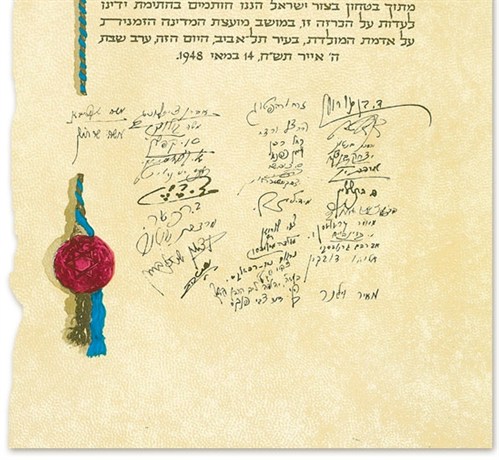
The Declaration of Independence of Israel was signed by representatives of the entire political and religious spectrum of that time. I believe the “Declaration of Independence” was also a “Declaration of the UNITY of the Jewish people”.
Among the signatories were, for example, representatives of the socialist party leftist; secular Jews; Jews from the center; Jews to the right, and religious Jews. It is worth remembering the presence and signatures of important rabbinical personalities. Israel’s Declaration of Independence was signed by five rabbis: Rabbi Moshe Maimon, Rabbi Saadia Kubashi, and Rabbi Zeev Gold; these three rabbis belonged to the religious Zionist Organization Mizrahi. And the Declaration was also signed by Rabbi Kalman Kahana and Rabbi Yitzhak Meir Levin, both rabbis of the religious movement “Agudat Israel”.

שהחיינו

On Friday, May 14, 5t of Iyar, Rabbi Moshe Maimon, who can be seen in this film on the right side of Ben Gurion, recited with great emotion, on behalf of all Am Israel, the blessing SHEHECHEYANU VEQIYEMANU VEHIGIYANU LAZEMAN HAZEH!
“Blessed are you, HaShem … that You have granted our existence, and You have allowed us to be alive in this special moment”.


What Did The Prophet Zekharia See?

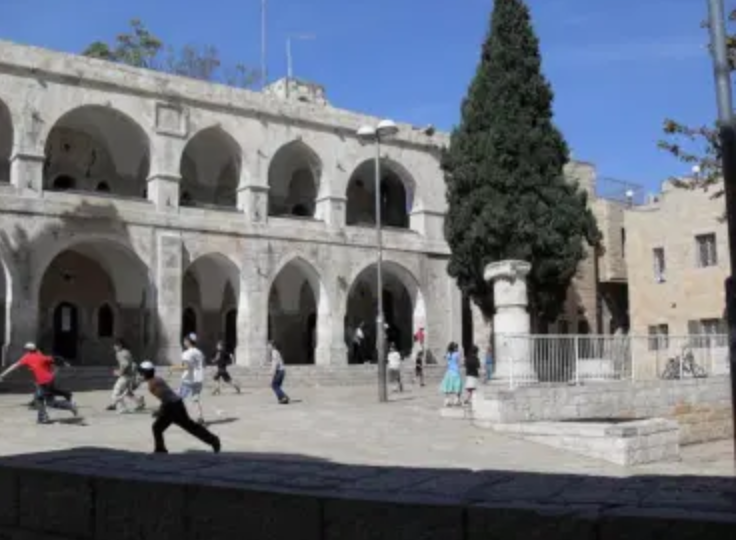
Look closely at this picture. Do you see anything special? Just children playing . Right? Well, not so fast…
This is the Old City of Jerusalem, you are looking at a place called Bate -Machase.  The two-story building with arches was built in 1871 with funds provided by Baron Wolf Rothschild of Frankfurt to house poor families. Today it houses the offices of the Jewish Quarter Municipality. In the court you see a very familiar scene: children running and playing. This happens every day because close to this playground there are two schools: The No’am Talmud Tora and the Silverstein Yeshiva.
What you don’t see in the picture is another familiar view: elders, old men and women, sitting on the benches of this square. Elders love the sight of children. And many times, after school hours, grandparents would also come here to watch their grandchildren play.
 
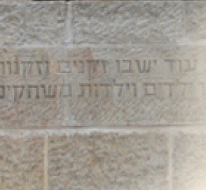
There is something else in this place (on the right side of the first picture), a very special scripture on a stone. What does it say?  
 

Next to where the children are playing, there is a Pasuq, a biblical verse carved in a stone, just below the playground. It’s a quote from the prophet Zechariah. Zekharia was a child when the Jews were in Babylonian exile 2500 years ago—without their own land and without the Bet HaMiqdash the future of the Jewish people looked very grim. Many were hopeless. Because in normal circumstances, after “exile,” people integrate into the local nation. And many Jews were actually assimilated into the Babylonian population. There was no precedent of a people returning to their nation after two or three generations in exile. It looked like the end of the Jewish nation was inevitable.
But a great miracle happened. Cyrus, the Persian emperor, was moved by HaShem (that is what he explicitly declared!), and he encouraged the Jews to come back to Israel, resettle there, and rebuild Jerusalem and its Temple. Although the majority of the Jews chose to remain in Babel (the first, but not last, “voluntary exile”), thousands came back. Zekharia was among them. When they arrived, around the year 530BCE, they found a completely destroyed city. Everything was in ruins—the city in ashes and desolated. There were no protective walls to guard the people against thieves and potential enemies, which made living in Jerusalem a mission impossible. It will take a few decades a very courageous Jew, Nechemia, to rebuild the walls and make Jerusalem habitable and safe again.
But while Jerusalem was still in ruins, Zekharia had a prophetic vision, a very unlikely prediction given the terrible conditions of Yerushalayim in those days.

כֹּה אָמַר ה’ צְבָאוֹת: עֹד יֵשְׁבוּ זְקֵנִים וּזְקֵנוֹת בִּרְחֹבוֹת יְרוּשָׁלִָם, וְאִישׁ מִשְׁעַנְתּוֹ בְּיָדוֹ מֵרֹב יָמִים. וּרְחֹבוֹת הָעִיר יִמָּלְאוּ יְלָדִים וִילָדוֹת מְשַׂחֲקִים בִּרְחֹבֹתֶיהָ (זכריה ח’ 5-4)

HaShem revealed to Zekharia that in the future, His presence will return to Zion and will dwell in Yerushalayim, and when that happens: “and once again men and women of ripe old age will sit in the streets of Jerusalem, each of them with a cane in hand because of their age. And the city squares will be filled with boys and girls playing there.”
Now, let us see the whole picture: You are in the Old City of Jerusalem, very close to where the prophet Zekharia stood when he announced this prophecy, and you are reading this extraordinary verse engraved on the stone in front of you. Then you lift your eyes at any given day, and you see the elders sitting on a bench, and the children playing in the street of the Old City. And you realize that you are a living witness of the fulfillment of Zekhariah’s prophetic words… Or perhaps you realize that you are not just a witness of Zekhariah’s prophecy: rather, you are the fulfillment of that Prophecy. You get the feeling that 2500 ago, in his incredible vision, Zekhariah saw “you”.

YOM HAATZMAUT SAMEACH


YOM HAATZMAUT: What did Isaiah see?

מִי-אֵלֶּה, כָּעָב תְּעוּפֶינָה וְכַיּוֹנִים, אֶל-אֲרֻבֹּתֵיהֶם

There will be those who will [return] flying like clouds, and like doves to their nests

The Tora predicted that the Jewish people would be exiled to all corners of the planet (Deut. 29) and also anticipated that, eventually, Jews would return to the land of Israel (Deut. 30). The prophet Isaiah (Yesha’yahu) described with prophetic and poetic words how this would take place. Addressing the Land of Israel, Yesha’yahu said, “Your sons shall come from afar, and your daughters shall be carried on the shoulders [of their fathers]…”. In that context, he also said (60:8),  There will be those who will [return] flying like clouds, and like doves to their nests

The Rabbi of Rehovot, Rabbi Simcha Kook, explained why Yesha’yahu used these metaphors, “clouds” and “doves”, in his prophecy. Because clouds and doves represent two opposite extremes in terms of movement. Clouds are moved by the winds, they do not control their movements. If the wind blows from the north, the clouds will move south, and vice versa. And when the wind does not blow, the clouds would stay where they are.

Doves, on the other hand, have an extraordinary sense of location. Unique! A biological GPS that is still a mystery to science. No other bird possesses a similar orientation sense. It is an instinct that virtually forces them to return to their nest, flying back from anywhere in the world, even thousands of kilometers away. For thousands of years, pigeons were used to send messages from one place to another. When someone traveled from point A to point B, they carried pigeons that were born and raised in A. And then, when they wanted to send a note to A, they would just release that pigeon. And regardless of how far B was from A, the pigeons always found their way back to point A, their nest, and deliver the notes.

Now we can better understand what the prophet Yesha’yahu was saying…and seeing!  in this extraordinary prophecy. When the people of Israel return to their land, there will be Jews who, like clouds, will “fly” (that was the verb incredibly used by Yesha’yahu!) to Israel moved by “winds”, all kinds of winds: political winds, financial winds, winds of anti-Semitism, etc. For Yesha’yahu, all these are “divine” winds that will bring the Jewish people, albeit somewhat ‘by force’, back to their land.

On the other hand, there will always be Jews who, like doves, will come to Israel guided by their internal GPS; they will fly to Israel like someone returning home to their nest. And while clouds are pushed by the winds, doves, in order to reach their nest, sometimes have to fly against the wind.

Eventually, God will help all of us — or inspire us– to return to Israel. If we don’t do it, our children or grandchildren will.  Some will be driven by the winds of history, while others will return “to their nest” guided by a strong sense of internal direction. However, regardless of how we arrive, what is important is that we work together to make Yesha’ayahu’s prophecy come true and build a bright future for the Jewish people in our ancestral land.


Rabbi Yehuda Alqalai (1798-1878) and Modern Zionism

Rabbi Yehuda Alqalai was one of the first rabbis (or Jews) in modern times to formulate the idea of a return to Zion. Following the footsteps of Rabbi Yehuda Bibas, he did not envision the return to Zion just as a solution for the eternal problem of anti-Semitism but essentially as a way to fulfill the Jewish aspiration of political normalization: i.e., Jews living in their Jewish homeland. He understood that the nation of Israel needs not wait passively until the Mashiach comes to realize this aspiration. Rather, it should actively seek the reestablishment of an independent Jewish state in the forefather’s land as a way to advance the coming of the Messiah.
Rabbi Alqalai formulated his plan and ideas for the restoration of the Jews in Israel in his book Goral lahaShem, published in Viena in 1857.   In this book, rabbi Alqalai designed a comprehensive plan with the religious foundations and the practical steps to be taken in order to reestablish the Jewish nation in Israel.  The book was published in three different editions and translated into many languages, including English. The correspondence between the practical ideas of this book and Theodore Herzl’s: “The State for the Jew” (Medinat haYehudim) is so similar that it is not improbable that Herzl was familiar with his book and had internalized its concepts which were later on formulated in his famous book.  Simon Loeb Herzl, Theodore Herzl’s paternal grandfather, attended the Alqalai’s synagogue in Semlin (Serbia) and the two frequently visited each other.  Grandfather Simon Loeb Herzl “had his hands on” one of the first copies of Alqalai’s  work Goral lahaShem prescribing the  “return of the Jews to the Holy Land and renewed glory of Jerusalem.” Many contemporary scholars conclude that Herzl’s own implementation of modem Zionism was undoubtedly influenced by that relationship.
Rabbi Alqalai made Aliya to Israel in 1874. He established himself in Yafo and together with other Jews from the Ottoman empire and North Africa founded the community Mikve Israel of the Old Yeshub of the city. He died four years later and he is buried in the Har Hazetim (Jerusalem).
I present to the readers the book   GORAL LAHASHEM   by Rabbi Yehuda Alqalai. It is very interesting to see the haskamot  (Letters of support) he had from many prominent rabbis. to me, the most interesting haskama was the first one, which seems to have been written originally in Hebrew, by Sir Moses Montefiore   (1784-1885) a contemporary of rabbi Alqalai.