The Tenth Principle: God knows everything.


The Tenth principle asserts our belief that the Creator knows all the thoughts and actions of man, as it is said, “He who molds their hearts alike, understands all their deeds.” (Psalm 33:15). From this we learn that God is all-knowing, or omniscient.
Man cannot understand the nature of God’s knowledge, i.e., how God knows what we are thinking or feeling, or how His knowledge of the future does not compromise our freedom of choice, etc. As the prophet Yesha’ayahu said (55:8): “My thoughts [God’s thoughts] are not your thoughts, My ways are not your ways”
One of the ramifications of our belief in God’s absolute knowledge is our belief that God, and only Him, knows man’s true potential. A math teacher will judge two students by the same standards: If student A answers right 8 out of 10 questions, his score will be 8/10. And if student B answers 6 questions right, his score will be 6/10.  God by virtue of His omniscience knows, for instance, that the student that got 8 had a potential for 10, but he did not make his best effort. Whereas the student that got 6 had a potential for 6, and he made every possible effort. For the math teacher, 8 is higher than 6. But from the point of view of God’s knowledge B obtained a higher score than A.  Because, even though 8 is higher than 6,  mathematically 6/6 is higher than 8/10! God knows A’ denominator (10). And therefore, He is the only one that can assess the real value of A’s nominator (8).
He knows what conduct should be expected of us by reason of our intelligence, potential, education or environment.  The greater our intelligence, the better our education, the more enlightened our environment, the higher are the ideals of conduct expected from us by God.
READ
The stark contrast of the two events sheds light on what it means to be a Jew.
by Rabbi Aharon Lopiansky, from Aish.
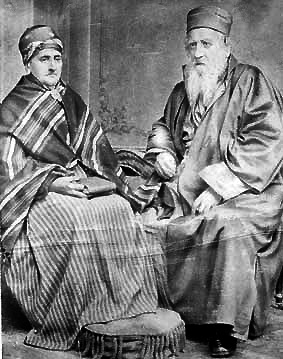


Rabbi Yehuda Alqalai (1798-1878)

Rabbi Yehuda Chai Alqalai (or Alkalai) was born in Sarajevo, Bosnia. He came to Israel with his parents at the age of 11.  At a very young age he was ordained as a rabbi by Rabbi Eliezer Pappo, the author of Pele Yo’etz.  He was sent from Israel to serve as the Rabbi of the important Sephardic community of Zemun (present day Serbia).

In 1839 rabbi Alqalai met with rabbi Yehuda Bibas (see this), who inspired him and shared with him his enthusiastic ideas about the return of the Jews to the land of Israel.
In 1840 the Jewish world was  shocked by the Damascus blood libel. Not only because of the ridicule accusations that “Jews killed gentiles to consume their blood”, but especially because the French authorities in Damascus and the modern “media” of that time, accepted those absurd accusations. “The Jews thought that the world had outgrown, especially in the West, where Jews were convinced that Western culture would not accommodate such terrible lies.”
The Damascus libel affair represented a turning point in the life of Rabbi Alqalai. His ideals would now become part of a practical plan to restore the Jews to the land of Israel and obtain their political independence, as Rabbi Yehuda Bibas had envisioned and preached.
Rabbi Alqalai published in 1840 his first book, Minchat Yehuda, where he called the Jews to reunite in the land of Israel.
Rabbi Alqalai had practical plans for the establishment of the Jews in israel. He wrote and spoke about the need of teaching the Hebrew language to the Jews. He saw that the revival of Hebrew will represent a unifying factor between the Jewish communities worldwide. He also wrote about the need of having a Jewish Bank which, through individuals’ funds, will buy lands in Israel. He insisted in the urgency to address the Sultan of the Ottoman Empire. He suggested the formation of joint-stock company between the Jewish Bank and the Ottoman Empire, such as a steamship or railroad trust, with the purpose of inducing the  Sultan to cede Palestine to the Jews as a tributary country, on a plan similar to that on which the Danube Principalities were governed.
To be continued….
 
Rabbi Yehuda Alqalai with his wife Esther (Viena, 1874).
Read here about the Damascus Blood Libel of 1840


RELIGIOUS INTEGRITY: When all depends on the intention

We have explained the prohibition of genebat da’at, i.e., when I falsely pretend that I care or I want to help, just to benefit from leaving a positive impression in somebody else mind. Our Rabbis classified these actions as “stealing peoples’ mind”. 
A typical example: If one of my friends is preparing a party or an event for which manpower is required, and my help is definitely needed.  And, for whatever the reason might be, I don’t come to help. But when I estimate that everything is done and ready and my help is not needed anymore, I come to my friend’s house to offer my help.  And when my friend tells me that everything is already done, I pretend as if I’m sorry and regret that I can not be of help…   For me, it might look like a win/win situation: I have not helped, and I still enjoy the benefit of having left a positive impression on my friend as if I had really helped him! 
The Tora condemns this type of cynical attitude and considers it a form of  “stealing”. 
There are some cases, however, in which one can sincerely be offering his or her help, even though one knows that his offer will be refused. If for example, I come to my friend’s house and I see that he has an unexpected guest or event, etc. and then I sincerely offer my help, not to cause a false impression, but to show that I care, knowing that my empathy will make my friend feeling good, then it is absolutely valid.  
In other words, the issue of genebat da’at depends on one’s intention and cannot be judged by a third party based just on the facts at sight. genebat da’at pertains to a category of actions that are judged only between oneself and God.  


ZERO POINT THREE PERCENT, 
a film about Jewish unity. 


Fasting on the wedding day

In many Jewish communities it is customary for the groom to fast the day before the wedding. This is because according to the Talmud Yerushalmi (Bikkurim 3:3), on the day that a person is married, all of his or her sins are forgiven. The fast is a sign of repentance and atonement. “With marriage one is beginning a new phase in life. Marriage involves a complete change in lifestyle, and the person is given a chance to start it with a pure soul. The love that the couple has for one another on their wedding day can annul any misplaced passion that they had in the past”. The couple also fast for the future, to deserve “divine guidance that they may be able to overcome problems as they arise” (Rabbi Aryeh Kaplan, Made in Heaven, page 83). In Ashkenazi communities this fast is very important.
 
 In most Sephardic communities, however, the custom is not to fast. Rabbi Obadya Yosef is very clear about this point and recommends the Sephardic grooms to avoid fasting. Other  Sephardic rabbis like Rabbi Chayim haLevy are even stricter and they forbid the groom to fast. The reason is that they consider that the couple has to be strong to endure all the pressure of the wedding, the party, etc. The process of Teshuba, they reason, can still be achieved by devoting themselves in this important day of their life to study Tora and elevate prayers to God. Rabbi Yosef also recommends that if the groom and bride still desire to fast, they should consider to do a “a fast of words” (ta’anit dibbur) not of food, which represents an even higher sign of self control, repentance and contrition.
 
In many communities, Ashkenazi and Sephardic, it is customary that the bride and the groom recite the Viduy (prayer of regret and confession, see here) from the Mincha service of Yom Kippur or other similar texts.

“Too Many Options”
The marriage crisis and why singles today don’t want to commit, 
by Rabbi Benjamin Blech


THE 13 PRINCIPLES: # 9. The Tora will not be changed or replaced


The ninth principle asserts that our God given Law, the Tora ( see this), could never be changed or replaced by another set of Laws.
Rabbi Pereira-Mendes explains:  “Our Tora was given us by God. He does not change. And His word stands for ever….It is because we believe that our Law never was and never is to be changed, that we reject Christianity.” Christianity and Islam share with Judaism the Eight Principle, i.e., the belief in the divine origin of the Tora.  But the Christian faith claims that God changed His mind and annulled the Pact with Israel (=ma’amad har Sinai, when God made Israel His chosen people) and now He made a new pact (berit chadasha) or a new testament with the Church, annulling the Biblical commandments and replacing them with a new set of laws.
Similarly, Islam accepts the divinity of the Tora, but their claim is that Mohammed’s prophecies were greater than Moshe Rabbenu (whom they also venerate) and the Qoran, therefore, replaces the Hebrew Bible.
The ninth principle conveys our categorical rejection of all these theories of replacement.  Every prophet in the Hebrew Bible came to teach and uphold the Tora and to encourage the People of Israel to be faithful to its commandments, not to change them. The Tora establishes clearly and explicitly (Deut. 13:2-6) that if a prophet comes and claims that we should modify even one Mitzva of the Tora, we know that he is a false prophet. Even though this prophet shows that he is capable of performing miracles, something which apparently would give credibility to his prophecy, we are commanded explicitly to reject his message and consider him a false prophet.  “In all these cases”, Maimonides says “we know that such a prophet is speaking presumptuously in God’s name, making up something not told him by God. For God Himself told Moses that these commandments (=The Tora) is for us and our descendants forever”.
 
Tonight is the 15 of the month of Ab, a happy day in the Jewish Calendar.
Click here to read:  “Six events occurred on Tu B’Ab, the 15th of Av, making it a festive day in the Jewish calendar” by Rabbi Israel Meir Lau, former Chief Rabbi of Israel, from Aish 


Rabbi Ytzhaq Nissim (1895-1981)


 √  A picture of Rabbi Yitzchaq Nissim z’l.
Rabbi Yitzchaq Nissim was the Sephardic chief Rabbi of the State of Israel from 1955 to 1972. He was born in Baghdad, Iraq, in 1895.
In 1925 he came to Jerusalem where he studied with the greatest rabbis of the time: Rabbi Chizqiya Shabetay, Rabbi Ben-Zion Abraham Cuenca and Rabbi Ben-Zion Uziel among others.
Rabbi Nissim established one of the first rabbinical academies in Jerusalem, among his students were Rabbi Mordechai Elyahu , who was also a chief rabbi of Israel from 1983-1993.
Rabbi Nissim struggled to unify the Jews that lived in Israel. He thought that after centuries of being separated, Sephardic and Ashkenazi Jews and very especially religious and non-religious Jews should leave the differences aside and find the common grounds between them. He endeavored to create and build bridges of communication in which all Jews would work together to build a unified “Israel”.
Rabbi Nissim became world famous for his refusal to meet with the pope Paulus the Sixth in 1964. When the pope came to visit Israel, he made sure to visit East Jerusalem (in those days in the hands of the Jordanians), but he deliberately avoided Israeli-controlled West Jerusalem, forcing Israeli President Zalman Shazar and Prime Minister Levi Eshkol to travel to the northern town of Meggido to greet him in a 20-minute ceremony.  Rabbi Nissim was invited as part of the delegation that would meet the Pope in Megiddo, but he refused to go.  Reasoning that if he would attend that ceremony he would legitimize the Vatican’s delegitimization of Israel.  (The Vatican did not recognize Israel as a state. In a thank-you letter sent to Israeli president Zalman Shazar, for example, the pope deliberately left out the title “President”, and erroneously but pointedly addressed it to Tel Aviv rather than Jerusalem). Rabbi Nissim was known as “the Rabbi that dared said “no” to the Pope”. The Israeli newspaper haAretz declared that the refusal of the Rabbi was an historical event, because it was a strong symbol of the independence of the State of Israel.
Rabbi Nissim died in Jerusalem in 1981.

Professor Meir Benayahu, one of the most important scholars of Jewish studies in modern times,  and former Kenesset member and Israeli Minister  Moshe Nissim were his sons.

√ Read more here about the controversial visit of pope Paulus the sixth to Israel in 1964.


RELIGIOUS INTEGRITY: Leaving involuntarily a false positive impression

The Rabbis defined geneabt da’at  (stealing other people mind) as a situation in which I mislead other people to think favorably about me or about an action I did (see here). 
Some times however, there are borderline circumstances, in which a positive but misleading impression is leftinvoluntarily. The Rabbis argued about the merits of this matter. 
A real example: It was customary that when a Rabbi would come to town his students or colleagues would go to welcome him before he reached the city. It happened that two rabbis, Raba and Rab Safra, left their city to take care of some personal matters and to their surprise on the way they met a distinguished rabbi, Mor Zutra, who was coming into their city. Mor Zutra thought that they came to welcome him, and with a deep sense of gratitude he said: “I’m so honored that such distinguished Rabbis like you have come all the way to welcome me!”. Rab Safra, which was famous for being extremely straightforward and truthful said: “Well, the truth is that we did not know that you were coming. We were in our way for a different matter and we happened to meet you. However, if we would have known of your coming, we would have received you with more honors”. Later on Raba questioned Rab Safra’s attitude and said to him: “Why did you have to hurt Mor Zutra who thought that we were coming to honor him?”. Raba added “In this case we did not initiate anything proactively with the intention of leaving a false big impression on him! We did not want to mislead him. But now we have actually hurt him and embarrass him!”.   
When the other Rabbis heard and analyzed this case they thought that Raba was right and they asserted that the prohibition of causing a positive false impression on someone applies when we initiate the misleading action, but if the other person brings himself to that impression, and especially in this type of situations bordering with embarrassment, then we do not need to rectify the false positive impression we left.    


WATCH   Is Israel an apartheid state?   by Dennis Prager 


The “best man” or shushbinim

In ancient times, a member of the wedding party was known as the shushbin. We find that when Samson (=Shimshon) was married, he took thirty young men to be the close members of his wedding party.  In Talmudic times, the wedding feast was often made as a communal meal and the attendees were called the shushbinim (plural of shushbin).

In modern times, we often have more than thirty guests at a wedding. The shushbinim in our days are not the only attendees but the closest friends (the members of his “do-re” in Persian culture) of the groom. The bride also has her shushbinim (or bridesmaids). One of the shushbinim -writes Rabbi Aryeh Kaplan- would be at the groom’s or the bride right hand, and take care of all his or her needs. It could be a friend or a relative of the groom (a brother, a cousin, etc.)  He would act as the groom’s secretary and valet, seeing the details of the wedding. He would often announce the honors at the ceremony and would make sure that the ceremony and dinner run smoothly. In modern terms, we would call this shushbin “the best man”.
Maimonides dedicates a whole chapter in Mshne Tora (zekhia umatana, chapter 7) to describe the function of the shushbinim, which is radically different from the modern concept of the best man (or “men”). He says that the tradition in all Jewish communities is that when one gets married his close friends give him some monetary gift to afford the expenses of the wedding. These close friends, whom with their gifts assist the groom to afford the wedding party, are known as the shushbinim. In general, Maimonides explains, the monetary gifts are given generously, of an amount above the cost of the food the friends are served at the party. In return, the groom is expected (read: legally expected) to do the same thing toward his friends when they get married. Thus, everyone in that group of friends supports each other to afford the expenses of the wedding party.  


 Read  LOVE INFUSIONS  Three ways to bring love back into your relationship”.  By Rabbi Shlomo Slatkin, from Aish.com


When the 9th of Ab falls on Shabbat

This year, 2012, the 9th of the month of Ab falls on Shabbat (from Friday July 27th at night, until Saturday July 28th at night). When that happens our Rabbis instructed us to postpone the mourning day and the fast for the next day, Sunday (beginning Saturday night).  So, this year the Jewish National Day of Mourning will be commemorated on the 10th of Ab, beginning Saturday night July 28th at 9.04 p.m. (N.Y. time), once Shabbat ends.

√ Because the eve of the fast day falls on a Shabbat we do not have a se’udat hamafseqet, the last meal that we eat before the fast in a mood of mourning (see HERE). Actually, There are NO restrictions or any customs of mourning during this Shabbat. This Shabbat it is permitted to eat meat normally, even for Se’uda Shelishit (=the last meal, Shabbat afternoon).
√ We will stop eating before 8.15 p.m (= 8.15 p.m. is sunset in N.Y.C). And no preparations for Tish’a BeAb should be done until Shabbat is over at 9.04 p.m. N.Y. time.
√ After 9.04 p.m. by saying “barukh hamabdil ben qodesh lechol”(=Blessed is He, Who established the difference between holy and profane) Shabbat is over.
  √ We should change our Shabbat clothes for weekdays clothes and come to Synagogue with no-leather shoes. That night there is no Habdala other than the Berakha “Bore Me-ore haEsh”, which is going to be said in the Synagogue.
√ In our community all the Minyanim will start Tish’a BeAb services at 9:30 p.m. And although we have not yet said Arbit, we can still drive to Synagogue, because by saying “barukh hamabdil…” we have declared the end of the sanctity of Shabbat.

√ This year, that Tish’a BeAb falls on Saturday and it is postponed for Sunday, pregnant women and women who are actually breast-feeding do not need to fast on Tish’a BeAb. If they want and can fast they should fast until Chatzot (1:05 p.m.).
√ When one is allowed to eat during Tish’a BeAb for health reasons, one should eat only whatever is necessary for his or her health, and not for pleasure or in excess.
√ The fast will end 30 minutes after sunset, Sunday July 29th at 8:45p.m (N.Y.T). In some Minyanim at 8:55 p.m. For the Habdala Sunday night we will not say “Bore Mine Besamim” but only “haGefen” and “haMabdil”.
√ This year, because the 9th of Ab falls on Shabbat, we can eat meat, shave or get a haircut immediately after the fast ends.
Shabbat Shalom!
Candle lighting in NYC 7:57 p.m.
Shabbat Ends in NYC 9.04 p.m.
May we all have an easy and meaningful fast.
May this be the last Tish’a beAb that we mourn for the destruction of our Temple.


See  here  the laws of the fast day and who is exempted from fasting.
See  here  and  here other activities that are forbidden on Tish’a BeAb besides fasting.
See here “What happened on Tish’a BeAb?”


Music during the three weeks (Part 2)

Yesterday we saw the opinion of Rabbi Eli’ezer Melamed regarding playing or listening to music during the three weeks. The thrust of his opinion is not all music is the same, and what should be avoided is happy or celebratory music ( see here).  The primary source for this criteria is Maimonides (Ta’anit 5:14) that says “…qol shel shir asur lismoach bahem…  “…it is forbidden to joy with musical songs”. In other words, when it is not intended for joy and happiness, it is not forbidden.    
In the same text, Maimonides also said before: “Vekhen gazru shelo lenagen bikhle shir…” “The rabbis forbade playing musical instruments (in remembrance of the destruction of the Bet haMiqdash)”. Rabbi Obadya Yosef explains that what makes music a source of happiness is not its content  (as rabbi Melamed claims) but the fact that is played (live or electronically) with instruments.  This is why Rabbi Yosef would authorize only playing or listening to Jewish songs a cappella, i.e., without instruments, until Rosh Chodesh Ab, even if the music is of a celebratory nature. 
This is a good example to see how two or more opinions among rabbis are formed even when both analyze one single source (=Maimonides). In this case, the two rabbis understand differently the nature of ‘celebratory music’. For Rabbi Melamed is about the content, for Rabbi Yosef, if it’s played with instruments. 
In the Mashadi community the custom is to avoid listening to live music from the 17 of Tamuz until Rosh Chodesh Ab. After Rosh Chodesh Ab we should not listen to music even when played over the media, MP3s, Ipods, etc. (Mr Nassim Bassalian explain to me that some families in Teheran were strict with music only during the week of Tish’a beAb, especially when–unlike this year– Tish’a beAb would fall in the middle of the week). 


All for One Tisha BeAb and the secret of Jewish unity by Charlie Harary